Plot Summary
Monster Hunters' Last Holiday
Lee and Mal, inseparable since school, share a passion for cryptozoology and each other. Their summer trip to Bodmin Moor, inspired by a mysterious YouTube video, is meant to be another playful monster hunt. Instead, they stumble upon evidence of something truly unnatural: monstrous Birdmen, impossible snow in July, and a slaughtered flock of sheep. Their adventure turns to horror as they are swept into a blizzard and attacked by the Birdmen. In the chaos, Mal vanishes, leaving Lee alone, traumatized, and unable to explain the truth to anyone. The loss shatters Lee's world, setting her adrift in grief and disbelief, haunted by the memory of the impossible.
The Birdmen and the Blizzard
Lee's life is defined by Mal's absence. She mythologizes the loss, writing about monsters while never truly moving on. Four years later, a phone call from Mal—impossible, untraceable—summons Lee to Camden. The reunion is tense and surreal: Mal is changed, scarred, and wary, accompanied by a terrifying companion. Their brief, emotional encounter is cut short as Mal warns Lee of dangers to come, then vanishes again. Lee is left with more questions than answers, her reality further destabilized. The world feels full of cracks, and Lee's longing for Mal is now tangled with fear and the sense that something vast and strange is unfolding.
Lost and Found in Time
Elsewhere, British intelligence agent Julian Sabreur and analyst Alison Matchell are drawn into a web of intrigue when Dr. Kay Amal Khan, a brilliant and controversial mathematician, becomes the target of a far-right group. A violent attack on Khan's flat leaves several dead, but the real mystery is the intervention of two unknown figures—one resembling Mal, the other a monstrous man. Surveillance footage and strange computer intrusions hint at forces beyond human comprehension. As Lee is kidnapped by impostor police and swept into another world, the boundaries between realities blur. The search for Mal, and now Lee, becomes a race against time and the unknown.
The Crack in the World
Lee's captors, agents of the shadowy Rove Denton corporation, are swept with her into a prehistoric forest teeming with dinosaurs. Pursued by both human and inhuman threats, Lee escapes with the help of the Birdmen and the enigmatic Stig, a Neanderthal from another world. She is rescued from death by cold by the intervention of the Ice Mind, a vast, ancient intelligence. Meanwhile, Khan and Alison are drawn deeper into the mystery of the cracks between worlds, encountering the Plug-Uglies—Neanderthal agents who can slip between realities. The cracks are multiplying, and something is hunting for the minds that can understand and perhaps repair the damage.
The Secret Service and the Scientist
Julian and Alison's investigation reveals a pattern of impossible events: monsters, disappearances, and inexplicable computer phenomena. They uncover the involvement of Rove Denton, whose CEO, Daniel Rove, is orchestrating a plan that spans worlds. Khan, now a fugitive, is recruited by the Plug-Uglies, who reveal the universe is collapsing—its many timelines, or "branches," are breaking down. The only hope lies in gathering the brightest minds from every world to find a solution. As the cracks widen, the threat becomes existential: not just for individuals, but for all of reality.
The Plug-Uglies' Shadow
The Plug-Uglies—Neanderthals from a parallel Earth where their kind became the dominant species—are revealed as key players. They have been monitoring humanity, seeking out scientists like Khan to help avert the end. But they are not alone: the rat-people, rulers of a world choked by overpopulation, are also vying for survival, willing to invade and conquer other timelines. Rove, ever the opportunist, plays both sides, seeking to save only what he values. The Plug-Uglies, the rats, and the humans are all drawn into a desperate alliance and rivalry, each with their own vision of salvation.
The Rat Kings' Gambit
Khan is taken to the rat world, a dystopian nightmare of endless city and desperate hierarchy. There, she collaborates with Dr. Rat, a brilliant but anxious scientist, to understand the mathematics of the collapsing multiverse. Rove manipulates events from behind the scenes, using his own agent, Charen Volkovska, to infiltrate the Ice Mind—a planet-sized computer built by a long-dead race of fish-people. The rats plan an invasion of Earth, seeking space and resources, while Rove prepares to betray everyone for his own ends. The stakes rise as the cracks between worlds become catastrophic.
The Neanderthal Connection
The Plug-Uglies, or Cousins, reveal their history and their own world—a pastoral, decentralized society built on mutual aid and caution. They have long known about the cracks between worlds and have been preparing for this crisis. With the help of the Ice Mind and the arrival of the ancient Wayfarers—immortal, spacefaring trilobites—they assemble a coalition: humans, Neanderthals, rats, and others. Each brings their own strengths and perspectives, but also their own prejudices and agendas. The challenge is not just technical, but social: can such different peoples work together to save everything?
The Ice Mind's Whisper
Alison, uniquely attuned to the Ice Mind, becomes a conduit for its vast knowledge. She glimpses the true scale of the crisis: the multiverse is a tree of timelines, all rooted in a single, original world. The Ediacaran, a primordial, planet-spanning organism, is the source of all branching realities. Now dying, it can no longer sustain the structure it created. The Ice Mind, the Wayfarers, and the assembled scientists race to find a mathematical solution—a way to stabilize the branches before everything collapses. But every attempt fails, and time is running out.
The Gathering of Worlds
The coalition travels aboard the Wayfarer, a living trilobite ship, to the original Earth. There, they find a world locked in stasis, covered in the quilted forms of the Ediacaran biota. No animals, no plants, only the ancient, dying intelligence that once dreamed all other worlds into being. The team realizes that every previous attempt to save the multiverse has failed, each time ending in collapse. The Ediacaran, in its last moments, is creating new timelines, giving its children endless chances to find the right answer. The final experiment begins.
The End of All Branches
As the coalition works, Rove enacts his own plan: to save only England, sacrificing all other worlds. He is confronted and, after a violent struggle, killed by Stig. The team faces the truth: the only way to save the multiverse is not to seal the cracks, but to embrace them—to bind the worlds together, creating a stable network of connections. This radical idea, born from the unique perspectives of humans, Neanderthals, and rats, is their last hope. The choice is stark: isolation and extinction, or unity and survival.
The Red King's Dream
The final plan is enacted. The cracks between worlds are multiplied, not sealed, creating a web of connections that stabilizes the multiverse. The Ediacaran dies, its dream ending, but the worlds endure—now forever linked. The survivors return home, changed and uncertain, but alive. The doors between worlds remain open, and a new era begins: one of contact, cooperation, and challenge. The multiverse is no longer a tree of isolated branches, but a living, interconnected forest.
The Last Experiment
In the aftermath, the world reels from the revelation of other Earths, other peoples, and the end of isolation. Khan, now a global figure, urges humanity to prepare for an age of unprecedented change. The Cousins, the rats, and the Wayfarers become partners and neighbors, bringing new technologies and new dangers. The survivors—Lee, Mal, Julian, Alison, and others—find their places in this new order, their relationships tested and transformed by what they have seen and done. The future is uncertain, but full of possibility.
The Choice of Sacrifice
Throughout the crisis, the question of what to save—who to save—haunts every character. Rove's vision of a purified, isolated England is contrasted with the messy, inclusive, and unpredictable reality of a multiverse bound by difference and connection. The ultimate lesson is that survival depends not on purity or exclusion, but on embracing diversity, cooperation, and change. The doors of Eden are open, and paradise is not a garden, but a crossroads.
The New Eden
As the new order takes shape, humanity faces the challenges and opportunities of a multiversal society. Old prejudices and fears persist, but so do hope and curiosity. Lee and Mal, reunited at last, choose to explore the new worlds together. Julian and Alison, their bond deepened by shared ordeal, look to the future with cautious optimism. The multiverse is no longer a secret, and the adventure is just beginning.
The Doors Remain Open
The story closes with the sense that every ending is a new beginning. The cracks in the world, once a source of terror, are now the doors of Eden: portals to discovery, understanding, and growth. The characters, changed by their journey, step through these doors into a future that is uncertain, but theirs to shape. The lesson is clear: paradise is not lost, but found in the courage to embrace the unknown.
The Many-Worlds Future
In the final vision, the multiverse is a living, evolving network of worlds, each unique, each necessary. The legacy of the Ediacaran is not stasis, but endless branching, endless difference. The doors of Eden are open to all who dare to walk through. The story ends not with closure, but with the promise of infinite stories yet to be told.
Analysis
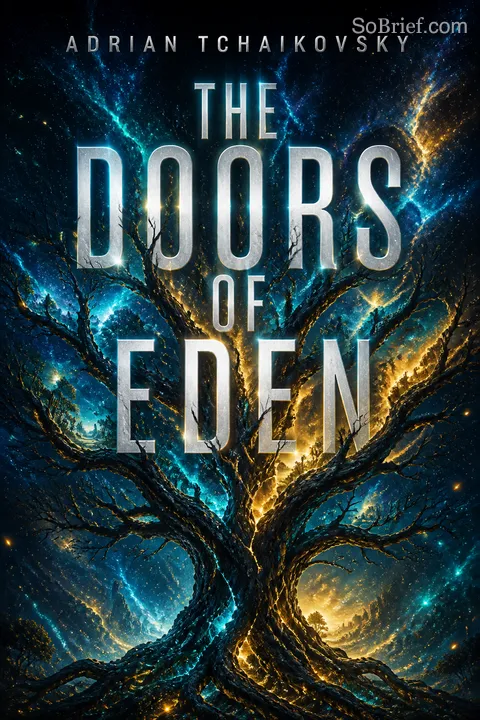
Adrian Tchaikovsky's The Doors of Eden is a dazzling, ambitious exploration of parallel worlds, evolutionary possibility, and the meaning of survival. At its core, the novel is a meditation on difference: biological, cultural, personal. Through its intricate narrative structure—blending thriller, romance, and speculative science—it asks what it means to be human, and whether paradise is a place, a state of mind, or a process of becoming. The recurring motif of cracks—between worlds, between people, within the self—serves as both threat and opportunity. The novel rejects the fantasy of purity and isolation, insisting that true survival, true Eden, lies in connection, cooperation, and the embrace of the unknown. Its characters—diverse, flawed, and deeply human (or Neanderthal, or rat)—embody the struggle to adapt, to forgive, and to hope. In a world (or worlds) threatened by collapse, The Doors of Eden offers a vision of redemption not through exclusion, but through the courage to open the door and step through, together. The lesson is clear: paradise is not lost, but found in the willingness to change, to learn, and to love across every boundary.
Review Summary
The Doors of Eden is a complex science fiction novel exploring parallel worlds and alternative evolutionary paths. Readers praise Tchaikovsky's imagination and world-building, particularly the interludes describing different Earths. The story follows multiple characters as they uncover cracks between realities. While some found the characters underdeveloped, many enjoyed the blend of hard science and thrilling plot. The book's themes of diversity and cooperation resonated with fans. Overall, it's considered an ambitious and thought-provoking work, though opinions vary on its execution compared to Tchaikovsky's other novels.
People Also Read
Characters
Lee Pryor
Lee is a British cryptozoologist whose life is defined by her love for Mal and her obsession with the unexplained. Her journey from playful monster hunter to traumatized survivor and, finally, to multiversal explorer is the emotional heart of the novel. Lee's loyalty, curiosity, and resilience drive her to seek answers even when reality itself unravels. Her relationship with Mal is both her anchor and her vulnerability, and her willingness to embrace the unknown makes her a catalyst for change. Lee's arc is one of grief, hope, and the courage to accept that paradise is not a place, but a choice.
Elsinore "Mal" Mallory
Mal is Lee's best friend, lover, and the one who vanishes into the cracks between worlds. Her disappearance and return are the engine of the plot, and her transformation—physically and emotionally—reflects the story's themes of adaptation and survival. Mal's time among the Birdmen and the Nissa (Neanderthals) gives her a unique perspective, blending human and inhuman experiences. She is both a victim and a hero, her choices shaping the fate of worlds. Mal's struggle to reconcile her past with her new self mirrors the novel's exploration of identity and belonging.
Dr. Kay Amal Khan
Khan is a trans woman and a genius whose work on cryptic informational transformation space (CITS) becomes the key to understanding the multiverse's collapse. Her journey from government scientist to fugitive to leader of the coalition is marked by wit, defiance, and vulnerability. Khan's outsider status—scientifically, socially, and personally—gives her the perspective needed to see solutions others miss. Her relationships with Julian, Alison, and the non-human characters are complex, blending respect, frustration, and empathy. Khan embodies the novel's faith in the power of difference and the necessity of cooperation.
Julian Sabreur
Julian is a British intelligence officer whose life is upended by the crisis. His professionalism, skepticism, and loyalty are tested as he confronts the impossible. Julian's relationship with Alison is a source of strength and tension, and his interactions with Khan, Lee, and the others force him to question his assumptions about authority, identity, and what is worth saving. Julian's arc is one of humility and growth, as he learns to trust others and accept that some problems require more than rules and protocols.
Alison Matchell
Alison is an intelligence analyst whose anxiety and obsessive need for control make her both vulnerable and invaluable. Her unique connection to the Ice Mind allows her to access knowledge beyond human comprehension, but at great personal cost. Alison's friendship with Julian is deep and complicated, and her role as a mediator between worlds is both a burden and a gift. She represents the power of analysis, empathy, and the willingness to see patterns where others see chaos. Alison's journey is one of self-acceptance and the realization that understanding is not the same as control.
Daniel Rove
Rove is the CEO of Rove Denton, a private security and intelligence firm. Driven by a vision of purity and control, he seeks to save only what he values, even at the cost of everyone else. Rove's intelligence, charisma, and ruthlessness make him a formidable antagonist, but his inability to accept difference is his undoing. His relationship with Lucas May is transactional, and his manipulation of Charen Volkovska is both pragmatic and cruel. Rove embodies the dangers of isolationism, hubris, and the refusal to adapt.
Lucas May
Lucas is Rove's right-hand man, a former soldier whose loyalty is tested by the unfolding crisis. He is competent, adaptable, and increasingly uneasy with Rove's plans. Lucas's journey from enforcer to reluctant ally reflects the novel's theme of moral ambiguity and the possibility of redemption. His eventual rejection of Rove's vision is a small but significant act of resistance, suggesting that even those complicit in harm can choose a different path.
Stig
Stig is a member of the Nissa, the Neanderthal civilization that has mastered travel between worlds. He is physically imposing but emotionally reserved, carrying the weight of his people's hopes and fears. Stig's role as a diplomat and protector brings him into contact with Lee, Mal, and the others, and his struggle to communicate and connect is both poignant and essential. Stig represents the possibility of understanding across profound differences, and his actions are guided by duty, empathy, and a deep sense of responsibility.
Ertil (Dr. Rat's Translator)
Ertil is the translator and companion of Dr. Rat, the rat-people's chief scientist. After Dr. Rat's death, Ertil becomes a symbol of the costs and possibilities of cooperation. His struggle to find a place among the humans and Neanderthals reflects the broader challenge of building a multiversal society. Ertil's perspective is shaped by suffering, loyalty, and the hope for acceptance. He is both a survivor and a pioneer, embodying the novel's faith in the power of unlikely alliances.
Charen Volkovska
Charen is a systems administrator whose obsession with the "network" leads her to become the human interface for the Posticthyan Ice Mind. Her fate is tragic: used by Rove, trapped in suspended animation, and ultimately transformed into something more than human. Charen's presence haunts the story, her actions shaping events even after her physical self is gone. She is both a victim and a guide, her final act one of warning and hope. Charen represents the dangers and wonders of losing oneself in the pursuit of knowledge.
Plot Devices
Multiversal Branching and Cracks
The central plot device is the existence of a multiverse: countless parallel Earths, each diverging at key moments in prehistory. The "cracks" between worlds—points where realities bleed into each other—are both symptom and solution. Initially seen as threats, these cracks become the means by which the protagonists gather allies and knowledge. The narrative structure mirrors this device, with interludes exploring alternate evolutionary histories, each a meditation on possibility and contingency. The cracks force characters to confront the limits of their understanding and the necessity of cooperation.
Nonlinear Narrative and Interludes
The novel weaves together multiple plotlines—Lee and Mal's personal journey, Julian and Alison's investigation, Khan's scientific quest, Rove's machinations—interspersed with interludes that explore alternate Earths. These interludes serve as both world-building and thematic commentary, illustrating the fragility and contingency of sentience, civilization, and survival. The nonlinear structure allows for foreshadowing, dramatic irony, and the gradual revelation of the true stakes.
The Ice Mind and the Wayfarers
The Posticthyan Ice Mind—a planet-sized computer built by a long-dead race of fish-people—and the Wayfarers—immortal, spacefaring trilobites—are both plot devices and metaphors. They provide the knowledge, perspective, and technological means to address the crisis, but also embody the dangers of stasis, isolation, and the loss of purpose. Their interactions with the human and Neanderthal characters highlight the limits of understanding and the necessity of translation, both literal and metaphorical.
Recursion and Iteration
As the Ediacaran dies, it creates new timelines, giving its children endless chances to find the right answer. The narrative itself becomes recursive, with characters experiencing and learning from alternate versions of events. This device underscores the themes of adaptation, learning, and the value of difference. The final solution—embracing the cracks, binding the worlds together—is only possible because of this iterative process.
Sacrifice and Choice
Throughout the novel, characters are forced to choose between isolation and connection, purity and diversity, safety and risk. The plot is driven by these choices: Rove's attempt to save only what he values, Khan's willingness to sacrifice herself for the greater good, Lee and Mal's decision to embrace the unknown. The ultimate lesson is that survival depends on embracing difference, cooperation, and change.
About the Author
Other books by Adrian Tchaikovsky
Download PDF
Download EPUB
.epub digital book format is ideal for reading ebooks on phones, tablets, and e-readers.








































