
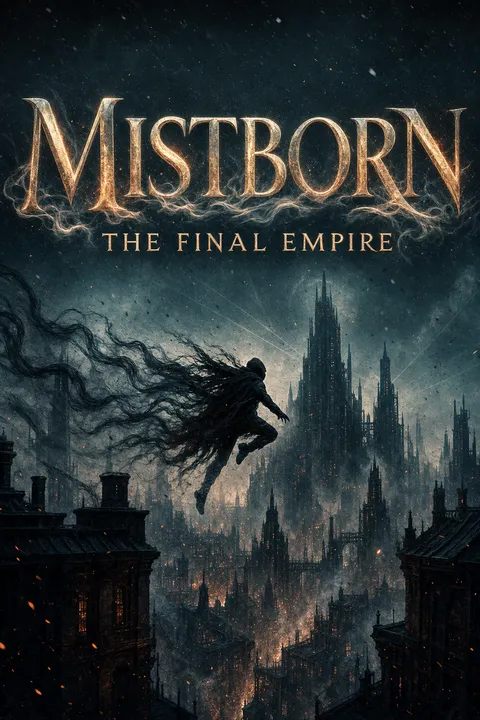


Plot Summary
Prologue
On a plantation under a sky of falling ash, Lord Tresting and a tattooed obligator congratulate themselves on the docility of their skaa slaves. One field worker, a scarred man named Kelsier,2 locks eyes with Tresting in open defiance, then vanishes. That night he visits a crowded skaa hovel, brings stolen noble food, and mocks the Lord Ruler's5 claim to have stolen even laughter from the oppressed.
When a girl is dragged off for the lord's pleasure, Kelsier2 walks into the forbidden mists. By dawn the manor is a smoldering ruin, every soldier and noble dead, the girl returned alive. The elder Mennis understands the terrible gift Kelsier2 left behind: defiance, and the necessity of flight.
The opening miniature of the whole novel: oppression rendered as casual bureaucratic cruelty, then ruptured by a single act of impossible violence. Sanderson establishes the mists as both threat and promise, the skaa as a people trained into apathy, and Kelsier as a catalyst who does not free people so much as force them to choose. Mennis's resentful gratitude prefigures the book's central question about whether hope can be manufactured. The prologue also seeds the engine of the plot: Kelsier provokes rebellion knowing others must bear the consequences, a morally uneasy heroism that the rest of the story will interrogate rather than simply celebrate.
Ash, Beatings, and Hidden Luck
Vin1 survives Luthadel's underworld as a scrawny thief in the crewleader Camon's gang, beaten regularly and trusting no one. Her brother Reen,14 who raised and abused her before vanishing, drilled in one lesson: everyone betrays everyone. Without understanding it, Vin1 uses a subtle ability she calls Luck to calm marks and smooth Camon's cons.
When Camon impersonates a desperate nobleman to swindle a Ministry obligator, Vin1 nudges the priest's suspicion away, but the act marks her to a Steel Inquisitor, a creature with spikes driven through its eyes. Days later, suspecting betrayal, Camon flies into a drunken rage and beats Vin1 toward death on the lair floor. Then the door bursts open, and a smiling, scarred stranger2 steps out of the mist.
Sanderson grounds an epic in a single abused child's psychology. Vin's worldview, inherited from Reen, is a survival ideology: intimacy equals exposure. Her Luck is dramatized as instinct rather than skill, suggesting that the oppressed often wield power they have been taught not to recognize. The Inquisitor's interest reframes Vin's smallness as significance, while Camon's violence establishes the baseline brutality against which every later kindness will register as suspicious. The section's tension lies less in physical danger than in the threat of being seen, the very thing Vin has organized her life around avoiding, and which the plot will relentlessly force upon her.
The Survivor Claims Vin
The newcomer2 hurls Camon across the room without touching him, scatters the crew, and names himself Kelsier,2 the Survivor of Hathsin, the only man ever to escape the Lord Ruler's5 atium pits. He studies Vin1 and delivers a revelation that reorders her world: she is not an ordinary trickster but Mistborn, able to burn all the Allomantic metals rather than just one, a gift rarer than almost anything in the empire.
He has her drink a vial, teaching her to sense iron, steel, tin, pewter, and the emotion-bending metals she already used. Kelsier2 explains that he and his partner Dockson6 lured away the Inquisitor tracking her scent. For the first time, someone treats Vin1 as valuable rather than disposable, which terrifies her more than any threat.
The recruitment scene weaponizes hope against a character armored in cynicism. Kelsier offers the two things Vin trusts least: power and belonging. His casual dismantling of Camon performs justice as spectacle, the mode in which Kelsier always operates. The Mistborn revelation is a classic identity-inflation, but Sanderson complicates it: Vin reads kindness as manipulation, correctly intuiting that Kelsier is using her even as he saves her. The scene's genius is that both readings are true. Allomancy is introduced through Vin's ignorance, letting exposition feel like discovery, and establishing the magic's central logic of consequence and constraint that will govern every later confrontation.
A Thief's Impossible Job
Kelsier2 assembles his veteran crew of skaa specialists: steady Dockson,6 the silver-tongued Soother Breeze,7 the philosophizing Thug Ham,8 the gnarled Smoker Clubs,11 and the boy lookout Spook.12 Their nominal employer is Yeden,10 leader of the failing skaa rebellion.
Kelsier2 lays out a plan the others call lunacy: gather a hidden army, lure the Luthadel Garrison out of the city, ignite a war among the noble Great Houses, then seize the palace and the Lord Ruler's5 legendary atium treasury. He further vows to kill the immortal Lord Ruler5 himself with a mysterious Eleventh Metal. To fund the weapons, Kelsier2 installs a flawless impostor15 in place of the murdered nobleman Lord Renoux. Skeptical but bound to Kelsier's2 vision, Vin1 signs on.
The heist framework lets Sanderson smuggle revolution inside genre pleasure. Each crewmember embodies a specialized competence, but Kelsier reframes professional thievery as moral war, insisting he chose men of conscience. The plan's audacity functions thematically: it is the size of the impossibility that makes belief meaningful. Yeden, the true believer, is positioned as both employer and ideological mirror, the earnestness Kelsier's cynicism conceals. The Eleventh Metal enters as an unverified rumor, planting the book's chief mystery. Crucially, Kelsier names altruism and revenge in the same breath, refusing to let his heroism be clean, and inviting the reader to wonder which motive truly drives him.
Dancing in the Mists
Under Kelsier's2 nightly tutelage, Vin1 learns to ride the mists, Pushing and Pulling on metal to vault rooftops and clear the city wall. She absorbs the brutal rules of Allomancy: every push has an equal and opposite consequence, and metal carried on the body makes you vulnerable.
Kelsier2 presents her to Sazed,4 a dignified Terrisman steward who becomes her guardian and teacher, and to the false Lord Renoux.15 Her role sharpens: pose as the rural noblewoman Lady Valette1 and infiltrate aristocratic society to mine political intelligence.
Sazed4 drills her in etiquette and quietly offers her the forgotten religions he preserves as a Keeper. Vin,1 who has always hidden in corners and shadows, must now master the harder art of hiding in plain sight, dressed in silk and perfume.
Training sequences double as identity construction. Allomancy's physics, force, weight, anchor, mirror the social physics Vin must learn at court, where leverage and counter-leverage decide survival. Sazed embodies an alternative to Kelsier's vengeance: preservation rather than destruction, memory as resistance. His offered religions quietly raise the novel's interest in belief as something chosen and load-bearing. The disguise motif is psychologically acute: Vin discovers that aristocrats see costume, not person, which both protects her and confirms her lifelong intuition that nobody truly sees anyone. The mists, framed as her element, begin transforming from a thing feared into a source of self.
Lady Valette's Debut
At a dazzling ball in Keep Venture, Vin1 discovers that her gown is the perfect camouflage: the court sees the dress, not the thief. Avoiding dances, she retreats to a balcony and collides with Elend Venture,3 heir to the Final Empire's most powerful house. He reads books at parties, openly mocks his own class, and treats her as a person rather than a conquest.
Their prickly banter unsettles her in ways danger never has. Sazed4 warns that Elend3 probably toys with her to provoke his domineering father, and Kelsier2 flatly orders her to avoid so prominent a lord, since entanglement endangers the whole operation. Vin1 collects her first court rumors, yet leaves wanting, against every instinct Reen14 ever beat into her, to see Elend3 again.
The romance is engineered as Vin's most dangerous heist: the theft of her own guardedness. Elend functions as a thesis figure, a nobleman who reads forbidden philosophy and questions the order he benefits from, complicating Kelsier's blanket hatred of the aristocracy. Their meeting over books rather than dancing signals an intimacy of minds, the rarest currency for a girl trained to expect only transaction. The balcony, a liminal perch above the spectacle, mirrors Vin's position between worlds. Sanderson uses the courtly façade to dramatize a broader theme: oppression is sustained not only by force but by beautiful, anesthetizing ritual that lets the comfortable ignore the dying.
Blood Beneath the Courtesy
The Ministry catches up with Camon's old gang. Vin1 and Kelsier2 find the lair painted in gore, the thieves torn apart by an Inquisitor that tortured Camon before killing him. The slaughter confirms the spike-eyed creature still hunts Vin1 as the unlawful half-breed child of an unknown obligator.
At court, the cruel and beautiful Shan Elariel,13 Elend's3 former betrothed and a secret Soother, conscripts Vin1 to spy on Elend's3 forbidden books. Vin1 glimpses the horror beneath noble manners when she watches a guard casually slit a begging skaa boy's throat outside a keep, and when Dockson6 recounts how a lord murdered the woman he loved. The glittering world Vin1 had begun to admire curdles, forcing her to hold both its beauty and its savagery at once.
Sanderson juxtaposes two registers of cruelty: the Inquisitor's grotesque, ritualized butchery and the aristocracy's bored, administrative murder. The boy's death outside the ball is the book's moral hinge, collapsing the distance between silk and slaughter. Shan introduces emotional Allomancy as social predation, a woman who demeans by Soothing, weaponizing intimacy itself. Vin's discovery that her father is an obligator deepens her status as an impossible person, born of the very system hunting her. The section refuses easy moral comfort: Vin is learning to love a world she must also recognize as monstrous, the same dissonance the entire skaa population has been conditioned to suppress.
The Palace's Waiting Trap
Vin1 tails Kelsier2 and learns he intends to break into Kredik Shaw, the Lord Ruler's5 thousand-spired palace, to discover the secret of his immortality. He gives her atium, the rarest metal, which lets an Allomancer glimpse seconds into the future, and reluctantly brings her along.
Inside, three Steel Inquisitors are waiting, and the infiltration collapses into a desperate chase through the spires in driving rain. An Inquisitor drives a glass axe into Vin's1 side, and she escapes only because someone finds her in the darkness and carries her to safety.
She wakes weeks later at Clubs's11 shop, stitched together by Sazed,4 having absorbed the harshest truth Kelsier2 could offer: for all their power, they are not invincible, and the Lord Ruler's5 strongholds can kill them.
This is the novel's first true humbling, puncturing the heist's swagger. Atium's future-sight makes Vin briefly godlike, then her near-death exposes the ceiling on that power. The Inquisitors are revealed as something the magic cannot fully explain, a horror outside the system's neat rules, which keeps the world genuinely dangerous. Vin's rescue by an unseen savior plants a quiet mystery and demonstrates that, against her training, someone risked everything for her. The wound and long convalescence force the crew into pause, and force Vin into the unfamiliar experience of being cared for rather than discarded when she ceases to be useful, eroding Reen's doctrine.
The Tyrant's Journal
While Vin1 recovers, Sazed4 translates the book she snatched from the palace shrine: a logbook written by the man who became the Lord Ruler,5 penned before his Ascension a thousand years earlier.
It describes a humble, self-doubting hero trekking toward the Well of Ascension in the frozen Terris mountains, hounded by a world-devouring force called the Deepness and shadowed by a resentful Terris packman named Rashek.5 The journal stops abruptly the night before the cavern.
Through it Sazed4 reveals the Terris art of Feruchemy, the storing of strength, senses, and even age inside metal, which is how he saved Vin's1 life. Reading the tyrant's anxieties, Vin1 can no longer picture the Lord Ruler5 as a simple monster, only as a man whose story went catastrophically wrong.
The interleaved logbook, present at every chapter head, pays off as both worldbuilding and thematic counterweight. By humanizing the future tyrant, Sanderson destabilizes the revenge narrative: the enemy was once exactly the kind of reluctant hero stories celebrate. Feruchemy expands the magic into a third system and quietly arms the plot's later reversals. Rashek's hatred and the unexplained ending become a structural lacuna the reader is invited to fill. The section meditates on power as corruption and on the terror of being a chosen one, suggesting that the gap between savior and despot may be a single decision made in cold, exhausted solitude.
Building the Survivor's Legend
In caves outside the city, the rebel army takes shape under Ham's8 training. Visiting, Kelsier2 stages a confrontation: a doubting soldier named Bilg openly calls the plan suicide, so Kelsier2 arranges a duel and secretly uses his own Allomancy to make the weaker champion, Demoux, appear to channel miraculous strength and defeat Bilg.
The performance feeds a swelling myth that Kelsier2 can grant supernatural power and that the Eleventh Metal will topple the Lord Ruler.5 His reputation among the skaa grows toward worship, and he begins visiting tenements at night to be touched and revered.
The crew grows uneasy at how deliberately Kelsier2 cultivates his own godhood, but he insists the people must believe in something before they will ever find the courage to rise.
Here the novel turns its sharpest lens on its own hero, dramatizing the deliberate fabrication of religion. Kelsier's rigged duel is a pious fraud, and Sanderson refuses to pretend it is anything else. The crew's discomfort voices the reader's: is manufactured faith still faith, and does a noble end sanctify manipulation? The growing veneration foreshadows a cost. Psychologically, Kelsier feeds the skaa the one thing the Lord Ruler's Soothing has stolen, passion, but he does it by making himself the object of devotion, blurring liberator and tyrant. The Eleventh Metal myth becomes load-bearing precisely because its truth remains unknown even to him.
The Army's Slaughter
Yeden,10 intoxicated by Kelsier's2 promises of divine protection, abandons the plan and marches the army to assault the Holstep Garrison. The gambit exposes the rebels, and a relieving force from another garrison ambushes and butchers them in a valley.
Kelsier2 and Vin1 sprint cross-country on flared pewter, reaching the hills only to watch the massacre helplessly from above. Of nearly seven thousand men, only the two thousand who stayed behind in the caves survive.
Wracked with guilt, Kelsier2 nearly surrenders to despair, until an old plantation skaa he once knew reminds him that even this defeat is the largest blow the skaa have struck in centuries. Refusing to quit, Kelsier2 resolves to stop accepting noble failures and to show his people what an actual victory looks like.
The disaster is the consequence of the previous section's mythmaking: belief untethered from discipline becomes fatal hubris, and Yeden's faith in Kelsier kills thousands. Sanderson makes the hero culpable, the deaths a direct yield of the confidence Kelsier so carefully sowed. The old man's framing, that catastrophic loss counts as the skaa's greatest victory, exposes how thoroughly oppression has shrunk the horizon of the possible. Kelsier's refusal to accept that diminished standard becomes the engine of the third act. Grief here is not paralyzing but radicalizing, transforming a thief's caper into a genuine, costly war whose price is now written in real corpses.
A Duel on the Rooftops
With the Great Houses tipping toward open war, Elend3 coldly ends things with Vin1 at a ball, calling her a liability and revealing he has guessed she hides her true identity. Crushed, Vin1 nonetheless extracts from the gossip Kliss the news that Shan Elariel13 has sent a Mistborn assassination team to murder Elend3 that very night.
Vin1 races across Keep Venture's rooftops and ambushes the killers with a spray of coins. In a savage duel atop the walls she faces Shan13 herself, also Mistborn, and survives a deadly atium standoff by feigning that her own atium has run out, then killing Shan13 with a broken arrow. Bleeding and heartbroken, Vin1 saves the very man who just discarded her,3 then flees into the mist.
Vin's choice inverts everything Reen taught her: she risks her life for someone who has just betrayed her trust, distinguishing love from utility. The atium duel is the magic system's purest chess, a contest of feints where the only counter to seeing the future is seeing it yourself, dramatizing that even prescience can be outwitted by psychology. Shan's death closes the court-intrigue thread with brutal finality. The emotional core is Vin's discovery that loyalty need not be reciprocal to be real, a direct rebuttal of her brother's doctrine. Heartbreak and heroism arrive fused, and Vin's identity tilts decisively from survivor toward protector.
Marsh's Bloody Warning
Kelsier's stern brother Marsh,9 who infiltrated the Steel Ministry posing as an obligator, smuggles out a detailed map of the Soothing stations, hidden posts where Ministry Allomancers blanket the skaa slums with dampened emotion, explaining why Luthadel's people are so uniquely beaten down.
The intelligence is a triumph. Then a second message lures Kelsier2 and Vin1 to a meeting place where they find only a butchered, flayed body: Marsh,9 apparently broken under torture and killed by an Inquisitor.
Because Marsh9 knew the crew's plans, aliases, and hideout, everything is compromised. Kelsier2 orders the crew scattered to a backup lair and Renoux15 withdrawn from his mansion. Grief curdles into cold fury, and Kelsier2 disappears, promising to strike a wound as deep as the one just dealt to him.
Loss escalates from the abstract army to the intimate family, sharpening the war's personal stakes. The Soothing stations retroactively explain the skaa's docility as engineered chemistry of the soul, a chilling literalization of ideological control. Marsh's apparent fate reframes the Ministry as a competent, ruthless intelligence apparatus rather than mere bureaucracy. The compromised lair strips the crew of safety just before the climax, a structural tightening of the screws. Kelsier's reaction, vengeance rather than retreat, recommits the novel to its argument that grief, properly aimed, becomes the most dangerous weapon the powerless possess, while leaving his exact plan ominously unstated.
Shattering the Pits
Kelsier2 travels alone to the Pits of Hathsin, the prison-mine where he survived a year of forced labor and where his wife Mare died, and which remains the world's only source of atium.
The metal grows in fragile crystal pockets that shatter when Allomancy is used nearby, which is why slaves, not Allomancers, must harvest it. Descending into the cracks that once nearly killed him, fighting old terror as much as old wounds, Kelsier2 uses iron and steel to find and shatter hundreds of crystal beds, ending atium production for centuries.
He frees the surviving prisoners as he climbs. The act guts the imperial economy and cripples the Lord Ruler's5 chief leash on the nobility, finally convincing the stunned crew that this mad plan might truly work.
Kelsier confronts his trauma by transforming a personal hell into a strategic weapon, the most psychologically resonant beat of his arc. The Pits represent both his lowest point and the source of his power, the place where suffering Snapped him into a Mistborn. By destroying atium, he attacks the empire's invisible architecture, money and the monopoly on power, rather than its visible soldiers. This is the thief's true insight: economies are more fragile than armies. The scene also quietly reveals the depth of Mare's loss and reframes atium, the heist's ostensible prize, as something Kelsier is willing to annihilate for a larger aim, signaling his goal was never wealth.
The Survivor's Final Stand
When the Ministry parades fresh prisoners through the streets, Renoux's15 captured servants and the boy Spook12 among them, Kelsier2 abandons all caution and attacks the convoy in daylight.
As Ham's8 soldiers free the captives, Kelsier2 faces the same Inquisitor that has haunted him and, in a ferocious display of Allomancy, pins its head to a wagon and beheads it, proving the creatures can die. The watching skaa begin to chant his name, hope flaring in their chests.
Then the Lord Ruler5 arrives in his black carriage, shrugs off spears thrust through his body, and strikes Kelsier2 down with a single contemptuous backhand before driving a spear through his heart. The Survivor2 dies in the ash of the square, and the crowd's courage gutters under the tyrant's smothering presence.
The climax of Kelsier's arc fuses triumph and catastrophe. Killing an Inquisitor in public is the proof-of-concept the skaa needed, a visible crack in the empire's invulnerability. The Lord Ruler's casual lethality immediately re-establishes the impossible scale of the enemy, ensuring the victory feels earned rather than cheap. Kelsier's last claim, that he embodies hope and therefore cannot truly be killed, is both bravado and prophecy, transforming his execution into the seed of something larger. Sanderson stages martyrdom as deliberate strategy, retroactively recoloring every earlier piece of mythmaking. The hero falls precisely when his fall will do the most work.
A God Made of Hope
That night the skaa do the unthinkable: galvanized by the Survivor's2 death, they flood the streets and rise against the Lord Ruler.5 The crew discovers Kelsier2 engineered everything. A kandra,15 a flesh-shaping creature that had worn Renoux's15 face, now wears Kelsier's2 bones and appears among the people as a risen god, fueling the legend.
Hidden warehouses of weapons, pre-trained soldier units, and a written battle plan await them. Kelsier2 had always intended to die, knowing the people needed a martyr and a deity more than they needed another thief. Dockson,6 Ham,8 and Breeze7 take command of the armies, Elend3 turns himself in to beg mercy for the nobility, and Vin,1 refusing to let the price be wasted, turns toward the palace and the Lord Ruler.5
The reveal recasts the entire novel as a theological con, the ultimate heist whose mark is an entire civilization's despair. Kelsier's death was the keystone, deliberately placed. Sanderson interrogates the ethics of necessary martyrdom and authored religion: the kandra impersonation is literally a manufactured resurrection, faith built on a beautiful lie that nonetheless produces genuine courage. The crew's reassignment, bureaucrat, soldier, politician, shows Kelsier trained successors rather than followers. The uprising answers the book's recurring question, what gives belief power, with a devastating thesis: a god worth dying for, and one worth killing for, can be the same fabricated figure. Vin alone perceives the unfinished danger above.
The Bracelets of Youth
Vin1 crashes through the throne room window to kill the Lord Ruler,5 but her daggers and the Eleventh Metal seem useless against him. Captured, she learns her father was the lord prelan, and watches the Inquisitors seize the Ministry.
One Inquisitor proves to be Marsh,9 alive and infiltrated far deeper than anyone knew; he slays his fellow creatures and hunts the tyrant's weakness. Sazed4 rescues Vin1 with stored Feruchemical strength, and Elend3 arrives, having braved the rebellion to reach her.
The Eleventh Metal finally yields its truth: the Lord Ruler is Rashek,5 the packman who murdered the real hero and stole the power at the Well, surviving a millennium as both Allomancer and Feruchemist by burning youth stored in two bracelets. Vin1 tears them free, ages him to dust, and spears his withered heart.
The resolution rewards every planted clue: the logbook's Rashek, Feruchemy's age-storage, Vin's anomalous ability to pierce hidden Allomancy. The tyrant's secret demystifies his godhood into mechanism, a man who cheated death with a metallurgical trick, collapsing divine terror into mortal fraud. Vin's victory is intellectual as much as physical, achieved by understanding rather than overpowering, the thief's solution. Elend's arrival and Sazed's rescue dramatize the trust Vin spent the novel learning to accept, contradicting Reen at the decisive moment. Killing Rashek with the Survivor's words on her lips closes the martyrdom loop, making Vin the inheritor and completion of Kelsier's manufactured hope.
Epilogue
On a rooftop above the freed city, Sazed4 and the recovered Marsh9 piece together the Lord Ruler's5 secret: he had been both Allomancer and Feruchemist, burning stored youth to live a thousand years. His vast atium hoard is nowhere to be found, and his dying warning, that in killing him they have doomed themselves, lingers unexplained beside unanswered questions about the Deepness and the Well of Ascension.
Elend3 takes the throne and begins drafting a new code of laws, while Marsh9 moves to quietly bend the Ministry from within. Vin,1 convinced she does not belong in Elend's3 world, nearly slips away, then remembers that her brother14 died protecting her rather than betraying her. She returns to Elend3 and lets herself be held.
The denouement resists triumphalism by seeding unease: the missing atium and the Lord Ruler's ominous final words convert victory into a cliffhanger of cosmic dread, implying the tyrant may have been holding something back at terrible cost. Sanderson reframes the empire's collapse as a beginning rather than an ending, with governance, the unglamorous work, left to idealistic Elend. Vin's arc resolves emotionally, not politically: the discovery of Reen's true sacrifice dismantles the betrayal doctrine that defined her, freeing her to choose connection. Her decision to return is the book's quiet thesis, that trust, the most dangerous Allomancy of all, is also the only real freedom.
Analysis
Mistborn fuses the mechanics of a heist thriller with the scope of epic fantasy, and the marriage is thematic, not just structural. A caper's logic, exploit the system's rules, target the invisible infrastructure rather than the visible guards, becomes a theory of revolution: Kelsier2 attacks the empire's economy and mythology before its armies, understanding that a thousand-year regime is sustained less by force than by conditioned despair. Sanderson's rigorously ruled magic reinforces this, since victories must be earned through understanding rather than raw power, and the climax is solved by deduction, a thief reading clues, as much as by combat. The novel's richest move is its interrogation of hope. Kelsier2 manufactures faith through rigged miracles, cultivated legend, and ultimately his own death, raising an uncomfortable question the book refuses to resolve cheaply: is engineered belief a noble gift or a cynical manipulation? By staging martyrdom as deliberate strategy, Sanderson suggests that meaning can be authored, that a fabricated god may still liberate real people, while never letting Kelsier2 off the hook for the lives his confidence costs. Vin's1 parallel arc grounds these abstractions in intimate psychology. Trained by an abusive brother14 to treat every bond as a prelude to betrayal, she experiences trust as the most dangerous power of all, more frightening than any Inquisitor. Her gradual, halting decision to believe, in the crew, in Kelsier's2 vision, in Elend,3 in her brother's hidden love,14 mirrors the skaa's collective awakening from apathy to defiance. The recurring logbook humanizes the tyrant5 into a cautionary double of every reluctant hero, warning that the gap between savior and despot is a single choice made in exhaustion. The book closes not in triumph but in unease, missing atium, an ominous dying warning, leaving liberation as a beginning whose true cost remains to be paid.
Review Summary
The Final Empire is widely praised as an exceptional fantasy novel with intricate world-building, a unique magic system, and compelling characters. Readers appreciate Sanderson's skillful plotting, character development, and the balance of action and emotion. The story follows Vin and Kelsier as they lead a rebellion against the oppressive Lord Ruler. While some find the pacing slow at times, most readers are captivated by the twists, turns, and satisfying conclusion. The novel is often recommended as an excellent entry point to Sanderson's work and the fantasy genre.
People Also Read


Characters
Vin
Hunted street thief MistbornA half-starved teenage thief shaped by years of abuse and abandonment, Vin survives by trusting no one, a creed drilled into her by her brother Reen14: anyone will betray you. Beneath the wariness lies fierce intelligence, lethal instinct, and a buried hunger to be wanted. Discovering she is Mistborn gives her unprecedented power, but her real transformation is emotional, as the crew's loyalty and a nobleman's affection3 slowly erode her armor of suspicion. Forced to pose as an aristocrat, she fractures between identities, the cornered urchin and the poised lady, unsure which is real. Vin is the novel's beating heart: a study in how a person conditioned for solitude learns, painfully and incompletely, to risk love, belief, and belonging.
Kelsier
Charismatic rebel mastermindThe Survivor of Hathsin, the only man to escape the Lord Ruler's atium pits, Kelsier is a brilliant thief turned revolutionary whose arms are crisscrossed with scars from that ordeal. Magnetic, witty, and relentlessly optimistic, he masks profound grief over his wife Mare's death and a furnace of hatred for the nobility. He laughs as defiance, refusing to let his oppressor claim joy. Kelsier is also a deliberate myth-maker, cultivating worship among the skaa and couching idealism inside heists, which unsettles even his closest friends. He preaches trust and friendship while keeping his deepest plans secret. Part liberator, part manipulator, he embodies the novel's central tension: whether hope built on calculation and sacrifice is still genuine hope.
Elend Venture
Bookish noble heirHeir to the empire's most powerful house, Elend defies expectation: he reads forbidden philosophy at balls, mocks his own class, and dreams of a fairer order. Disheveled and disarming, he treats Vin1 as an equal mind rather than a prize, drawing out her true self. Beneath the affable rebellion lies guilt over his complicity and a slowly hardening resolve to be more than his domineering father's pawn.
Sazed
Terrisman scholar and guardianA Terrisman steward and secret Keeper, Sazed memorizes the world's lost religions, languages, and histories, resisting the empire through preservation rather than violence. Calm, gentle, and quietly subversive, he becomes Vin's1 tutor, protector, and confidant. His hidden mastery of Feruchemy, the storing of strength and attributes in metal, makes him far more formidable than his serene scholar's demeanor suggests.
The Lord Ruler
Immortal god-emperorThe deathless tyrant who has ruled the Final Empire for a thousand years, worshipped as a living god and enforced by his Steel Ministry. He radiates an emotional pressure that smothers hope in anyone near him, and he has survived burning, beheading, and dismemberment. Cold, weary, and contemptuous of the skaa he oppresses, he treats rebellion as a recurring nuisance. Yet a logbook from before his Ascension hints at a once-humble, doubting man, making him as much tragedy as monster, an enigma the crew must understand before they can hope to defeat him.
Dockson
Crew's steady organizerKelsier's2 oldest partner and the crew's logistical backbone, Dockson handles supplies, contracts, and coordination with unflappable competence. A plantation-born skaa who lost a loved one to a lord's cruelty, he carries quiet, durable anger beneath his pragmatism, and serves as the realist counterweight to Kelsier's2 flamboyant schemes.
Breeze
Vain manipulative SootherAn immaculately dressed Soother who bends emotions with practiced subtlety, Breeze treats manipulation as the fundamental art of social life. Pompous, indolent, and fond of fine wine, he hides genuine skill and loyalty beneath the posturing. His running verbal sparring with Ham8 provides levity, even as his powers prove vital to recruiting and steadying crowds.
Ham
Philosophizing strongman ThugA pewter-burning Thug who provides muscle and security, Ham is built like a soldier but delights in tangled ethical questions that exasperate his companions. Warm and principled, he keeps his family hidden far away to protect them, and quietly worries whether the rebellion does true good, voicing the crew's conscience.
Marsh
Kelsier's stern brotherKelsier's2 older brother, a former leader of the skaa rebellion who abandoned it in disillusionment. Stern, disciplined, and unsmiling, nicknamed Ironeyes for his hard gaze, he despises the Steel Ministry with a passion mirroring Kelsier's2 hatred of nobles. A skilled Seeker, he agrees to infiltrate the obligators, risking everything to gather the secrets the rebellion needs.
Yeden
Earnest rebellion leaderThe official leader of the skaa rebellion and the crew's nominal employer, Yeden is morally upright but inexperienced, openly disapproving of thieves even as he hires them. Over time Kelsier's2 confidence wins him over, but his eager belief in promises of victory makes him dangerously susceptible to reckless decisions.
Clubs
Gruff Smoker carpenterA scowling master carpenter and Smoker whose shop hides the crew and whose coppercloud conceals their Allomancy. Cynical and curmudgeonly, he joins out of spite for the Lord Ruler5 and conceals an old soldier's experience behind his limp.
Spook
Young slang-speaking lookoutClubs's11 teenage nephew, a Tineye whose enhanced senses make him the crew's best lookout. Earnest, awkward, and infatuated with Vin1, he speaks an Eastern street dialect that baffles the others, and craves acceptance among the crew's veterans.
Shan Elariel
Cruel noble SootherA beautiful, imperious noblewoman and Elend's3 former betrothed, secretly a Soother. She torments Vin1 at court with calculated contempt and conscripts her into a scheme against Elend3, embodying the aristocracy's polished, predatory cruelty.
Reen
Vin's absent abusive brotherVin's1 older half-brother, who raised, trained, and beat her before vanishing. Though never present in the story, his voice persists in Vin's1 mind, endlessly repeating that everyone will betray her, a doctrine she must overcome.
OreSeur
Shape-stealing kandra servantA kandra, a flesh-shaping creature bound by contract, who impersonates the murdered nobleman Lord Renoux with flawless precision. Passionless and unsettling, it consumes the bodies of the dead to wear their forms, serving the crew while inspiring deep unease.
Plot Devices
Allomancy
Metal-fueled magic systemThe empire's magic, in which gifted people swallow and burn metals to gain powers. Iron and steel pull and push on nearby metal, letting Allomancers fly and fight; tin sharpens the senses; pewter grants strength and endurance; zinc and brass riot or soothe emotions; copper hides Allomancy while bronze detects it. Most are Mistings, able to burn a single metal, while rare Mistborn can use them all. Crucially, the magic obeys strict physical logic, every push has a reaction, and carried metal makes a person vulnerable, so battles become contests of leverage, weight, and trajectory. Sanderson uses these constraints to make heists and duels feel like solvable puzzles, and the system's gaps drive the central mysteries.
Atium
Precious metal of prophecy and powerThe rarest and most valuable substance in the empire, atium lets an Allomancer briefly see the immediate future of everyone nearby, making its user nearly unbeatable in combat. Because it can only be mined from one secret location and is doled out by the Lord Ruler5 at ruinous prices, control of atium is one of the chief leashes binding the nobility to the throne. The crew's heist targets the imperial treasury's atium reserve, both as wealth to fund a new order and as the linchpin of imperial power. Atium duels become the deadliest confrontations in the book, contests where prescience can only be countered by prescience, and where the loser is whoever burns out first.
The Eleventh Metal
Mysterious key to killing a godA pale, unfamiliar bar of metal Kelsier2 obtained in the distant north, around which he has spread a deliberate legend. He claims it can kill the supposedly immortal Lord Ruler5, though he confesses, privately, that he cannot figure out how it works and dares not test it, since burning an unknown metal can be lethal. The Eleventh Metal anchors the rebellion's hope and Kelsier's2 growing myth, functioning as a promise the crew must take on faith. Its true nature is one of the novel's central withheld mysteries, debated and doubted by the crew throughout, and its eventual revelation reframes both the Lord Ruler's5 secret and the limits of the known Allomantic system.
The Logbook
Tyrant's pre-Ascension journalA leather-bound journal recovered from the palace, written by the man who would become the Lord Ruler5 before his Ascension, with excerpts heading each chapter. It chronicles a doubting hero's journey toward the Well of Ascension to stop a world-ending force called the Deepness, accompanied by Terris packmen and shadowed by a resentful guide named Rashek5. The text humanizes the future tyrant, supplies the history the Ministry has erased, and introduces Feruchemy and the prophecies underpinning the empire. Translated by Sazed4, it becomes both worldbuilding engine and thematic counterweight, complicating the crew's view of their enemy. Its abrupt ending the night before the cavern is a deliberate gap the climax later fills.
Feruchemy
Metal-storage power of the TerrisThe secret Terris art practiced by Keepers like Sazed4, distinct from Allomancy. Rather than drawing power from metal, a Feruchemist stores attributes inside metal by drawing them from his own body, growing weak for hours to bank strength, or aging himself to save up youth, then withdrawing the reserve later. The trade is always balanced, fueled by the user's own flesh. Because the Lord Ruler5 hunts Keepers ferociously and breeds the Terris to suppress the gift, Feruchemy is shrouded in secrecy. Introduced quietly through Sazed's4 lessons and his rescue of Vin1, it deepens the world's magical logic and is carefully positioned to enable the novel's decisive reversals, where stored strength and stored age prove unexpectedly pivotal.
FAQ
Synopsis & Basic Details
What is Mistborn: The Final Empire about?
- Oppression and Rebellion: The story is set in a world where ash falls constantly, and the skaa people are oppressed by the immortal Lord Ruler and his noble class. It follows a group of rebels, led by the charismatic Kelsier, as they plan to overthrow the Final Empire.
- Magic and Intrigue: The narrative is driven by the unique magic system of Allomancy, where individuals can gain powers by burning metals. This magic is intertwined with political intrigue, as the rebels seek to exploit the weaknesses of the ruling class.
- A Journey of Self-Discovery: The story also focuses on Vin, a young street thief who discovers her Allomantic abilities and her place in the rebellion. Her journey is one of self-discovery, as she learns to trust and embrace her power.
Why should I read Mistborn: The Final Empire?
- Unique Magic System: The intricate and well-defined system of Allomancy, with its various metals and powers, offers a fresh and engaging take on fantasy magic.
- Compelling Characters: The story features a diverse cast of characters, each with their own motivations, flaws, and strengths. From the charismatic Kelsier to the wary Vin, the characters are complex and relatable.
- Intriguing Plot: The plot is full of twists and turns, keeping readers engaged and invested in the outcome. The blend of political intrigue, action, and magic creates a compelling narrative.
What is the background of Mistborn: The Final Empire?
- A Thousand Years of Oppression: The story takes place a thousand years after the Lord Ruler took power, creating the Final Empire. This history of oppression and subjugation forms the backdrop for the skaa rebellion.
- A World of Ash and Mist: The environment is a key element of the story, with ash falling constantly from the sky and mists appearing at night. These environmental factors symbolize the oppressive nature of the Final Empire.
- A Rigid Social Hierarchy: The Final Empire is characterized by a rigid social hierarchy, with the nobility ruling over the skaa. This social structure is a source of conflict and a driving force behind the rebellion.
What are the most memorable quotes in Mistborn: The Final Empire?
- "Sometimes, I worry that I'm not the hero everyone thinks I am.": This quote, from the prologue, reveals Kelsier's self-doubt and sets the stage for the themes of heroism and responsibility.
- "Anyone will betray you, Vin. Anyone.": Reen's cynical words, repeated throughout the story, highlight the theme of distrust and the harsh realities of the underworld.
- "I'm not here to lead a rebellion among you, Goodman Mennis. I just want to stir up a little trouble.": Kelsier's words reveal his true intentions, highlighting his role as a catalyst for change rather than a traditional leader.
What writing style, narrative choices, and literary techniques does Brandon Sanderson use?
- Detailed Worldbuilding: Sanderson is known for his meticulous worldbuilding, creating a rich and immersive setting with its own history, culture, and magic system.
- Character-Driven Narrative: The story is driven by the complex and compelling characters, whose motivations and relationships shape the plot.
- Subtle Foreshadowing: Sanderson uses subtle foreshadowing and callbacks to create a sense of depth and complexity, rewarding careful readers with hidden connections and meanings.
Hidden Details & Subtle Connections
What are some minor details that add significant meaning?
- The Color Red: The recurring color red, often associated with the sun and ash, symbolizes the oppressive nature of the Final Empire and the violence that permeates the world.
- The Scars on Kelsier's Arms: The scars on Kelsier's arms, initially presented as a sign of his past in the Pits of Hathsin, become a symbol of his resilience and his defiance against the Lord Ruler.
- The Lord Ruler's Jewelry: The Lord Ruler's rings and bracelets, initially presented as symbols of his power, are later revealed to be a key to his Feruchemical abilities and his vulnerability.
What are some subtle foreshadowing and callbacks?
- Mennis's Warning: Mennis's warning to Kelsier about wasting energy foreshadows Kelsier's eventual sacrifice and the importance of choosing one's battles wisely.
- The Obsidian Coin: The obsidian coin that Reen left behind, which Vin carries as a good luck charm, foreshadows the importance of obsidian in the fight against the Lord Ruler.
- The Description of the Pits: The descriptions of the Pits of Hathsin, initially presented as a place of punishment, foreshadow their true nature as a source of atium and the Lord Ruler's power.
What are some unexpected character connections?
- Vin and the Lord Ruler: The revelation that Vin is the daughter of a high prelan in the Steel Ministry creates an unexpected connection between her and the Lord Ruler's regime.
- Kelsier and Marsh: The complex relationship between Kelsier and Marsh, as brothers with differing views on the rebellion, adds depth to their characters and the story's themes.
- Sazed and the Keepers: The reveal that Sazed is a Keeper, a member of a secret society dedicated to preserving knowledge, adds a layer of mystery and intrigue to his character.
Who are the most significant supporting characters?
- Sazed: As a Terris Keeper, Sazed provides a link to the past and a source of knowledge about the world's history and religions. His role as a guide and mentor to Vin is crucial to her development.
- Dockson: As Kelsier's trusted friend and the crew's planner, Dockson provides a level-headed perspective and a sense of stability to the group. His organizational skills are essential to the rebellion's success.
- Marsh: As Kelsier's brother and a former rebel leader, Marsh provides a counterpoint to Kelsier's idealism. His skepticism and knowledge of the Ministry make him a valuable, if reluctant, ally.
Psychological, Emotional, & Relational Analysis
What are some unspoken motivations of the characters?
- Kelsier's Desire for Recognition: Beyond his desire to overthrow the Lord Ruler, Kelsier seeks recognition and validation for his abilities and his past suffering.
- Vin's Fear of Betrayal: Vin's constant fear of betrayal stems from her past experiences with Reen, and it shapes her relationships and her actions throughout the story.
- Marsh's Need for Redemption: Marsh's skepticism and his desire to infiltrate the Ministry are driven by his need to atone for his past failures and to find a way to make a difference.
What psychological complexities do the characters exhibit?
- Kelsier's Charisma and Self-Doubt: Kelsier's charismatic leadership is juxtaposed with his underlying self-doubt and his fear that he is not the hero everyone believes him to be.
- Vin's Internal Conflict: Vin struggles with her desire for connection and her fear of betrayal, creating an internal conflict that shapes her actions and her relationships.
- Marsh's Cynicism and Idealism: Marsh's cynicism and skepticism are balanced by his underlying idealism and his desire to make a difference, creating a complex and nuanced character.
What are the major emotional turning points?
- Vin's Acceptance of Allomancy: Vin's acceptance of her Allomantic abilities marks a turning point in her emotional journey, as she begins to embrace her power and her place in the rebellion.
- Kelsier's Death: Kelsier's death is a major emotional turning point, leaving the crew devastated and forcing them to confront the reality of their mission.
- Vin's Betrayal by Elend: Vin's realization that Elend was using her for his own purposes is a major emotional blow, forcing her to confront her own vulnerability and her fear of betrayal.
How do relationship dynamics evolve?
- Vin and Kelsier: The relationship between Vin and Kelsier evolves from a mentor-student dynamic to a complex bond of trust and respect.
- Kelsier and Dockson: The friendship between Kelsier and Dockson is a source of stability and support, highlighting the importance of loyalty and camaraderie in the face of adversity.
- Vin and Sazed: The relationship between Vin and Sazed is one of mutual respect and understanding, as they both grapple with their pasts and their roles in the rebellion.
Interpretation & Debate
Which parts of the story remain ambiguous or open-ended?
- The Nature of the Deepness: The true nature of the Deepness, the force that the Lord Ruler supposedly defeated, remains ambiguous, leaving readers to wonder about its origins and its potential return.
- The Lord Ruler's Motivations: The Lord Ruler's true motivations for his actions remain unclear, leaving readers to speculate about his goals and his reasons for oppressing the skaa.
- The Eleventh Metal's True Power: The true nature and power of the Eleventh Metal remain ambiguous, leaving readers to wonder about its potential to defeat the Lord Ruler.
What are some debatable, controversial scenes or moments in Mistborn: The Final Empire?
- Kelsier's Methods: Kelsier's methods, particularly his willingness to use violence and manipulation, are debatable, raising questions about the morality of his actions.
- Vin's Use of Allomancy: Vin's use of Allomancy, particularly her emotional manipulation, raises questions about the ethics of her powers and her responsibility to use them wisely.
- The Lord Ruler's Actions: The Lord Ruler's actions, particularly his oppression of the skaa and his use of violence, are controversial, raising questions about the nature of power and the responsibility of leaders.
Mistborn: The Final Empire Ending Explained: How It Ends & What It Means
- The Lord Ruler's Death: The Lord Ruler's death, while a victory for the skaa, is also a moment of uncertainty. It leaves the future of the Final Empire in question, and it raises concerns about the power vacuum that has been created.
- Vin's Transformation: Vin's transformation from a wary thief to a powerful Mistborn is complete, but her journey is far from over. She has embraced her power, but she must now learn to use it responsibly.
- A New Beginning: The ending of "The Final Empire" marks the beginning of a new era for Luthadel, but it also hints at future challenges. The skaa have gained their freedom, but they must now learn to govern themselves and to build a new society.
The Mistborn Saga Series
About the Author
Download PDF
Download EPUB
.epub digital book format is ideal for reading ebooks on phones, tablets, and e-readers.








































