

Key Takeaways
Your personality is a stack of borrowed agreements you never chose
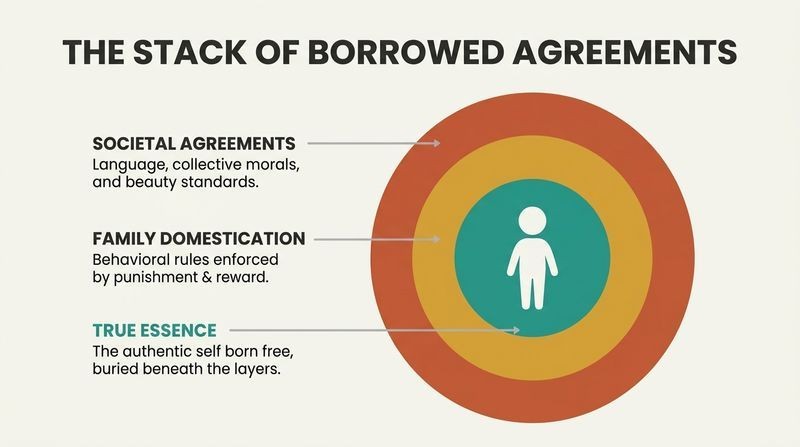
You were programmed, not born free. Ruiz argues that from infancy society hooks a child's attention and installs its rules through repetition: language, religion, morals, what is beautiful, what is acceptable. He calls this domestication, and it works exactly like training a pet, through punishment and reward. Eventually you no longer need parents or teachers to enforce the rules. You become your own domesticator, punishing yourself for breaking a code you never agreed to.
The dream of the planet. Ruiz calls collective society's beliefs the dream of the planet, and your private version the personal dream. He claims a startling ninety-five percent of stored beliefs are lies we suffer for. Freedom begins the moment you realize your identity is a costume, not your essence.
The framing echoes developmental psychology and social constructionism: Vygotsky showed cognition is scaffolded by culture, and Bourdieu's concept of habitus describes internalized social structures that feel like personal choice. Ruiz's punchier claim, that domestication mirrors animal conditioning, aligns neatly with Skinnerian operant reinforcement. What's striking is the reframe of agency: he insists the same repetition that imprisoned you can liberate you. The ninety-five-percent figure is rhetorical rather than empirical, but the underlying point survives scrutiny. Cognitive behavioral therapy rests on an almost identical premise, that maladaptive automatic beliefs, learned early, can be identified and rewritten through deliberate practice.
Your inner Judge makes you pay a thousand times for one mistake
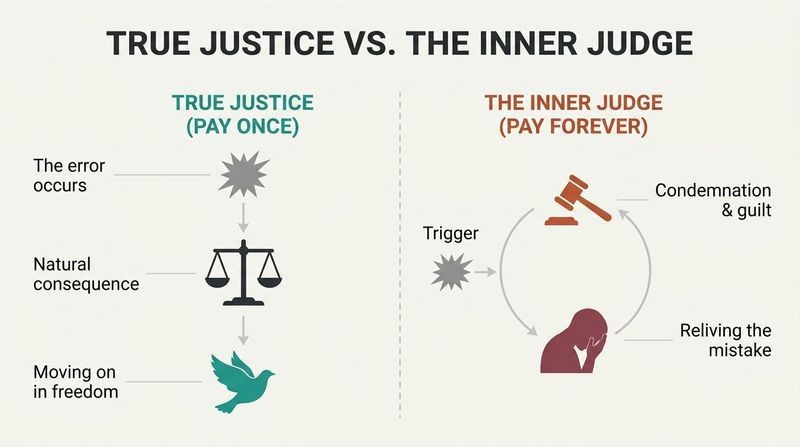
Justice means paying once. Ruiz personifies the mind's cruelty as three characters: the Judge, who condemns everything you do against the internal rulebook; the Victim, who absorbs the blame, guilt, and shame; and the Book of Law, the belief system supplying the verdicts. Humans, he notes, are the only animals that punish themselves repeatedly for a single error. A dog pays once. A person relives the mistake for years, and recruits spouses and parents to remind them.
Self-abuse sets the ceiling. No external abuser matches the internal one. Crucially, the abuse you tolerate from others exactly matches the abuse you inflict on yourself. If someone mistreats you slightly less than your Judge does, you stay. This is why self-love, not willpower, is the real lever.
The Judge and Victim map cleanly onto what psychologists call the inner critic and learned helplessness. Ruiz's insight that tolerated abuse tracks self-abuse anticipates attachment research: people often recreate the emotional climate they consider normal. The claim that animals pay only once is a useful heuristic, though rumination likely served an evolutionary function, helping ancestors avoid repeating fatal errors. The problem is a thermostat stuck on high. Steelmanning Ruiz: modern self-compassion research by Kristin Neff shows that treating oneself with kindness reduces anxiety and rumination more effectively than self-criticism, empirically validating his central prescription.
Speak impeccably: your word is a spell that builds or burns
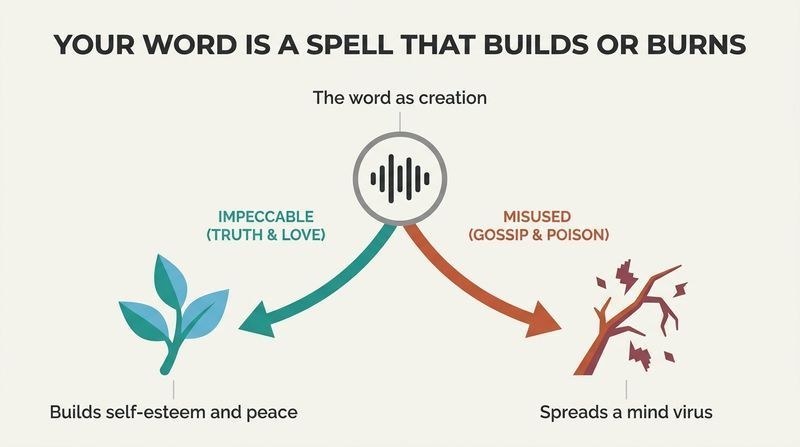
The first and hardest agreement. Ruiz redefines impeccable from its Latin root, without sin, and redefines sin as anything you do against yourself. To be impeccable with your word means never using language against yourself or others. The word is your tool of creation, and misusing it is what he calls black magic. A mother snapping that her daughter's voice is ugly can silence the girl for life. One careless opinion becomes a spell the listener casts on herself.
Gossip is a mind virus. He compares gossip to malicious computer code inserted into others: one bit of poison about a teacher makes you hate the class before it starts. The antidote is directing your word toward truth and love, beginning with how you talk to yourself.
Ruiz overlaps with linguistic relativity and speech-act theory: J.L. Austin showed that certain utterances do not describe reality but create it, like a promise or a verdict. The mother-daughter example is essentially a demonstration of the Pygmalion effect, where expectations become self-fulfilling. Framing gossip as a contagious virus prefigures memetics and today's misinformation research. One caveat: the mystical language of spells and magic may alienate skeptics from a sound psychological core. Stripped of metaphor, the claim is defensible: language shapes self-concept, and habitual self-talk measurably affects mood, performance, and even physiological stress markers.
Nothing others do is about you, even a bullet
The maximum expression of selfishness. Ruiz's second agreement, don't take anything personally, rests on a counterintuitive claim: taking offense is actually a form of self-importance, the assumption that everything revolves around you. Everyone lives inside their own dream, reacting from their own wounds and programming. When someone insults you, they are describing their internal world, not yours. Even if someone shot you, he argues, it was still nothing personal.
Immunity in the middle of hell. When you refuse the poison, it stays with the sender and never enters you. The pain you feel from a comment is a preexisting wound being touched, not fresh damage. Ruiz claims mastering just the first two agreements dissolves seventy-five percent of the tiny agreements that keep you suffering.
This is Stoicism in Toltec dress. Epictetus taught that we are disturbed not by events but by our judgments about them, and Marcus Aurelius practiced not taking insults personally. The reframe of offense as covert egotism is genuinely provocative and clinically useful, appearing in modern detachment-based therapies. The hard edge, that even being shot is impersonal, invites reasonable pushback: some harm is targeted, and denying all personal relevance can shade into spiritual bypassing, dismissing legitimate grievance. The steelman: Ruiz is describing an internal stance toward emotional reactivity, not a legal or moral verdict on the perpetrator's responsibility.
Ask instead of assuming; your mind invents fictions to feel safe
Assumptions are asking for problems. The third agreement targets the mind's compulsion to fill gaps with invented answers. Because uncertainty feels dangerous, we manufacture explanations and then defend them as truth. Ruiz traces a chain reaction: we assume, misunderstand, take it personally, then spread poison through gossip. A stranger's smile in a mall becomes an imagined wedding. A spouse's silence becomes proof of betrayal.
Real love needs no assumptions. In relationships, we assume partners can read our minds, then punish them for failing a test they never knew about. The remedy is simple and hard: have the courage to ask questions until communication is clear. Ruiz makes a bold claim that clear communication alone would end wars, violence, and misunderstanding.
Neuroscience strongly supports this. The predictive-processing model of the brain holds that perception is largely the mind generating expectations and correcting them against sensory data, so we quite literally see our assumptions. Ruiz's insight that we assume to reduce the discomfort of ambiguity aligns with research on the need for cognitive closure, where anxious individuals grab premature answers. In relationships, the Gottman Institute's decades of data confirm that unspoken expectations and mind-reading predict divorce. The claim that clear communication would end all war overreaches, since many conflicts involve genuine clashes of interest, not just misunderstanding, but as a personal practice it is potent.
Always do your best, knowing your best fluctuates hour to hour
The agreement that powers the rest. The fourth agreement is the engine that makes the other three habits stick, because it is about action and repetition. Crucially, your best is a moving target. Sick, tired, or heartbroken, your best is lower than when rested and joyful, and that is fine. Overdoing depletes you; underdoing breeds guilt. Aim precisely at your best, no more, no less.
A monk's lesson. A man asks a master whether meditating eight hours daily will speed enlightenment more than four. The master says it will take longer, because grinding past your best misses the point: you are here to live and love, not to sacrifice joy. When you truly do your best, the Judge loses its case, because there is nothing left to accuse.
This reframe quietly dismantles perfectionism, which research links to burnout, procrastination, and depression. By defining best as relative to today's capacity, Ruiz preempts the all-or-nothing thinking that sabotages habit formation, echoing self-determination theory's finding that intrinsic motivation, doing something for its own sake, outlasts reward-driven effort. The meditation parable is a critique of the productivity culture that equates more hours with more virtue. There is tension worth noting: the elastic definition of best could rationalize chronic underperformance. Ruiz guards against this by pairing it with honest self-assessment, learning from mistakes through practice rather than punishment.
A parasite feeds on your fear; starve it or fight it
The mind's freeloader. Ruiz combines the Judge, Victim, and Book of Law into a single entity he calls the parasite, a being of emotional energy that lives inside your mind and survives on the negative emotions generated by fear: anger, jealousy, envy, shame. It dreams through you and drains your vitality, contributing nothing.
Three ways to reclaim your mind. He offers a Toltec battle plan:
1. Face your fears one by one, attacking the parasite head by head.
2. Stop feeding it by refusing to fuel fear-based emotions, starving it out.
3. Undergo the initiation of the dead, a symbolic death of the old self.
The person who wages this war he calls a warrior, defined not by winning but by rebelling against the parasite's rule.
The parasite is a vivid externalization technique. Modern therapy uses the same move: narrative therapy encourages clients to name and separate from a problem, turning the depression into an adversary rather than an identity. This reduces shame and restores agency. Ruiz's warrior distinguishes refraining from repressing, holding an emotion and releasing it deliberately rather than stuffing it, which anticipates emotion-regulation research showing suppression backfires while reappraisal helps. The metaphysical framing of an autonomous energy-being is unfalsifiable and may strain credibility, but as a psychological device for disidentifying from one's own destructive patterns, it is remarkably effective and mirrors mindfulness-based defusion.
Forgive to heal yourself, not because anyone earned it
Forgiveness is selfish medicine. Ruiz frames emotional wounds as an infection covering the mind like diseased skin, so painful that everyone keeps their distance and calls the dysfunction normal. Healing requires the scalpel of truth to open the wounds, drain the poison, and let them close. The only way to drain the poison is forgiveness, granted not because the offender deserves it but because you love yourself too much to keep paying for their crime.
A concrete test. He gives a clean diagnostic: you know you have truly forgiven when you can hear the person's name, or see them, and feel no emotional charge. Ruiz insists on forgiving parents first, since they abused you only out of their own domestication, doing the best their programming allowed.
This aligns tightly with clinical findings. Studies on forgiveness therapy, notably by Robert Enright, show that releasing resentment lowers anxiety, depression, and even blood pressure, and the benefit accrues to the forgiver regardless of the offender's remorse. Ruiz's reframe severs forgiveness from reconciliation, a distinction therapists stress: you can forgive internally without restoring the relationship or excusing the act. The no-emotional-charge test is an unusually practical benchmark for an inner state. His injunction to forgive parents because they were themselves programmed resembles the compassion that arises in family-systems work, though critics note it risks minimizing genuine harm if applied prematurely.
Use death as your advisor to strip away trivial fears
The angel of death as teacher. Ruiz's initiation of the dead means letting death itself instruct you on how to live. Since you could die tomorrow, every fear of others' opinions becomes absurd. If a doctor gave you one week, you would stop performing for approval and simply be yourself. He urges beginning each day grateful for the sun and one more chance to be who you are.
Death takes the past so you can live now. He reframes death as a gift: it continually removes the dead past so life can proceed in the present. The parasite wants you to haul your history everywhere, making existence heavy. Surrendering the past to death lets you tell people you love them today, because tomorrow is never guaranteed.
Ruiz joins a long lineage of memento mori practices, from Stoic negative visualization to Carlos Castaneda's Don Juan, who called death an adviser sitting on your left shoulder. Terror management theory in psychology shows that mortality awareness can either trigger defensive rigidity or, when integrated, prompt more authentic and intrinsically motivated living, which is precisely the constructive path Ruiz points toward. Empirically, hospice workers and near-death survivors report the same clarifying effect: petty status anxieties evaporate. The practice of expressing love now, because tomorrow is uncertain, is not sentimentalism but a rational hedge against the most common and irreversible of regrets.
Suffering and happiness are both choices you renew daily
Heaven is a state of mind you can enter now. Ruiz's closing claim is that hell and heaven are not afterlife destinations but conditions of the mind available immediately. Most human society, ruled by fear, matches the classic religious description of hell exactly. But once your agreements change, you can perceive love radiating from trees, sky, and strangers, a condition he calls bliss.
You will find excuses, never reasons. He asserts you can always locate excuses to suffer but never a genuine reason. Suffering persists mainly because it feels familiar and therefore safe. Adopting the four agreements is a declaration of war to reclaim the personal power currently spent maintaining fear-based agreements. Each broken agreement returns power to you, compounding until transformation becomes self-sustaining.
The insistence that happiness is a decision rather than a circumstance finds partial support in positive psychology, where Sonja Lyubomirsky estimates roughly forty percent of happiness variance is within intentional control, while genetics and circumstance claim the rest. So Ruiz overstates the case: trauma, poverty, and neurochemistry are not dissolved by choice alone. Yet the core is sound and echoes Viktor Frankl's insight from the concentration camps, that the last human freedom is choosing one's attitude. The observation that suffering endures because it feels safe is astute, matching research on how familiar distress can be preferred over uncertain change, the comfort of the known cage.
Analysis
The Four Agreements packages an ancient-sounding Toltec cosmology into four deceptively simple behavioral rules, and its enduring appeal lies in that compression. Ruiz is doing cognitive restructuring dressed in shamanic robes. His central move, treating beliefs as chosen agreements rather than fixed truths, is philosophically identical to the premise underlying cognitive behavioral therapy, Stoicism, and Buddhist notions of conditioned mind. What distinguishes the book is not novelty of content but memorability of form: four imperatives a child can recite yet an adult can spend a lifetime practicing.
The book's greatest strength is its diagnostic precision about self-inflicted suffering. The Judge, Victim, and Book of Law give readers a vocabulary for the inner critic, and the parasite metaphor enables the therapeutic act of disidentification. The claim that tolerated abuse mirrors self-abuse is a genuinely useful clinical heuristic. Its practical instructions, ask instead of assume, do your best relative to today's capacity, forgive to free yourself, remain sound advice validated by independent research across psychology.
The weaknesses are equally clear. Ruiz universalizes to a fault: statements that clear communication would end all war, that nothing is ever personal even under violence, and that happiness is purely a choice ignore structural harm, genuine conflicts of interest, and the biological substrates of mood. The metaphysical scaffolding, energy parasites, the dream of the planet, spells and black magic, is unfalsifiable and may repel empirically minded readers, though it functions well as metaphor. There is also a subtle risk of spiritual bypassing, where detachment becomes an excuse to dismiss legitimate emotion or accountability.
Read charitably, the book is best understood not as metaphysics but as a portable operating system for the mind. Its power is pedagogical. By reducing a vast tradition to four rules and pairing them with vivid stories, Ruiz makes profound psychological work rehearsable in daily life, which is precisely why it has outlasted flashier self-help.
Review Summary
The Four Agreements has received mixed reviews, with many praising its simple yet profound wisdom. Readers appreciate the four principles: be impeccable with your word, don't take anything personally, don't make assumptions, and always do your best. Some find the book life-changing and transformative, while others criticize it as oversimplified or repetitive. Many readers note that the concepts are not new but presented in an accessible way. The book's short length and straightforward approach are generally viewed positively, though some find the writing style lacking.
People Also Read


Glossary
Domestication
Social programming of human beliefsRuiz's term for how society trains children into its beliefs through repetition and a punishment-reward system, exactly as one trains an animal. Over time the person internalizes these rules so completely that they become self-domesticating, enforcing beliefs they never consciously chose. Domestication builds the personality and the entire inherited belief system that governs one's dream of life.
The Dream of the Planet
Collective inherited social realityThe combined dream of billions of individual human minds, encompassing all of society's rules, laws, religions, cultures, and institutions. Ruiz argues we perceive reality as a dream even while awake, and that this outside collective dream is imposed on each newborn, shaping their smaller personal dream before they can choose otherwise.
Mitote
Mental chaos of competing voicesA Toltec term (also compared to the Indian concept of maya, illusion) for the fog of a thousand conflicting voices talking at once inside the mind, like a crowded marketplace. Because stored agreements contradict one another, the mitote prevents a person from seeing who they truly are or knowing what they genuinely want.
The Judge, the Victim, and the Book of Law
Inner critic, sufferer, rulebookThree linked mechanisms of self-torment. The Book of Law is the internalized belief system supplying all verdicts. The Judge condemns every thought and action that violates it. The Victim receives the resulting blame, guilt, and shame. Together Ruiz calls them the parasite, and they cause humans to punish themselves repeatedly for a single mistake.
Impeccability of the Word
Using language without self-betrayalThe first agreement. Impeccable derives from a Latin root meaning without sin, and Ruiz redefines sin as anything done against oneself. To be impeccable with your word is to direct your speech toward truth and love, never using it to blame, gossip, or attack yourself or others. He calls misuse of the word black magic.
The Parasite
Fear-feeding entity in mindRuiz's name for the combined Judge, Victim, and belief system understood as a single living being made of emotional energy. It lives inside the mind, dreams through the person, and survives by feeding on negative emotions generated by fear. He offers three ways to defeat it: facing fears individually, starving it of fear, or the symbolic initiation of the dead.
Initiation of the Dead
Symbolic death of old selfA practice found across esoteric traditions in which one takes death as a teacher and symbolically dies, killing the parasite without harming the body. By living as though each day could be the last, one strips away fear of others' opinions, releases the past, and is reborn childlike but wise, free to use one's own mind.
FAQ
What's "The Four Agreements: A Practical Guide to Personal Freedom" about?
- Overview: "The Four Agreements" by Don Miguel Ruiz is a guide to personal freedom and spiritual enlightenment based on ancient Toltec wisdom.
- Core Concept: The book introduces four agreements that can lead to personal transformation and a life of happiness and love.
- Toltec Wisdom: It draws from the Toltec tradition, which emphasizes living a life of awareness, transformation, and intent.
- Purpose: The book aims to help readers break free from self-limiting beliefs and societal domestication to achieve true freedom.
Why should I read "The Four Agreements"?
- Personal Transformation: The book offers practical advice for transforming your life by changing your belief system.
- Emotional Freedom: It provides tools to free yourself from emotional pain and suffering.
- Universal Appeal: The teachings are applicable to anyone seeking a more fulfilling and authentic life.
- Simplicity and Depth: The agreements are simple yet profound, making them easy to understand and implement.
What are the key takeaways of "The Four Agreements"?
- Be Impeccable with Your Word: Use your words to create love and truth, not harm or deceit.
- Don't Take Anything Personally: Understand that others' actions are a reflection of their own reality, not yours.
- Don't Make Assumptions: Communicate clearly to avoid misunderstandings and unnecessary drama.
- Always Do Your Best: Your best will vary, but consistently doing your best will lead to a fulfilling life.
What is the first agreement, "Be Impeccable with Your Word"?
- Definition: Being impeccable means using your words in the direction of truth and love.
- Power of Words: Words have the power to create or destroy; they are a form of magic.
- Avoid Self-Harm: Misusing words can lead to self-rejection and emotional poison.
- Positive Impact: Impeccability with words can transform your life and relationships.
What does "Don't Take Anything Personally" mean in "The Four Agreements"?
- Self-Reflection: Understand that what others say and do is a projection of their own reality.
- Emotional Immunity: By not taking things personally, you become immune to emotional poison.
- Self-Importance: Taking things personally is a form of selfishness, assuming everything is about you.
- Freedom from Offense: This agreement helps you avoid unnecessary suffering and conflict.
How does "Don't Make Assumptions" help in personal freedom?
- Clarity in Communication: Assumptions lead to misunderstandings; clear communication prevents this.
- Avoid Drama: Assumptions often result in unnecessary emotional drama and conflict.
- Ask Questions: Encourage open dialogue to understand others better and avoid false beliefs.
- Reality Check: Assumptions are often based on our fears and insecurities, not reality.
What is the significance of "Always Do Your Best"?
- Consistency: Doing your best varies with circumstances but ensures you live without regrets.
- Self-Judgment: It helps you avoid self-judgment, guilt, and regret.
- Action-Oriented: Focus on action and effort rather than outcomes or rewards.
- Personal Growth: This agreement fosters continuous improvement and personal growth.
How does "The Four Agreements" relate to Toltec wisdom?
- Toltec Tradition: The book is based on the ancient wisdom of the Toltecs, known for their spiritual knowledge.
- Way of Life: Toltec wisdom is not a religion but a way of life focused on happiness and love.
- Spiritual Masters: It honors all spiritual masters and traditions, emphasizing universal truths.
- Path to Freedom: The agreements are a practical application of Toltec teachings for personal freedom.
What is the "Dream of the Planet" in "The Four Agreements"?
- Collective Dream: It refers to the collective beliefs and agreements of society that shape our reality.
- Domestication: Humans are domesticated to conform to societal norms, losing their true selves.
- Breaking Free: The book encourages breaking free from this dream to create your own reality.
- Awareness: Recognizing the dream of the planet is the first step toward personal freedom.
What are the best quotes from "The Four Agreements" and what do they mean?
- "Be impeccable with your word." This emphasizes the power of words to create or destroy.
- "Don't take anything personally." Highlights the importance of understanding others' actions are not about you.
- "Don't make assumptions." Encourages clear communication to avoid misunderstandings.
- "Always do your best." Focuses on effort and action, leading to a fulfilling life.
How can "The Four Agreements" help in achieving personal freedom?
- Breaking Old Agreements: The book guides you to break fear-based agreements that limit you.
- Creating New Agreements: Encourages forming new, empowering agreements based on love and truth.
- Emotional Healing: Provides tools for healing emotional wounds and achieving inner peace.
- Path to Heaven on Earth: By following the agreements, you can transform your life into a personal heaven.
What is the "New Dream" in "The Four Agreements"?
- Heaven on Earth: The new dream is a life of love, happiness, and freedom.
- Personal Creation: You have the power to create your own reality and live in bliss.
- Love and Acceptance: Emphasizes living without fear, judgment, or the need for acceptance.
- Ultimate Goal: The new dream is the ultimate goal of personal transformation and freedom.
About the Author
Other books by Miguel Ruiz



Download PDF
Download EPUB
.epub digital book format is ideal for reading ebooks on phones, tablets, and e-readers.








































