Key Takeaways
1. Defining the Otrovert: The Eternal Outsider
Quite literally, otrovert means “one who is facing a different direction.”
A unique orientation. An otrovert is a person whose fundamental orientation is rarely the same direction everyone else is facing, embodying a personality trait of non-belonging. Unlike Carl Jung's introverts (facing inward) or extroverts (facing outward), otroverts face a different direction, even when physically present within a group. This means they are eternal outsiders in a communal world, despite often being friendly and empathetic.
Core qualities. Otroverts possess distinct characteristics that set them apart from communal people. They exhibit a lack of communal impulse, preferring one-on-one interactions over group gatherings and disliking organized activities. They are always observers, never truly feeling part of a group's shared identity, even if they connect with individuals within it. This inherent nonconformity means they march to the beat of a different instrument altogether, preferring to stand out rather than fit in.
Independent thought. At their core, otroverts are independent, original thinkers who reject the "hive mind." They don't partake in shared visions or care about collective consensus, instead relying on their personal interests and point of view. This innate inability to feel like they belong is a deeply embedded cognitive feature, not a choice, and attempts to "fix" it are as misguided as trying to change left-handedness.
2. The World's Misconceptions of Otroverts
Otroverts are outsiders who are treated like insiders.
Misunderstood identities. Otroverts are often mistaken for other personality types due to their quiet discomfort and internal experience of non-belonging. They are not shy introverts who seek refuge within themselves; rather, they are acutely aware of others and can be overwhelmed by the cacophony of thoughts and observations in a group setting. However, unlike introverts, they don't find one-on-one interactions draining.
Beyond nonconformity. While they appear nonconformist, an otrovert's individualism is not a philosophical stance or an act of rebellion; it's their default state. They don't recognize the existence of "the norm" in the first place, making them impervious to social influence and trends. Their perceptions are shaped by personal interests, not group consensus, allowing them to see a flag as merely a piece of cloth, devoid of communal meaning.
Not socially anxious or neurodivergent. Otroverts are not socially phobic; their discomfort in crowds stems from being forced to "participate" rather than observe, leading to a feeling of loneliness when surrounded by many people. They are neurotypical, displaying no discernible behavioral differences from others, and their internal experience of non-belonging is not a psychiatric diagnosis. They are considerate and non-confrontational, often making great efforts to appear predictable to others, which can mask their internal struggle.
3. The Meek Rebel: Quiet Nonconformity
Otroverts think outside the bounds, too, but all their revolutionary ideas are private, contained within themselves.
Internal revolution. Otroverts are "meek rebels" whose revolutionary ideas are private and contained, unlike historical figures who rallied others. They are naturally polite, people-pleasers, and confrontation-averse, often mistaken for weak or self-effacing. This disarming attitude is a survival tactic, allowing them to camouflage their internal rebellion and nonconformism by dutifully adhering to unspoken social rules.
Disdain for tradition. Shared traditions and rituals, whether religious, national, or communal, rarely feel compelling to otroverts. They struggle to anchor themselves in the social background of these traditions, finding milestones like birthdays or graduations arbitrary. Instead, they anchor themselves in personal habits and rituals, which frees them from unnecessary obligations but can also make them inflexible about their routines.
Freedom in self-control. While their daring spirit is absent from the experiential side of life, their freedom is an internal experience. They value peace of mind over excitement and self-control over experimentation, avoiding anything that risks losing control. Small acts of covert disobedience, like obfuscating trivial facts, provide an exhilarating sense of freedom, defending their inner world without creating conflict or attracting unwanted attention.
4. The Pseudo Extrovert: A Social Facade
Playing the gregarious socializer while being deeply private is quite taxing on otroverts, especially in the earlier stages of life.
Performing for acceptance. Many otroverts adopt a "pseudo extrovert" persona, appearing charming and sociable in contained, familiar circumstances, despite feeling uncomfortable in large public spaces. They avoid small talk but can engage in meaningful conversations when given the chance. This gregarious facade is a protective shield, fiercely guarding their deeply private inner life, and is particularly taxing during adolescence and early adulthood.
Shining in assigned roles. Otroverts often excel when given a specific social role, such as a host, keynote speaker, or DJ. This designated position makes group attendance tolerable by providing a socially acceptable way to maintain their boundaries and differentiate themselves from the crowd. It's not a narcissistic need for special regard, but a means to align their outer experience with their inner sense of difference, bringing a harmonious calm.
Evolving with age. Fortunately, the pseudo-extrovert tendency often diminishes beyond young adulthood. As otroverts mature, they find it easier to avoid uncomfortable situations and gravitate towards more structured socializing, like intimate dinners or one-on-one meetings. This shift allows their authentic self to emerge, bringing peace of mind and enabling them to choose relationships and activities on their own terms, as exemplified by the patient A who blossomed in his twenties.
5. The Otrovert's Innate Creativity and Empathy
The ability to distinguish another’s perspective from their own also explains why otroverts tend to be radically nonjudgmental.
Unleashed creativity. Otroverts are inherently creative because they are unencumbered by the limits of communal thinking. They are impervious to collective notions of what makes art "good" and don't need others' approval or agreement. This allows them to conjure ideas not derived from past conventions, making unique contributions that often subvert conventional wisdom, as seen in figures like Frida Kahlo and Neil deGrasse Tyson.
Bespoke empathy. Unlike communal people who assume everyone feels the same way in similar circumstances, otroverts possess a deeper, non-judgmental empathy. They imagine what you would do in your shoes, not what they would do, looking at your circumstances through your eyes. This ability to distinguish another's perspective from their own fosters a high level of empathetic insight, free from the biases of personal beliefs and values.
Beyond the "Bluetooth phenomenon." Otroverts lack the "Bluetooth phenomenon"—the passive, automatic connection communal people feel in groups. This absence compels them to pay intense, granular attention to every individual, regardless of the encounter's brevity or anonymity. While this can be overwhelming in crowds, it becomes a powerful asset in one-on-one interactions, enabling them to forge meaningful connections and understand others on a profound, individual level.
6. Born Alone, Taught to Belong
The truth is that we all arrive in the world alone and leave the world alone.
Innate individuality. While society instills the belief that humans have an innate urge to belong, the author argues that we are all born alone. The initial impulse to attach to a caregiver is innate for survival, but anything beyond this, such as group belonging, must be taught. Infants are solipsistic, focused on immediate gratification, and lack understanding of complex social concepts or their place within a group.
Social conditioning. Around age three, children are systematically conditioned to abandon self-absorbed behaviors and prioritize group needs. Concepts like "share" and "wait your turn" are drilled in, with communal behaviors rewarded with affection and praise. Parallel play is replaced by interactive forms, railroading the once self-centered toddler into a life of communality. This universal conditioning shapes the upbringing of most children.
Otrovert resistance. True otroverts are the exception to this conditioning. Even at a young age, they cannot subjugate their inner world for a shared experience, despite parental and societal pressure. This resistance is met with misunderstanding and disapproval, as their progression from unique individual to social animal does not unfold smoothly. The author's own childhood experience of resisting the Scouts illustrates this early, painful realization of being different.
7. The Fallacy of Fitting In: A Draining Pursuit
The danger which threatens human nature is not the excess, but the deficiency, of personal impulses and preferences.
Societal pressure to conform. Our culture places a high premium on joining, teaching us from childhood to align our behavior with those around us and rewarding conformity. This "guided joining" intensifies in adolescence, where disregard for the group leads to unhappiness. Adults then actively seek out and make efforts to join groups, equating popularity with self-worth.
The cost of pretense. Otroverts are penalized for being unable to abandon their deepest selves for communal purposes. They spend significant time creating an illusion of belonging by abiding by group decorum, which makes routine encounters maddeningly exhausting. This pretense is often fueled by well-meaning peer pressure or an unconscious attempt by others to validate the group, leading otroverts to cave easily despite their discomfort.
Liberation from obligation. The belief that there's a price to pay for straying from unnecessary social engagements is often unfounded. Otroverts like the patient J, who felt overwhelmed by family obligations, found immense relief by choosing leisure commitments according to their own needs. People rarely notice or care if an individual opts out of communal events, allowing otroverts to honor their authentic desires and protect their valuable time without negative consequences.
8. Emotional Self-Sufficiency: The Power of Solitude
When I am willfully alone, a slight ordering of my interior begins to take place, and I need nothing more.
Comfort in solitude. Otroverts are inherently comfortable in solitude, viewing it as intrinsic to their lifelong experience, unlike communal people who often fear being alone as it reminds them of their solitary destiny. In a group, otroverts feel lonely, finding the performance of fitting in exhausting and unrewarding. Embracing solitude allows them to tune out external expectations and tune into themselves.
Self-reliance and decisiveness. Untethered from the collective, otroverts can distinguish between group gravity and their personal center of gravity. They don't fear "wrong" thoughts or feelings because they don't measure themselves against communal yardsticks. This inherent self-sufficiency means they rarely experience self-recrimination and are decisive, willful, and confident in their life choices, trusting their instincts without needing external validation.
Prioritizing peace of mind. Otroverts prioritize peace of mind, often refusing to engage in conflicts or competitive struggles that communal people might pursue for money or revenge. Their non-competitive nature makes winning or losing inconsequential. This self-preservation allows them to walk away from draining situations, even against the advice of friends or family, feeling strong for sticking to their convictions rather than weak for "giving in."
9. Thinking Outside the Hive: Originality and Insight
It was evident to me that the lack of a response to medication that works for similarly diagnosed patients meant that there was a mismatch between medication and diagnosis, yet the “normal” way of dealing with those patients who remained symptomatic was to make them wait for “new and improved” versions of the medication they were not responding to.
Challenging consensus. Unencumbered by the hive mind, otroverts are original thinkers who question conventional assumptions and ponder alternative interpretations. The author's "Second Chance Program" for psychiatric patients exemplifies this, challenging the prevailing groupthink that labeled patients as "treatment nonresponders" rather than questioning the treatment itself. This led to hundreds of patients being transitioned back into the community after decades of institutionalization.
Disregarding abstractions. Otroverts place no trust in groups formed around abstract ideas like ideology, politics, or nationality, which exist only in the collective mind. They find unquestionable devotion to such groups illogical. While communal people adhere to these abstractions for connection and guidance, otroverts are not swayed by the number of people who hold an idea; for them, the idea itself matters, regardless of its source or popularity.
A longitudinal sense of time. Untethered from the hive mind's focus on the present zeitgeist, otroverts perceive their place in history and time differently. Their personal experience of the present is not linked to others, and their memories are not clouded by collective narratives. This longitudinal sense of time means that every moment and memory is precious, and today is an outcome of yesterday, with tomorrow a consequence of today, fostering a unique perspective on life's journey.
10. The Richness of an Unpoliced Inner Life
Inside myself is a place where I live all alone and that is where I renew my springs that never dry up.
A private sanctuary. Otroverts possess a rich, multi-layered inner world that serves as a private sanctuary, a place to retreat from the chaos of the collective. Unlike most people who neglect their inner lives due to discomfort with solitude, otroverts are hyper-aware of the boundary between their inner and outer worlds. This allows them to tune out external concerns like envy and shame, and instead tune into themselves, accessing a complex universe of thought, memory, and imagination.
Freedom from internal policing. Otroverts understand that their inner mind is private and not subject to societal rules or judgment. They feel perfectly free to indulge all their innermost emotions and urges, even those considered "unattractive" by society, without guilt or shame. This freedom from policing their internal dialogue is immensely liberating, as thoughts and feelings cannot be "wrong" or "right" because they cannot be controlled.
Beyond verbal language. While communal people condense emotional experiences into simplified verbal sound bites, otroverts maintain two separate languages: one verbal for public interaction, and one non-verbal or pre-verbal for communicating with the self. This allows them to remember in feelings that cannot be articulated in words, preserving the richness of their inner experience from being lost in the recesses of memory. This deep, unshared internal world provides much-needed solitude and a profound sense of self-ownership.
11. Navigating Life Stages: From Childhood to Old Age
If a teen can traverse the gauntlet of adolescence unscathed, they emerge wanting to never be anyone else.
The otrovert child. In early childhood, all children are inherently otroverts, but otrovert children retain this individuality. They show an affinity for adults, possess curious and inventive minds, are popular with a few close friends, and are happiest when left to their own devices. They dislike organized activities, are unusually considerate, careful, and risk-averse, and struggle with change. Parents should practice "the art of letting be," encouraging one-on-one friendships and trusting their child's instincts, rather than forcing conformity.
Adolescence: The toughest gauntlet. Adolescence is the most challenging period for otroverts, as peer groups become cult-like, demanding unbridled fealty. Being themselves and being a teenager feel fundamentally incompatible, leading to painful feelings of otherness. Some may become "reckless pseudo extroverts" or struggle to blend in, often using substances to cope with the pretense. Parental understanding is crucial to help teens navigate this period without triggering inner rebellion or exacerbating feelings of inadequacy.
Work and relationships. In adulthood, otroverts thrive in independent work environments that allow self-generated decisions and creative thinking, as corporate life's collaborative demands are taxing. They prioritize personal fulfillment over status or money, defining success by their achievements rather than external validation. In romantic relationships, otroverts seek deep, intimate bonds, valuing mutual understanding and respect for boundaries over social conventions. They are loyal, protective, and bring an innate capacity for intimacy, putting their partner first.
Peace in old age and death. For most otroverts, later life brings peace and contentment. Having curated a life around their needs and cultivated a rich inner world, they face old age and death cheerfully. Their lifelong solitary journey makes them less likely to fear dying alone, as they understand that their mind is the only thing they truly own. They accept their fate, creating their own narrative about death, finding peace in self-acceptance and knowing they lived authentically.
Review Summary
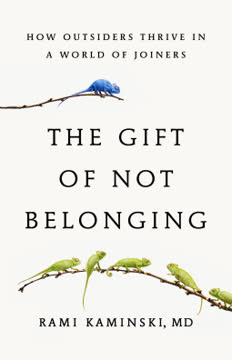
The Gift of Not Belonging introduces the concept of "otroverts" - individuals who feel like outsiders and don't conform to social norms. Reviews are mixed, with some readers feeling deeply understood and others criticizing the lack of scientific evidence. Many appreciate Kaminski's insights on embracing uniqueness, while others find the theory poorly supported. Some reviewers relate strongly to the otrovert description, while others see it as a repackaging of existing personality types. The book's anecdotal approach and lack of citations are common criticisms, though many find the ideas thought-provoking.
People Also Read



 Immersive


FAQ
1. What is "The Gift of Not Belonging" by Rami Kaminski about?
- Explores the concept of otroverts: The book introduces and defines "otroverts," individuals who inherently lack the communal impulse to belong to groups, yet are empathetic, friendly, and often mistaken for introverts or outsiders.
- Challenges societal norms: Kaminski examines how society is structured for joiners and how those who don't fit in are often misunderstood or pathologized.
- Offers a new perspective: The book reframes non-belonging as a gift, highlighting the strengths, virtues, and unique contributions of otroverts to society.
- Blends personal and clinical insight: Drawing from his own life and decades as a psychiatrist, Kaminski uses stories, patient cases, and psychological theory to illustrate the otrovert experience.
2. Why should I read "The Gift of Not Belonging" by Rami Kaminski?
- Validation for outsiders: If you've ever felt like you don't fit in, the book offers understanding, reassurance, and a positive reframe of your experience.
- Insight for friends and family: It helps readers better understand and support the otroverts in their lives, whether children, partners, or colleagues.
- Practical advice: Kaminski provides actionable strategies for embracing non-belonging, navigating social pressures, and building a fulfilling life as an otrovert.
- Broader societal relevance: The book challenges the cultural obsession with belonging, offering a fresh lens on individuality, empathy, and creativity.
3. What is an "otrovert" according to Rami Kaminski?
- Definition of otrovert: An otrovert is someone who remains an eternal outsider in a communal world, not due to shyness, anxiety, or neurodivergence, but because of an innate lack of the communal impulse.
- Distinct from introverts and outsiders: Otroverts are often friendly, empathetic, and even popular, but never feel like true participants in groups, preferring one-on-one connections or solitude.
- Binary trait: Kaminski argues that otroversion is not a spectrum; you either are or are not an otrovert, much like being left-handed.
- Core qualities: Otroverts are non-joiners, observers rather than participants, nonconformists, independent thinkers, and emotionally self-sufficient.
4. How does "The Gift of Not Belonging" by Rami Kaminski distinguish otroverts from introverts, nonconformists, and neurodivergent individuals?
- Not introversion: Unlike introverts, otroverts are not shy or withdrawn; they are often outgoing and enjoy deep one-on-one connections but dislike group dynamics.
- Not just nonconformists: Nonconformists may still crave group belonging or rebel for attention, while otroverts are individualists by default, not by choice or philosophy.
- Not neurodivergent: Otroverts do not display the social or cognitive traits associated with autism or ADHD; their non-belonging is internal and not due to behavioral differences.
- Not marginalized outsiders: Otroverts are not excluded by others; they are often welcomed but simply do not feel a sense of belonging, regardless of social acceptance.
5. What are the main qualities and strengths of otroverts as described in "The Gift of Not Belonging"?
- Lack of communal impulse: Otroverts prefer solo activities, avoid group celebrations, and are uncomfortable in crowds or group settings.
- Observer mindset: They feel like outsiders even when included, rarely identify with group identities, and prefer not to mix different social circles.
- Nonconformity and originality: Otroverts are independent thinkers, often uninterested in popular culture, and confident in their unique perspectives.
- Emotional self-sufficiency: They do not seek validation from groups, are content with solitude, and possess strong self-awareness and self-reliance.
- Deep empathy and connection: Otroverts excel at one-on-one relationships, are highly empathetic, and can connect deeply without needing group affiliation.
6. How does Rami Kaminski explain the challenges otroverts face in a world made for joiners?
- Cultural pressure to belong: Society rewards joining and conformity from early childhood, making non-belonging seem abnormal or problematic.
- Misunderstanding and misdiagnosis: Otroverts are often mistaken for being shy, anxious, or suffering from a disorder, leading to ineffective interventions.
- Social exhaustion: Attempts to fit in or mask their true nature can lead to emotional fatigue, anxiety, or even depression.
- Difficulty in adolescence and work: The pressure to join is most intense during teenage years and in collaborative work environments, making these periods especially challenging for otroverts.
7. What practical advice does "The Gift of Not Belonging" offer for otroverts and their families?
- Embrace non-belonging: Accept and value your otrovert traits rather than trying to force yourself to fit in.
- Set boundaries: Learn to distinguish between necessary and unnecessary social obligations, and give yourself permission to decline group activities that drain you.
- Parenting otrovert children: Recognize and support their need for solitude and one-on-one friendships, avoid pushing them into group activities, and trust their instincts.
- Career choices: Seek work environments that allow for independence, creativity, and minimal group collaboration, and avoid roles that require constant teamwork or socializing.
8. How does "The Gift of Not Belonging" redefine empathy and connection for otroverts?
- Bespoke empathy: Otroverts don't assume others feel as they do; instead, they imagine what others experience from the other's perspective, leading to radical nonjudgmental empathy.
- One-on-one depth: They form deep, meaningful connections with individuals rather than groups, valuing quality over quantity in relationships.
- Dislike of small talk: Otroverts prefer genuine, substantive conversations and often find small talk or group rituals meaningless or irritating.
- Empathy as a strength: Their outsider perspective allows them to see individuals clearly, fostering authentic connection and understanding.
9. What are the virtues and benefits of being an otrovert, according to Rami Kaminski?
- Emotional self-sufficiency: Otroverts are comfortable with solitude, trust their instincts, and are less susceptible to peer pressure or groupthink.
- Originality and creativity: Their independence from the hive mind enables them to think outside the box and make unique contributions in art, science, and problem-solving.
- Contentment and confidence: Otroverts are less likely to experience FOMO, envy, or status anxiety, and are generally content with their choices and lifestyle.
- Rich inner life: They maintain a vibrant internal world, which provides fulfillment, resilience, and a source of creativity and self-renewal.
10. How does "The Gift of Not Belonging" address romantic relationships and work life for otroverts?
- Romantic compatibility: Otroverts thrive in relationships with partners who respect their need for solitude and individuality, whether or not the partner is also an otrovert.
- Communication and boundaries: Successful relationships require mutual understanding, clear boundaries, and acceptance of differences in social needs.
- Work environment fit: Otroverts excel in roles that allow for autonomy, creativity, and minimal group interaction, such as consulting, freelancing, or leadership positions with clear boundaries.
- Avoiding burnout: Recognizing and honoring their own needs helps otroverts avoid emotional exhaustion and find fulfillment in both personal and professional life.
11. What are the key takeaways from "The Gift of Not Belonging" by Rami Kaminski?
- Non-belonging is a gift: Otroverts' outsider status is not a flaw but a source of strength, creativity, and empathy.
- Society needs otroverts: Their independent thinking and empathy enrich collective wisdom and drive progress.
- Self-acceptance is crucial: Embracing one's otrovert nature leads to greater happiness, fulfillment, and authentic relationships.
- Redefining success: True success for otroverts is living in alignment with their own values and needs, not conforming to societal expectations.
12. What are the best quotes from "The Gift of Not Belonging" and what do they mean?
- "You are the captain, and this is your ship." – Kaminski emphasizes personal agency and the importance of charting your own course in life.
- "I was not an ugly duckling, nor was I a swan. I was another kind of bird altogether." – This highlights the uniqueness of otroverts and the value of embracing one's true nature.
- "The individual has always had to struggle to keep from being overwhelmed by the tribe." (Kipling) – Used to illustrate the challenge and necessity of maintaining individuality in a conformist world.
- "There is no gate, no lock, no bolt that you can set upon the freedom of my mind." (Virginia Woolf) – Celebrates the otrovert's inner freedom and independence of thought.
- "Freedom is the will to be responsible for ourselves." (Nietzsche) – Underscores the book's central message of self-ownership and the liberation that comes from accepting one's own path.








































