
Plot Summary
Rain's Prophecy Falls
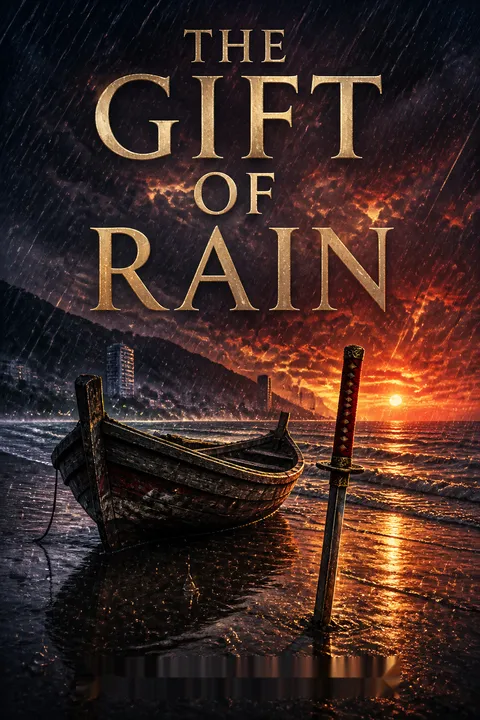
From the very beginning, rain is both memory and fate. The narrator, Philip Hutton, recalls his birth marked by a fortune-teller's prophecy: he has the "gift of rain," promising a life of abundance and flood. In the waning years of his life, Philip feels the weight and ambiguity of this destiny—how rain can nurture and also destroy. When Michiko, a Japanese woman from his sensei's past, appears at his family estate in Penang, the gentle monsoon sets the tone for journeys into memory. As rain smears the boundaries between past and present, destiny and choice, Philip's story slowly unfolds, shimmering with regrets and hope, heavy with unsaid sorrow for what is to come.
Crossing Paths, Changing Worlds
Philip's comfortable, if lonely, Eurasian existence is upended when Hayato Endo, a dignified Japanese diplomat, leases Philip's childhood island. Endo's arrival coincides with Philip's familial alienation and longing for belonging. Through a chance act—lending a boat—Philip enters Endo's orbit. The two begin a mentor-student relationship centered on aikijutsu, Japanese martial arts, and meditation. Philip is drawn by Endo's discipline and the space it provides to integrate his fractured identity. Between training by the sea and explorations of Penang, the two forge a complex, familial bond. This bond will soon be tested by the tides of coming war.
The Island Teacher
On his family's island sanctuary, Philip finds both freedom and new confinement as Endo's student. Training is strict, ritualized, and founded in trust—physical connection, surrender, and flight. Endo's teaching merges physical mastery with spiritual lessons: "Stillness in movement, movement in stillness." But their relationship is not solely instructor-pupil; it is intimate, challenging Philip to articulate his identity as an outcast Eurasion. Endo, marked by his own marginalization in Japan, both softens and stiffens Philip's world, prompting him to question belonging and duty under his teacher's enigmatic guidance.
Rituals of Trust
The culture of colonial Penang is a tight weave of rituals and boundaries: religious observances, family traditions, the etiquette of sword and tea. Philip's training deepens as he learns not just martial forms but how to surrender ego and trust others—an effort paralleled by his gradual reconciliation with his estranged family, especially his formidable grandfather. Festivals, worship at Buddhist and Anglican altars, and family gatherings are infused with ambiguous blessings and fraught inheritance. Rain—sometimes a flood, sometimes a balm—accompanies his journey at every step.
Secrets, Swords, Foundations
The Hutton mansion is a vessel of family memory, haunted by both love and unresolved pain. Philip learns the weight of history through ancestral tales of empire—in China, Malaya, England—and through his family's hybrid bloodlines. Endo's own sword, and the twin piece he gifts Philip, become symbols of trust and the burden of power. Possession of a weapon signifies not only defense but a hidden fate. Interspersed are tales of secret societies, triads, and the shifting allegiances that underpin Penang's peace. Forbidden loves and generational rifts echo through every gesture.
Bonds of Family and Loss
As the world darkens with threats of war, Philip's attempts to understand his family, especially his emotionally distant father and embittered grandfather, meet with both failure and moments of connection. Journeys to Ipoh, ancestral homes, and family temples reveal revelations of betrayal and honor, magnified by the heartbreak of severed connections. Philip is forced to grow up—fast—amid familial deaths and mounting political crises. Each encounter with parents, siblings, or would-be lovers is charged with the urgency of loss or reconciliation, shaping his heart for the wrenching choices yet to come.
Shadows of Colonial Penang
Philip befriends Kon, son of a Chinese triad leader, their relationship evolving through mutual respect forged on the mat and in the streets of Penang. Through their friendship, Philip sees the island's tensions: racial hierarchies, undercurrents of resistance, and the looming storm of global conflict. Parties, business rivalries, and secret training sessions echo with laughter, competition, and the specter of tragedy. The threat of Japanese occupation, dismissed by many, becomes an undeniable tidal force. As war approaches, friendships and rivalries are cast into sharper relief, their meanings shifting under the gathering storm.
Occupation's Betrayal
The Japanese invasion shatters Penang's fragile peace, forcing Philip and his family into impossible dilemmas. Loyalty becomes a trap—every decision fraught with danger to oneself and others. As the British evacuate, surrendering Malaya and abandoning their subjects, Philip, drawn by his ties to Endo and his love for family, navigates a world where trust means betrayal and resistance means revenge. Family members become casualties; collaborators are branded traitors. Philip is forced to work for the occupiers—ostensibly to protect his own, but in so doing, is marked forever by compromise, guilt, and survival.
Threads of Loyalty Tested
Philip maneuvers between conflicting allegiances: exploited by the Japanese, reviled by the islanders, and haunted by friends and family now dead or imprisoned. He covertly helps local resistance, even as he is forced to witness and abet atrocities. The cost of loyalty is inscribed onto Philip's soul in blood and silence. Every bond is tested—his sister's clandestine courage, his father's pride, his friends' desperation. The line between victim and accomplice blurs. Loss piles on loss: beloved siblings perish, trusted allies turn vengeful, and Philip's own hands become inescapably stained.
Surviving War's Ties
As war ravages body and spirit, fragments of hope emerge amidst devastation. In the tangled aftermath of betrayal and sacrifice, Philip saves and is saved by others—sometimes at unthinkable cost. The destructive tide of Sook Ching executions and occupation brutality leaves Philip no clear moral ground. Through fatal confrontations and wrenching sacrifices (as with Isabel, his sister), his loyalty to friends like Kon, and the ultimate dissolution of family, Philip endures. He learns that sometimes to love is to risk all, and sometimes, heartbreakingly, to love is to let go.
Guilt, Resistance, and Choice
The war's end is not absolution: Philip, branded a traitor by some and hero by others, must face judgment—his own and that of a restored British order. Endo-san, his sensei, is marked for trial; old enemies and new authorities alike demand reckoning. Memory becomes both torture and solace: the ghosts of Kon, Endo, Isabel, and so many others crowd Philip's heart. The search for redemption is relentless, but lessons learned through pain, sacrifice, and endurance become Philip's only anchor. The meaning of justice, blame, and survival are cast in complicated, ambiguous light.
Letting Go, Finding Peace
In the slow return to peace, Philip reconstructs both Penang's physical ruins and his own shattered self. With the help of Michiko, who arrives carrying her own grief and longing for Endo-san, he finally allows himself to mourn, to remember, and—to some degree—to forgive. Old swords are exhumed, houses restored, and stories retold. In this sharing, Philip finds not closure but peace: an acceptance that memory can wound and heal at once, and that the past is always present in the living. By letting go, he paradoxically keeps love and history alive.
Memory's Gift Endures
As the years pass, Philip remains the guardian of memory, honoring both European and Asian heritages. In ceremonies commemorating war's end, old adversaries and friends gather to reckon with their intertwined histories. Philip's restored family name, his relinquishing of ancestral swords, and his stewardship of space and story represent his final acceptance of self. The "gift of rain" is no longer just prophecy—it is the cycle of life, renewal, and memory, washing clean without erasing. As Philip nears the end of his days, he feels integrated and whole, and rain becomes not only a symbol of sorrow, but of forgiveness and verdant hope.
Analysis
The Gift of Rain is an intricate meditation on identity, memory, and the endurance of love and conscience amidst the devastations of war. Through Philip Hutton's journey across cultures and moral frontiers, Tan Twan Eng explores the deep complexities of collaboration, the paradox of survival, and the persistent question—Is one ever truly free to choose, or are our lives scripted by past and circumstance? The novel resists clear categorization: it is at once a postcolonial coming-of-age story, a chronicle of familial disintegration and reconciliation, and a philosophical inquiry into fate, agency, and forgiveness. Rain serves as a master symbol: its capacity to nourish and destroy parallels the entwined themes of trauma and healing. Martial arts, both as practice and worldview, embody the tensions between power and surrender, self-discipline and empathy. The world of colonial Malaya, rendered with sensual, historical detail, becomes the crucible for examining the fraught union of East and West. Ultimately, the novel argues for the necessity of remembering, of bearing witness, and of embracing ambiguity: reconciliation does not erase guilt or suffering, but makes it possible to live anew. By the end, Philip's acceptance of his full name and inheritance is less about resolution and more about the possibility of integration—a testament that even in the wash of history's flood, one may find peace, if only by telling one's story, and giving memory the structure of a gift.
Review Summary
Most readers deeply admire The Gift of Rain, praising its rich portrayal of wartime Penang, lyrical prose, and emotionally complex characters. Philip Hutton's divided loyalties and moral dilemmas resonate strongly, with many calling it an epic, moving debut. The relationship between Philip and Endo-san is frequently highlighted as haunting and nuanced. Critics note occasional pacing issues, overly flowery writing, and some structural weaknesses typical of a debut novel. Nevertheless, the majority consider it a beautifully crafted, historically illuminating work that lingers long after reading.
People Also Read




Characters
Philip Hutton
Philip, the mixed-blood protagonist, is a man divided and unified by competing legacies—English and Chinese, colonizer and colonized, privilege and outcast. His psyche is shaped by perpetual not-belonging; neither the English nor the Chinese communities fully accept him, and even his own family regards him with detachment. Endo's mentorship offers Philip discipline and spiritual anchorage amid personal and external chaos. Throughout the story, Philip's collective guilt and self-doubt war with his yearning for acceptance, love, and meaning. The war amplifies his internal schism: every act to protect his family brands him as a traitor or a coward to others. However, Philip's arc is one of hard-won integration: through suffering, loss, and the act of remembering, he finally becomes not just an amalgam of East and West, but a person who reconciles action with conscience—and memory with hope.
Hayato Endo
Endo, the Japanese aikijutsu master and diplomat, is Philip's sensei, surrogate father, and greatest test. Haunted by his own family's disgrace and his conflicted service to imperial Japan, Endo is both participant and dissenter in the machinery of occupation and atrocity. He operates by a strict moral code rooted in self-discipline, spiritual inquiry, and the hope for inner harmony—yet cannot escape complicity. Endo's relationships, whether with Michiko or Philip, are tender but ultimately tragic, as he becomes the agent of both salvation and destruction. Psychologically, he is driven by duty, guilt, and an almost fated yearning to set things right, even at ultimate personal cost. His final acts—requiring the ultimate sacrifice and the demand for release from Philip—bring their tangled destinies full circle and offer catharsis.
Michiko Murakami
Michiko, the widow of Endo's old love and a survivor of Hiroshima, arrives late in Philip's life as both listener and confessor. Her own bereavement, illness, and ambiguous feelings toward Endo mirror Philip's journey of reconciliation with the past. By asking Philip to retell his story, she gives him permission to grieve, forgive, and reclaim agency over memory. Her presence catalyzes healing, facilitating both Philip's and her own acceptance of pain and love. Their bond is deeply empathetic: together, they shape a space where history's burdens can be witnessed and, if not erased, at least softened.
Noel Hutton
Noel, Philip's English father, is a paradigm of colonial confidence turned tragic endurance. He loves his family and his adopted homeland but is unable to bridge the gulf left by his second wife's death and the emotional needs of his mixed-race son. Throughout the narrative, he is marked by a blend of affection withheld and proactive responsibility. As the island collapses around them, his pride edges into stubbornness, yet his final moments are marked by grace, acceptance, and a sacrificial act of love. He becomes not just a figure of the past but a model for Philip's final acceptance of heritage.
Isabel Hutton
Isabel offers Philip a mirror for both connection and alienation—a sibling who shares but also challenges his experience of loss and belonging. Her arc sees her transform from lively and willful to fiercely resistant, ultimately undertaking espionage and paying the ultimate price. Isabel embodies both idealism and inescapable tragic consequence: her defiance contrasts with Philip's more pragmatic survival, and her death is both an indictment and a release, allowing Philip to grieve and love more deeply than he allows himself.
Kon (Yeap Chee Kon)
Kon, the son of a triad leader, is Philip's closest friend and parallel—a figure who occupies Penang's other hidden world, navigating its secret societies and anti-Japanese resistance. Through martial contest and shared confidences, Kon becomes a brother-in-arms; his journey into resistance and sacrifice offers a route Philip cannot or will not take, sharpening the story's moral tension. His final fate—lost, perhaps dead, in the jungle—haunts Philip as a road not taken, and a lingering presence in his story.
Towkay Yeap
Kon's father embodies generational, cultural, and criminal power, wielding the authority of a lifetime's alliances and grudges. He straddles lines of legality, survival, and morality with a mixture of cynicism, loyalty, and unspoken grief for lost youth and family. By sheltering and endangering Philip, then later by demanding unlikely heroics, he becomes a force for both complication and reluctant grace in the narrative's web of alliances.
Khoo Wu An (Grandfather)
Philip's Chinese grandfather provided the matrix of tradition, myth, and inheritance that tethers the complex generational psyche of the family. A survivor of palace intrigue, clan politics, and immense loss, he is both a judge and a would-be redeemer. His lessons—sometimes stern, sometimes tender—draw on both ancestral wisdom and the bruises of revolution, urging Philip toward reconciliation with fate and family. His own enigmatic end recalls the persistence of legend and the incomplete nature of closure.
Tanaka
Tanaka, a fellow aikijutsu master and friend/rival to both Endo and Philip, embodies an alternate path: one of steadfast principle, refusal to accommodate tyranny and a reluctant but necessary acceptance of sacrifice. His journey from teacher to victim, and ultimately, his orchestrated death at Kon's hand, starkly reveals the costs of duty, love, and resistance. His influence persists even in absence, marking the possibilities and limits of agency.
Goro
Goro, a Japanese officer and sadistic enforcer, is the narrative's personification of occupation cruelty. Repeatedly counterposed to Endo's code and Philip's moral struggle, he is both adversary and dark mirror. His confrontations with Philip are not just physical but psychological, representing the externalization of the violence and compromise that haunts the colonized and the survivors alike.
Plot Devices
Framing Device: Narrative as Confession
The core structure of The Gift of Rain is a reflective, near-death narrative: elderly Philip recounts to Michiko the full arc of his life before, during, and after the Japanese occupation of Malaya. This device permits a non-linear, memory-driven structure where time contracts and expands, allowing the thematic overlay of regret, fate, and redemption. Each recollected episode is tinged with both nostalgia and anguish, underscoring the irrevocable impact of every choice. The act of storytelling is therapy: it creates space for both speaker and listener to grieve, forgive, and understand.
Objects as Symbols: Swords, Rain, and Boats
Gifted swords (the matched Nagamitsu blades), a small boat crossing the channel, family keris, and unending rain become recurring talismans. They are at once practical and profoundly symbolic—markers of inheritance, duty, and the struggles of loyalty. The rain, in particular, brings together opposing meanings: fertility and flood, grief and renewal, connecting the novel's metaphysical explorations with the cyclical experience of war and peace.
Martial Arts and Ritual
Martial arts practice is both literal and metaphorical—a language of trust, control, surrender, and balance. The gradations of pupil, nage, and sensei play out in both physical contest and moral dilemma, blurring the boundary between competition, love, and the testing of loyalties. Rituals, whether in martial arts, tea ceremony, or family festival, serve as bridges between past and present, East and West, self and other.
Foreshadowing and Recursion
Through fortune-teller prophecies, repeated requests to "borrow a boat," and explicit reference to patterns (like the "gift of rain"), the novel continually prefigures its own events, creating a sense of fatalism and circularity. Key moments—an execution on the sand, the gifting and return of a sword—echo through generations and across characters, reinforcing the idea of recurrent cycles until the possibility of transcendence appears.
Parallelism and Doubling
The story consistently draws parallels—between Philip and Kon, Endo and Tanaka, colonial fathers and grandfathers, East and West, betrayal and redemption. These doubles serve as both contrast and complement, demonstrating the universality of moral conflict and the possibility (or impossibility) of reconciliation across difference.
Download PDF
Download EPUB
.epub digital book format is ideal for reading ebooks on phones, tablets, and e-readers.








































