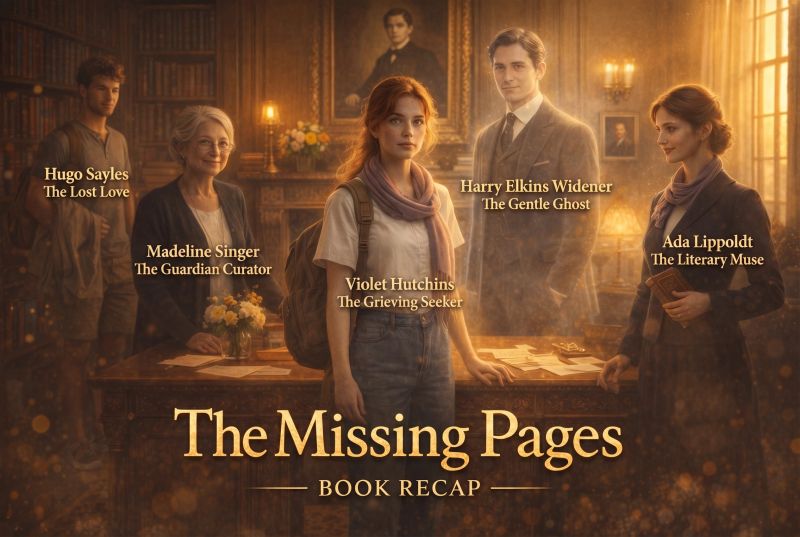
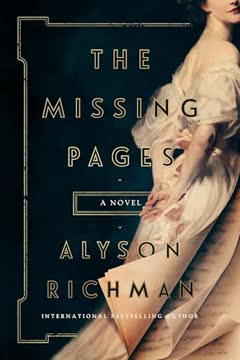
Plot Summary
Prologue
Harry Elkins Widener2 speaks from the afterlife. At twenty-seven, he drowned aboard the Titanic in 1912 — legend says he returned to his cabin for a priceless book. Tour guides at the Harvard library bearing his name embellish this story for wide-eyed prospective students, but Harry2 doesn't mind. His mother Eleanor6 built the library as a monument to grief, reconstructing his Philadelphia study as its central room.
His oil portrait hangs above the mantel. Fresh flowers appear on his desk each week, as Eleanor6 requested, to create the sensation he might walk in at any moment and begin to read. This is where his ghost waits — not for scholars or tourists, but for one particular person he has been expecting for a very long time.
Grief Walks Into Widener
In the fall of 1992, Violet Hutchins1 — a Harvard junior from a working-class Philadelphia family — can barely get out of bed. Her boyfriend Hugo7 drowned in a diving accident that summer, and she watched his body pulled from the water.
Raised alongside a book-loving grandmother named Helen10 who was adopted as an infant and never learned her origins, Violet1 has always found comfort in reading. She takes a part-time job as a library page at Widener, where curator Madeline Singer5 assigns her to transcribe letters between Harry Widener2 and bookseller Rosenbach,8 and to order weekly flowers for Harry's2 Memorial Room desk — a tradition Eleanor Widener6 established after the Titanic. Reading his 1911 correspondence, Violet1 encounters the name Ada Lippoldt,3 Quaritch's9 assistant in London. Something about it snags her attention.
Smoke Without Fire
While studying in Widener's reading room, Violet1 detects the rich aroma of pipe tobacco — vanilla, oak, bourbon — drifting through the air. No one else notices. The scent follows her to the Memorial Room, growing stronger near Harry's2 portrait.
Days later, a gilded laurel leaf detaches from the carved frame around the painting and falls at her feet with no vibration or impact to explain it. Madeline5 half-jokes that Harry's2 ghost might be trying to get her attention.
Then in the stacks, a book falls at Violet's1 feet: W.T. Stead's writings on life after death. Stead perished on the Titanic alongside Harry.2 When the book drops a second time, open to a passage about spirits making themselves known, Violet1 whispers Harry's2 name and asks if he is there.
The Martha Washington Dinner
Harry's2 ghost narrates the beginning of his love story. In early 1912, Ada Lippoldt3 wrote to him offering to curate rare books for his London visit. Her description of books as having souls captivated him.
When she traveled to New York on business, Harry2 raced from Philadelphia to meet her at Delmonico's — but a horse-cart accident trapped his train for two hours. He arrived to find her gone, then tracked her to the Martha Washington Hotel, a women-only establishment. Ada3 was waiting in the lobby with a book, unsurprised by his lateness.
Over dinner surrounded by suffragettes and independent women, Harry2 discovered someone who matched his passion for language and literature. They played a favorite-word game — his was celestial, hers phosphorescence — the first private spark between them.
Dearest Harry, Dearest Ada
After Ada3 returned to London, their letters shed formality like winter coats. She informed Harry2 that Quaritch9 possessed a rare 1598 miniature edition of Francis Bacon's Essays — the Little Bacon — small enough to cup in a gentleman's palm.
Harry2 was desperate to own it. He sent her a fairy-tale book he'd purchased from Rosenbach,8 tucking in a drawing of a steamer ship sprinkled with fairy stars. Their salutations evolved from stiff propriety to open affection — her letters eventually beginning with Dearest Harry.
He stored them in a lacquered box locked inside his bedroom armoire, hidden from his family. As their departure on March 13th approached, Harry2 could barely concentrate on reading. The trip to London was no longer principally about acquiring books.
Holland Park Kiss
At Quaritch's9 London shop, Ada3 presented the Little Bacon — a three-hundred-year-old marvel so small Harry2 slipped it into his breast pocket, vowing never to remove it. Together they visited elderly Emilie Barrington at Leighton House to negotiate a Rossetti poetry book Ada3 coveted for herself.
Ada3 offered eight pounds; Emilie wanted twelve. They left empty-handed. But walking through Holland Park afterward, Harry2 asked permission to kiss Ada3 beneath the budding cherry trees. She consented.
Later, Harry2 quietly returned to Emilie and persuaded her to sell at Ada's3 price without revealing his intervention. Meanwhile, Bernard Alfred Quaritch9 asked Harry2 to chaperone a bejeweled Rubaiyat across the Atlantic. Harry2 declined personally — but suggested Ada3 as courier, engineering her passage aboard the Titanic with him.
The Board Spells LOVE
Theo,4 Hugo's7 rowing friend who has remained kind to Violet1 throughout her grief, follows her into the Widener stacks with a Ouija board. She had tried it alone in her dorm without success — Harry's2 ghost explains he can only channel energy from within the library, his spiritual home. This time, with both their hands resting on the planchette, the triangle slides firmly to YES when Violet1 asks if Harry2 is present.
Neither of them pushed it. When she asks why he is contacting her, the planchette darts across the alphabet: L-O-V-E. Theo4 goes from humoring Violet1 to genuinely shaken. Violet1 tells him this confirms her suspicion — Harry2 experienced a love story no one has ever uncovered, and for some reason he has chosen her to find it.
The Floating Library
Harry2 boarded the Titanic in Southampton while his parents joined at Cherbourg. He met Ada3 in the ship's second-class library — a space where none of his parents' elite circle would venture. They composed spontaneous sonnets, riffing on a word game the Rossetti siblings invented as children.
Harry2 planned to introduce Ada3 to his parents over Monday dinner, knowing their different stations would complicate things. His mother6 was consumed with planning a grand party for Captain Smith on Sunday night.
Ada,3 meanwhile, dined with fellow passenger William Stead, the spiritualist whose writings about death had already fallen at Violet's1 feet decades later in the Widener stacks. Each night Harry2 slipped away from cigars with his father to find Ada3 reading in the library, their private floating world shrinking toward a horizon neither could see.
He Went Back for Her
On Sunday night, after his mother's6 party, Harry2 visited Ada's3 cabin. They were intimate for the first time. Near midnight, the ship struck an iceberg. Harry2 rushed to his parents and helped his terrified mother into lifeboat 4. She pleaded with him to follow.
He told her he was going back for a book. He went back for Ada.3 His father embraced him and said to find her. Harry2 discovered Ada3 on the listing stern, coatless, clutching a stranger's infant — she had given her coat to a third-class mother to help the woman pass as first class.
Harry2 carried the toddler to a collapsible raft, kissed Ada,3 draped his dinner jacket over her shoulders, and lifted her aboard. The Little Bacon rode in its breast pocket against her heart. Minutes later, the Atlantic swallowed him.
Ada and the Starling Key
In a second Ouija session, the planchette spells A-D-A when Violet1 asks for the name of Harry's2 love. But when she requests a surname, it slides to NO. Asked where to learn more, it spells K-E-Y. Violet's1 mind leaps to the mysterious second key she noticed weeks earlier in Harry's2 desk drawer — an ornate key with two kissing starlings forged at its bow.
Pete from Lamont Library had used the smaller companion key to wind Harry's2 crystal inkwell clock, but neither he nor anyone on staff ever identified what the starling key unlocked. Violet1 shows Theo4 the key through the Memorial Room's threshold. She suspects it opens something deeply personal to Harry2 — something connecting to Ada3 and to the word his ghost first communicated: love.
The Unread Letter
Ada3 survived the collapsible raft and was rescued by the Carpathia. Weeks later in New York, she realized she was pregnant. She extended her American stay, cultivated female book collectors on advice from Belle da Costa Greene, and began working for Rosenbach8 in Philadelphia.
When Rosenbach8 brought her to visit Eleanor6 at Lynnewood Hall to discuss completing Harry's2 library, Eleanor6 grew suspicious that Ada3 might have been the companion Harry2 wanted to introduce aboard the ship. Pained by reminders of the life her son would never live, Eleanor6 forbade Ada3 from returning.
Desperate, Ada3 mailed a letter revealing her pregnancy and asking for mercy. Eleanor6 threw the sealed envelope in the trash. Her maid Amalie11 retrieved it and locked it inside Harry's2 bedroom armoire — in the drawer secured by the starling key.
Elizabeth Hawkins Is Born
Rosenbach8 fired Ada3 for contacting Eleanor6 — never knowing the letter's true contents. Penniless, with no family in America and no recourse as an unwed mother, Ada3 entered St. Anne's Home.
She gave birth to a daughter she named Elizabeth Hawkins: Elizabeth for Rossetti's muse Elizabeth Siddal, Hawkins for Jim Hawkins of Harry's2 beloved Treasure Island. She inscribed her tiny bird-and-initials doodle inside the fairy book Harry2 had given her and asked the nuns to include it with the baby.
The infant was adopted through St. Joseph's Orphan Asylum, renamed Helen10 by her new parents, and raised with no knowledge of her origins. Only one artifact traveled with her into that new life — a faded fairy-tale book whose secret marking its owner would never decode.
Lux Names Amalie
Madeline5 suspends Violet1 from her page work after another act of book vandalism and whispered rumors from her suitemates about Violet's1 ghost fixation. Over Thanksgiving break, Theo4 arranges for Violet1 to meet Lux,15 a psychic his mother trusts.
They bring a tin of Harry's2 custom tobacco blend — oak, vanilla, bourbon — recreated from original Leavitt & Peirce ledgers that recorded his student purchases. Lux15 detects two water-related deaths surrounding Violet:1 Hugo,7 who has not fully crossed over, and Harry,2 whose presence burns fiercely.
She says Harry2 wants Violet1 to visit his home and bring a specific key. Then Lux15 offers one final name: Amalie.11 Neither Violet1 nor Theo4 knows who she is, but they begin planning a winter-break trip to Lynnewood Hall.
The Starlings Unlock
At Lynnewood Hall — now a run-down seminary — Violet1 and Theo4 try the copied starling key in room after room without success. In Harry's2 old bedroom, Violet1 spots two carved birds on the armoire's crest: starlings. Its bottom drawer has a keyhole at the center.
She inserts the key. The lock releases. Inside, beside yellowed dress shirts, rests a black lacquer box. They lift the lid and find Ada's3 sealed letter to Eleanor6 on top, with Harry's2 collection of Ada's3 personal letters beneath. Violet1 reads Ada's3 desperate pregnancy revelation.
Then Theo4 notices something critical — Ada3 signed each letter with a tiny bird doodle and the initials A.L., identical to the marking inside Violet's1 grandmother Helen's10 fairy-tale book, the one possession Helen10 carried from the orphanage.
Jim Hawkins on the Certificate
They drive straight to St. Joseph's, the former orphanage where Violet's1 grandmother was adopted. In the basement archives, a nun produces records for a girl born January 5, 1913.
The original birth certificate lists the mother as Ada Lippoldt3 and the father as Jim Hawkins — the hero of Treasure Island, the book Harry2 loved most since boyhood, the one he kept in his desk's secret compartment. Ada3 had encoded Harry's2 identity where only a fellow book lover could recognize it.
Violet's1 grandmother Helen10 was Harry2 and Ada's3 daughter, given up because Ada3 had no resources and an unread letter sitting in a locked armoire. Harry's2 ghost chose Violet1 because she is his great-granddaughter. The word he spelled on the board — love — was not metaphor. It was lineage.
A Murmur of Starlings
Back at Harvard, the book slasher has been caught — the night janitor Mr. Berns, who once reprimanded Violet1 for sitting at Harry's2 desk. Vindicated, she returns to the Memorial Room with Theo.4
At the desk, she runs her fingernail along the left panel until a hidden compartment slides open — the secret drawer Harry2 once described to Ada.3 Inside lies a worn childhood copy of Treasure Island and, beside it, a second far smaller volume: the Little Bacon. As Violet1 lifts both books, the scent of Harry's2 tobacco saturates the air.
Outside the window, hundreds of starlings rise and plunge in synchronized flight — a murmuration, the word Hugo7 once taught her on the banks of the Charles. Violet1 grips Theo's4 hand. The birds are unmistakable. A message of love that persists beyond death.
Epilogue
In 1962, Ada Lippoldt3 — now over seventy, white-haired, a published scholar of Pre-Raphaelite poetry — returns to America for the first time since she gave up her daughter. She visits the former site of St. Anne's Home, then climbs the steps of Harvard's Widener Library.
Inside the Memorial Room, she ducks past the rope, finds the secret drawer in Harry's2 desk exactly where he described it decades earlier, and places the Little Bacon beside his childhood copy of Treasure Island. She had carried the miniature book since the night Harry2 draped his dinner jacket over her shoulders on the sinking ship.
A security guard tells her visitors are not allowed inside. She takes one last look at Harry's2 portrait — forever twenty-seven — and walks away, having returned a piece of his heart to the room his mother6 built to hold it.
Analysis
The Missing Pages operates as a layered meditation on what survives death — not just souls, but stories, and who controls their telling. Eleanor Widener6 built an entire library as her version of Harry's2 narrative, yet the story she curated was radically incomplete, sanitized of the messy human love her son experienced with a woman she refused to acknowledge. Ada's3 unread letter is the novel's most devastating symbol: a life-altering truth that existed on paper but was never received, an envelope that could have rewritten the Widener legacy if one grieving woman had simply broken its seal.
Richman draws a sophisticated parallel between book collecting and love. Harry's2 library was never about accumulating expensive objects but about constructing an external self-portrait — each volume chosen for personal resonance rather than market prestige. His relationship with Ada3 follows identical logic: he recognizes her value the way a collector identifies a misattributed first edition, through intuition and deep attention rather than social credentials. Ada's3 working-class background renders her invisible to Eleanor's6 calculations, just as the Charlotte Smith novel Ada3 discovered in a bargain bin was invisible to other buyers.
The generational architecture is the novel's structural masterstroke. Violet's1 grief for Hugo7 mirrors Ada's3 for Harry,2 which mirrors Eleanor's6 for her son — yet each woman processes loss differently. Eleanor6 builds monuments, Ada3 surrenders what she loves most, and Violet1 investigates. The novel argues that investigation — the willingness to ask questions of the dead — is the most generative response to grief.
The ghost narrator device inverts the bereaved person's fantasy of one final conversation. Harry2 can orchestrate birdsong and topple laurel leaves but cannot speak a sentence to his mother or great-granddaughter. The dead, Richman suggests, are as desperate to reach us as we are to reach them. Communication requires both parties to listen, and grief often makes the living deaf to precisely the signals being sent.
Review Summary
The Missing Pages receives an overall 4.2/5 rating across 499 reviews. This dual-timeline historical fiction follows Harry Widener, who died on the Titanic, and Violet Hutchins, a 1990s Harvard student working in the library built in his memory. Readers praise the beautiful writing, compelling historical backdrop, and themes of grief, love, and books. Many found Harry's storyline more engaging than Violet's. Some criticized the dialogue as stilted, pacing issues, and historical inaccuracies. The paranormal elements and mystery divide readers. Most appreciate the emotional depth and literary references, though a few found it too sentimental.
People Also Read

 Immersive
 Immersive

 Immersive
 Immersive

Characters
Violet Hutchins
Grieving page turned detectiveA Harvard junior and library page navigating paralyzing grief after her boyfriend's7 drowning death. Raised in working-class Philadelphia with a grandmother10 who instilled her love of books, Violet carries chronic imposter syndrome among wealthy peers. She is intelligent and intuitive but socially withdrawn, channeling all emotional energy into her work at Widener. Her sensitivity to atmosphere and narrative subtext — a reader's instinct honed since childhood — makes her uniquely receptive to signals others would dismiss. Violet represents the intersection of grief and curiosity: her loss opens a door to questions about what persists after death, and her scholarly rigor compels her to follow the evidence. Through investigation, she transforms from a woman defined by what she has lost into one defined by what she discovers.
Harry Elkins Widener
Ghost narrator and bibliophileA privileged yet deeply soulful young man who died aboard the Titanic at twenty-seven and now narrates from the afterlife. Born into one of Philadelphia's wealthiest families, Harry rejected the superficial social life expected of him, finding his truest self among rare books. His collecting was never about prestige but about constructing an external self-portrait — each volume chosen for personal resonance over market value. Shy with women and awkward compared to his gregarious college roommate, Harry is unexpectedly cracked open by romantic love. As a ghost, he reveals patience cultivated over decades, deploying birds, tobacco scent, and falling objects to communicate. His narration balances wry humor with devastating tenderness — a man who found his voice only after losing his body.
Ada Lippoldt
Bookwoman who captures HarryA Cambridge-educated Englishwoman working at Quaritch's9 London bookshop, Ada is brilliant, self-possessed, and quietly revolutionary in a male-dominated field. Raised modestly after her father's death, she forged her career through talent and mentorship, particularly from Newnham College's librarian Katharine Stephen. Ada possesses the social courage Harry2 lacks, yet she is equally vulnerable to the forces of class and gender governing Edwardian society. She negotiates book prices with steely composure, quotes Dickinson with genuine feeling, and navigates a world that repeatedly underestimates her. Ada's deepest tension lies between the autonomous identity she has constructed and the sacrifices that love may demand in an era offering women almost no room for both independence and devotion.
Theo
Loyal ally and co-investigatorHugo's7 former rowing teammate who becomes Violet's1 steadfast companion in her investigation. Easygoing and affluent but genuinely empathetic, Theo carries his own quiet grief for Hugo7 while channeling it into looking after Violet1. His open-mindedness — partly inherited from a mother who visits psychics — makes him the rare peer who takes Violet's1 supernatural experiences seriously rather than dismissing them. He provides both practical help and emotional grounding.
Madeline Singer
Widener's devoted curatorThe head librarian and curator of the Widener Memorial Collection, researching Harry's2 book-buying relationships with scholarly passion. She serves as both Violet's1 mentor and institutional gatekeeper, introducing her to Harry's2 correspondence and the library's traditions while maintaining professional boundaries. Intellectually curious and warm but institutionally cautious, she must balance her own belief in Harry's2 lingering presence with administrative responsibilities when vandalism threatens the collection.
Eleanor Widener
Monument-builder in mourningHarry's2 mother, a formidable Philadelphia socialite whose adventurous spirit and fierce love for her son drive her to build Harvard's greatest library in his memory. Elegant and class-conscious, she channels catastrophic grief into architectural creation. Her inability to see past social propriety toward what her son truly valued creates consequences she never fully grasps, making her simultaneously the story's most powerful builder and its most consequential gatekeeper of truth.
Hugo
Violet's lost belovedViolet's1 deceased boyfriend, a Harvard rower who drowned in a diving accident the summer before the novel begins. Romantic, poetic, and comfortable in his privilege, Hugo adored Violet1 despite their class differences and introduced her to poetry, art, and the Pre-Raphaelites. He exists entirely in Violet's1 memories, embodying the love she must learn to carry rather than bury. His knowledge of starlings becomes an unexpected thread connecting past to present.
A.S.W. Rosenbach
Philadelphia's foremost book dealerThe famed bookseller who mentored young Harry2 in collecting and later employed Ada3 in Philadelphia. Scholarly, warm, and business-savvy, Rosenbach genuinely mourns Harry's2 death and initially welcomes Ada3 into his orbit. But his institutional loyalty to Eleanor Widener6 — his most important patron — ultimately forces a painful professional decision that transforms Ada's3 trajectory entirely.
Bernard Alfred Quaritch
London bookseller and matchmakerThe jovial London bookseller who sells Harry2 the Little Bacon and unwittingly facilitates the romance by employing Ada3 and arranging her Titanic passage as courier for the bejeweled Rubaiyat.
Grandma Helen
The missing link between erasViolet's1 maternal grandmother, adopted as an infant and raised without knowledge of her biological parents. A voracious reader who spent her life searching books for clues about why she was given up, she carried one artifact from the orphanage — a fairy-tale book.
Amalie
Eleanor's quietly decisive maidEleanor Widener's6 trusted lady's maid, loyal and quietly perceptive. Her small acts of independent judgment when handling correspondence carry enormous consequences for whether the truth survives.
Sylvia
Violet's grounded suitemateViolet's1 closest suitemate and the women's rowing coxswain, offering patient support without condescension. She serves as Violet's1 emotional anchor among peers who grow impatient with her grief.
Jenny
Insensitive gossip-spreading roommateViolet's1 blunt suitemate whose gossip about Violet's1 ghost talk and mental state contributes to social consequences that threaten Violet's1 library position.
Fanny
Ada's compassionate neighborAn Irish seamstress in Ada's3 Philadelphia boarding house who recognizes Ada's3 condition and offers hard-won guidance born from her own experience of surrendering a child.
Lux
Suburban psychic mediumA plainly dressed medium whose unassuming appearance belies genuine ability. She provides Violet1 with the critical name and directive that redirect the entire investigation toward Lynnewood Hall.
Plot Devices
The Little Bacon
Love's physical vesselA miniature 1598 edition of Francis Bacon's Essays, small enough to fit in a gentleman's palm, serves as the novel's central artifact. Harry2 purchases it from Quaritch's9 London shop and carries it in his breast pocket, vowing never to remove it. The book connects Harry2 and Ada3 through their shared appreciation of Bacon's famous observations about reading. On the Titanic's final night, Harry2 unknowingly passes it to Ada3 inside his dinner jacket when he gives her his coat before lifting her onto the lifeboat. The Little Bacon thus becomes the physical embodiment of their love — carried against one heart, then transferred to another, then hidden for decades, and ultimately discovered in Harry's2 secret desk drawer, completing a circle across eighty years.
The Starling Key
Lock guarding the buried truthAn ornate key stored in Harry's2 desk alongside his inkwell winding key, distinguished by two kissing starlings forged at its bow. No one at Harvard — not curators, staff, nor even Eleanor Widener6 herself — ever identified what it opened. Harry's2 ghost directs Violet1 toward the key through the Ouija board. It unlocks the bottom drawer of a bird-carved armoire in Harry's2 bedroom at Lynnewood Hall, where his maid Amalie11 secretly hid Ada's3 letters and the sealed pregnancy revelation Eleanor6 refused to read. The starlings symbolize communication and love — the same birds Hugo7 once taught Violet1 to recognize in murmuration above the Charles River, binding past and present through ornithology and devotion.
The Ouija Board
Bridge between living and deadViolet's1 instrument for communicating with Harry's2 ghost. It fails completely in her dorm room but works powerfully in the Widener stacks, because Harry2 can only channel energy from within his library — the single location where a ghost's spiritual powers concentrate. Through the board, Harry2 spells LOVE, ADA, and KEY across three sessions, providing the breadcrumbs that launch and sustain Violet's1 investigation. The device transforms the novel's supernatural premise into a detective-story structure, turning séance into research methodology. It also serves as a litmus test for trust — Theo's4 willingness to participate despite skepticism deepens his bond with Violet1.
The Weekly Flowers
Ritual connecting grief to careEleanor Widener's6 standing order for fresh flowers on Harry's2 Memorial Room desk, maintained continuously since the library opened in 1915. The tradition creates the illusion that Harry2 might walk in at any moment and sit down to read. For Violet1, inheriting the weekly flower order from Madeline5 becomes her most personal connection to Harry's2 legacy and her entry point into his world. The flowers also introduce her to Lottie, the elderly florist whose family has supplied the arrangements for generations, extending the chain of caretakers across the twentieth century. The ritual embodies Eleanor's6 belief that love can be expressed through sustained, quiet acts of devotion rather than grand gestures.
The Fairy Book
Generational thread across adoptionsA children's fairy-tale book Harry2 purchased from Rosenbach8 as a gift for Ada3, featuring colorful etchings of sprites and garden insects. Ada3 inscribed her signature bird doodle and initials inside its cover before asking the nuns at St. Anne's Home to include it with her baby. It becomes the only artifact connecting Ada3 to her daughter10, traveling with the infant into adoption. Renamed Helen10, the child grows up treasuring the book without understanding its origin. When Theo4 notices the bird-and-initials marking matches Ada's3 letter signatures decades later, the fairy book becomes the critical visual evidence linking Violet's1 grandmother to Harry2 and Ada's3 love story.








































