Key Takeaways
1. Mental illness is a metaphor, not a literal medical disease
If we accept this scientific definition of disease, then it follows that mental illness is a metaphor, and that asserting that view is asserting an analytic truth, not subject to empirical falsification.
The metaphorical nature of illness. Szasz argues that literal disease requires a demonstrable physical lesion or physiological malfunction of the body. Because the "mind" is not a physical organ, it cannot host a literal disease; therefore, calling a psychological or behavioral problem an "illness" is a category error.
Linguistic confusion. The medical profession has conflated physical pathology with behavioral deviance, treating metaphorical sickness as a literal bodily defect. This confusion obscures the true nature of human struggles, which are ethical and social rather than biological.
- Physical disease: Alteration of cells, tissues, and organs.
- Mental illness: A metaphorical label for disapproved behaviors.
- Category error: Treating a mind as if it were a brain.
The search for brain lesions. While some behaviors may eventually be traced to neurological disorders, discovering a physical cause simply reclassifies the condition from psychopathology to neuropathology. The remaining "mental illnesses" are not diseases but expressions of human conflict and problems in living.
2. The medicalization of behavior serves as a tool for social control
Political power and professional self-interest unite in turning a false belief into a 'lying fact.'
Social control disguised as medicine. By defining socially disruptive or non-conforming behaviors as medical conditions, society can manage deviants without resorting to the explicit mechanisms of the criminal justice system. This medicalization allows the state to enforce conformity under the benevolent guise of providing healthcare.
The role of the psychiatrist. Psychiatrists often act as agents of social stability rather than as pure healers, using their medical authority to police behavior. This dual role creates a conflict of interest where the practitioner serves the state or the family rather than the individual patient.
- Medicalization: Reclassifying moral or social deviance as sickness.
- Double standard: Publicly claiming organic etiology while privately managing social conflicts.
- Institutional power: Using medical prestige to enforce state-sanctioned conformity.
The erosion of responsibility. When bad behavior is labeled as an illness, the individual is stripped of moral agency and personal responsibility. This shift transforms moral choices into involuntary symptoms, weakening the ethical foundations of a free society.
3. Hysteria is a protolanguage used to communicate distress
The manifest diversity among mental illnesses—for example, the differences between hysteria, depression, paranoia, schizophrenia, and so forth—may be regarded as analogous to the manifest diversity among languages.
Communication through symptoms. Szasz reinterprets conversion hysteria not as a mysterious physical reaction to mental conflict, but as a nonverbal form of communication. When individuals lack the power or vocabulary to express their distress directly, they resort to the "language of illness" to make their needs known.
The structure of body signs. Hysterical symptoms function as iconic signs that mimic physical illness to convey a message of helplessness. This protolanguage is highly effective at eliciting sympathy and care from others while shielding the speaker from the consequences of direct communication.
- Protolanguage: A primitive, nonverbal system of communication using bodily signs.
- Iconic signs: Symptoms that resemble physical illness to convey meaning.
- Indirect communication: Expressing forbidden or embarrassing needs without taking direct responsibility.
The challenge of translation. Because these symptoms are presentational rather than discursive, they cannot be easily translated into ordinary speech. The task of the therapist is not to "cure" a disease, but to help the patient translate this body language into direct, verbal communication.
4. Human behavior is governed by rule-following and game-playing models
In this book I shall view psychiatry, as a theoretical science, as consisting of the study of personal conduct.
The game-playing model. Human social interactions can be understood as games characterized by specific roles, rules, and payoffs. Instead of being driven by blind biological forces, individuals actively choose strategies within these games to navigate their social environments.
Rules and personal conduct. Personal conduct is always structured by rules that are either learned from parents, imposed by society, or adopted through personal choice. Understanding a person's behavior requires identifying the specific game they are playing and the rules they are following.
- Object games: Basic biological survival and tension-release activities.
- Metagames: Socially constructed games that regulate interpersonal behavior.
- Rule-following: The conscious or unconscious adherence to behavioral norms.
The conflict of games. Psychological distress often arises when a person is caught between conflicting games or is forced to play a game whose rules they do not accept. Therapy provides an opportunity to analyze these games and help the individual choose more satisfying rules of conduct.
5. The ethics of helplessness rewards disability over autonomy
Blessed are the meek: for they shall inherit the earth.
The power of weakness. Western religious and social traditions have long maintained rules that reward helplessness, sickness, and dependency while penalizing self-reliance. By displaying disability, the weak can coerce the strong into providing care, turning helplessness into a powerful interpersonal strategy.
Paternalism and therapeutism. This ethic of helpfulness creates a transactional loop where the patient's claim of illness obligates the physician to provide care. This paternalistic arrangement infantilizes the patient, encouraging them to remain disabled to secure social and emotional rewards.
- Coercion by disability: Using symptoms to force others to meet one's needs.
- Paternalism: Treating adults as helpless children in need of medical guardianship.
- Rule reversal: Codifying weakness and dependency as moral virtues.
The cost of dependency. While the strategy of helplessness provides immediate security, it prevents the individual from achieving genuine autonomy and competence. A truly therapeutic relationship must reject this paternalistic contract and encourage the patient to assume full responsibility for their life.
6. Psychiatric diagnoses are stigmatizing labels rather than objective medical facts
Pathologists use a variety of molecular, microbiologic, and immunologic techniques to understand the biochemical, structural, and functional changes that occur in cells, tissues, and organs.
Diagnoses as social judgments. Unlike medical diagnoses, which are based on objective physical tests, psychiatric diagnoses are subjective labels applied to behaviors that violate social norms. These labels serve to stigmatize the individual and justify social exclusion or forced treatment.
The fiat standard of disease. The psychiatric classification system is not a map of natural phenomena but a collection of social and political consensus decisions. Diagnoses are created, modified, or discarded based on changing cultural values and professional interests rather than scientific discovery.
- Pathology-driven diagnosis: Based on demonstrable physical lesions or causes.
- Fiat-driven diagnosis: Based on social consensus and behavioral disapproval.
- Stigmatization: Using medical-sounding terms to marginalize non-conforming individuals.
The illusion of objectivity. By dressing social judgments in the language of medicine, psychiatry creates an illusion of scientific objectivity. This practice protects the profession from moral scrutiny and allows society to avoid facing the ethical conflicts underlying behavioral deviance.
7. Involuntary psychiatric interventions are coercive violations of human rights
I am not aware of any antipsychiatrist who has agreed with this principle or abided by this limitation.
Coercion disguised as care. Szasz argues that involuntary mental hospitalization is a form of imprisonment, not medical treatment, and that coercive psychiatrists function as jailers rather than healers. Depriving individuals of their liberty based on a metaphorical disease is a grave violation of fundamental human rights.
The crime of psychiatric slavery. When the state partners with psychiatry to enforce involuntary treatment, it bypasses the constitutional protections of the criminal justice system. This arrangement creates a system of "psychiatric slavery" where individuals are detained without having committed a crime.
- Civil commitment: Involuntary imprisonment disguised as medical hospitalization.
- Insanity defense: An excuse that deprives the individual of moral agency and legal responsibility.
- Coercive psychiatry: The use of state power to force treatment on non-consenting adults.
The necessity of consent. Any ethical therapeutic relationship must be based strictly on the mutual consent of the participants. Involuntary interventions must be abolished, and individuals who break the law must be held responsible and dealt with through the legal system, not the medical system.
8. The therapeutic state replaces theological tyranny with medical tyranny
Formerly, when Church and State were allied, people accepted theological justifications for state-sanctioned coercion.
The rise of the therapeutic state. Just as medieval society used theological concepts to justify the persecution of witches and heretics, modern society uses medical concepts to justify the control of social deviants. The therapeutic state has replaced the church as the primary institution of social control, using "health" as its supreme value.
The medicalization of the soul. This alliance between medicine and the state has led to the medicalization of all human suffering and conflict. By defining personal and moral struggles as public health issues, the state expands its authority to regulate almost every aspect of personal conduct.
- Theological state: Coercion justified by religious salvation and the soul.
- Therapeutic state: Coercion justified by medical health and the mind.
- Medical tyranny: The state-sanctioned monopoly over defining and treating behavior.
The threat to liberty. When the state is empowered to define what constitutes a healthy mind and a healthy lifestyle, individual liberty is placed in grave danger. To preserve freedom, we must separate medicine from the state, just as we previously separated church from state.
9. True psychotherapy is an educational dialogue, not a medical treatment
The actual behavior of a particular psychiatrist may thus be that of a physician, psychologist, psychoanalyst, policeman, clergyman, historian, literary critic, friend, counselor, or teacher...
Psychotherapy as education. Szasz contends that genuine psychotherapy is not a medical treatment for a disease, but a confidential, educational conversation between consenting adults. Its purpose is to help the client understand the rules of the games they are playing and to expand their choices in life.
The therapeutic contract. An ethical psychotherapeutic relationship must be strictly confidential and free from any threat of coercion. The therapist acts as the client's agent, helping them analyze their communications and assume responsibility for their own conduct.
- Educational dialogue: Analyzing personal conduct and communication rather than treating disease.
- Autonomy: Helping the client make conscious, responsible choices in their life.
- Confidentiality: A strict two-person contract free from third-party or state interference.
The goal of self-mastery. Rather than aiming for a medical "cure," true psychotherapy aims for self-mastery and personal growth. By learning to communicate directly and honestly, the individual can abandon the coercive strategies of illness and live a more autonomous life.
Review Summary
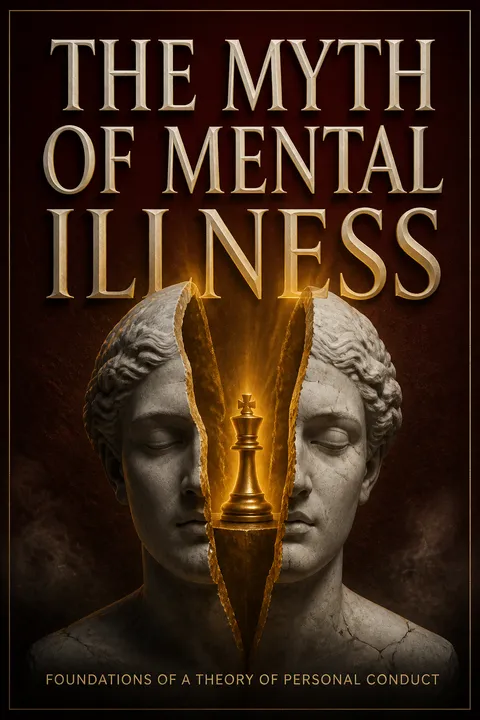
Reviews of The Myth of Mental Illness are deeply divided. Supporters praise Szasz's bold challenge to psychiatric authority, celebrating his argument that "mental illness" is a metaphor rather than a genuine medical condition. Critics, however, find his thesis dangerously oversimplified, noting he largely ignores severe conditions like schizophrenia, addiction, and psychosis. Many acknowledge valid criticisms of psychiatry's medicalization of human behavior while rejecting his absolutist stance. Personal experiences with mental illness frequently color negative reviews, with some readers finding his ideas invalidating and potentially harmful to vulnerable individuals.
People Also Read








Download PDF
Download EPUB
.epub digital book format is ideal for reading ebooks on phones, tablets, and e-readers.








































