Key Takeaways
1. The Cola Wars: A Relentless Battle for Dominance
By comparison, of course, the battles that Pepsi-Cola and Coke fight in the Cola Wars are trivial. There are no final defeats. The ammunition we fire at one another is often damn silly stuff.
Intense rivalry. The competition between Pepsi and Coke is a high-stakes, continuous battle for market share and consumer loyalty, involving billions of dollars and immense corporate pride. Despite the seemingly trivial nature of soft drinks, the "Cola Wars" are fought with the intensity of real warfare, where every move by one company elicits a response from the other. This constant back-and-forth fuels innovation and keeps both brands on their toes.
Historical context. For decades, Coke held an unassailable lead, often ignoring Pepsi. Pepsi, however, consistently chipped away at Coke's dominance through aggressive marketing and product innovation. This long history of competition meant that by the 1980s, Pepsi was no longer a distant third but a formidable challenger, forcing Coke to react in ways it never had before.
Mutual benefit. Paradoxically, the rivalry benefits both companies by swelling the overall soft drink market. Consumer interest in the Pepsi-Coke competition often leads to increased sales for all brands, as the public is captivated by the ongoing drama. The key is to keep the "warfare" fun and engaging, ensuring neither side appears to be on the ropes, maintaining public curiosity about "what Coke will do tomorrow?"
2. Leadership: A Bold Vision and Calculated Risks
The most successful executives don't follow narrow career paths, carefully laid-out steppingstones to the top. More often, they've allowed themselves the opportunity to learn and grow in a more natural—even if seemingly haphazard—fashion.
Embracing risk. Roger Enrico's presidency at Pepsi USA was defined by a willingness to take massive, calculated risks, often against conventional wisdom. From signing Michael Jackson for an unprecedented $5 million to pushing for new product launches like Slice, Enrico believed that bold moves were essential to accelerate growth and challenge Coke's entrenched position. He learned early on that "being in business is all about being a leader, whether your title says you are or not."
Point of view. Enrico emphasized that leadership fundamentally requires a clear point of view and the courage to articulate it, even when it means challenging established norms or superiors. His early experiences, from the Navy to Frito-Lay, taught him the importance of digging deep for facts and then acting decisively. This conviction allowed him to push through initiatives like the "Pepsi Now" campaign despite initial agency and internal skepticism.
Strategic ambition. Enrico set an audacious goal for Pepsi USA: to double its business in the 1980s, a target he believed was achievable through aggressive innovation and market expansion. He instilled a culture where employees were encouraged to think creatively, challenge assumptions, and pursue "leadership marketing" events that captivated consumer imagination and drove significant business results.
3. The Power of Imagery: Selling Emotion, Not Just Taste
Imagery is how we define ourselves—and then how we present ourselves to you. After making sure that our products are as good as we know how to make them, sharpening our image is the most important thing we do.
Beyond taste. While taste superiority was a cornerstone of Pepsi's strategy (e.g., the Pepsi Challenge), Enrico recognized that emotional connection and brand imagery were paramount in the soft drink industry. Distinctions between carbonated flavored waters are not always universally appreciated, making a distinct and appealing image crucial for success.
The "Pepsi Generation." For two decades, Pepsi successfully positioned itself as the "leading edge" soft drink, appealing to forward-looking, curious individuals through its "Pepsi Generation" campaign. This strategy boxed Coke into an image of nostalgia and tradition, which, while appealing to some, was "deadly in the soft drink business if that's your dominant image."
Celebrity endorsements. The signing of Michael Jackson for $5 million was a prime example of leadership marketing, transforming Pepsi's image and generating immense publicity. It wasn't just about the commercials; it was about merging Pepsi's identity with Michael's magic, creating a "pure Hollywood moment" that resonated deeply with consumers and drove sales. Subsequent endorsements with Lionel Richie and others reinforced this strategy.
4. Innovation: The Engine of Growth and Competitive Advantage
There are no old brands—only old marketers who are unable to breathe new life into the products they're supposed to market.
Constant evolution. Enrico believed that the soft drink market would grow as fast as companies offered new ideas and products. Pepsi's strategy was to be first to market with innovative products, keeping competitors guessing. This led to the rapid development and launch of several successful brands:
- Pepsi Free: A caffeine-free cola, launched to capitalize on a growing market segment and blunt 7-Up's "Like" cola.
- Slice: A 10% juice-added lemon-lime soda, which created an entirely new product category and became a $500 million business in its first year.
- 3-liter bottle: A packaging innovation that offered consumers cost savings and convenience, taking the market by storm.
Challenging R&D. Enrico pushed his R&D team to overcome technical hurdles, such as controlling the quality of juice-added sodas, by threatening to hire outside consultants. This aggressive approach ensured that product development aligned with market opportunities, even when internal resistance was high.
Strategic pricing. For new products like Slice, Pepsi deliberately accepted lower profit margins per case to gain market share quickly. This strategy aimed to establish the brand before competitors could react, betting on high volume to offset lower per-unit profits and expand the overall market.
5. Empowering Partners: The Bottler Network
Bottlers don't have some temporary right to distribute Pepsi. They own their territories. They also own their bottling plants and their route trucks and their vending machines.
Crucial partnership. Pepsi's 208 independent franchise bottlers are not mere distributors; they are owners who make significant capital investments in their businesses. Their commitment and enthusiasm are vital for Pepsi's success, as they are responsible for local distribution, merchandising, and sales. Enrico understood that "our job is to sell Pepsi—Pepsi concentrate and Pepsi marketing—to them."
Building trust. Enrico's early challenge with bottlers over a concentrate price increase highlighted the need for trust and responsiveness. By delaying the price hike for six months, he demonstrated that Pepsi USA cared about their concerns, fostering a spirit of cooperative partnership essential for taking the business to "new heights."
Shared vision. Bottlers were actively involved in shaping Pepsi's strategies, offering ideas for new products, aggressive marketing, and expanded distribution. Their "strong proprietary attitude" meant they were deeply invested in the company's success, and when they believed in Pepsi's direction, they executed with "great enthusiasm and, usually, terrific results."
6. Coke's Blunder: Abandoning a Legacy for a "New" Taste
For Merchandise 7X was not just a mixture of sugar and flavoring—it was an alchemical concoction. And the soft drink it produced was not just a thirst-quencher. It was the one unchanging taste in a world that changed more rapidly than anyone would have wished.
Sacrosanct formula. For 99 years, Coca-Cola's formula, "Merchandise 7X," was a closely guarded secret and a symbol of American tradition and constancy. Robert Woodruff, Coke's patriarch, fiercely protected it, even pulling Coke out of India rather than disclosing the formula. This made the decision to change it in 1985 an almost unthinkable act.
Misguided research. Coke's executives claimed extensive taste tests showed consumers preferred "New Coke." However, these tests were flawed:
- They were "one-sip" tests, not extended home-use tests.
- Consumers were never told that choosing "New Coke" meant killing "Old Coke."
- The research focused on taste preference, ignoring the deep emotional attachment consumers had to the original brand.
Ignoring emotional connection. Coke's management, driven by a desire to reverse declining market share and beat Pepsi in taste tests, overlooked the profound emotional and nostalgic connection millions of Americans had to "Old Coke." This oversight led to a massive public outcry, demonstrating that for a brand like Coke, identity and heritage were more important than a slightly sweeter taste.
7. Seizing the Moment: Pepsi's Swift Response to New Coke
After 87 years of going at it eyeball to eyeball, the other guy just blinked.
Declaring victory. Upon learning of Coke's formula change, Pepsi immediately declared victory with a full-page newspaper ad stating, "After 87 years of going at it eyeball to eyeball, the other guy just blinked." This bold, preemptive strike framed Coke's move as an admission of defeat, not an innovation, and set the narrative for the ensuing "180 Days War."
Aggressive counter-marketing. Pepsi launched a multi-pronged offensive to capitalize on Coke's vulnerability:
- Sympathetic advertising: New commercials, like the "teenage girl" and "Wilbur" spots, expressed sympathy for loyal Coke drinkers betrayed by the change.
- Increased visibility: An $8 million fund (matched by bottlers) boosted in-store merchandising and displays.
- Purchase incentives: A $6 million investment in coupons offered trial incentives for Coke drinkers and refunds for loyal Pepsi customers.
"Savannah Cola" gambit. Enrico even ordered Pepsi's R&D lab to recreate "Merchandise 7X" (dubbed "Savannah Cola"), planning to launch it if Coke refused to bring back its original formula. This audacious move, though never executed, underscored Pepsi's readiness to fill the void left by Coke's perceived betrayal and further pressure its rival.
8. The Underdog Mentality: Agility and Irreverence Win
We love being the scrappy underdogs in the industry—and we couldn't be if the boys in Atlanta threw in the towel.
Challenger mindset. Pepsi consistently embraced its role as the underdog, using agility, speed, and irreverence to challenge Coke's long-held supremacy. This mentality fostered a culture of risk-taking and innovation, allowing Pepsi to react faster and more creatively than its larger rival.
Exploiting weaknesses. Pepsi skillfully exploited Coke's perceived arrogance and corporate stodginess. The "other guy blinked" campaign, the "Archeology" commercial (depicting the old Coke bottle as a relic), and the playful jabs at Coke's "megabrand" concept all served to highlight Coke's missteps and reinforce Pepsi's image as the dynamic, consumer-focused choice.
Humor and self-awareness. Pepsi's ability to inject humor into the Cola Wars, even at its own expense, resonated with the public. Enrico's candidness about the Michael Jackson deal's cost or the "Eddie Murphy" idea demonstrated a refreshing lack of corporate pretense, contrasting sharply with Coke's often defensive and humorless responses. This approach made Pepsi more relatable and endearing to consumers.
9. Mentorship: Cultivating Future Leaders
You're there to learn. And the people above you and around you are there to teach.
Learning from experience. Enrico's career path, though seemingly haphazard, was a continuous learning experience shaped by influential mentors. From Lieutenant Commander Bill Aldenderfer in Vietnam, who taught him to "take chances, and to get the job done—no matter what," to Steve Chase at General Mills, who brought him into marketing, these individuals provided invaluable lessons.
Kendall's coaching. Don Kendall, PepsiCo's chairman, became Enrico's most significant mentor, offering guidance not just on business but on life, arts, and global affairs. Kendall's approach was supportive yet challenging, encouraging Enrico to "do big things to keep the image of the product out there" and fostering a sense of trust and direct communication.
Empowering teams. Enrico, in turn, sought to empower his own team, recognizing that "people, even the best professionals in the business, look for leadership. And the essence of all leadership is a point of view." He assembled a strong management team, giving them autonomy and encouraging them to champion ideas, even when it meant challenging his own initial skepticism, as seen with Dan Clark's persistence on 100% aspartame.
10. Mastering the Media: Controlling the Narrative
The press loves the Cola Wars too much for that—loves calling Pepsi for a reaction to the latest Coke move, loves telling Coke what the people at Pepsi just said. All this makes for exceptionally well-balanced coverage—and for lively reading.
Strategic communication. Pepsi understood that in the Cola Wars, controlling the narrative was as crucial as product quality or advertising spend. They actively engaged the media, providing compelling stories and soundbites that shaped public perception, often turning Coke's announcements into opportunities for Pepsi.
Leveraging events. Pepsi masterfully used events like the Michael Jackson signing and the Grammy Awards premiere to generate massive, free publicity. They also strategically leaked information or made timely announcements (e.g., the 100% aspartame launch) to preempt Coke or amplify their own message, ensuring they were always part of the breaking news cycle.
Transparency and humor. While Coke often appeared defensive and evasive, Pepsi adopted a more transparent and humorous approach. Enrico's willingness to engage with reporters, even with self-deprecating humor, made Pepsi seem more authentic and relatable. This contrasted sharply with Coke's "smoke and mirrors" tactics, which ultimately damaged its credibility with both the public and the press.
Review Summary
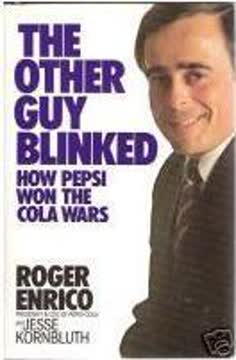
The Other Guy Blinked receives mixed reviews averaging 3.82 stars. Readers praise it as an entertaining marketing case study of Pepsi's 1980s competition with Coca-Cola, featuring Roger Enrico's leadership, the Pepsi Challenge, and celebrity campaigns with Michael Jackson. Many consider it excellent for understanding branding and imagery in commodity businesses. Critics appreciate its business insights about consumer psychology and corporate innovation. Some find Enrico's self-portrayal suspect, while others view it as required reading for marketing professionals. Spanish-language reviewers particularly enjoyed the nostalgic 1980s business narrative, though skeptics note Pepsi remains second to Coke.