
Plot Summary
Welcome to Boredom's Frontier
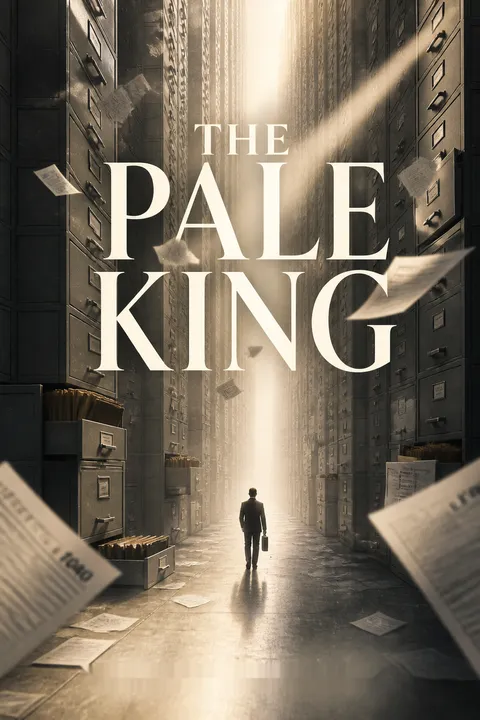
The Pale King thrusts us into the mundane—and transformative—world of an IRS Regional Examination Center, where ordinary people fight extraordinary battles against boredom. The sprawling complex in Peoria, Illinois, is more than just an administrative hub; it is a crucible in which the essential nature of modern life is examined. Amid piles of forms and shifting stacks of returns, men and women wrangle with mathematics and meaning in equal measure. Their labor is heroic not in the conventional sense, but as acts of endurance against psychic erosion, toneless routine, and the subtle terror of having one's days consumed by trivia. The narrative is deliberate, fragmented, and self-conscious—a world where even the author's promises of truth spiral into paradox. Bureaucracy is revealed as not only a system but an existential condition.
The Flight to Peoria
The book follows Claude Sylvanshine, a timid auditor, as he journeys by rickety plane from the East to Peoria. His anxious mind flits between technical tax law and intrusive, irrelevant facts—a symptom of his overwhelming thought patterns. On the plane, Sylvanshine compulsively reviews IRS study material and obsesses over CPA exam failure while enduring a queasy, turbulent ride. This liminal flight heralds the arrival into a place thick with heat, expectation, and self-doubt—a setting where the surface dullness masks deeper currents of meaning and dread. Peoria, seen through Sylvanshine's agitated lens, is not only a destination but a psychological terrain: a place where pressure, anxiety, and spectral failure meet.
Human Hearts, Inhuman Duties
The IRS Center's daily grind is revealed through vignettes and news clippings—most chillingly, the unnoticed death of an examiner who remained at his desk for four days. The routine of tax examination is portrayed as simultaneously numbing and fraught, with harried administrators and indifferent co-workers. Characters like Stecyk, pathologically eager to please, and others, who are worn thin by routine, highlight the necessary toughness and alienation the bureaucracy imposes on its inhabitants. These workers are bureaucratic functionaries and wounded souls, each struggling to maintain their humanity in a system that rarely notices their suffering—or their triumphs.
Invisible Men, Forgotten Women
The novel peeks behind the veneer of order, revealing the stories of the marginalized—outcasts, the ill, the pathologically helpful, and the doomed. We see these through the obsessive Stecyk, whose relentless cheer provokes loathing as much as gratitude, and through Toni Ware, a young woman whose survivalist cunning is forged in a landscape of trauma and neglect. Their stories resist mere quirk; rather, they interrogate how invisibility, utility, and difference play out in a society obsessed with order and compliance.
Stecyk's Pathological Virtue
Young Leonard Stecyk emerges as a disturbing, oddly sanctified figure: irrepressible, generous, and unceasingly "good," to the point that his virtue becomes its own sickness. Driven by the urge to help, Stecyk is universally despised despite his tireless efforts for those around him. His optimism and selflessness only serve to isolate him, inciting a mix of resentment, confusion, and guilt in those he tries to aid. Here, the novel deeply examines the paradoxical nature of goodness in a world that punishes rather than rewards such attempts at perfect virtue.
Choices in Sun and Shadow
The park bench conversation between Lane Dean Jr. and his girlfriend, Sheri—a centerpiece of the narrative—epitomizes the struggle to act in the face of ethical dilemmas. Caught in the inertia of indecision about an unplanned pregnancy and the possibility of abortion, Lane's contemplations swirl with guilt, love, and fear of hypocrisy. His sense of spiritual failure and longing for forgiveness is sharply depicted, yet the scene is unexpectedly suffused with grace. Through silence, tension, and love's ambiguous forms, the characters search for meaning and release, illuminated by fleeting but transformative moments of understanding.
Initiations and Incantations
The orientation of new IRS hires forms a modern rite of passage, featuring a host of odd, anxious newcomers—each bearing their secret shames and compulsions—herded through endless forms, personnel directives, and technical jargon. The process is not only administrative but existential: the act of being inducted into a system so vast and repetitive that one risks losing all sense of individuality. The narrative's emphasis on formality, acronym, and code brings into relief the strangeness and vulnerability of those entering a life defined by paperwork.
Complexities of Arrival
Arrival at the IRS Post is a trial by confusion—a bureaucratic minotaur's maze of intake stations, wrong lines, scrambled identities, and lost luggage. "David Wallace" is met with error and mistaken status, carted through the system as both insignificant and mysteriously important. The Center's physical and procedural design seems a parody of reason, yet is all too real in its endless obstacles, delays, and humiliations. Amid the chaos, sly humor and quiet kindness flicker, but the overwhelming impression is of a system that both dwarfs and baffles its human servants.
Boredom and the Modern Mind
The book relentlessly examines the theme of boredom—its physical symptoms, existential terror, and its potential as a crucible for self-discovery. From the tedium of "rote exams" to the psychic toll of relentless paperwork, characters develop rituals and compulsions (like Cusk's sweat-induced anxiety), confronting attention's limits and the mind's desperate attempts to escape monotony. Yet, as one narrative voice suggests, there is also the possibility of unearthing a kind of transcendence on the far side of boredom, a hard-won serenity found not in distraction but in endurance.
The Mythology of Paperwork
The IRS is more than an organization; it is a mythmaking machine, replete with its own arcana—codes, desk names, sacred forms, and initiation stories. Through sly metafiction, ghost stories (a man so unremarkable in death he haunts only as a "companionable" presence), and the secret language of examiners, the novel unveils the IRS as an institution with its own culture and folklore. Collective identity and meaning are constructed from the very tools of tedium that threaten to annihilate individuality.
Childhoods of Obsession
Braided through the adult world are stories of childhood obsession and pain—including the tale of a boy obsessed with pressing his lips to every inch of his body, highlighting the longing for autonomy, wholeness, and self-understanding. These accounts reveal the roots of adult neurosis and bureaucratic devotion. The traumas and attempts at self-mastery experienced by children like Toni Ware or the "lips" boy echo in the fixations and compulsions of the grown IRS ranks.
The Freaks, The Saints
The Center becomes a living catalogue of psychological variance: fact psychics, sweating obsessives, ascetic prodigies of attention, and pathological do-gooders. Each character is beset by their own inner afflictions and unique forms of suffering, which the system both tolerates and exploits. The narrative explores the costs and gifts of these afflictions; in their idiosyncrasies and endurance, these "freaks and saints" offer models of survival in a context designed to render them invisible.
Pain: Body and Spirit
The pain of confined bodies—cramped IRS offices, debilitating routines, old injuries, psychiatric episodes, and even religious stigmata—grounds the novel's exploration of boredom as not just a mental but a corporeal trial. The reader is made to feel the weight of suffering bodies and the heroism in their refusal to dissociate or flee. At the same time, the narrative suggests the futility of total self-possession, the ever-present risk of collapse, and the ways pain both isolates and connects.
Mirror Ghosts, Phantom Selves
Spectral presences drift through the IRS—the literal ghost of a forgotten examiner, the imagined phantoms brought forth by tedium—and give voice to the novel's entwinement with mortality and psychic fragmentation. Work has become so repetitive that the specter of non-being looms everywhere: in the ghost who haunts the examiners, in metaphoric suicides of attention, in the recursive self-observation practiced by anxious characters. These echoes dramatize how easily the self, in seeking meaning, can dissolve into absence.
Love, Loneliness, and Administration
The tangle of loneliness, desire, and connection emerges not only in tales of youthful longing but in the adult relationships at the heart of the Center. Characters such as Meredith Rand and Shane Drinion explore, in their awkward Meibeyer's tete-a-tete, the possibilities and tragedies of intimacy. Their dialogue is both touching and clinical, revealing the ways that administration, habit, and trauma shape the ability to love—or even to recognize love—in a world governed by routine.
Perils of Attention
The book explores the extremes of attention: compulsive, nervous hyperattention; the ability to focus so intensely as to levitate; and, conversely, the inability to pay attention or tolerate boredom. For some, like Drinion, attention is a source of happiness and mastery; for others, like Cusk, it is a source of agony and social alienation (his sweating, his panic). The capacity to be "unborable" is held out as a potential redemptive key to modern survival.
Ghosts of the Machine
Looming over every scene is the prospect of automation—the "A/NADA" system poised to replace human examiners. The machinic and the human are in competition, each tested for efficiency, accuracy, and endurance. The bureaucracy mutates accordingly, its administrators wrestling with the meaning of human labor in a world that increasingly values systems over souls. The real terror becomes not only obsolescence, but a dread that everything meaningful will be replaced by something entirely unfeeling.
Drinion's Contentment
Shane Drinion, the book's quietly radiant presence, demonstrates that joy can be achieved not by fleeing boredom and repetition, but by enduring them with patient, immersive attention. His conversations, especially with the troubled Meredith Rand, show how deep, nonjudgmental focus can create intimacy, awareness, and even fleeting happiness. Drinion is not so much heroic as exemplary—a testimony that transcendence is possible not by breaking free from the system but by inhabiting it fully.
Obedient Systems, Collapsing Souls
The novel ends by broadening its scope: reflections on the collapse of civics, the confusion of liberty and selfishness, the alienation produced by consumer capitalism, the ambiguous legacy of the country's founders, and the inexhaustible hunger for order, meaning, and distinction. The IRS, for all its absurdity, represents the last thread connecting citizens in collective enterprise—but it is fraying, even as the real action in life (as one character says) begins only after the audience has left.
Analysis
The Pale King is an unfinished, audacious epic that renders the soul of late-modern life by magnifying its least dramatic feature: boredom. Set in the stultifying world of mid-1980s tax processing, the novel is both a social satire and a radical philosophical inquiry. Its characters struggle not with grand battles, but with the heroism of sitting still, the ordeal of enduring tedium, and the spiritual cost of excessive attention. By dissolving conventional plot in favor of vignettes, digressions, and nested meta-commentaries, Wallace foregrounds the shared agony and solace of administrative routine. He asks: What does it mean to matter in a world dominated by systems that render individuals interchangeable? Is there a redemptive heroism in obedience, in doing necessary but unglamorous labor, in serving within a structure that risks reducing even meaning itself to paperwork? The answer is ambiguous: while the machine threatens to erase our humanity, the act of paying attention itself—embracing boredom, persisting in the face of meaninglessness—offers a hard-won grace, a glimpse of something beyond survival or suffering. The Pale King ultimately suggests that salvation, if it exists, lies not in fleeing routine but in mastering how and what we choose to attend to. It is a work of empathy, a secular meditation, and a challenge: can we, too, wake up amid the monotony—and, if only for a moment, remain awake?
Review Summary
Reviews of The Pale King are largely positive, with readers praising Wallace's linguistic virtuosity, thematic depth, and ability to transform mundane bureaucratic life into profound literature. Many highlight standout sections—particularly the lengthy Chris Fogle chapter and the Drinion/Rand dialogue—and appreciate the novel's meditation on boredom, attention, and modern existence. Common criticisms note its unfinished, fragmented nature and occasionally impenetrable passages. Most readers agree that while incomplete, the work remains an impressive, emotionally resonant achievement that rewards patient, attentive reading.
People Also Read





Characters
Claude Sylvanshine
Sylvanshine, a GS-9 examiner, is paralyzed by obsessive thought, random psychic fact intrusion, and existential dread. He embodies the struggle to separate the meaningful from the irrelevant in a world overloaded with data. Hyper-self-conscious, nervous about his professional status and CPA exam, he flits between anxiety about his own weaknesses and technocratic "facts" he cannot control. Notably, he possesses a peculiar ability to intuit endless details about people and events—often useless, always overwhelming—which further fragments his sense of self and focus. His loyalty to authority wavers, but he is burdened by a neurotic drive to belong and a gnawing fear of inadequacy. Sylvanshine is both comic and tragic—an everyman drowning in the chaos and monotony of bureaucratic life.
Leonard Stecyk
As a child and adult, Stecyk seeks to help everyone, to an almost saintly (and inhuman) degree. His relentless altruism paradoxically breeds contempt among peers, who find his goodness both threatening and unnatural. This tragicomic position—outsider through generosity—reveals the limits of virtue in a world that mistrusts it. Later, as Deputy Director of Personnel, Stecyk tries to reshape the bureaucracy for the better, wrestling with the unintended consequences of kindness. His development is a nuanced study of the temptation and danger of self-sacrifice: Stecyk is destroyed by his own desire to be good, and in the process, exposes the bureaucracy's incapacity for true compassion.
Lane Dean Jr.
Lane is a young examiner consumed by religious conscience and self-doubt. His relationship with his girlfriend, Sheri, and their shared ordeal over abortion, forms the book's emotional core. Lane is paralyzed by the fear of hypocrisy, haunted by the knowledge that right action may demand not logic or faith alone but the courage to act within imperfection. His enlightenment comes not as resolution but as acceptance: the capacity for grace in ambiguity, and the realization that "not knowing" and "not loving perfectly" are themselves parts of being human. His journey is a mirror for the novel's not-quite-heroic struggle to find meaning in duty.
David Wallace ("Author")
A deliberately blurred figure, he is alternately present as memoirist, unreliable narrator, and character. Wallace's role is to disrupt the conventions of realism and force the reader back to the raw fact of attention—to the act of perceiving and enduring boredom, paradox, and narrative fragmentation. Torn between a personal quest for significance and an immersion in the numbing world of tax examination, Wallace ultimately vanishes into the machinery he tries to describe: his disappearance is symptomatic of a world where personality is sacrificed to system.
Meredith Rand
Meredith is a GS-10 examiner whose outer beauty masks profound wounds—an adolescent history of self-harm, psychiatric hospitalization, and a sense of being trapped by others' perceptions. Her long, confessional conversations, particularly with Drinion, expose her fear that attractiveness is both her only asset and her prison. Simultaneously, she longs for and distrusts true connection. Through her, the narrative explores the paradoxical loneliness that can accompany privilege or beauty, and the desperate search for someone who can see "the real me."
Shane Drinion
A near-autistic, socially awkward examiner, Drinion possesses a quasi-supernatural ability to pay attention without distraction—revealed in scenes where he literally levitates when truly focused. He neither craves nor understands social connection in the ordinary sense, yet through deep, present attention, he may be the book's happiest character. Drinion's dialogues with Rand become transformational: both are changed, albeit in different directions, by the intensity and equanimity he brings to boredom and to human suffering. He demonstrates the possibility of flourishing even within—and because of—the system's constraints.
Toni Ware
Toni's backstory, threaded with abandonment, abuse, cunning, and violence, forms a grim contrast to the white-collar world of the IRS. Her capacity for manipulation and retaliation is a direct response to trauma: for her, trust is inadmissible and survival paramount. Yet there is dignity and complexity in her story—love for her dogs, moments of awe, and even aesthetic pleasure. She represents the novel's concern with invisibility, damage, and self-fashioning amid a hostile world.
Chris 'Irrelevant' Fogle
Fogle drifts through academia and life, addicted to distractions and narcotics until a fateful encounter with a substitute teacher in an Advanced Tax class convinces him that true heroism lies in endurance and probity. Fogle's story is threaded with self-mockery, extreme self-consciousness, and an almost parodic internal monologue. His transformation and subsequent immersion into the world of exams is both sincere and comic—a commentary on the modern search for meaning.
DeWitt Glendenning Jr.
As director at Peoria's REC, Glendenning exemplifies the "old guard": a believer in tax collection as a matter of civic virtue. He is committed, compassionate, and respected but ultimately overwhelmed by a changing institutional culture that values efficiency and profit over justice or duty. His authority is real—but his influence wanes as competing visions of the IRS's mission (and the rise of automation and systems) render his kind of leadership obsolete. Glendenning is a tragic figure, a witness to the passing of an era.
Claude Cusk
Cusk's life is dominated by acute social anxiety, manifesting as uncontrollable sweating and terror of attention. He is self-reflective to the point of paralysis, yet desperately seeks strategies to cope with the public world. His journey through orientation and routine captures the embodied suffering of boredom, shame, and desire for invisibility—his personal war echoing the greater battle waged within the corridors of the IRS.
Plot Devices
Narrative Fragmentation and Polyphony
The novel is not a linear story but an assembly of voices, records, interviews, author's notes, and "memoir" interludes. This collage structure echoes both the unassembled, disordered nature of bureaucratic reality and the chaos of modern consciousness, forcing readers to grapple with incoherence, digression, and colliding perspectives—just as the characters must. The use of non-chronological vignettes and metafictional commentary destabilizes the reader, queering the contract between author and audience and reflecting the inherently fragmented, unending "plot" of bureaucratic life.
Boredom and Attention as Thematic Engines
The book's core device is recasting boredom not merely as privation but as the central spiritual ordeal of contemporary existence. Heroism—traditionally tied to action—is here redefined as the ability to endure monotony with grace, probity, and unwavering attention. The IRS serves as both symbol and literal setting for this ordeal, where characters are tested and transformed (or destroyed) by their capacity to resist, sublimate, or embrace tedium. In some, like Drinion, this yields bliss; in others, collapse or fragmentation.
Bureaucratic Mythmaking and Ghostly Intrusion
Through recounted urban legends, recurring motifs (phantoms, ghosts), and ritualized behaviors, the book transforms the IRS into an almost mythological setting. The persistent presence of the dead—a forgotten examiner haunting the office, trauma rippling through generations—demonstrates how bureaucracy creates its own metaphysics. The blending of the supernatural and the workaday real undercuts the rational certainties upon which systems depend.
Metafictional Disruption and the Author as Character
The shifting "I" of the text, and extended meditations on the foreword's role, foreground the unreliability of narration and problematize the distinction between fiction and memoir. This device invites the reader to consider the act of attention not only as a theme but as a requirement for understanding—a demand placed simultaneously on character, author, and audience.
Automation and Obsolescence
Subplots involving the development and impending supremacy of computer systems (A/NADA) frame the struggle between fallible, distracted human examiners and the inexorable logic of algorithms. The specter of replacement fuels anxiety and competition, intensifying the existential crisis for those whose identities are defined by bureaucratic labor.
Recursion and Doubling
Recurring scenes of self-observation (mirrors, self-inflicted pain, phantoms) and conversations that loop back upon themselves dramatize the dangers and potentialities of too much introspection or meta-attention. This recursive patterning echoes the looping, repetitive nature of the work and the psyches of those drawn to it.
About the Author




Download PDF
Download EPUB
.epub digital book format is ideal for reading ebooks on phones, tablets, and e-readers.








































