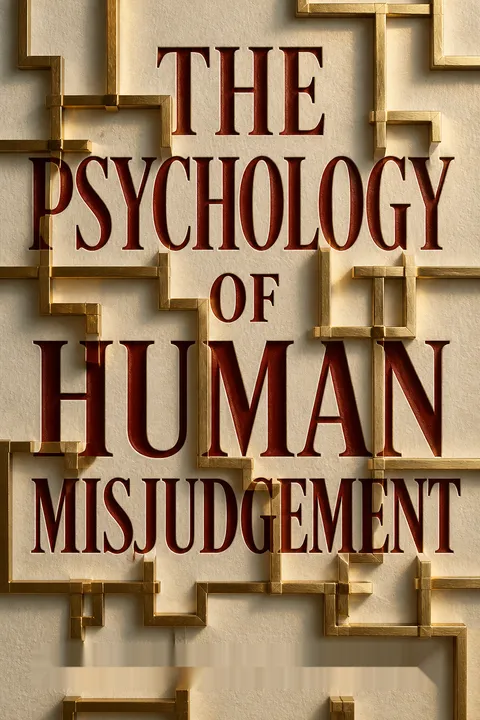

Key Takeaways
1. Incentives are the Ultimate Superpower
Never a year passes but I get some surprise that pushes a little further my appreciation of incentive superpower.
Incentives drive behavior. Munger places the reward- and punishment-superresponse tendency first because its power is almost universally underestimated. People, animals, and even entire systems respond profoundly to incentives, often in ways that defy logic or moral suasion. This "superpower" can shape cognition and behavior more effectively than any other force.
Perverse incentives lead to perverse outcomes. History is replete with examples where poorly designed incentive systems led to disastrous or unethical behavior.
- Federal Express struggled with its night shift until it paid per shift, allowing employees to go home early if work was done fast.
- Xerox salesmen pushed inferior machines because their commission structure rewarded it.
- A surgeon in Munger's youth performed unnecessary gallbladder removals, rationalizing his actions due to the financial incentive.
This "incentive-caused bias" means one should always be wary of advice that greatly benefits the adviser.
Antidotes are crucial. Recognizing the pervasive nature of incentive-caused bias demands robust countermeasures. Simple solutions like cash registers make dishonesty harder, while sound accounting practices prevent fictional profits. Wise employers like Sam Walton prohibited purchasing agents from accepting even minor favors, understanding the subconscious power of reciprocation. The success of free-market capitalism, in part, stems from its inherent incentive structures that reward efficiency and penalize waste.
2. The Mind's Drive to Avoid Doubt and Inconsistency
It is easy to see that a quickly reached conclusion, triggered by doubt-avoidance tendency, when combined with a tendency to resist any change in that conclusion, will naturally cause a lot of errors in cognition for modern man.
Quick decisions reduce discomfort. The human brain is programmed to quickly eliminate doubt by reaching a decision, a tendency rooted in evolutionary survival. This "doubt-avoidance tendency" is often triggered by puzzlement and stress, leading to rapid conclusions, even in complex matters like religious faith. This inherent drive for closure can be a significant source of error in modern life.
Resistance to change entrenches beliefs. Once a conclusion is reached, the brain's "inconsistency-avoidance tendency" makes it reluctant to change. This is evident in human habits, loyalties, and even deeply held beliefs. Marley's ghost, "I wear the chains I forged in life," aptly describes how early-formed mental habits become difficult to break, even when they are detrimental.
Combating cognitive inertia. This combination of quick conclusions and resistance to change creates "first-conclusion bias." Effective antidotes include:
- Forcing consideration of counterarguments, as in legal systems requiring judges and juries to hear both sides.
- Adopting Charles Darwin's practice of intensively seeking evidence that disconfirms one's own hypotheses (the opposite of "confirmation bias").
- Recognizing that new ideas are often rejected not because of intrinsic difficulty, but because they are inconsistent with old ideas already in place, as Max Planck observed even in physics.
3. Excessive Self-Regard and Overoptimism Distort Reality
He mostly misappraises himself on the high side, like the 90 percent of Swedish drivers who judge themselves to be above average.
Universal self-enhancement. Humans universally tend to over-appraise themselves, their spouses, children, and even their minor possessions (the "endowment effect"). This "excessive self-regard tendency" leads to irrational decisions, such as buying lottery tickets with self-picked numbers (despite identical odds) or repeatedly betting against superior players in games of skill.
Overoptimism fuels poor judgment. Complementing self-regard, "overoptimism tendency" causes people to believe what they wish to be true, even in the absence of pain or threat. Demosthenes noted this three centuries before Christ: "What a man wishes, that also will he believe." This bias leads to foolish predictions about future performance or market trends, often with disastrous business consequences.
Antidotes for self-deception. To counter these pervasive biases, one must actively cultivate objectivity.
- Underweigh face-to-face impressions in hiring, favoring past records.
- Force oneself to be more objective about personal abilities and prospects.
- Apply simple probability math (Fermat and Pascal) to assess risks, rather than relying on evolutionary "rules of thumb."
While justified pride is a constructive force, unchecked self-regard and optimism can lead to a "Tolstoy effect," where individuals make excuses for poor performance rather than fixing it.
4. Losses Loom Larger Than Gains (Deprival Superreaction)
A man ordinarily reacts with irrational intensity to even a small loss, or threatened loss, of property, love, friendship, dominated territory, opportunity, status, or any other valued thing.
Losses hurt more than gains please. The "deprival-superreaction tendency" describes how the pain of a loss is felt more intensely than the pleasure of an equivalent gain. This bias extends to "near misses"—almost getting something greatly desired and having it snatched away triggers a reaction similar to losing something already possessed. This irrational intensity can lead to counterproductive behavior.
Mis-framing problems leads to poor decisions. People often misframe problems by comparing what is near rather than what truly matters. A person with millions might be disproportionately irritated by a small cash loss from their wallet. This tendency fuels bureaucratic infighting over turf, causes resistance to necessary "takeaways" in labor negotiations, and can lead to the ruinous pursuit of "getting even" in gambling, where near misses are deliberately exploited by slot machine designers.
Antidotes for loss aversion. Recognizing this powerful tendency is key to mitigating its negative effects.
- Jack Welch's fight against bureaucratic ills at General Electric was a wise campaign against turf protection.
- Deliberately bringing in articulate disbelievers can counter groupthink fueled by deprival-superreaction against conflicting ideas.
- Warren Buffett's simple rule for open-outcry auctions—"Don't go"—is a direct antidote to being triggered into foolish prices by the fear of missing out.
Munger himself admits to a multi-million dollar mistake due to this tendency, highlighting that psychological ignorance can be very expensive.
5. Social Proof and Authority Can Lead Us Astray
Learn how to ignore the examples from others when they are wrong, because few skills are more worth having.
Following the crowd is often automatic. Humans possess an automatic "social-proof tendency" to think and act as they observe others doing, especially in situations of puzzlement or stress. This followership, while often useful (like following a crowd to a football game), can lead to ridiculous or even dangerous outcomes, as seen in elevator experiments or the tragic inaction of bystanders (Kitty Genovese case).
Authority figures command undue influence. Man is born to follow leaders, and society's dominance hierarchies augment this "authority-misinfluence tendency." This can be amusing, as when a nurse misinterprets a doctor's order, or tragic, as when a pilot crashes a plane trying to please a general. The Milgram experiment chillingly demonstrated how far ordinary people could be led into gross misbehavior by a perceived authority figure.
Counteracting external pressures. To avoid being misled by social proof and authority:
- Parents should focus on manipulating the quality of their children's peers rather than relying solely on exhortations.
- Societies must quickly stop bad behavior from spreading and actively foster good behavior.
- Copilots are trained to ignore foolish orders from chief pilots, even if it means allowing a simulated crash.
- Be extremely careful whom you appoint to power, as dominant figures are hard to remove.
The Serpico story, where an honest cop resisted a corrupt police division driven by social proof and incentives, serves as a powerful didactic example of the dangers of unchecked social contagion.
6. Beware of Mere Association and Contrast Misreaction
When one thus sees perception so easily fooled by mere contrast, where a simple temperature gauge would make no error, and realizes that cognition mimics perception in being misled by mere contrast, he is well on the way toward understanding not only how magicians fool one but also how life will fool one.
Trivial associations sway judgment. The "influence-from-mere-association tendency" means that responses can be triggered by simple, often irrelevant, associations rather than direct rewards. Advertisers exploit this by associating products with positive imagery (e.g., Coke with happiness) or by implying quality through high prices. Even accidental associations with past success can mislead, causing people to repeat foolish gambles or ventures.
Contrast distorts perception and cognition. Our nervous system relies on contrast, not absolute units, to register information. This "contrast-misreaction tendency" makes us susceptible to manipulation.
- A $1,000 car dashboard seems cheap compared to a $65,000 car.
- Real estate brokers show awful houses first to make a merely bad house seem acceptable.
- Vendors create phony high prices to make their standard price appear a "big reduction."
This bias can lead to disastrous life choices, like marrying someone who seems satisfactory only in comparison to terrible parents.
Antidotes for perceptual traps. To avoid these misjudgments:
- Carefully examine past successes for accidental, non-causative factors.
- Recognize that "Persian messenger syndrome" (killing the messenger of bad news) is a dangerous outcome of associating a person with a hated outcome; cultivate a habit of welcoming bad news.
- Understand that small, incremental steps toward disaster can be missed because each step presents too little contrast from the current position, akin to the frog in slowly heating water.
- Avoid classification stereotypes, remembering that average group dimensions don't reliably predict specific items.
7. The Destructive Force of Liking, Hating, Envy, and Reciprocation
As I have shared the observation of life with Warren Buffett over decades, I have heard him wisely say on several occasions, "It is not greed that drives the world but envy."
Liking and loving blind us. The "liking/loving tendency" causes us to ignore faults, comply with wishes, and favor people/products merely associated with the object of our affection. This feedback loop, where admiration intensifies love, can be a powerful constructive force (e.g., admiring good teachers) but also leads to distorted facts and even self-destruction for what is loved.
Disliking and hating distort reality. Conversely, the "disliking/hating tendency" makes us ignore virtues in disliked objects, dislike associated people/products, and distort facts to facilitate hatred. This innate tendency, evident in continuous human warfare and political animosity, can be channeled constructively (e.g., elections) but also fuels sibling rivalry and irrational business appraisals of competitors.
Envy and jealousy are powerful, often hidden drivers. Munger highlights "envy/jealousy tendency" as a profound, yet often undiscussed, force. Forbidden in the laws of Moses and observed in university salary disputes, envy can be a stronger motivator than greed. The taboo against labeling arguments as envy-driven prevents proper psychological analysis, despite its widespread impact.
Reciprocation shapes social interaction. The "reciprocation tendency" drives humans to return both favors and disfavors. This facilitates group cooperation and trade but also fuels brutal conduct in wars and can be exploited by manipulators.
- Salesmen offer small courtesies (coffee) to trigger subconscious reciprocation.
- Cialdini's experiment showed that a small concession (asking for less) tripled compliance.
- The Watergate burglary was partly enabled by a subordinate's concession being reciprocated by the Attorney General.
While it can cause guilt and destructive cycles, reciprocation's constructive contributions, especially in relationships of affection, far outweigh its destructive effects.
8. Stress and Availability Skew Our Judgment
An idea or a fact is not worth more merely because it is easily available to you.
Stress impairs rational thought. While light stress can improve performance, heavy stress causes significant dysfunction, leading to extreme pessimism, fatigue, and even mental breakdowns. Pavlov's later work with dogs demonstrated that extreme stress could cause profound, lasting changes in behavior and personality, which could only be reversed by reimposing stress. This suggests that in extreme cases, like cult brainwashing, heavy-handed interventions might be the only remedy.
Availability biases our decisions. The "availability-misweighing tendency" describes how our limited-capacity brains overweigh information that is easily available, memorable, or vivid, while underweighing less accessible but potentially more important data. This leads to misjudgments because an idea's worth is not correlated with its ease of recall.
Antidotes for cognitive overload. To counter these tendencies:
- Use checklists and procedures to ensure all relevant factors are considered, not just the easily available ones.
- Consciously underweigh extra-vivid evidence and overweigh less vivid but more statistically significant information.
- Hire skeptical, articulate people to advocate for notions opposite to incumbent ideas, forcing a broader consideration of facts.
- Recognize that stress can make other psychological tendencies, like social proof, even more powerful, leading to heightened susceptibility to manipulation.
9. The "Man-with-a-Hammer" and Twaddle Tendencies
To a man with only a hammer, every problem looks pretty much like a nail.
Narrow expertise limits perspective. Munger frequently refers to the "man-with-a-hammer tendency," where someone with a single skill or mental model applies it to every problem, regardless of its suitability. This over-reliance on a familiar tool, often a byproduct of academic specialization, leads to distorted problem-solving and a failure to see alternative solutions. B.F. Skinner, despite his brilliance, became ridiculous by overclaiming for incentive superpower and ignoring other psychological forces.
Twaddle obscures serious work. Humans, as social animals with language, are prone to "twaddle tendency"—prattling and pouring out incoherent or irrelevant talk. Just as a honeybee performs an "incoherent dance" when it cannot communicate the location of nectar straight up, people often produce meaningless chatter when faced with complex problems they cannot adequately describe. This unproductive communication can severely hinder serious work.
Combating intellectual narrowness and noise. Effective administration and personal development require strategies to mitigate these tendencies:
- Actively seek out and integrate knowledge from diverse disciplines to build a "latticework of theory," preventing the "use-it-or-lose-it" decay of rarely used skills.
- Keep "prattling people pouring out twaddle far away from the serious work," as a Caltech professor advised.
- Recognize that overspecialization, while sometimes efficient, can lead to significant blind spots and errors in judgment, especially when problems cross traditional disciplinary boundaries.
10. The Power of "Why" and Reason-Respecting
Few practices, therefore, are wiser than not only thinking through reasons before giving orders but also communicating these reasons to the recipient of the order.
Innate love for accurate cognition. Humans, especially in advanced cultures, possess a "reason-respecting tendency"—a natural love for accurate cognition and joy in its exercise. This explains the popularity of puzzles, games of mental skill, and the effectiveness of teaching that provides clear reasons for what is being taught. Learning is most easily assimilated and used when experience is hung on a "latticework of theory" that answers the question "Why?"
Reasons enhance compliance and understanding. Carl Braun, a brilliant oil refinery designer, mandated that all communications specify "who was to do what, where, when, and why." He understood that ideas are best understood and followed when the underlying reasons are meticulously laid out. This practice not only improves compliance but also deepens understanding and reduces errors.
Beware of superficial reasons. Unfortunately, this tendency is so strong that even meaningless or incorrect reasons can increase compliance. Psychology experiments have shown that people are more likely to grant a request if any reason is given, even a trivial one like "I have to make some copies." This byproduct is often exploited by commercial and cult compliance practitioners to manipulate others, highlighting the need for critical evaluation of the reasons presented.
11. Extreme Outcomes from Confluent Psychological Tendencies (Lollapalooza)
This tendency was not in any of the psychology texts I once examined, at least in any coherent fashion, yet it dominates life.
The synergy of biases. Munger's "Lollapalooza tendency" describes the phenomenon where extreme consequences arise from the confluence of multiple psychological tendencies acting together in favor of a particular outcome. This synergistic effect is far more powerful than the sum of individual biases. It explains why seemingly normal people can be brainwashed into cults or why the Milgram experiment yielded such shocking results.
Cults as a prime example. Destructive cults often stumble upon "practice evolution" to bring immense pressure from many psychological tendencies to bear simultaneously on conversion targets.
- Isolation and stress (Stress-influence, Social-proof)
- Small, incremental commitments (Inconsistency-avoidance)
- Charismatic authority figures (Authority-misinfluence)
- Intense liking/loving within the group, hatred for outsiders (Liking/loving, Disliking/hating)
- Deprival-superreaction to any challenge to their new beliefs.
This combination can cause minds to "snap into zombiedom," a phenomenon Munger found poorly explained in traditional psychology texts.
Beyond academic silos. Munger criticizes traditional psychology for its failure to adequately address these compound effects, often focusing on single tendencies in isolated experiments. He argues that any intelligent person with a checklist of psychological tendencies could have better understood complex phenomena like the Milgram experiment. The "Lollapalooza tendency" underscores the need for a multidisciplinary approach to understanding human behavior, recognizing that real-world problems rarely fit neatly into single-tendency explanations.
12. Antidotes: A Multidisciplinary Checklist for Wisdom
Tendency is not always destiny, and knowing the tendencies and their antidotes can often help prevent trouble that would otherwise occur.
Knowledge is power. While psychological tendencies are deeply programmed by evolution and cannot be simply eliminated, understanding them and their antidotes is crucial for spreading wisdom, fostering good conduct, and avoiding disaster. Munger emphasizes that these tendencies are generally more good than bad, but their misapplication or unchecked influence can be profoundly detrimental.
Practical applications of psychological insight. Munger provides a list of real-world examples where elementary psychological knowledge has been effectively applied:
- Carl Braun's communication practices: Requiring "why" in all orders.
- Pilot training simulators: Practicing rarely used skills to prevent "use-it-or-lose-it."
- Alcoholics Anonymous: Using multiple psychological tendencies to counter addiction.
- US Constitutional Convention rules: Secret meetings, reversible votes, and a single final vote to prevent hardened, inconsistent positions.
- "Granny's rule": Doing unpleasant tasks before rewarding oneself.
- Harvard Business School's decision trees: Countering psychological biases with structured thinking.
- Johnson & Johnson's "autopsy equivalents": Revisiting past acquisitions to compare predictions with outcomes, combating confirmation bias.
- Charles Darwin's anti-confirmation bias: Actively seeking disconfirming evidence.
- Warren Buffett's auction rule: "Don't go" to avoid deprival-superreaction and social proof.
The paradoxical value of psychology. Munger notes a paradox: the more people learn about these psychological tendencies, the less true they become, as awareness helps prevent their negative effects. This makes the system immensely valuable. By consciously applying a multidisciplinary checklist of these tendencies, individuals and institutions can make better decisions, navigate complex situations, and achieve more rational outcomes, proving that tendency is not always destiny.
Review Summary
Readers widely praise The Psychology of Human Misjudgement as a dense, insightful, and transformative read. Many highlight its practical value as a checklist for identifying cognitive biases in everyday decision-making. Reviewers note that Munger was ahead of his time, predating much of modern behavioral economics. While some find it challenging to fully grasp in one reading, most agree it rewards revisiting. A few critics note the lack of scientific evidence and unconventional terminology, but the overall consensus is that it offers exceptional wisdom in a compact format.
People Also Read







About the Author
Other books by Charles T. Munger
Download PDF
Download EPUB
.epub digital book format is ideal for reading ebooks on phones, tablets, and e-readers.








































