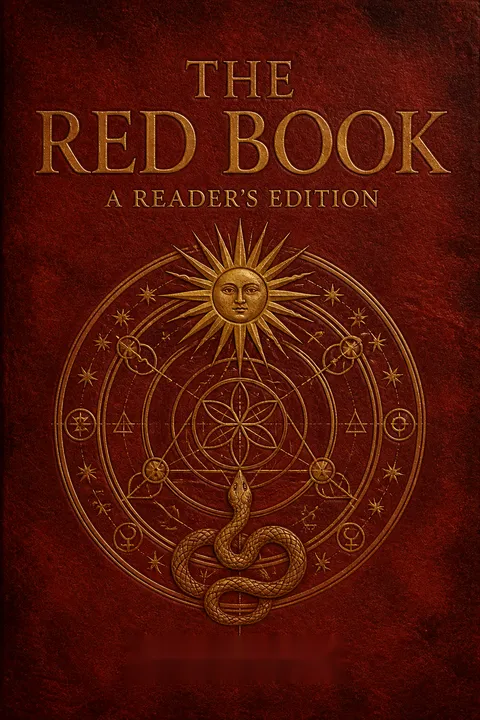
Key Takeaways
1. The Call of the Depths: A Crisis of the Soul
The spirit of this time would like to hear of use and value. I also thought this way, and my humanity still thinks this way. But that other spirit forces me nevertheless to speak, beyond justification, use, and meaning.
Confronting the unconscious. In 1913, C.G. Jung, having achieved worldly success, experienced a profound inner crisis, a "confrontation with the unconscious." He felt compelled by a "spirit of the depths" that challenged the prevailing "spirit of this time," which valued only utility and rational explanation. This inner force demanded he look beyond conventional understanding.
The supreme meaning. This other spirit revealed a "supreme meaning" that transcended logic and absurdity, manifesting as both image and force. It was the "God yet to come," an image appearing in the paradoxical union of sense and nonsense. This meaning was not merely intellectual but a path to future understanding.
Prophetic visions. Jung's journey began with terrifying visions of a catastrophic flood and a sea of blood, which he initially feared indicated his own madness. The outbreak of World War I in 1914, however, revealed these visions as precognitions of collective events, validating his inner experiences as deeply connected to world affairs. This realization gave him the courage to record his journey in Liber Novus.
2. Refinding the Lost Soul: The Inner Journey Begins
I had to become aware that I had lost my soul.
Lost connection. Jung realized he had lost his soul by objectifying it through scientific study, treating it as something external to be judged and categorized. The spirit of the depths compelled him to address his soul as a living, self-existing entity, distinct from his intellectual constructs.
The soul's nature. The soul is not a dependent thing but a vibrant, autonomous being, the source of inner life and images. It communicates through dreams and fantasies, which are "guiding words." To truly know the soul, one must live fully, embracing both the lived and the unlived aspects of oneself.
Humility and service. The spirit of the depths taught Jung extreme humility, revealing him as a "servant of a child"—his own soul. This meant accepting the soul's childlike nature and recognizing that the divine child, the "God in my soul," is where true, unexpected life originates.
3. Embracing Divine Madness: Beyond Reason and Normality
To the extent that the Christianity of this time lacks madness, it lacks divine life.
Divine vs. sick delusion. Entering the world of the soul is akin to madness from a conventional perspective. Jung differentiated between "sick delusion," where the spirit of the depths overwhelms and forces incoherent expression, and "divine madness," which is the intentional overpowering of the "spirit of this time" by the "spirit of the depths."
The path through chaos. This journey requires enduring fear and doubt, acknowledging their justification, and even loving what horrifies. It means opening oneself to the "dark flood of chaos" to produce the "divine child," the supreme meaning beyond conventional order. This process is not about escaping the terrible but embracing it.
Accepting the other half. Disorder and meaninglessness are the "mother of order and meaning," the other half of the world. To overcome madness, one must suspend judgment, accept simplemindedness, and wait for the fruits of this confrontation. This acceptance allows for a true overcoming, rather than mere suppression.
4. The Sacrifice of the Hero: Death of Old Ideals
Our Gods want to be overcome, since they require renewal.
Overcoming the old God. Jung's vision of murdering Siegfried, the blond hero, symbolized the necessary destruction of old ideals and the "hero ideal of efficiency." This act, though seemingly an assassination, was a prerequisite for the birth of a new God and a new adaptation to life.
Truth and absurdity. The highest truth, Jung realized, is one with the absurd. Meaning and absurdity are interdependent, like day and night. The old God, when it becomes too old, turns into "shadow, nonsense," and must fall to allow for renewal.
Collective sacrifice. The murder of the hero is a collective act, reflected in the world war, where humanity unknowingly sacrifices its "prince" (the ruling spirit of the time). This sacrifice, though bloody, is the "foundation stone of what is to come," leading to a new life born from torment and blood.
5. The Birth of the Ambiguous God: Union of Opposites
I understood that the new God would be in the relative.
God in the relative. The new God is born from "terrible ambiguity," encompassing the hateful-beautiful, evil-good, laughable-serious, sick-healthy, inhuman-human, and ungodly-godly. This God is not found in absolute perfection but in the relative, embracing the fullness of life's contradictions.
Descent into Hell. Christ's journey to Hell after death is a metaphor for integrating the "Antichrist," the underworldly brother. This process involves confronting the "deepest Hell," where one realizes that Hell itself is also a "cheerful Heaven," a paradox of being.
Enlivening death. To overcome death, one must "enliven it." This means digging deep mines, throwing in sacrificial gifts, and reflecting on evil to bring life back to dead matter. The "thousand serpents" that emerge are dreadful thoughts and feelings, but also the source of new life.
6. The Power of Magic: Unreason and the Incomprehensible
Magic is the negative of what one can know.
Beyond reason. Magic, as taught by Philemon, is not a set of practices to be learned but the "negative of what one can know," operating through unreason. It is everything that eludes comprehension, a force that causes disarray and lack of clarity where reason establishes order.
Embracing the lawless. To engage with magic is to accept the incomprehensible and the lawless, which arises without rules or by chance. This requires a "stupidity" that transcends cleverness, allowing one to receive or invoke messengers from the unknown.
The magical way. Magic is a way of living, a "noncomprehension" that opens spaces without doors and leads to the open where there is no exit. It is dangerous, confusing, and alluring, always making one its first victim. This path is essential for those who have opened chaos within themselves.
7. The Demands of the Dead: Unlived Life and Collective Guilt
The dead demand your expiatory prayers.
The unredeemed past. The dead represent the unlived aspects of life, both personal and collective, that demand completion. They are "a great waiting flock hovering over their graves," longing for knowledge and redemption from the living.
Accepting the lowest. To redeem the dead, one must accept the "lowest in you," the despised and least valued aspects of human nature. This involves a "sacrificial murder" of the divine child (the image of God's formation) to reclaim one's life force and integrate primordial powers into the soul.
Community with the dead. This process is a "Last Supper" with oneself, recognizing complicity in evil and eating the "bloody sacrificial flesh." It is a necessary, hidden work, a "community of spirits founded on outer signs with a solid meaning," that ultimately leads to a new salvation.
8. The Serpent and the Bird: Differentiating the Soul's Nature
What seems like a bird to you is a serpent to the other, and what seems like a serpent to you is a bird to the other.
Duality of the soul. The soul manifests in a threefold nature: the serpent (earthly, daimonic, thought-desire), the human soul (living within), and the bird (celestial, desire-thought). These are not merely symbols but active forces that shape inner experience.
The conflict of opposites. The union of God and devil, or the serpent and the bird, brings life to a standstill, creating an unbearable tension. This conflict is essential for growth, as it forces one to find the "middle way" between extremes, transcending one-sidedness.
Beyond good and evil. To grow, one must unlearn the rigid distinctions between good and evil, recognizing that they are united only in growth. Steadfastness in great doubt becomes a "veritable flower of life," allowing one to discern the direction of growth from below to above.
9. The Incubation of the God: From Egg to Sun
He who wanted to go down with the sun found me through his downgoing. I became his nocturnal mother who incubated the egg of the beginning.
Rebirth of the divine. Jung's act of opening the egg, containing the diminished Izdubar, symbolized the rebirth of the God. He, the "nocturnal mother," incubated the divine seed, allowing the God to rise renewed and transformed, shining with greater splendor.
The mother's sacrifice. This rebirth comes at a cost: the mother (Jung's soul) is "cruelly mauled and bleeding her life into the child." She descends into the "horror of the underworld," losing her light and power as the God ascends, leaving her with the "afterbirth of the God," the eternally vulgar and powerless.
Animating emptiness. The process involves accepting the emptiness of matter and allowing the force of form to flow into it, animating the "emptiness of matter from which the formation of evil grows." This paradoxical act of giving birth to the God through sacrifice and descent is a "cheerful play and cold horror."
10. The Way of the Cross: Self-Sacrifice and Individuation
The symbol is the word that goes out of the mouth, that one does not simply speak, but that rises out of the depths of the self as a word of power and great need and places itself unexpectedly on the tongue.
Living one's own life. The "way of the cross" is the path of living one's own life, a task so difficult it requires immense humility and self-sacrifice. It means turning one's "most dangerous weapon against himself," consuming one's own greed, and accepting the "burning torment" of self-confrontation.
The saving symbol. Inner freedom is created through the symbol, which emerges from the depths of the self as a "word of power." This symbol is a "new gate" to inner chambers, invisible at first, but essential for progress. It is neither thought up nor found, but "becomes," like life in the womb.
Eternal recurrence and creation. The meaning of life lies not in the "eternal recurrence of the same" but in the "manner of its recurring creation." One cannot be a charioteer through will alone; futurity grows against will and intention. This process of giving birth to the ancient in a new time is creation and redemption.
11. Philemon's Wisdom: The Lover of the Soul
You are a lover of your soul, who anxiously and jealously guards its treasure.
The magician's paradox. Philemon, the magician, embodies the wisdom of the serpent: cold, poisonous, yet healing. He is the "lover of his own soul," a host to the Gods, who survives chaos by unwittingly granting hospitality to the divine. His magic is not about external power but about inner transformation.
Self-nourishment. Philemon teaches that one must nourish oneself from oneself, forcing men to confront their own "human animal" and its inherent disgust. This self-consumption, though initially repulsive, leads to satiety and freedom from external demands.
Beyond saviorhood. Philemon is no savior; he does not give but allows things to grow from within. He represents the dignity of man, who is not a sheep, and the wisdom of things to come, which is invisible and unknowable, yet pours forth "living water" for the soul's garden.
12. Man as a Gateway: The Eternal Moment
Man is a gateway, through which you pass from the outer world of Gods, daimons, and souls into the inner world, out of the greater into the smaller world.
The inner infinity. Man is a "gateway," a small and inane being, yet through him, one passes into an "inner infinity." Each individual possesses a "one God," a lonely star in the zenith, which is his world, his Pleroma, his divinity. In this inner world, man is Abraxas, the creator and destroyer.
Prayer and the star. Prayer increases the light of this inner star, building a bridge across death and preparing life for the "smaller world." This star shines when the "greater world turns cold," offering solace and purpose in solitude.
The human mediator. The Gods need a human mediator and rescuer. Man, through his human wits, has power over the Gods, not as a slave but as a limb they cannot do without. This means accepting one's own suffering and doing what is required, even if it is against one's will, to alleviate the "burning torment of the Gods."
Review Summary
Reviews of The Red Book are polarized but lean positive, averaging 4.39/5. Many praise it as a profound, life-altering descent into the unconscious, offering rare insight into the origins of Jungian thought. However, critics find it inaccessible, overly dense, and difficult without prior knowledge of Jung's framework. Readers consistently recommend familiarity with Jung's other works beforehand, and many suggest the illustrated facsimile edition enhances the experience. Common themes include its value as shadow work documentation, its non-linear structure, and its historical significance as the seed of Jung's later theories.
People Also Read

About the Author
Other books by C.G. Jung
Download PDF
Download EPUB
.epub digital book format is ideal for reading ebooks on phones, tablets, and e-readers.








































