Key Takeaways
1. Reactionary Rhetoric: A Three-Part Play
Is it not true that not just the last but each and every one of Marshall’s three progressive thrusts has been followed by ideological counterthrusts of extraordinary force?
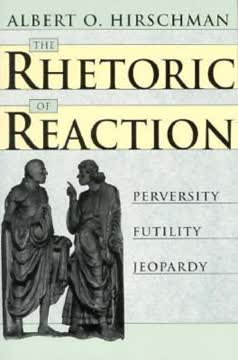
Unsettling experience. Modern democratic societies often experience a systematic lack of communication between groups like liberals and conservatives, leading to mutual puzzlement and revulsion. This book aims to coolly examine the surface phenomena of discourse and rhetoric, revealing how arguments are shaped by their own imperatives, not just personality traits. The goal is to loosen these rhetorical servitudes and restore communication.
Three progressive thrusts. T.H. Marshall's scheme of citizenship development—civil, political, and social—provides the historical backdrop. Each of these progressive advances, from individual freedoms in the 18th century to universal suffrage in the 19th and the Welfare State in the 20th, has been met with powerful ideological counterthrusts. These reactions highlight Whitehead's observation: "The major advances in civilization are processes which all but wreck the societies in which they occur."
Three reactionary theses. To analyze these counterthrusts, the book identifies three principal reactionary arguments:
- Perversity Thesis: Purposive action to improve a condition only exacerbates it.
- Futility Thesis: Attempts at social transformation will be unavailing, failing to "make a dent."
- Jeopardy Thesis: The proposed change's cost is too high, endangering previous accomplishments.
These arguments, while not exclusive to reactionaries, are most typical of conservative attacks on progressive policies.
2. The Perversity Thesis: Good Intentions, Bad Outcomes
The attempt to push society in a certain direction will result in its moving all right, but in the opposite direction.
Daring maneuver. Reactionaries, often facing a hostile intellectual climate that values progressive objectives, rarely attack those objectives head-on. Instead, they endorse the goal (sincerely or not) but then argue that the proposed action is ill-conceived and will, through unintended consequences, produce the exact opposite of the proclaimed objective. This "perverse effect" argument is simple, intriguing, and devastating if true.
Everything backfires. The perversity thesis claims that efforts to achieve liberty lead to slavery, quests for democracy produce oligarchy, and social welfare programs create more poverty. This argument gained prominence after the French Revolution, where "Liberté, Egalité, Fraternité" seemingly degenerated into tyranny. Edmund Burke famously predicted this outcome, asserting that the revolutionaries' striving for public good would result in evil and calamity, contrary to their stated goals.
Intellectual lineage. Burke's formulation drew from the Scottish Enlightenment's stress on unintended effects, particularly Adam Smith's "Invisible Hand" where self-interest leads to positive social outcomes. Burke inverted this, arguing that striving for the public good could lead to perverse, negative outcomes. This marked a radical ideological shift from Enlightenment optimism to pessimism, suggesting a malevolent Providence that foils human designs.
3. The Futility Thesis: Change is an Illusion
Plus ça change plus c’est la même chose.
Cooler critique. Unlike the "hot" perversity thesis, the futility thesis is "cool" and refined, asserting that attempts at change are abortive. Any alleged change is merely superficial, cosmetic, or illusory, leaving society's "deep" structures untouched. This argument, epitomized by Alphonse Karr's aphorism "The more things change, the more they stay the same," denies the possibility of real change and celebrates the resilience of the status quo.
More insulting. While seemingly more moderate than perversity, futility is more humiliating to "change agents." If actions are counterproductive (perversity), hope remains for correction. But if actions are incapable of "making a dent," promoters of change are demoralized and doubt their endeavors' meaning. This thesis often emerges later than perversity, as it requires historical distance to claim that monumental events were ultimately inconsequential.
Debunking revolutions. Tocqueville's L'Ancien Régime et la Révolution (1856) famously argued that the French Revolution represented far less of a break with the Ancien Régime than commonly believed. He showed that many "conquests" of the Revolution, like administrative centralization and small-scale farming, were already in place. This position, more stinging than direct attacks, deflated the Revolution's titanic struggles, making them seem puzzling and even ridiculous in retrospect.
4. The Jeopardy Thesis: Progress Threatens Past Gains
The cost of the proposed change or reform is too high as it endangers some previous, precious accomplishment.
Unacceptable costs. This thesis argues against a proposed change by claiming that, while perhaps desirable in itself, it involves unacceptable costs or consequences, specifically by endangering an older, highly prized accomplishment. This allows for a comparison of "progress" in common terms: is the new worth sacrificing the old? The reactionary, in this argument, often adopts progressive language, lamenting the potential loss of hard-won gains.
Marshall's scheme inverted. T.H. Marshall's sequential progression of civil, political, and socioeconomic rights provides a perfect framework for the jeopardy thesis. Opponents of universal suffrage argued it would destroy established civil liberties. Later, critics of the Welfare State claimed it threatened both individual rights and democratic governance. This argument highlights potential conflicts between different dimensions of progress, challenging Marshall's optimistic view of smooth, cumulative advancement.
"This will kill that." The jeopardy thesis draws strength from deeply rooted myths and stereotypes, such as the "zero-sum mentality" or the Hubris-Nemesis sequence. The idea that a new advance will imperil an older, more valuable one is immediately plausible. This often leads to simplistic "ceci tuera cela" (this will kill that) pronouncements, where the harm to the older achievement is exaggerated, and the new progress is presented as not just illusory, but actively impoverishing.
5. Historical Applications: Revolution, Suffrage, Welfare
Each of the three theses has its own domain of special influence.
Perversity's dominance. In the context of the French Revolution and the Welfare State, the perversity thesis has been particularly influential.
- French Revolution: The idea that radical societal remaking backfires became deeply ingrained due to the Revolution's dramatic dynamics.
- Welfare State: The claim that assistance to the poor generates more poverty (from Mandeville to Murray) has been a powerful and recurring attack.
Jeopardy and futility for suffrage. The 19th-century drive for universal suffrage saw the jeopardy and futility theses take center stage:
- Jeopardy: Debates in England focused on democracy's alleged incompatibility with liberty, fearing new political rights would damage past achievements (e.g., Lowe's warnings against the 1867 Reform Bill).
- Futility: Mosca and Pareto's "elite theory" argued that universal suffrage was a sham, merely masking existing power structures, particularly influential in countries like Italy and Germany where individual liberties were less established.
Varying impact. The effectiveness of each thesis varies across historical episodes and national contexts. While perversity often wins as the most popular and effective weapon, futility offers a more "insulting" critique by denying any real change, and jeopardy appeals to the preservation of cherished, hard-won accomplishments. The specific historical conditions of each nation often determine which argument gains the most traction.
6. Perversity's Roots: Unintended Consequences and Divine Foiling
One could not wish for a more extreme statement. Maistre’s total conviction about Providence’s unfailingly arranging for an outcome of human actions that is the precise opposite of human intentions reminds one of certain parents who, having observed the contrary behavior of their child, hit on the idea of telling the child to do the exact opposite of what they want him or her to do.
Ancient wisdom, new twist. The perversity thesis, while gaining prominence after the French Revolution, has ancient roots. It echoes the Greek Hubris-Nemesis sequence, where human arrogance and ambition lead to disastrous, self-defeating outcomes, often through divine intervention. Hobbes, too, warned that attempts to reform a commonwealth could destroy it, akin to breaching God's commandments.
Secularized nemesis. The Enlightenment, with its belief in human agency and skepticism towards divine intervention, required a secularized version of this myth. The concept of "unintended consequences" perfectly met this need. Human actions, particularly grand societal projects, were shown to produce the exact opposite of their intentions, not by divine will, but through complex social dynamics. This allowed critics to portray revolutionaries as foolish and criminal.
Intellectual arrogance. The perverse effect, a special and extreme case of unintended consequences, offers its analysts a "great feeling of superiority." They revel in portraying ordinary humans as blindly groping, while they themselves appear remarkably perspicacious. This intellectual appeal, coupled with its connection to powerful myths, makes the perversity thesis attractive, but also raises doubts about its claimed ubiquity, as it often simplifies complex social outcomes into a single, opposite result.
7. Futility's Power: Unmasking Invariant Social Laws
The ambition to democratize power in society through the establishment of universal suffrage is laughable in the eyes of Pareto, who had investigated the distribution of income and wealth and had found that it follows everywhere an invariant, highly unequal pattern that came to be known as Pareto’s Law.
Unchangeable structures. The futility thesis posits that human actions are frustrated not by unforeseen side effects, but by their inability to alter society's fundamental structures. It views the social world as highly structured, evolving according to immanent laws that human actions are impotent to modify. This perspective is inherently insulting to reformers, suggesting their efforts are naive and pointless.
Laws of social immobility. This thesis often relies on "laws" discovered by social science to prove the unchangeable nature of society.
- Mosca's "political class": All organized societies are divided into a small ruling minority and a vast powerless majority, making democratic aspirations a sham.
- Pareto's Law of Income Distribution: Income distribution follows an invariant, highly unequal pattern, rendering attempts at redistribution futile.
- Michels' Iron Law of Oligarchy: Mass organizations are invariably ruled by self-serving oligarchies, defying democratic control.
These "laws" serve to debunk democratic and redistributive efforts as going against the natural order.
Radical affinity. The futility thesis, despite its conservative origins, shares a striking resemblance with radical critiques. Both "unmask" reforms as failing to alter basic "structures," using metaphors like "mask," "veil," or "disguise" to expose the supposed hypocrisy of proclaimed goals versus actual outcomes. However, this "unmasking" can also create tension, potentially leading to new, more determined efforts for change, thus making the thesis self-refuting in the long run.
8. Jeopardy's Appeal: The "This Will Kill That" Fallacy
“Ceci tuera cela” (This will kill that) is the title of a famous chapter in Victor Hugo’s novel Notre-Dame de Paris.
Zero-sum thinking. The jeopardy thesis thrives on the "ceci tuera cela" (this will kill that) mentality, a form of zero-sum thinking where a gain in one area is believed to necessitate an equivalent loss in another. This perspective, rooted in the "Image of Limited Good," makes the argument that a new advance will imperil an older one immediately plausible, especially when the older achievement is highly valued.
Hubris-Nemesis revisited. This argument often aligns with the Hubris-Nemesis myth, where human aspirations for change lead to a worse outcome than before. The new reform, initially appearing as progress, is portrayed as not just illusory but actively impoverishing, sacrificing something precious for something less valuable or even detrimental. This narrative provides a powerful, emotionally resonant case against change.
Historical context matters. The jeopardy thesis requires a specific historical backdrop: a living memory of a highly prized earlier reform or achievement that could be endangered by a new move. This is why it was prominently invoked in England against suffrage reforms, where civil liberties were well-established. In contrast, countries without such a consolidated tradition found the argument less persuasive, illustrating how historical context shapes rhetorical effectiveness.
9. Interactions: How Arguments Undercut or Reinforce
Logical incompatibility between two arguments that are attacking the same policy or reform does not mean that they will not both be used in the course of some debate, sometimes even by the same person or group.
Incompatibility and attraction. The perversity and futility theses, despite their logical incompatibility (one claims active harm, the other claims no effect), are often both used. This paradox highlights the rhetorical imperative to deploy any argument that might sway opinion, even if contradictory. The sheer outrageousness of combining incompatible arguments can sometimes be effective.
Jeopardy's temporal lag. The jeopardy thesis often appears earlier in a debate, as it can be invoked as soon as a new policy is proposed. Perversity typically requires some negative experience with the policy, and futility even more distance to claim ultimate inconsequence. This temporal separation often prevents their joint deployment, even when logically compatible.
Undercutting effects. One reactionary argument can undercut another. For instance, the futility thesis, by portraying democracy as a sham, can weaken the jeopardy thesis's claim that the Welfare State threatens democracy. If democracy is already seen as ineffective, then threats to it are less alarming. This dynamic, seen in countries like Germany, ironically facilitated the early emergence of the Welfare State by neutralizing a powerful opposing argument.
10. Progressive Counterparts: Mirroring Reactionary Tactics
Progressives are eternally convinced that “all good things go together,” in contrast to the zero-sum, ceci-tuera-cela mentality of the reactionaries.
Synergy illusion. Just as reactionaries exaggerate harm (jeopardy thesis), progressives often exaggerate mutual support, believing that "all good things go together." This "synergy illusion" posits that new and older reforms will always reinforce each other, rather than conflict. This optimistic outlook contrasts sharply with the reactionary's zero-sum, "this will kill that" mentality.
Imminent danger. The progressive counterpart to the jeopardy thesis is the "imminent-danger thesis." Instead of warning about the dangers of action, it stresses the perils of inaction, arguing that forceful measures are urgently needed to avert impending disaster. Both arguments share a tendency to present their scenarios as certain and inescapable, focusing exclusively on one category of risks.
History on their side. The progressive equivalent of the futility thesis (which asserts invariant social laws) is the belief in "laws of motion" that guarantee inevitable forward progress. Marxism, for example, proudly claimed to have discovered the "economic law of motion of modern society." This conviction that "history is on their side" provides activists with confidence and motivation, mirroring the discouraging effect of the reactionary futility thesis.
11. Beyond Intransigence: Towards Democracy-Friendly Debate
What I have ended up doing, in effect, has been to map the rhetorics of intransigence as they have long been practiced by both reactionaries and progressives.
Exposing rhetorical flaws. The book's primary aim is to demonstrate the repetitive and often faulty nature of standard reactionary reasoning. By showing how these arguments are routinely invoked across diverse situations, often hitching onto powerful myths or flattering their authors' egos, it raises suspicion about their intrinsic truth value. This exposure aims to corrode their persuasive power.
Two identical impertinences. The analysis reveals that reactionary and progressive rhetorics often present "two identical impertinences"—extreme, highly polarized statements that are limiting cases in complex debates. For example, the reactionary claim of "disastrous consequences" is mirrored by the progressive claim of "disastrous consequences if no action is taken." Recognizing these paired exaggerations helps downgrade both to mere extreme positions.
Democracy-friendly dialogue. The ultimate goal is to move public discourse beyond these intransigent postures towards a more "democracy-friendly" dialogue. Democratic legitimacy relies on open deliberation where participants are willing to modify their opinions. However, historically, democracies often emerge from bitter standoffs, leading to debates that are "a continuation of civil war with other means." Identifying these "danger signals"—arguments designed to make deliberation impossible—is a crucial step towards fostering more constructive engagement.
Review Summary
Reviewers widely praise The Rhetoric of Reaction as a concise, elegant, and enduring framework for analyzing political discourse. Most highlight Hirschman's three core theses—perversity, futility, and jeopardy—as remarkably applicable to contemporary debates. Many note the book's surprising relevance decades after publication. Some critics find Hirschman occasionally too brief in challenging individual thinkers, while others appreciate his intellectual fairness toward conservative arguments. The final chapter's hopeful vision for democratic dialogue strikes some as naïve given modern political realities, but overall the book earns consistent admiration for its clarity and insight.
People Also Read