


Key Takeaways
Engineer your circumstances so success arrives without effort or talent
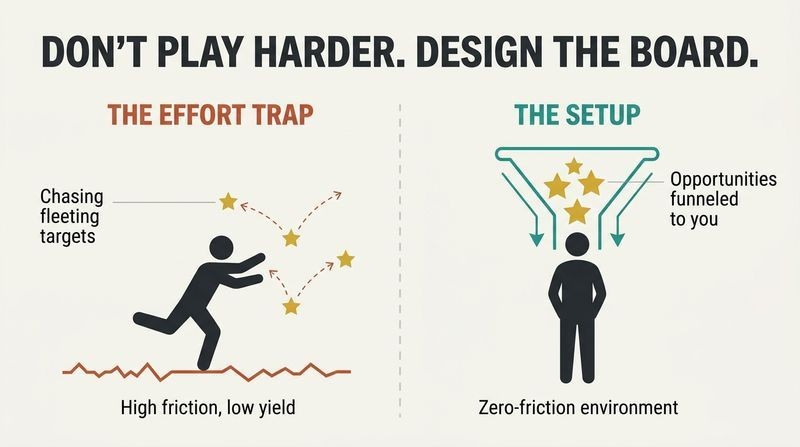
The setup is the book's spine. Bilzerian argues you don't win at sex, money, or fame by trying harder, being better looking, or having rare talent. You win by arranging your environment so the outcome you want becomes almost inevitable. He calls himself "the most famous man in the world without a talent" and insists that is the point.
His proof-of-concept was a Minnesota lake summer as a teen: a ski boat, a beer cooler, and a cute five-year-old cousin used as bait to invite girls aboard. His "game" hadn't improved, but the environment did the work. Every later chapter (poker games stacked with rich bad players, parties with eight-to-one female ratios) is the same move at larger scale. Design the board, then let people play into it.
What's striking is how closely this mirrors legitimate behavioral science. Choice architecture (Thaler and Sunstein) and B.J. Fogg's work on designing for behavior both argue that environment beats willpower nearly every time. James Clear made the same case for habits. Bilzerian's contribution is applying it ruthlessly to status and seduction rather than flossing. The obvious limit: his "setups" rested on enormous capital (jets, mansions, poker bankrolls) most readers lack. The transferable kernel is real, though: stop optimizing your performance and start optimizing the conditions under which you perform.
Stop chasing; neediness repels attraction like garlic repels vampires
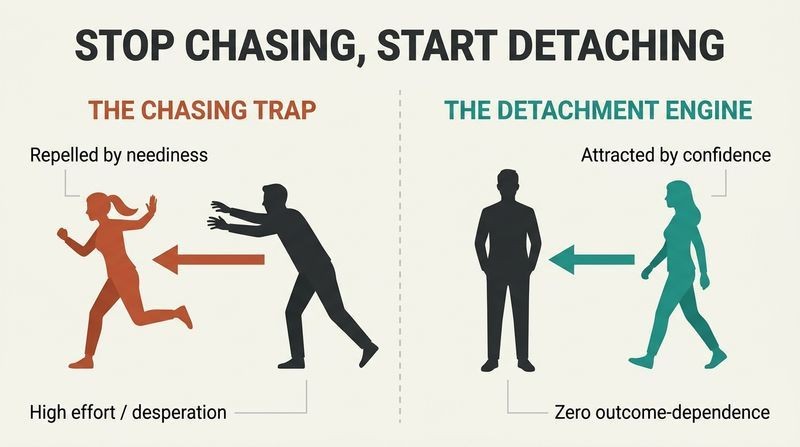
Detachment is the counterintuitive engine. As a bullied kid with buck teeth, Bilzerian got zero female attention until he studied a friend named Wayne who talked to every girl without ever hitting on them. Wayne genuinely didn't care about the outcome, and that indifference read as confidence. The breakthrough insight: reframe the goal from "seduce her" to "just talk," which removes the possibility of rejection and lowers perceived effort.
Bilzerian's rule became: if she says no, the music stops and he leaves, no begging. He compares chasing to spinning your tires in mud, the more you struggle, the deeper you sink. On a private jet he once popped a sleeping pill rather than keep pursuing a woman who declined, and she initiated the next morning.
This maps onto attachment theory and the well-documented "scarcity heuristic." Psychologist Robert Cialdini showed people value what seems less available, and clinicians note that anxious pursuit signals low mate value. The steelman is solid. The blind spot is that "never chase" optimizes for volume and short-term conquest, not intimacy, which requires vulnerability and, yes, the willingness to risk rejection. Bilzerian implicitly concedes this by noting his best relationships stalled because he could not tolerate feeling out of control. Detachment is a superb tactic and a poor foundation for love.
Manufacture scarcity and competition to make yourself instantly desirable
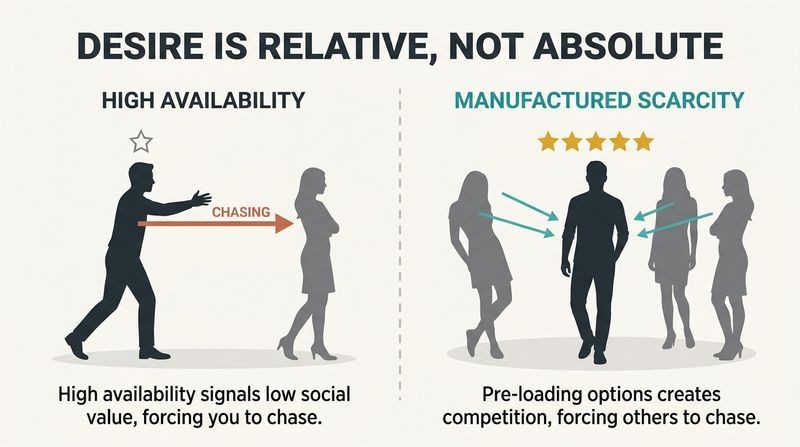
Desire is relative, not absolute. Bilzerian's economics-class epiphany came at a fraternity body-paint party where an absurd girls-to-guys ratio forced women to compete for scarce male attention. He watched unremarkable guys hook up effortlessly. The lesson: an abundance of women plus a shortage of men equals sex with minimal effort.
He contrasts two rock stars. His friend John, a wealthy drummer with fame and a reputation for being well-endowed, underachieved with women because he traveled with no female entourage, which made the two girls on his tour bus feel like the scarce commodity and lowered his value. Bilzerian's fix: pre-load the environment with many women so any attention you give one signals she must compete. His entire harem strategy (a rotation of fifty-plus women he never paid) ran on this snowball of manufactured competition.
The supply-and-demand framing is genuinely useful and echoes evolutionary psychology's "mate copying," a real phenomenon documented in guppies, quail, and humans, where females prefer males already chosen by other females. Bilzerian even cites the goldfish study. The uncomfortable ethical layer is that this treats people as inventory to be arbitraged. It works precisely because it exploits status signaling and social proof, but it also breeds the jealousy and cattiness he eventually found exhausting on a $300 million yacht. Engineered scarcity scales attraction and, simultaneously, misery.
Status recognized by a crowd outperforms good looks every time
"Fame brain" is preselection on steroids. Bilzerian's hedge-fund friend Clarence coined the term for a pattern he observed: attraction rises in proportion to how eagerly others treat someone. Preselection is the unconscious shortcut of trusting people others have already vetted (a Yale student gets credibility just from the label). Fame is the most acute version because everyone, everywhere, signals your value at once.
The demonstration was surreal. In Cannes, actor Ron Perlman sat beside Bilzerian while strangers ignored the movie star and asked Bilzerian for photos. He deliberately walked women past crowds knowing the requests for selfies would tighten a date's arm around him within minutes. His swim into a Montreal pool from a hovering helicopter, the mobs abroad: all engineered proof of status that did the seducing for him.
This is one of the book's sharpest observations and well supported. Social proof, halo effect, and mate copying all converge here. Sociologist Randall Collins would call fame a form of concentrated "emotional energy" that others instinctively want to touch. The dark irony Bilzerian himself surfaces is that the same mechanism became a cage: he could not attend concerts, hike, or walk foreign streets without being mobbed. Preselection is a tool with no off switch. It also decays; recognizability outlasts relevance, leaving many famous people trapped by attention they can no longer monetize.
Let opponents underestimate you, then hunt the rich and terrible
In poker, game selection beat skill. Bilzerian was, by his own high-stakes peers' accounts, a mediocre player. Yet he became one of the winningest, because he cultivated a "table image" as a spoiled trust-fund kid splashing money around badly. That reputation got him invited into private games (Molly's Game, Nick Cassavetes's home game) stuffed with rich, worse players. He avoided tournaments and bracelets entirely; those were ego. He wanted cash games against suckers.
His edge stacked three ways: seem rich and reckless to get action, choose games where wealth was inversely proportional to skill, and stay hyper-aggressive so frustrated amateurs called him with junk. When Clarence advised him to check his ego in an emotional-intelligence class, he did, precisely because the guy willing to look dumb keeps the money.
This is arguably the book's most transferable business lesson, and it generalizes far beyond cards. Warren Buffett's "you don't have to swing at every pitch" and the poker maxim "if you can't spot the fish, you're the fish" say the same thing: opponent selection dominates raw ability. Startups win by picking soft markets, not by being smartest. The ego suppression point is underrated; most professionals overweight being respected and underweight winning. Bilzerian's willingness to be seen as an idiot was a genuine competitive moat, one most talented, status-conscious people refuse to build.
Compress a lifetime of reps into weeks to build any edge
Volume manufactures expertise faster than talent. Broke and in debt during college, Bilzerian rebuilt a bankroll by playing every day, sixteen hours a day, for a month straight. Online, he ran ten tables at once, seeing roughly 14,000 hands a day, more than obsessive live players see in a lifetime. That sheer throughput taught him bluff-and-call tendencies and table image faster than any book could, back before solvers and tutorials existed.
He frames this as a universal first step: find a way to cram the most experience into the shortest period. It applied to women too (approach, approach, approach until failure stops stinging) and to the military, where he attributed his eventual success to accumulated reps and the ability to learn, which he ranks above natural talent.
This is deliberate-practice logic with a twist. Anders Ericsson emphasized quality of practice over quantity, but Bilzerian's point is that in feedback-rich, high-variance domains (poker, cold approaches, sales), raw volume compresses the learning curve because each rep delivers fast, unambiguous data. Chris Rock reportedly workshops jokes across hundreds of small club sets for the same reason. The caveat: volume without reflection just entrenches bad patterns. Bilzerian survived partly because he analyzed his image and adjusted. Reps are the accelerant; feedback and adaptation are what turn them into skill rather than repetition.
Survive brutal challenges by shrinking the goal to the next minute
Break the impossible into bite-sized survival. Bilzerian arrived at Navy SEAL training (BUD/S) at 165 pounds with stress-fractured legs, having never run more than two miles. During Hell Week, five-plus days with almost no sleep and 200-pound boats carried on their heads, an instructor privately told him he'd never graduate and should quit. He refused, not out of toughness but because he wouldn't add self-loathing to a lifetime of humiliation.
His method: never contemplate the full seven months or five sleepless days. Just make it to the next meal, the next evolution, or if things got truly bad, the next minute. "You can do anything for a minute." Of 119 who started, 17 finished. He completed two winter Hell Weeks, more training days than most actual SEALs, before being administratively dropped.
This is textbook goal-proximation, validated across endurance sport and clinical psychology. Marathoners "chunk" races into segments; addiction recovery uses "one day at a time." The neuroscience is that distant, overwhelming goals spike anticipatory dread, while proximal micro-goals keep the prefrontal cortex engaged and deliver frequent completion rewards. There's poignancy here too: Bilzerian's grit came not from confidence but from fear of self-contempt, a reminder that elite persistence often runs on darker fuel than motivational posters suggest. The technique works regardless of the fuel, which is what makes it portable.
Whoever can walk away controls the negotiation, the game, and the bed
Willingness to leave is leverage. Bilzerian repeats one principle across poker, business, and dating: the person who cares least about the outcome holds the power. In poker he learned to check his ego and let others think him a sucker, because whoever cares most about the money usually loses it. In seduction, he shut things down the instant a woman played games, which paradoxically flipped her from passive to pursuing.
The cleanest illustration is his ranch story: a woman drove ninety minutes at midnight, then stalled. Rather than beg, Bilzerian slept with a different woman in front of a girl he wanted, proving she was replaceable, which reignited her desire. He generalizes it to sales: never march the buyer to the register before she's ready, and never let them smell desperation.
This is BATNA (Best Alternative To a Negotiated Agreement) from the Harvard negotiation literature, dressed in far cruder clothes. Fisher and Ury proved that the party with the stronger walk-away alternative dictates terms. Behavioral economists add that loss aversion makes visible need exploitable. The insight is genuinely sound and underused; most people negotiate salaries, deals, and relationships from a posture of scarcity that broadcasts weakness. The ethical hazard is treating human connection as a leverage contest. Manufacturing indifference wins the transaction while quietly corroding the trust that makes relationships worth having in the first place.
Answer honestly even when the truth stings; it builds trust fast
Uncomfortable candor is a shortcut to intimacy and credibility. Asked by a woman he was dating whether he'd slept with others that week, Bilzerian answered "three" without apology, because he'd never promised monogamy. Rather than ending things, the honesty deepened the relationship; she opened up about things she'd hidden from everyone, trusting him precisely because he wouldn't lie to please her.
He extends this to a lie-detector logic: if a woman claims a tame number of past partners, he assumes she's lying, but if she looks him in the eye and says seventy-eight, he believes her, because that's not a number a liar invents. His maxim: you can't fully trust someone unless you have a little dirt on them, and everyone has dirt, some are just better at hiding it.
There's a real principle buried in the bravado. Research on self-disclosure (Aron's work) shows that mutual vulnerability accelerates closeness, and "costly signaling" theory explains why an unflattering truth reads as more credible than a flattering claim: it's expensive to say, so it must be sincere. Radical candor also removes the cognitive load of maintaining a story. The limitation is that Bilzerian uses honesty as a one-way disclosure that lowers others' expectations of him rather than as reciprocal accountability. Truth-telling builds trust; using it mainly to license your own behavior is a narrower, more self-serving version of the virtue.
Perspective, not circumstance, decides whether you're happy
Happiness is a chosen frame. Hungover in his Hollywood-hills mansion, Bilzerian asked a Marine who'd lost both legs in Iraq how he stayed so cheerful. The answer floored him: losing his legs was the best thing that happened, because before the injury nobody cared about him, and now he traveled, spoke, helped people, and was eating breakfast overlooking Los Angeles. Same event, radically different frame.
He found the same in Taylor, a boy with terminal leukemia living in poverty who never complained despite a mile-long list of legitimate grievances, while Bilzerian, with millions and a garage of exotic cars, struggled to feel content. The recurring realization: his happiest stretches (making $860 a month in the Navy, occasional movie nights in San Diego) came when simple things felt like luxuries, because he was working toward a goal and everything was relative.
This is Stoicism and modern hedonic-adaptation research colliding. Epictetus taught that we're disturbed not by events but by our judgments of them, and Sonja Lyubomirsky's studies estimate circumstances account for only around 10 percent of happiness variance, with mindset and intentional activity dominating. The legless-Marine story is a vivid case of "benefit finding" documented in post-traumatic growth literature. The one wrinkle Bilzerian glosses is that he paid a woman to sleep with the Marine that night, muddying the anecdote. Still, the core claim, that reference points and gratitude, not raw conditions, govern wellbeing, is among the most robust findings in psychology.
Money buys pleasure, never happiness, and pleasure is a bottomless pit
The book's confession is its most valuable page. After achieving every hedonistic goal (jets, mansions, tens of millions, more women than he could physically satisfy), Bilzerian paddled a board out to sea on mushrooms and realized he felt nothing. A new Ferrari didn't thrill him for twenty-four hours. He'd fucked so many women he was numb.
He separates two things people conflate:
1. Pleasure comes from sex, money, partying, and self-indulgence; it works exactly like a drug, spikes fast, fades faster, and demands ever-larger doses just to avoid feeling bad.
2. Happiness comes from meaningful relationships, helping others, working toward goals, and peace of mind; it's a durable state of mind, not a hunger to be fed.
Goals like money, sex, and power are black holes, he warns, infinite by nature and impossible to fill. His giving experiments (a $20,000 gift to a sick child's family produced more joy than winning a hundred times that) pointed at the alternative.
Coming from the self-styled modern Hugh Hefner, this lands harder than any monk's sermon precisely because he maxed out the experiment most people only fantasize about. The pleasure-versus-happiness distinction tracks neuroscience cleanly: dopamine (wanting, pursuit, tolerance) versus serotonin and oxytocin (contentment, bonding). Robert Lustig's "The Hacking of the American Mind" makes exactly this case, and the hedonic treadmill explains why escalation never satisfies. The tension the book never fully resolves is that Bilzerian delivers this wisdom, then keeps running the circus for his cannabis brand. That contradiction is arguably the most honest thing in it: knowing the trap and staying in it anyway is the human condition.
Analysis
The Setup is a memoir disguised as a self-help manual, or perhaps the reverse. Structurally it is a picaresque: a chronological rogue's tour through childhood humiliation, SEAL training washout, poker degeneracy, and manufactured internet fame, punctuated by first-person vignettes from friends (Goggins, Molly Bloom, Tom Goldstein) that function as corroborating witnesses. The difficulty in summarizing it is that the shock content (drugs, orgies, a porn star tossed off a roof) is bait; the actual intellectual payload is a coherent, cynical operating system for extracting status, sex, and money by manipulating environments and incentives rather than by developing conventional virtue.
What elevates the book above its provocations is its unusual epistemic honesty. Bilzerian is running a decades-long personal experiment: he holds the outcome variable most men chase (unlimited pleasure) constant at maximum, and reports the result. The finding, that pleasure is a dopaminergic treadmill and happiness is something else entirely, is not novel, but it is rarely delivered by someone with such extreme data. The credibility comes from the fact that he cannot be accused of sour grapes.
The book's coherent through-line is a single mechanism applied at escalating scale: reduce your own neediness and increase others' perceived scarcity, then let social proof and incentive gradients do the work. This is choice architecture, mate-copying, BATNA, and hedonic adaptation folded into one worldview. Its ceiling is also its flaw: a philosophy optimized for winning transactions is structurally incapable of producing intimacy, which requires the vulnerability and non-strategic disclosure Bilzerian systematically avoids. He documents this cost (failed relationships, a self-built prison of fame, numbness) without quite conceding that his method caused it. The reader's task is to steal the tactics (environment design, ego suppression, proximal goals, walk-away leverage) while rejecting the terminal values, because the author himself, arriving at that same conclusion offshore on psychedelics, could not stop feeding the black hole he had so accurately diagnosed.
Review Summary
The Setup receives mixed reviews, with an overall rating of 4.14 out of 5. Many readers find it entertaining and insightful, praising Bilzerian's honesty and the book's unexpected depth. Some appreciate his unconventional lifestyle and success strategies, while others criticize the repetitive content and perceived misogyny. The book is noted for its wild stories, discussions on wealth and fame, and Bilzerian's unique perspective on life. Critics argue it lacks substance and promotes harmful attitudes, while fans see it as a captivating look into an extraordinary life.
People Also Read






Glossary
The Setup
Engineering circumstances to guarantee outcomesBilzerian's central concept: arranging your environment, image, and incentives so that a desired result (sex, money, fame) becomes almost inevitable and requires minimal effort or talent. Instead of improving yourself to win a game, you rig the conditions so the game plays in your favor. Applied to poker table selection, party ratios, and social-media image alike.
Fuck-you money
Wealth that buys total freedomEnough money that you never have to answer to anyone, tolerate anyone's demands, or do work you dislike. For Bilzerian the point of wealth was never possessions but autonomy and the power to walk away from any situation, which he first tasted after winning $187,000 in a month of nonstop poker.
Fame brain
Attraction rising with others' eagernessA term coined by Bilzerian's friend Clarence for an acute form of preselection: people unconsciously assign higher value and desirability to someone they see many others recognizing, chasing, or deferring to. Fame acts as universal social proof, making seduction and access effortless because the crowd's attention does the persuading.
Table image
Cultivated poker reputation to misleadThe perception other players have of how you play. Bilzerian deliberately built the image of a rich, reckless, bad player so he'd be invited into high-stakes private games with wealthy amateurs and get called down on his strong hands. Managing that perception mattered more to his winnings than actual card skill.
Intermittent positive reinforcement
Random rewards create addictive attachmentA behavioral-conditioning principle (Ferster and Skinner) that unpredictable, occasional rewards produce stronger, more change-resistant behavior than consistent ones. Bilzerian's harem dynamic and social-media algorithms both exploit it: giving attention arbitrarily made women crave it more, the same mechanism that makes gambling and slot machines compulsive.
FAQ
1. What’s The Setup by Dan Bilzerian about?
- Life journey and transformation: The book chronicles Dan Bilzerian’s evolution from a bullied, awkward child to a wealthy, controversial social media celebrity, high-stakes gambler, and entrepreneur.
- Themes of excess and strategy: It explores themes like perseverance, strategic life setup, fame, pleasure versus happiness, and the consequences of living on the edge.
- Authentic, unfiltered storytelling: Written without a ghostwriter, it offers raw, candid stories about relationships, business, military training, and personal struggles.
- Purpose and inspiration: Bilzerian aims to inspire readers to strategically “set up” their lives for success, emphasizing authenticity and learning from failures.
2. Why should I read The Setup by Dan Bilzerian?
- Unique, firsthand perspective: The book provides an unfiltered look into the life of a modern playboy and entrepreneur, blending wild anecdotes with real-life lessons.
- Practical life strategies: Readers gain insight into creating advantageous conditions for success, applicable to wealth, relationships, and personal growth.
- Candid lessons on mindset: Bilzerian shares how he overcame setbacks, bullying, and family turmoil, offering lessons on resilience and self-acceptance.
- Entertaining and thought-provoking: Beyond the hedonism, the book delves into human behavior, fame, and the pursuit of lasting happiness.
3. What are the key takeaways from The Setup by Dan Bilzerian?
- Master your environment: Success often comes from strategically arranging your life and surroundings, not just raw talent or luck.
- Balance pleasure and happiness: True fulfillment comes from meaningful pursuits and relationships, not just fleeting pleasures or material excess.
- Authenticity and self-acceptance: Being unapologetically yourself and embracing your flaws is central to Bilzerian’s philosophy.
- Resilience and perseverance: The book emphasizes learning from failures, taking calculated risks, and never giving up on your goals.
4. What is the concept of “The Setup” in The Setup by Dan Bilzerian?
- Definition of The Setup: “The Setup” is about creating situations where success—especially with women, money, and fame—comes with less effort by leveraging environment, perception, and social dynamics.
- Mindset and strategy: It’s both a mental approach and a practical method for positioning yourself advantageously in life.
- Application across domains: Bilzerian applies this concept to dating, gambling, business, and fame, showing how to “rig the system” in your favor.
- Scarcity and competition: The Setup involves creating scarcity, competition, and desire through your environment and behavior.
5. How does Dan Bilzerian define and use “setup” as a method for success?
- Strategic life arrangement: Setup means paying your dues early and arranging your environment to make success inevitable and sustainable.
- Preparation and perseverance: It involves preparation, discipline, and creating conditions that minimize unnecessary struggle.
- Universal application: Bilzerian stresses that setup is crucial for any goal—financial, social, or personal.
- Long-term advantage: By mastering setup, you can make your objectives more attainable and avoid future hardship.
6. How did Dan Bilzerian’s childhood and family background shape his approach in The Setup?
- Early adversity: Bilzerian faced bullying, social isolation, and humiliation due to his father’s legal troubles, fueling his drive to prove himself.
- Influence of family dynamics: His father’s work ethic and “time is money” philosophy, contrasted with his mother’s modesty, shaped his views on success and effort.
- Exposure to risk and wealth: Early experiences with wealth, guns, and risk-taking, along with an ADHD diagnosis, set the stage for his later pursuits.
- Formative role models: Figures like his uncle “Big Dan” and flashy neighbors inspired his ambitions and contributed to the foundation of The Setup.
7. What role did military experience play in Dan Bilzerian’s life and philosophy in The Setup?
- Navy SEAL training: Bilzerian’s attempt at SEAL training was marked by physical injuries, mental challenges, and perseverance through Hell Week and multiple phases.
- Discipline and resilience: Military training instilled discipline, mental toughness, and a “fuck-you confidence” that influenced his later life.
- Pushing boundaries: His controversial use of steroids to recover from injuries reflects his willingness to find an edge and push limits.
- Personal development: The military experience was pivotal in shaping his mindset and The Setup philosophy.
8. How did Dan Bilzerian achieve success in gambling and poker according to The Setup?
- Early poker obsession: Bilzerian developed an addictive relationship with poker in college, learning through high-volume play and experience.
- Leveraging image and connections: He moved into high-stakes private games with wealthy amateurs and celebrities, using his image to attract action.
- Psychological strategy: Bilzerian focused on game selection, bankroll management, and understanding opponents’ psychology to gain an edge.
- Emotional and physical toll: The book details the stress, massive wins, and devastating losses that came with his gambling career.
9. What is “fame brain” and how does it affect relationships in The Setup by Dan Bilzerian?
- Definition of fame brain: Fame brain is an acute form of preselection, where attraction and respect increase based on others’ eagerness and recognition of a person.
- Social proof and attraction: Bilzerian explains that fame brain makes women more attracted to him because they see others wanting him, amplifying his social and sexual success.
- Unconscious psychological effect: This dynamic explains why celebrities have influence beyond their talents and why social proof is critical in relationships.
- Broader implications: Fame brain shapes human behavior and is a powerful tool in social and romantic contexts.
10. How does Dan Bilzerian approach relationships and women in The Setup?
- Intermittent reinforcement: He creates competition and intermittent attention among women, conditioning strong desire and investment.
- Abundance and power: Maintaining a large “harem” reduces neediness and increases his power in relationships, as women respond to men with options.
- Honesty and boundaries: Bilzerian is clear about his lifestyle, expects women to accept it, and avoids controlling or restricting them.
- Role of social media: He uses platforms like Instagram to create jealousy, competition, and a desirable image, attracting women with minimal direct effort.
11. How does Dan Bilzerian describe the difference between happiness and pleasure in The Setup?
- Happiness vs. pleasure: Happiness is a lasting state derived from meaningful relationships, goals, and self-acceptance, while pleasure is a fleeting, addictive high from indulgence.
- Diminishing returns of pleasure: Bilzerian found that constant pursuit of pleasure led to numbness and dissatisfaction over time.
- Lesson in fulfillment: True fulfillment comes from balance, gratitude, and focusing on what genuinely makes you happy, not just temporary highs.
- Personal realization: Despite material excess and endless partying, Bilzerian realized that lasting happiness required more than pleasure.
12. What are the best quotes from The Setup by Dan Bilzerian and what do they mean?
- “Rather than love, than money, than fame, give me truth.” — Emphasizes the centrality of authenticity and honesty in Bilzerian’s philosophy.
- “The devil doesn’t come dressed in a red cape and pointy horns. He comes as everything you’ve ever wished for.” — Warns about the dangers of excess and temptation disguised as fulfillment.
- “It’s better to give than to receive.” — Reflects on the deeper satisfaction found in helping others versus material gain.
- “You don’t need what society tells you to succeed.” — Encourages readers to define their own paths and not conform to societal expectations.
- “You miss 100 percent of the shots you don’t take.” — Underscores the importance of action, risk-taking, and seizing opportunities.
Download PDF
Download EPUB
.epub digital book format is ideal for reading ebooks on phones, tablets, and e-readers.








































