

Plot Summary
A Sister's Gilded Cage
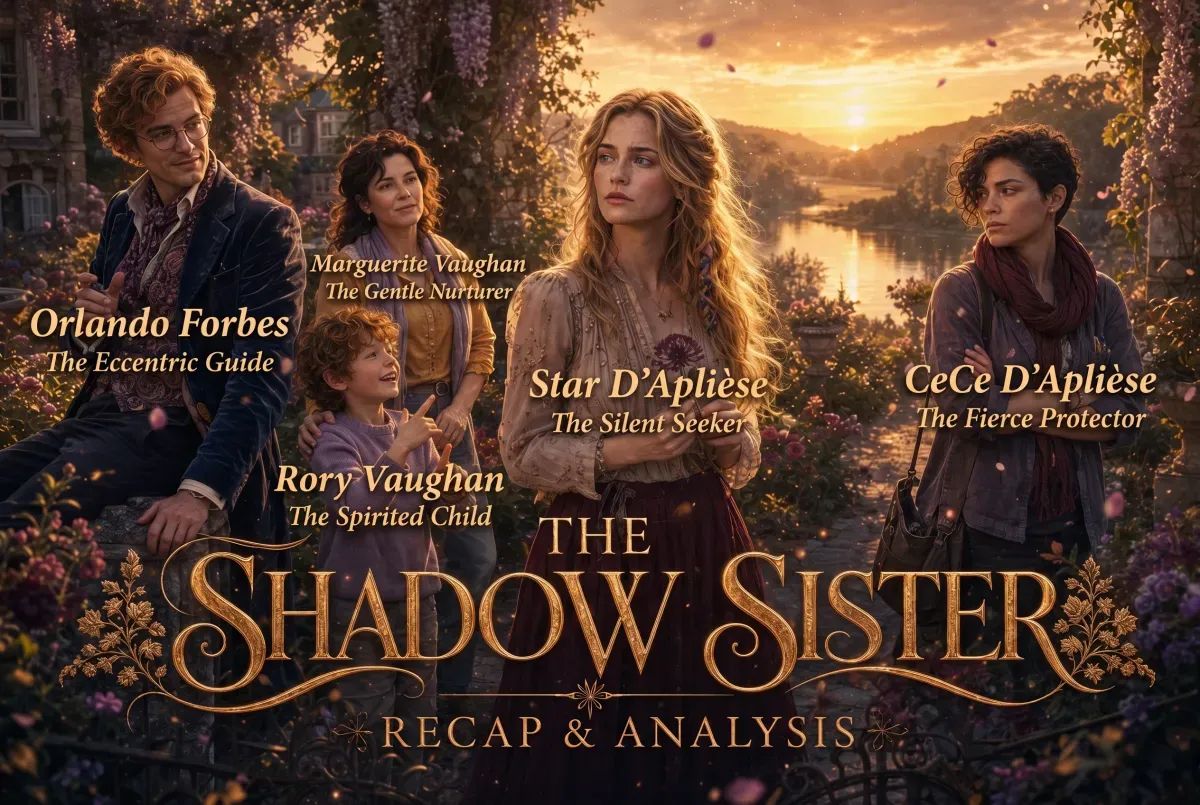
Star D'Aplièse,1 one of six adopted sisters, mourns her father Pa Salt15 inside a sterile glass apartment her sister CeCe2 has bought above the Thames. The two have always communicated in a private sign language born in childhood; loud, dyslexic CeCe2 speaks for the silent Star,1 and Star lets her, until the closeness curdles into suffocation.
Star1 once won a place at Cambridge and surrendered it to stay beside CeCe.2 Now twenty-seven, she aches to step out of her sister's domineering orbit. The Battersea flat, suspended and characterless, feels nothing like Atlantis, their enchanted home on Lake Geneva. Following her sister Tiggy's advice, Star1 begins writing her grief down, and quietly resolves that something in her life has to change.
The opening establishes codependency as both refuge and prison. Star's chosen muteness is not mere shyness but a survival strategy: by ceding voice to CeCe she avoids the risk of self-assertion. Riley frames the apartment, glass and rootless, as a literalized metaphor for a life lived on someone else's terms, contrasted against the organic, earthed paradise of Atlantis. Bereavement functions as a catalyst, loosening fixed identities. The psychological core is individuation: Star must separate from a fused dyad to become a self. The private sign language, intimate yet isolating, foreshadows the book's central question of who gets to speak and who is heard.
The Panther and the Address
At Atlantis, Star1 finally opens the envelope Pa Salt15 left. Inside lies a tender letter calling her his most complex daughter, a business card for Arthur Morston Books on Kensington Church Street, and instructions to ask there about a woman named Flora MacNichol.7
A small jewellery box holds a sleek onyx panther figurine with amber eyes. Pa15 hints that her trail to her origins is well concealed and will need human help, not objects, to unravel. Back in London, glimpsing the bookshop's sign from a passing bus feels like fate tightening.
After her sister Ally's fiancé Theo drowns in the Fastnet storm and Star1 attends his wrenching funeral, she finally gathers courage to enter the dusty shop, clutching her plastic wallet of clues and her fear in equal measure.
The quest narrative begins through inheritance rather than ambition: Star does not seek her past so much as it is bequeathed to her. The panther, an heirloom whose provenance is unknown to her, operates as a totemic lure, an object demanding a story. Theo's funeral introduces mortality and love's cost as parallel themes, and Ally's raw grief models the intensity of feeling Star has never allowed herself. The bus-glimpse coincidences gesture at the series' recurring tension between fate and agency. Crucially, Pa's note insists the answers require listening and human connection, validating Star's watchful nature as the very instrument of her self-discovery.
The Bibliophile's Strange Interview
Inside the cavernous, Dickensian shop, Star1 meets Orlando Forbes,3 a tall, anachronistic man in Edwardian dress who speaks in literary riddles and bans mobile phones from his premises. When she names Flora MacNichol,7 he reacts knowingly but slips away from answers, revealing only that Flora7 once knew Beatrix Potter,12 who briefly owned the shop.
Charmed when Star1 effortlessly identifies the obscure authors he tests her on, Orlando3 offers her a job on the spot, waving away any CV. Broke and starved for purpose, she accepts.
The shop becomes her sanctuary: cataloguing rare books in elegant longhand, sharing daily lunches, basking in a mind that flits like a bee between subjects. He dangles the promise of Flora's story7 and the panther's meaning, yet keeps deferring, drawing Star1 ever deeper.
Orlando embodies a deliberate refusal of modernity, a man who has retreated into the consoling order of literature and ritual. His instant recognition of Star's hidden erudition validates her in a way CeCe's loud advocacy never could; here her quietness reads as depth, not deficiency. The bookshop functions as a liminal threshold, a wardrobe into another time, where Star can try on a self outside her sister's reach. Riley sets up the recurring motif of withheld narrative: Orlando hoards Flora's story as he hoards books, doling it out to bind Star to him. Knowledge becomes both gift and currency of control.
The House She Could Not Leave
Orlando3 takes Star1 to High Weald in Kent for the seventh birthday of Rory,5 a charming deaf boy of the house, whom Star1 delights by reaching for her rusty sign language. She meets Marguerite,6 the warm, overstretched woman who paints murals to keep the crumbling estate afloat, and falls instantly in love with the rambling, beautiful house.
Then comes Mouse,4 Orlando's3 older brother: handsome, brilliant, and so cold he chills the room. He needles Star1 as a possible gold-digger and lectures Orlando3 about selling the loss-making bookshop.
Despite his rudeness, he takes her number, promising to share what he knows about Flora MacNichol,7 whom he has been researching for a fractured family history. Star1 leaves having found the place she could happily inhabit forever.
High Weald operates as the antithesis of CeCe's glass box: aged, organic, sunk into the earth, a home with foundations. Star's coup de foudre for the house is really a longing for rootedness and lineage. Riley introduces the wounded antagonist-as-future-love in Mouse, whose cruelty Star intuits as the armour of grief. Rory's deafness recasts Star's silence as connection rather than deficit; her childhood sign language, once a private bond with CeCe, becomes a bridge to a child who needs her. The estate's decay and the family's fractured history seed the inheritance mystery, hinting that Star's quest and theirs are entangled.
Flora's Lakeland Exile
Through journals Mouse4 shares, Star1 enters 1909. Flora MacNichol,7 nineteen and plain beside her exquisite sister Aurelia,9 roams the fells around Esthwaite Hall with her menagerie of rescued animals and her sketchbook.
The family is impoverished gentry; only Aurelia9 will have a London debut, funded by Aunt Charlotte. When the Vaughans come to tea, Flora7 recognizes the rider who nearly overturned her pony trap as Archie Vaughan,8 the boy who once pelted her with crab apples.
Grown now and devastatingly handsome, Archie8 writes her a charming apology, and Aurelia9 confesses she is already half in love with him. Flora,7 resigned to lonely spinsterhood among her plants and pets, dismisses Archie8 as an arrogant cad, blind to how her fierce, unflattered spirit has begun to captivate him.
The embedded historical narrative mirrors Star's present: two sisters, one luminous and favoured, one self-effacing and overlooked. Flora's identification with ghostly stick insects, creatures good at being invisible, rhymes with Star's chosen silence across the century. Riley uses the Edwardian marriage market to expose how women were appraised like livestock, and Flora's defiance, her breeches, her menagerie, her refusal to be presented, codes her as proto-feminist. The crab-apple history seeds an enemies-to-lovers arc while establishing Archie's careless privilege. Beneath the period charm runs a darker engine: economic desperation that will commodify both sisters, foreshadowing the sacrifices love and money will demand.
Three Days on Scafell
While her family is away in London, Archie8 returns to Esthwaite alone and coaxes Flora7 into guiding him through the mountains. Disguised in her father's breeches, she climbs Scafell Pike with him; sheltering under a blanket from a sudden squall, he kisses her and declares he adores her.
He begs her to trust him, hinting he must undo a terrible mistake before they can be together. Flora7 soon learns the mistake's shape: Archie8 had already agreed with her father to marry Aurelia,9 a match that would sell Esthwaite Hall to fund Aurelia's9 dowry and rescue his ailing estate, High Weald.
Torn between her newly awakened heart and her devotion to her sister, Flora7 retreats into anguished silence as Aurelia's9 lovesick letters from High Weald sharpen her guilt.
The mountain idyll is the novel's purest moment of self-actualization for Flora: in men's clothing, atop England's highest peak, she is free of gendered constraint and truly seen. The kiss is liberation and entrapment at once. Riley constructs a brutal moral geometry where economic survival, sisterly loyalty, and erotic love cannot coexist. Flora's tragedy is that her conscience is her undoing: the more deeply she loves, the more fiercely she must renounce. The breeches motif, recurring later when Star dons Mouse's metaphorical clothing, links the two heroines' journeys toward an authentic, un-performed selfhood briefly glimpsed and then surrendered to duty.
The King's Secret Court
Flora's7 parents sell Esthwaite and move to Scotland, dispatching Flora7 to London as a supposed tutor in the household of Mrs Alice Keppel,10 celebrated intimate of King Edward VII.11 Mystified, Flora7 finds herself corseted in finery, paraded through society, and inexplicably adored.
She is summoned to take tea with the King11 himself behind firmly closed parlour doors, and watches young Violet Keppel's17 consuming obsession with her friend Vita Sackville-West. Mrs Keppel10 insists Flora7 is no servant but a cherished guest, hinting at reasons she cannot yet disclose.
Flora,7 baffled by her sudden elevation and her sponsor's cryptic affection, senses she is a pawn in a game whose rules everyone knows but her. Beneath the glittering salons, she still aches for Archie,8 whose wedding to her sister now looms.
Riley immerses the reader in the Edwardian demimonde where adultery, discreetly managed, was woven into aristocratic marriage. Mrs Keppel reigns as an alternative queen, her salon a counter-court. Flora's bewilderment dramatizes a recurring structural irony: she is the last to understand her own story, a literal object of others' designs. The Keppel daughters, especially Violet's forbidden devotion to Vita, expand the novel's meditation on loves society refuses to sanction, echoing Flora's own. The motif of the pawn, of being moved by unseen hands, links to Pa Salt's orchestration of his daughters' quests, raising the book's quiet question of how much of any life is authored by others.
A Wedding, A Sealed Fate
Archie8 calls on Flora7 at Portman Square and confesses he avoided proposing to Aurelia9 because he loves Flora.7 Refusing to destroy her sister, Flora7 orders him to honor the engagement and make Aurelia9 truly happy. He obeys.
Yet at the wedding she cannot resist his kiss in the moonlit garden, and the perpetually drunk viscount Freddie Soames16 glimpses them. Cornered, and half-accepting it as her punishment, Flora7 agrees to marry Freddie,16 a foppish heir she neither loves nor respects, while Mrs Keppel10 gleefully orchestrates her launch as a future viscountess.
That Christmas the King11 gives Flora7 a Fabergé panther, naming the very figurine that will travel across a century. Engaged to a man she loathes while loving her sister's husband, Flora7 resigns herself to a life of self-inflicted misery.
Flora's renunciation is an act of radical, almost masochistic moral agency: she authors her own punishment to atone for a love she cannot help. Riley complicates simple villainy; everyone here is trapped by money and class. The garden kiss, witnessed by a fool, shows how a single uncontrolled moment can recolonize a carefully sacrificed future. The Fabergé panther, gifted now, closes the loop with Star's inherited figurine, the narrative's most elegant suture between timelines. Freddie embodies the era's grotesque arithmetic, where a woman's worth is measured against land and title. Flora chooses suffering over selfishness, the inverse of the self-realization the present-day plot will demand of Star.
Daughter of a Dead King
Aurelia9 discovers an incriminating letter and witnesses Flora7 and Archie8 together, then banishes her sister forever. Soon after, King Edward VII11 falls gravely ill and dies; Mrs Keppel,10 barred from his deathbed by the Queen, collapses in grief, and the household scatters, leaving Flora7 abandoned at Portman Square.
Her engagement to Freddie16 is abruptly cancelled now that the protective glamour has evaporated. Then Sir Ernest Cassel, the King's11 advisor, arrives bearing money and the truth: Flora7 is Edward VII's11 illegitimate daughter, the secret behind her mysterious patronage and her mother's long exile in the Lakes.
Reeling, she reads the King's11 own letter urging her to live freely and anonymously. With her beloved cat Panther tucked in a basket, Flora7 flees London for the only place that ever felt like home.
The revelation reframes the entire Keppel arc retroactively: Flora's inexplicable elevation was a father's quiet attempt to know and provide for a hidden child. Riley dramatizes the cruelty of illegitimacy in a rigid hierarchy, where blood confers both worth and erasure. The King's letter, prizing anonymity and authenticity over rank, becomes the book's thesis, that freedom from inherited expectation is the true inheritance. Aurelia's banishment and the King's death cluster into a single annihilating loss, stripping Flora of sister, suitor, sponsor, and father at once. Her flight north is regression and self-preservation, a wounded creature returning to its burrow to survive what cannot be undone.
Brownies, Pheasant, and a Thaw
Returning to the present, Star1 agrees to mind Rory5 at High Weald while Marguerite6 travels to France. Cooking from the orchard's windfall and teaching the boy signs, she watches Rory5 blossom under attention his busy family rarely gives.
Mouse,4 softening, admits over supper that he was once married and that his wife died, before retreating again into self-pity. He reveals the family teeters near bankruptcy and intends to sell the Kensington bookshop to clear its debts, which would devastate Orlando,3 whose entire identity lives among those shelves.
Star1 learns Orlando3 has hidden epilepsy and must take medication faithfully. She lends Mouse4 the Fabergé panther to authenticate, and they spar over Flora's missing journals, which Mouse4 needs to prove his father's claim that the Forbes line was cheated out of High Weald.
Domesticity becomes Star's medium of power: she heals through food, gardening, and patient attention, redefining ambition as care in a culture that prizes careers. Her bond with Rory, built on the very silence and signing she once shared only with CeCe, repurposes her wound into a gift. Mouse's grudging confession reveals grief as the source of his cruelty, inviting compassion rather than judgment. Riley layers the financial jeopardy to externalize the family's emotional bankruptcy: what is owed, what is lost, what might be saved. The disputed journals fuse the two timelines into a single inheritance mystery, where uncovering the past becomes the precondition for any livable future.
The Body at the Stairs
When Star1 agrees to also work for Marguerite,6 Orlando,3 hearing of it from Mouse,4 erupts and dismisses her as a traitor seduced by the family's siren call. Wounded, she returns the keys days later, only to find Orlando3 collapsed at the foot of the bookshop stairs, bloodied and unconscious after an epileptic seizure, the afternoon cake still gripped in his hand.
She calls an ambulance and saves his life. In the hospital, a chastened Orlando3 apologizes, rehires her, and grants his blessing to help with Rory.5 The crisis melts the standoff: the bookshop's sale moves forward, Orlando3 plans a charming new shop in Tenterden, and Mouse4 and Star,1 thrown together by emergency, edge toward something neither will name. Orlando3 finally agrees to tell Star1 the rest of Flora's story.7
Orlando's tantrum exposes the fragility beneath his erudite charm: his books are a substitute family, and Star's perceived defection reactivates an orphan's terror of abandonment. The seizure, foreshadowed earlier, pays off as both literal peril and metaphor for a man on the edge of collapse, saved by the quiet competence everyone underrates in Star. Riley uses the medical emergency to rupture pride and force reconciliation, a familiar but effective hinge. The bookshop's relocation reframes loss as renewal, mirroring the novel's larger argument that endings can be doorways. Star's value, repeatedly, lies not in self-assertion but in being present at the precise moment she is needed.
The Foundling Named Teddy
Orlando3 resumes Flora's7 tale where Mouse4 left off. After fleeing London, Flora7 bought a Lakeland farm and lived nine reclusive years, sustained only by Beatrix Potter's12 friendship and her animals. When her beloved cat Panther dies, Beatrix12 brings her a war orphan, the newborn son of a dead shepherd, and Flora,7 naming him Teddy13 after her royal father,11 claims him as her own.
Then Archie8 reappears, limping from war wounds, bearing devastating news: Aurelia9 has died ten days after giving birth to a daughter, Louise. In a final letter the dying Aurelia9 forgives Flora,7 releases her from guilt, and begs her to raise Louise and comfort Archie.8 The two great loves of Flora's7 life, sister and suitor, hand her a future built atop grief.
Flora's reclusion is self-punishment ossified into routine; her dead cat severs the last thread to a feeling past. Beatrix Potter, pragmatic and maternal, functions as the wise elder who keeps insisting that the living must move forward. The foundling Teddy embodies Flora's thawing heart and her instinct to nurture the abandoned, mirroring Pa Salt's own collection of orphaned daughters. Aurelia's deathbed forgiveness is the novel's moral pivot: it converts guilt into permission, reframing the lovers' future not as theft but as a dying woman's gift. Riley insists that absolution can come from the wounded party, transforming a tragedy of renunciation into a fragile, hard-won second chance.
The Lie That Made a Lord
Flora7 moves to High Weald with Teddy,13 raising him alongside baby Louise; born days apart, the two infants are so alike they pass as twins. Without consulting her, Archie8 registers Teddy's13 birth on Louise's date, claiming the foundling as his legitimate son and heir, an act he frames as honoring all the soldiers who fell, by handing a dead shepherd's child a title and estate.
Flora7 is horrified at the deception that erases her chance to be Teddy's13 legal mother and quietly disinherits Louise's true bloodline, yet she is now complicit.
After a year of secret courtship in the greenhouse, she and Archie8 marry. Flora7 pours her royal inheritance into restoring the house and gardens, and at last finds the love and belonging she once believed she would never know.
Archie's forgery, born of survivor guilt and noble intention, plants the time bomb that will detonate generations later. Riley probes how a single benevolent lie metastasizes into systemic injustice, dispossessing the legitimate while ennobling the accidental. The twins motif literalizes the novel's preoccupation with mistaken and constructed identity. Flora's complicity complicates her: the moral heroine becomes an accessory, bound by love into the very deception she fears. Yet these are also her years of fulfilment, suggesting Riley's hard truth that happiness and ethical compromise often share a bed. The restored garden, grown from a king's secret money, symbolizes beauty cultivated from buried, tainted roots.
Bombs Over Ashford
Decades on, Teddy13 grows dissolute, drunken, and entitled. During the war he impregnates a Land Girl, Tessie Smith, then denies it; Flora,7 shielding her son, pays Tessie to vanish and raise the child quietly, an act that shames her to the core. Then Archie,8 newly posted to RAF Ashford, is killed when a German bomb strikes the airbase.
Because he never rewrote his will, the old deception locks the estate, title, and house to Teddy,13 leaving Louise with nothing of her birthright. Flora,7 unable to expose the lie, buys neighbouring farmland to bequeath to Louise and her husband Rupert, leaves them the bookshop Beatrix Potter12 willed her, and quietly departs High Weald. She lives long and full, dying in her seventies beneath her rose arbour.
The chickens of Archie's lie come home, and Flora repeats the family pattern, protecting a flawed child by sacrificing justice to a wronged woman. Tessie's payoff is the original sin that will, unknown to all, seed Star's existence, the novel's most consequential offstage transaction. Archie's death by random bomb, after surviving so much, underscores Riley's recurring motif of love severed without farewell, echoing Ally's loss and Pa Salt's. Flora's quiet generosity to Louise reveals her ongoing moral accounting, atoning where she can without detonating the secret. Her peaceful death amid roses grants the embedded narrative a benediction: a woman who suffered greatly yet ultimately authored a life of meaning.
No Royal Blood After All
With Flora's7 full story told, Orlando3 connects the threads to Star.1 She is no blood relation of royalty or of the legitimate Vaughans. Instead, the panther and her birth coordinates, pinpointing Mare Street in Hackney, suggest she descends from Teddy's13 abandoned line, the very child Tessie Smith carried, making Star1 the great-granddaughter of Teddy,13 the maligned cuckoo of High Weald, and thus genuinely kin to Marguerite6 and Rory.5
Orlando's3 gleeful delight in the irony wounds Star,1 who flees in tears, raging at Pa Salt15 for delivering pain instead of belonging. Mouse4 finds her, comforts her, and gently insists she hear the rest before she judges. The revelation reframes everything: her clue led not to a crown but to ordinary, hard-won survival across three generations of struggling women.
Riley subverts the wish-fulfilment of secret royalty, the fantasy Orlando the snob craves, by routing Star's lineage through illegitimacy, poverty, and abandonment. The deflation is the point: belonging is not conferred by blue blood but by chosen connection, and Star is already loved by this family before any DNA is proven. Her tearful rage at Pa Salt voices the orphan's deepest fear, that the search for origins yields only fresh wounds. Mouse's tenderness here inverts his earlier cruelty, completing his arc toward repair. The Hackney coordinates ground the sweeping aristocratic saga in working-class reality, asserting the dignity of the unrecorded lives that history routinely erases.
Professor Sylvia Gray
Orlando's3 relentless detective work uncovers more. Star's1 birth certificate names her Lucy Charlotte Brown,1 born on Star's own birthday in 1980 to an eighteen-year-old named Petula Brown.14
But Petula14 vanished from the records because she changed her name to Sylvia Gray14 and rose, against every odd, from London's East End to become a professor of Russian literature at Yale, now married with three children. A photograph reveals a face uncannily like Star's1 own, only older and groomed.
Orlando,3 thrilled, urges Star1 to attend Sylvia's14 upcoming Cambridge lecture, but Star,1 terrified and ashamed, refuses. The mother who seemingly abandoned her baby went on to conquer the very Cambridge world Star1 herself surrendered for CeCe,2 and the jealousy and grief of that parallel paralyze her into staying away.
The mirror-photograph crystallizes identity's uncanny pull: Star sees her own future face in a stranger. Riley engineers a painful symmetry, the mother seized the educational opportunity the daughter relinquished, turning the reunion into a confrontation with Star's own roads not taken. Sylvia's trajectory rebukes determinism, proving class origins need not dictate destiny, while implicitly indicting Star's self-suppression. The refusal to attend the lecture is cowardice rooted in unworthiness, the same self-effacement that has shadowed Star throughout. The motif of names, Petula to Sylvia, Lucy to Star, underscores the book's theme that identity is partly self-authored, that one can rewrite the self even when the past cannot be undone.
The Mother Who Was Lied To
Mouse4 attends the Cambridge lecture himself and brings Sylvia14 to High Weald unannounced. Confronted with her near-mirror image, Star1 recoils, then breaks.
Sylvia14 reveals she never gave her baby away: her bitter, controlling mother forged a death certificate and told her the infant died of cot death, a lie confessed only after the old woman's recent death. She produces a charm bracelet she had made for the daughter she mourned for decades. Slowly, Star1 believes, and embraces her.
That same night Mouse4 delivers his own shattering confession: he loves Star,1 and Rory5 is not his nephew but his son. His deaf wife Annie died of cancer after refusing treatment to protect her pregnancy, and Mouse,4 blaming the baby, abandoned the boy to grief for years.
The double confession braids the novel's central wounds: maternal loss and parental abandonment, each rooted not in indifference but in catastrophe and denial. Sylvia's exoneration reframes abandonment as theft, restoring Star's narrative of being wanted, which is precisely the belonging she has hungered for. The charm bracelet, an unfinished ritual of love, materializes years of unspoken grief. Mouse's parallel revelation, that he rejected Rory out of blame and breakdown, mirrors Flora's and Teddy's failures of parenthood across the timelines, while offering the possibility of repair. Riley insists that the unforgivable can be understood, that grief distorts love into cruelty, and that truth, however late, can begin to heal.
The Sister Left Behind
Consumed by High Weald and her new family, Star1 neglects CeCe,2 who, lonely and adrift after quitting art college, leaves a misspelled, heartbroken note and disappears, ignoring Star's1 frantic calls. Wracked with guilt, Star1 realizes she abandoned the sister who spent a lifetime loving and speaking for her.
Meanwhile she commits to helping Mouse4 rebuild a bond with Rory;5 the man learns to bathe, read to, and sign with the son he once could not bear to look at. At her sister Ally's Bergen concert, Star1 glimpses a figure she swears is the dead Pa Salt.15 Eventually CeCe2 texts that she is safe and travelling, freeing Star,1 at last, to step fully into her own life and tentatively toward Mouse's4 love.
The cost of individuation comes due: Star's liberation is CeCe's exile, and Riley refuses to let self-actualization arrive guilt-free. The reversal, CeCe now the abandoned one, completes the dyad's painful unbraiding and reframes their codependence as mutual, not one-sided. Mouse's tender re-fathering of Rory enacts the reparative parenthood the historical timeline kept failing to achieve. The phantom sighting of Pa Salt threads the series' larger enigma through this volume, suggesting the orchestrator of these quests may not be entirely gone. The quote from Gibran framing the whole novel, of spaces in togetherness, finds its meaning here: love survives separation, and growth requires the courage to let go.
Where the Story Began
Before she can give herself to Mouse,4 Star1 confesses she is a virgin, never having had room for love beside CeCe.2 Tender rather than dismissive, Mouse4 takes her to the Lake District and Esthwaite Hall, now a hotel, Flora MacNichol's7 childhood home.
They visit Beatrix Potter's12 farm, Flora's7 lonely cottage, and climb the Langdale Valley. He returns the authenticated Fabergé panther, worth a fortune, as her rightful legacy from Teddy's13 line.
Then he reveals his true name: Oenomaus,4 the figure mythologically bound to Asterope, the woman behind Star's1 own name. He claims fate wrote them together from the moment he first heard who she was. Star1 feels her long-walled heart finally pour open, and agrees to go home with him to High Weald, and to Rory.5
The climax returns the present-day lovers to the precise landscape of the embedded tragedy, collapsing the two timelines into one redemptive arc: where Flora suffered loneliness, Star claims love. The virginity confession completes Star's journey from silence to disclosure, her ultimate act of voiced vulnerability. Riley closes the panther's circuit, the king's gift to Flora becoming Star's inheritance, binding past and present in a single object. The mythological name-match, Oenomaus and Asterope, gilds the romance with the series' fate motif, though notably it is Star's chosen openness, not destiny, that unseals her heart. The reunion of father, son, and chosen mother forms the healed family the historical narrative could never quite secure.
Epilogue
In a closing fragment from CeCe's2 perspective, she sits alone at Heathrow, unable to write down feelings she can only think. She reflects on how her love for Star1 curdled into a cage, how the apartment meant to bind them only drove her sister away. She has quit college, surrendered to wanderlust, and is flying toward one of the two places she always avoided.
Boarding without Star1 beside her for the first time, missing the calming pill her sister1 always slipped her, she clutches Pa Salt's15 letter and a small black-and-white photograph. Then, on the travelator, she glimpses a heartbreakingly familiar face among the crowd and runs back, but the final boarding call sounds and the figure is gone.
Shifting at last into CeCe's voice, Riley grants the silenced sister her own interiority, revealing the depth of feeling that never translated into speech or text, an inversion of Star, who could not speak aloud but wrote beautifully. The passage reframes the entire novel's central relationship: CeCe was not a tyrant but a frightened soul terrified of abandonment, whose every controlling gesture was love misfired. Her solitary departure both completes Star's liberation and launches the next sister's quest. The fleeting glimpse of a familiar face, echoing Star's sighting of Pa Salt, sustains the series' overarching mystery and ensures grief and hope remain unresolved, propulsive, and human.
Analysis
The Shadow Sister braids two women separated by a century who share a defining trait: the habit of self-erasure. Flora7 silences her desires for duty; Star1 silences her voice for her sister. Riley's dual structure is not decoration but argument, insisting that the past must be read before the present can be lived, and that inherited patterns of sacrifice can be either repeated or broken. The recurring motif of voice, signed, written, withheld, asks who gets to author a life. Both heroines are spoken for, managed, and elevated by others until they learn, painfully, to speak themselves. The novel interrogates inheritance in every sense: blood, money, property, and trauma. Crucially, it subverts the fairy-tale of secret royalty; Star's1 clue leads not to a crown but to a Land Girl, a forged birth record, and three generations of unrecorded women surviving against the odds. Belonging, Riley argues, is conferred not by lineage but by chosen love; Star1 is embraced by the Vaughan-Forbes family before any genealogy is confirmed. The book is also a sustained meditation on grief's capacity to distort love into cruelty, embodied in Mouse,4 who blames a child for a death, and in Flora7 and Teddy's13 failures of parenthood, all offered the possibility of repair. The Gibran epigraph about spaces in togetherness supplies the thematic key: love survives separation, and individuation requires the courage to let go, dramatized in the bittersweet unbraiding of Star1 and CeCe.2 Riley quietly champions an unfashionable value, that a domestic life of cooking, gardening, and care is as worthy as worldly ambition. The cost of self-realization is honestly reckoned: Star's1 liberation is CeCe's2 exile. Ultimately the novel celebrates quiet courage, the kind that saves a collapsed man, raises an orphan, or finally speaks one true word.
Review Summary
The Shadow Sister receives mostly positive reviews, with readers praising its engaging dual-timeline storyline, rich historical details, and complex characters. Many find Star's journey of self-discovery compelling, while others particularly enjoy Flora's historical narrative. The book's focus on literature and connection to Beatrix Potter is appreciated. Some readers note it requires commitment due to its length and intricate plot. A few criticize Star's character development and the romance subplot. Overall, it's considered a strong entry in the Seven Sisters series.
People Also Read
Characters
Star (Asterope)
Watchful silent seekerThe novel's present-day protagonist, third of six adopted sisters, intelligent, observant, and so quiet that childhood led her to a private sign language with CeCe2. An English Literature graduate who surrendered a Cambridge place to stay with her sister, she has spent years travelling in CeCe's2 shadow, speaking little because her sister speaks for her. She finds joy in cooking, gardening, and rare books, the simple, nurturing pursuits a striving culture undervalues. Psychologically, she is defined by a fused, codependent attachment and a terror of self-assertion; her muteness is both shield and prison. Pa Salt's15 death and his cryptic clue propel her, reluctantly and bravely, toward separation, identity, and the frightening possibility of being truly seen, heard, and loved on her own terms.
CeCe (Celaeno)
Fierce devoted sisterStar's1 adopted sister and lifelong companion, loud, fearless, dyslexic, and ferociously protective. Where Star1 is silent, she fills every space with words; where Star1 reads, she paints and pursues physical daring. She buys the sisters a glass apartment in London, an act of love experienced by Star1 as suffocation. Her overdeveloped hearing and her nightmares hint at deep vulnerability beneath the bravado. Psychologically she is driven by an orphan's dread of abandonment, channelling fear into control and constant advocacy for Star1. Her possessiveness is misfired devotion: she cannot conceive of a self that is not half of a pair, which makes the prospect of Star's1 independence feel like annihilation rather than growth.
Orlando Forbes
Eccentric rare-book dealerProprietor of Arthur Morston Books, a tall, anachronistic man who dresses in Edwardian velvet, speaks in literary riddles, and reveres the past as a gentler age. Brilliant and exacting, with obsessive habits and a tender heart, he conducts business by whim and quotation. He becomes Star's1 employer, mentor, and unlikely friend, recognizing the depth her silence conceals. He carries hidden epilepsy and an orphan's history, having lost both parents young, and his books function as a surrogate family he guards jealously. Psychologically, he uses ritual and literature to insulate himself from a reality he finds coarse and threatening, retreating into narrative to avoid the chaos of feeling and loss.
Mouse (Oenomaus) Forbes
Brooding grief-locked brotherOrlando's3 older brother, a former architect now reluctantly farming the family land, handsome, formidably intelligent, and initially glacial in his rudeness toward Star1. He is obsessed with researching the family history, convinced his branch was cheated of its inheritance. Beneath the cruelty lies catastrophic loss and unprocessed guilt that have hollowed him for years and corroded his relationships. He blows hot and cold, swinging between flashes of warmth and bitter self-pity, a man at war with his own capacity to feel. His arc is one of slow, halting repair: learning to forgive himself, to love again, and to become the father and partner his wounds had made impossible.
Rory
Bright deaf boyA charming, copper-haired deaf boy living at High Weald, fluent in sign language and a gifted painter beyond his years. Optimistic, affectionate, and trusting, he draws love from everyone around him and bonds instantly with Star1 through signing. His resilience and emotional openness make him the emotional heart of the household, and the child whose need for stability and a parent's love quietly drives much of the adults' moral reckoning.
Marguerite Vaughan
Overstretched estate chatelaineThe tall, striking, warm-hearted woman who runs the crumbling High Weald and paints murals to pay its bills. Cousin to Orlando3 and Mouse4, she is bohemian, generous, and perpetually exhausted by the burden of the house and her caregiving responsibilities. She welcomes Star1 readily and longs for a life and love of her own beyond the demands of duty, embodying the novel's recurring figure of the strong woman holding a faltering family together.
Flora MacNichol
Lakeland diarist heroineThe protagonist of the historical narrative, an Edwardian gentlewoman who considers herself plain beside her radiant sister9. Fierce, intelligent, and deeply attuned to nature, she keeps a menagerie of rescued animals, sketches wildflowers, and resigns herself early to spinsterhood rather than the marriage market she despises. A prolific diarist and reader, she observes everything and says little, a mirror across a century to Star1. Psychologically, she is governed by a near-punishing conscience and a self-effacement that makes her sacrifice her own happiness for those she loves. Her journey tests how much a woman of integrity can endure before duty, love, and survival force impossible choices upon her.
Archie Vaughan
Charismatic conflicted suitorHeir to the ailing High Weald estate, devastatingly handsome, a passionate amateur botanist who wears his heart on his sleeve. As a boy he tormented Flora7; as a man he is drawn irresistibly to her fierce, unflattered spirit even as financial necessity entangles him with her sister9. Charming yet capable of self-serving rationalization, he genuinely seeks love rather than mere advantage. The wars and losses of his era reshape him from an exuberant young man into a thoughtful, haunted adult, and his choices, born of both ardour and guilt, ripple destructively and creatively across generations.
Aurelia
Beautiful favoured sisterFlora's7 younger sister, golden-haired, sweet-natured, and fragile, treated like a porcelain doll by the family. Adored and indulged, she is destined for a London debut and an advantageous marriage. Trusting and tender, she loves Flora7 above all others, which makes the secrets between them especially fraught. Her gentleness masks a perceptiveness that surfaces painfully when betrayal touches her closest bonds.
Mrs Alice Keppel
Magnetic society patronThe celebrated, powerful mistress at the heart of Edwardian high society, who becomes Flora's7 mysterious sponsor. Regal, discreet, and shrewd, she rules her salon like a queen and can secure anything with a single word. Beneath the calculated charm lies genuine devotion and private vulnerability. She orchestrates Flora's7 elevation with motives that blend generosity, ambition, and affection, embodying the era's intricate codes of discretion and influence.
King Edward VII (Bertie)
Ailing jovial monarchThe aging, cigar-loving King of England, jovial yet weighed down by ill health and the loneliness of his position. Warm with children and quick to laughter, he conceals private sorrows beneath bluster. Long denied a meaningful role by his mother, he treasures the unguarded company he finds in certain households, and takes a particular, tender interest in Flora7.
Beatrix Potter
Pragmatic literary mentorThe famous children's author and Lakeland farmer, Flora's7 neighbour, closest friend, and guiding spirit. Sometimes thought a bad-tempered eccentric by villagers, she is in truth kind, clear-eyed, and fiercely practical, a lover of animals and land. She repeatedly nudges Flora7 to rejoin the living world and to act before time runs out, embodying earned wisdom and the consolations of work and nature.
Teddy
Charismatic dissolute heirA handsome, blond, blue-eyed young man raised in privilege at High Weald, charming but increasingly entitled, idle, and given to drink and womanizing. The apple of his mother's7 eye, he resists discipline and responsibility, leaving wreckage in his wake. His self-indulgence and lack of compassion test the limits of maternal love and set consequences in motion that echo far beyond his own lifetime.
Sylvia Gray
Reinvented accomplished motherA warm, elegant professor of Russian literature at Yale who rose from London's East End against every odds. Bright, driven, and articulate, she married into academia and built a full life with three children. Beneath her poise lies decades of grief and a fierce, undimmed love she was never allowed to express, making her both an intimidating mirror and a longed-for source of belonging.
Pa Salt
Mysterious orchestrating fatherThe enigmatic, immensely wealthy adoptive father of the six sisters, recently deceased, who raised them with love at Atlantis and named each after a star of the Pleiades. A passionate gardener and a man of unknowable origins, he leaves each daughter letters, coordinates, and clues to her heritage. His presence haunts the novel as both benefactor and puzzle, a quiet architect of his daughters' journeys toward themselves.
Freddie Soames
Drunken aristocratic suitorA handsome, wealthy, perpetually intoxicated viscount considered the catch of Edwardian London, who pursues Flora7 relentlessly. Beneath the glamour he is foppish, dim, and self-absorbed, embodying the era's grotesque equation of marriage with land and title rather than love.
Violet Keppel
Intense passionate daughterThe elder Keppel daughter, precocious and willful, consumed by a forbidden devotion to her friend Vita Sackville-West. Bright and defiant, she rejects society's expectations of women and marriage, voicing the novel's questions about loves the world refuses to sanction.
Plot Devices
The Fabergé panther
Heirloom clue across timeA small black onyx cat with amber eyes that Pa Salt15 leaves Star1 as her inheritance clue. As Flora's journals unfold, the same figurine surfaces in the past as a Christmas gift she once received, stitching the two timelines into one continuous thread. It operates as the novel's central material talisman: an object whose provenance must be decoded, drawing Star1 deeper into the Vaughan and Forbes history and ultimately confirming her bloodline. Its eventual authentication as a genuine Fabergé piece, worth a fortune, transforms it from sentimental keepsake into literal legacy. Riley uses it to dramatize how objects carry buried narratives, and how an inheritance can be both monetary and a recovered sense of self.
Flora's journals
Embedded historical narrativeDecades of silk-covered diaries kept by Flora MacNichol7, read aloud and transcribed by Mouse4 and then Orlando3 for Star1. They constitute the framing mechanism through which the entire 1909 to 1944 storyline reaches the reader, told as a story-within-the-story. They are simultaneously plot object and engine: their contents reveal the past, while their physical whereabouts (hidden, removed, sought) drive present-day tension and expose family conflicts over inheritance. A secret pocket inside one conceals the King's letter11, layering revelation upon revelation. Riley uses the device to control disclosure, to mirror Star's1 identity as a writer and reader, and to argue that recovering the past is the precondition for an authentic future.
Coordinates and letters
Quest-launching inheritance cluesPa Salt's15 posthumous legacy: an armillary sphere engraved with coordinates pinpointing each daughter's birthplace, paired with personal letters and quotations. For Star1, the coordinates lead to a humble Hackney street, and the letter directs her to a bookshop and a name, Flora MacNichol7. These devices launch the present-day quest and supply a controlled trail of breadcrumbs. The Gibran quotation about spaces in togetherness frames the novel's meditation on love and separation. Riley uses the clues to externalize the theme of orchestrated destiny versus self-authored identity, and to structure the mystery so that geography (working-class London) deliberately deflates the fantasy of secret aristocratic origins.
Private sign language
Motif of voice and silenceA hybrid of French sign language and invented gestures that Star1 and CeCe2 developed in childhood, allowing the near-mute Star1 to communicate without speaking aloud. The motif recurs structurally: it cements the sisters' suffocating closeness, then is repurposed when Star1 bonds with the deaf boy Rory5, and later when a grieving man4 reveals he too has long known how to sign. Riley deploys signing to dramatize the novel's central preoccupation with who speaks, who is heard, and how love can be expressed beyond words. What once bound Star1 into dependence becomes, transformed, the very gift through which she connects, heals, and finally finds her own voice.
The twin birth deception
Forged identity time bombAt High Weald, a grief-stricken man8 secretly registers a foundling's13 birth on the same date as his legitimate daughter, claiming the orphan as his twin son and rightful heir. Framed as an act of honour toward war dead, the lie quietly dispossesses the true bloodline and falsifies an entire family lineage. Decades later, this forgery determines who inherits the estate and title, and ultimately routes Star's1 own descent through the dispossessed, illegitimate line. Riley uses the deception to explore how a single well-intentioned falsehood metastasizes across generations, to power the inheritance dispute that fractures the present-day family, and to deliver the climactic revelation of Star's1 true, unglamorous, and hard-won heritage.
FAQ
Synopsis & Basic Details
What is The Shadow Sister about?
- A Quest for Identity: The story follows Star D'Aplièse, one of six adopted sisters, who embarks on a journey to uncover her origins after the death of her enigmatic father, Pa Salt. Her only clues are a letter and coordinates leading to a London bookshop.
- Intertwined Past and Present: Star's search connects her to the historical narrative of Flora MacNichol, a young woman in Edwardian England whose life is marked by societal expectations, hidden lineage, and a complex love triangle, revealed through her detailed journals.
- Finding Voice and Belonging: As Star delves into Flora's past and navigates her own present relationships, particularly her co-dependent bond with her sister CeCe and a burgeoning connection with the Forbes family at High Weald, she grapples with finding her own voice, independence, and a true sense of belonging.
Why should I read The Shadow Sister?
- Rich Historical Detail: The novel offers a captivating immersion into Edwardian society, particularly the lives of the aristocracy and the artistic/literary circles, brought to life through vivid descriptions and historical figures like Beatrix Potter and King Edward VII.
- Complex Character Journeys: Readers will be drawn into the emotional depth of both Star and Flora as they navigate societal pressures, personal secrets, and the universal search for identity and love, offering relatable struggles despite the historical setting.
- Intriguing Mystery and Family Saga: The layered mystery of Star's adoption and Flora's hidden past, interwoven with themes of fate, forgiveness, and the enduring power of love and family across generations, provides a compelling and satisfying reading experience.
What is the background of The Shadow Sister?
- Edwardian England's Social Fabric: The historical narrative is set against the backdrop of early 20th-century England, exploring the rigid social hierarchy, the expectations placed upon women, the impact of the Boer War and World War I, and the hidden lives within aristocratic circles, including the King's private life.
- The Lake District's Natural Beauty: Flora's story is deeply rooted in the natural world of the Lake District, contrasting the wild, untamed landscape with the constraints of society and symbolizing Flora's own desire for freedom and authenticity, influenced by figures like Beatrix Potter.
- The Seven Sisters Mythology: The novel is part of a series inspired by the Pleiades constellation, with each sister named after one of the stars. Star's mythological namesake, Asterope, is often depicted as the "shadowed" or less visible sister, mirroring Star's initial feelings of being overshadowed by CeCe.
What are the most memorable quotes in The Shadow Sister?
- "The oak tree and the cypress grow not in each other's shadow.": This quote, found in Pa Salt's clue for Star and attributed to Khalil Gibran, perfectly encapsulates the central theme of Star's relationship with CeCe and her struggle for independence, highlighting the need for individual growth outside of another's dominance.
- "Live your life in the freedom of anonymity as I wished to have had the chance to live mine. And above all, be true to yourself.": From King Edward VII's letter to Flora, this quote reveals his regret over the constraints of his royal life and serves as a powerful message of authenticity and freedom that resonates deeply with Flora's journey and ultimately influences Star's path.
- "Love is never wrong, darling Flora, it's only the timing that can be.": Archie's declaration to Flora in the garden at High Weald captures the essence of their forbidden love and the tragic circumstances that initially kept them apart, underscoring the novel's exploration of love's complexities and sacrifices.
What writing style, narrative choices, and literary techniques does Lucinda Riley use?
- Dual Narrative Structure: The novel employs alternating perspectives between the present-day protagonist, Star, and the historical figure, Flora MacNichol, linked by Pa Salt's clues. This structure allows for parallel thematic exploration and gradually reveals connections between the two timelines.
- Descriptive and Evocative Prose: Riley uses rich, sensory language, particularly in describing settings like the Lake District, High Weald, and Edwardian London, immersing the reader in the atmosphere and emotional landscape of each era.
- Symbolism and Motif: Recurring symbols such as plants (Astrantia, camellia, rosemary), animals (Panther, the cuckoo, the thrush), houses (Atlantis, Esthwaite Hall, High Weald, Portman Square), and names (Asterope, Teddy, Mouse) are woven throughout the narrative to deepen meaning and connect characters and themes across time.
Hidden Details & Subtle Connections
What are some minor details that add significant meaning?
- Star's Name and Mythology: Star's full name, Asterope, and its mythological association with being the least visible or "shadowed" Pleiad sister, subtly foreshadows and explains her lifelong struggle with feeling unseen and overshadowed, particularly by CeCe.
- The Fabergé Panther Figurine: The small onyx panther left by Pa Salt is initially a mysterious object, but Flora's journal reveals it was a gift to her from King Edward VII, symbolizing her royal lineage and providing a tangible link across generations that helps Star uncover her true connection to the historical narrative.
- Beatrix Potter's Letter to Young Flora: The framed letter from Beatrix Potter in the bookshop, initially just a charming detail, becomes a crucial piece of evidence linking Flora directly to the shop's history and Beatrix's life, highlighting the enduring impact of early inspiration and kindness.
What are some subtle foreshadowing and callbacks?
- CeCe's Fears and Dependence: CeCe's childhood fears of spiders and the dark, and her reliance on Star for comfort, subtly foreshadow the deeper anxieties and co-dependence that continue to shape their adult relationship and Star's struggle to break free.
- The Location of Arthur Morston Books: Star's accidental bus route taking her past the bookshop before she even opens Pa Salt's clue foreshadows the fated nature of her connection to the place and the history it holds, suggesting destiny at play.
- Flora's "Cuckoo in the Nest" Feeling: Flora's early feeling of being a "cuckoo in the nest" due to her appearance and personality differing from her family subtly foreshadows the later revelation of her true parentage and her literal status as an outsider in the MacNichol family.
What are some unexpected character connections?
- Star's Biological Mother's Academic Path: The revelation that Star's biological mother, Sylvia Gray (formerly Petula Brown), became a renowned professor of Russian literature at Yale, despite her difficult start, is an unexpected connection that highlights a shared intellectual passion and resilience across generations, linking Star's love for books to her biological heritage.
- Mouse's Connection to Rory: The shocking confession that Mouse is Rory's biological father, not his uncle, completely reframes their relationship and Mouse's motivations, revealing a deep, hidden trauma and adding a profound layer of complexity to his character and his bond with Rory and Star.
- Flora's Link to the Keppel Household: Flora's placement in the seemingly random Keppel household in London is later revealed to be a deliberate act orchestrated by her biological father, King Edward VII, through his mistress Alice Keppel, highlighting the hidden network of influence and protection surrounding Flora due to her lineage.
Who are the most significant supporting characters?
- Orlando Forbes: As the eccentric owner of Arthur Morston Books, Orlando serves as Star's initial guide into her past, a source of intellectual stimulation, and a loyal friend. His knowledge of history, literature, and his own family's connection to Flora are crucial to Star's discoveries.
- Mouse (Oenomaus) Forbes: Orlando's brother, Mouse, initially appears aloof but becomes a significant figure in Star's journey, providing key information about Flora's journals and the Forbes/Vaughan family history. His personal struggles and eventual vulnerability forge a deep emotional connection with Star.
- Beatrix Potter: Though appearing only briefly in person in Flora's narrative, Beatrix Potter is a profound influence and later a crucial benefactor. Her early encouragement of Flora's artistic talent and her later act of providing refuge and a legacy (the bookshop) are pivotal moments in Flora's life and Star's connection to it.
- Alice Keppel: As King Edward VII's mistress and Flora's patron in London, Alice Keppel is a powerful and complex figure. Her role in introducing Flora to society and the King, and her later support, are instrumental in Flora's story, revealing the hidden world of the Edwardian elite.
Psychological, Emotional, & Relational Analysis
What are some unspoken motivations of the characters?
- Star's Need for Independence: Beneath Star's quiet compliance lies a deep, unspoken yearning for autonomy and self-definition, driven by years of feeling subsumed by CeCe's personality and the collective identity of the adopted sisters. Her hesitation to open Pa Salt's letter initially stems from a fear of disrupting the only identity she's known.
- CeCe's Fear of Abandonment: CeCe's loud, controlling, and co-dependent behavior is implicitly motivated by a profound fear of being left alone, stemming from their shared experience of adoption and relying solely on each other during their travels. Her resistance to Star's independence is a desperate attempt to maintain their protective unit.
- Mouse's Self-Punishment: Mouse's initial bitterness, aloofness, and neglect of his responsibilities are unspoken manifestations of his intense grief and guilt over his wife Annie's death, which he wrongly blames on Rory's birth. His self-destructive behavior is a form of penance and emotional paralysis.
What psychological complexities do the characters exhibit?
- Star's Selective Mutism/Introversion: Star's difficulty expressing herself verbally, noted by her childhood speech therapist and contrasted with her ability to write and communicate through sign language, highlights a deep-seated introversion or selective mutism rooted in her early experiences and relationship with CeCe, impacting her ability to assert herself.
- Flora's Resilience and Adaptation: Flora exhibits remarkable psychological resilience, adapting from a sheltered aristocratic life to self-sufficient farming, enduring heartbreak and loss, and later navigating complex social dynamics. Her ability to compartmentalize grief and focus on practical tasks (like farming or managing High Weald) is a coping mechanism developed through hardship.
- Mouse's Trauma and Repressed Grief: Mouse's psychological state is deeply affected by the trauma of losing his wife and father in quick succession, compounded by his misplaced guilt regarding Rory. His initial inability to bond with his son and his emotional withdrawal are complex responses to overwhelming grief and trauma, requiring significant effort to overcome.
What are the major emotional turning points?
- Star Opening Pa Salt's Letter: This act is a pivotal emotional turning point for Star, symbolizing her conscious decision to confront her past and embark on a journey of self-discovery, moving beyond her initial paralysis after Pa Salt's death.
- Flora's Discovery of Her Parentage: The revelation that King Edward VII is her biological father is a seismic emotional shift for Flora, recontextualizing her entire life, her mother's actions, and her place in society, leading to both disorientation and eventual liberation.
- Mouse's Confession to Star: Mouse's raw confession about Annie's death, his guilt regarding Rory, and his feelings for Star is a major emotional turning point for him, breaking years of silence and self-imposed isolation, and opening the possibility for healing and a new relationship.
- Star Meeting Her Biological Mother: The unexpected meeting with Sylvia Gray is a highly charged emotional climax for Star, forcing her to confront her feelings of abandonment and begin the complex process of understanding and potentially forgiving her biological mother.
How do relationship dynamics evolve?
- Star and CeCe's Shifting Co-dependence: The relationship between Star and CeCe evolves from a seemingly unbreakable, mutually dependent bond into one strained by Star's growing need for independence. Their eventual physical separation, though painful, is presented as a necessary step for both sisters to develop individual identities.
- Flora and Archie's Forbidden Love: The relationship between Flora and Archie transforms from childhood antagonism to a deep, forbidden love that endures despite separation, societal constraints, and tragedy. Their eventual reunion and marriage are the culmination of years of unspoken feelings and sacrifice.
- Mouse and Rory's Developing Bond: The relationship between Mouse and his son Rory evolves from Mouse's initial avoidance and misplaced resentment to a conscious effort to connect and build a father-son bond, facilitated by Star's presence and Mouse's decision to confront his grief.
- Star and Mouse's Tentative Connection: Star and Mouse's relationship develops from initial curiosity and shared interests into a deep emotional connection, built on shared vulnerability, understanding of loss, and a mutual desire for healing and belonging, culminating in a tentative romantic relationship.
Interpretation & Debate
Which parts of the story remain ambiguous or open-ended?
- Pa Salt's True Identity and Death: The novel, like others in the series, leaves Pa Salt's ultimate identity and the circumstances of his death ambiguous. His sudden disappearance and private burial at sea remain unexplained, fueling the overarching mystery of the series.
- Merope, the Missing Sister: The identity and fate of the seventh sister, Merope, whose band on the armillary sphere is empty, remain a central mystery throughout the series, including in Star's story, leaving her existence and connection to the other sisters open to speculation.
- The Fate of Flora's Missing Journals: While Orlando reveals he hid Flora's later journals, the narrative doesn't explicitly detail what happens to them after Star reads them. Their future, whether they are published or remain a private family history, is left open.
What are some debatable, controversial scenes or moments in The Shadow Sister?
- Flora and Archie's Affair: The passionate encounter between Flora and Archie on the night of his wedding to her sister Aurelia is morally complex and debatable. While presented as an act of overwhelming, long-repressed love, it is also a significant betrayal of Aurelia, sparking debate about the characters' culpability and the nature of love versus loyalty.
- Archie's Lie About Teddy's Birth: Archie's decision to register Teddy as his and Aurelia's son, effectively erasing Teddy's true parentage and Flora's brief period as his mother, is a controversial act. While motivated by a desire to protect Teddy and honor his biological father, it involves deception and has lasting consequences for the family history and inheritance.
- Flora's Deal with Tessie: Flora's offer of money to Tessie, the Land Girl, to ensure her silence about Teddy's paternity is a morally ambiguous moment. While it protects Teddy and provides for Tessie and her child, it also involves covering up the truth and using financial leverage, raising questions about Flora's actions despite her good intentions.
The Shadow Sister Ending Explained: How It Ends & What It Means
- Star Finds Belonging and Love: The Shadow Sister ending sees Star embracing her newfound biological family (her mother Sylvia) and solidifying her chosen family (the Forbes/Vaughan clan). She accepts her past, including her biological mother's difficult choices, and finds a sense of belonging at High Weald and in her work at the bookshop.
- A New Relationship Begins: Star and Mouse (Oenomaus) acknowledge their deep connection and decide to pursue a romantic relationship. Mouse confronts his grief and guilt over Annie and Rory, while Star overcomes her fear of intimacy and vulnerability, suggesting a future built on mutual understanding and healing.
- Breaking Free and Finding Voice: Star's journey culminates in her breaking free from CeCe's shadow and her own self-imposed silence. By confronting her past, accepting love, and finding her place, she finally finds her voice and the courage to live authentically, symbolized by her decision to stay at High Weald with Mouse and Rory.
The Seven Sisters Series
About the Author
Other books by Lucinda Riley
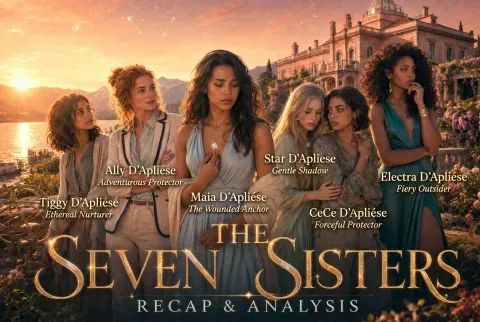





Download PDF
Download EPUB
.epub digital book format is ideal for reading ebooks on phones, tablets, and e-readers.








































