

Key Takeaways
Elites chase a flattering vision, not a testable truth
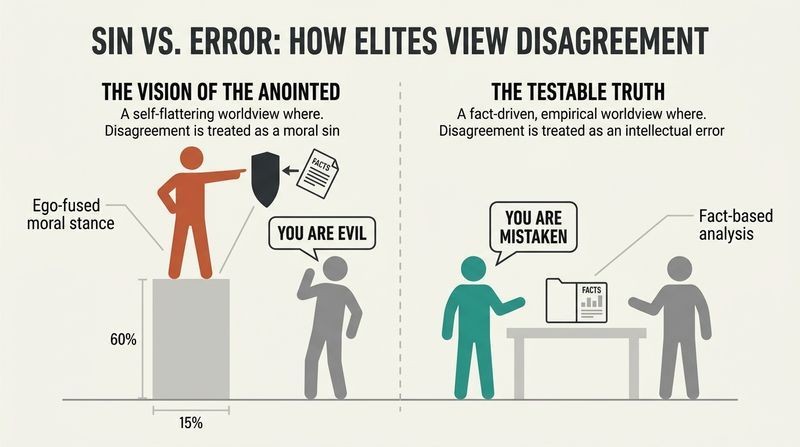
The core thesis. Sowell argues that America's intellectual and political elite share a self-flattering worldview he calls the vision of the anointed. Its appeal is not that it fits the facts but that it grants believers a special moral status: they are wise and compassionate, while opponents are not merely wrong but wicked, uncaring, or ignorant.
Sin versus error. He contrasts two styles of argument. When Malthus attacked popular thinkers, he praised their talents and sincerity. When Godwin replied, he called Malthus malignant and inhuman. That asymmetry persists: disagree with a conservative and you seem mistaken; disagree with the anointed and you seem evil. Because the vision is fused with ego, contrary evidence threatens identity itself, so it is dismissed rather than weighed.
What's striking is how Sowell anticipates modern research on motivated reasoning and identity-protective cognition. Yale's Dan Kahan has shown people process facts to defend group belonging, not to reach accuracy, which mirrors Sowell's ego-fused vision. The framing also echoes Jonathan Haidt's finding that moral intuitions arrive first and reasoning follows as press secretary. A fair challenge: Sowell aims this lens almost exclusively leftward, yet the psychology he describes is bipartisan. Tribal certainty and demonization of opponents are human universals, visible across the political spectrum, which arguably strengthens his mechanism even as it undercuts his one-sided application of it.
Watch for the four-stage con: crisis, solution, failure, excuse
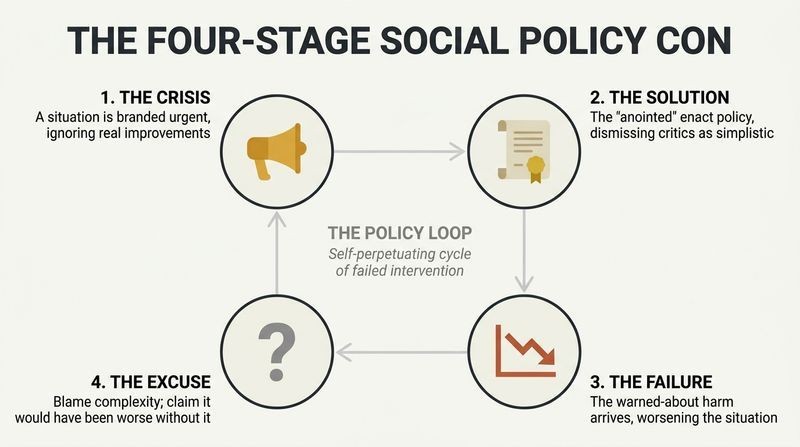
A repeating script. Sowell identifies a predictable pattern when favored policies fail.
1. Crisis: a situation is branded urgent, though it may already be improving.
2. Solution: the anointed promise benefit A, dismiss critics predicting harm Z as simplistic.
3. Results: harm Z arrives.
4. Response: critics are told outcomes are too complex to blame the policy, while no burden falls on the failed predictors.
The evidence. Before Johnson's War on Poverty, dependency on government to escape poverty had fallen by a third from 1950 to 1965. After the programs, that decline reversed. Sex education spending rose nearly twenty-fold in a decade, yet teen pregnancy and venereal disease climbed. Crime rates doubled after 1960s judicial reforms meant to reduce them.
The four-stage template is genuinely useful as a diagnostic, resembling a pre-registered prediction test that policy debates almost never run. Sowell's insistence that advocates never face a burden of proof connects to Karl Popper's falsifiability: unfalsifiable claims (things would have been even worse) explain everything and therefore nothing. The weakness is causal. Correlation between a program's launch and a worsening trend does not prove the program caused it, and Sowell sometimes leans on timing alone. His strongest move is more modest and more defensible: the promised benefits simply never materialized, which by itself should puncture the confidence of the forecasters.
A group gap is a question, not proof of discrimination
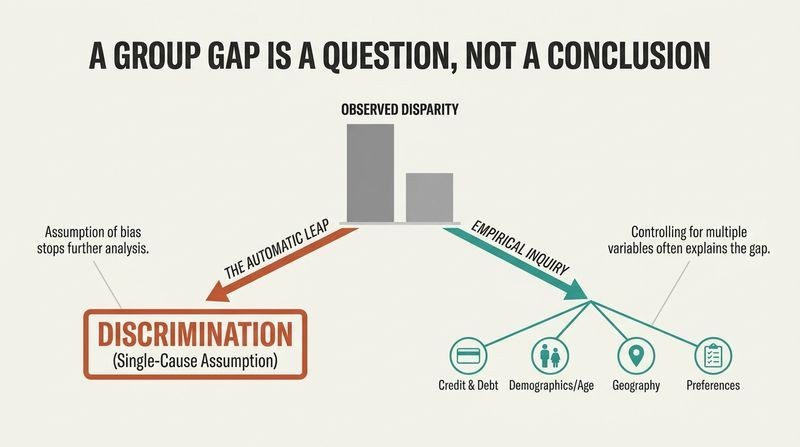
The statistical trap. Sowell attacks the automatic leap from disparity to discrimination. Blacks were denied mortgages more than whites, cited as proof of bias, but whites were denied more than Asian Americans, and nobody called that anti-white racism. When the Boston Fed controlled for debt, credit history, and loan size, the gap shrank but did not vanish, and default rates showed no racial difference, implying lenders were making rational calls.
Disparities are everywhere. He lists cases where bias cannot explain the gap: men are struck by lightning six times as often as women, Chinese minorities earned vastly more engineering degrees than Malays, and people of Japanese ancestry grew over two-thirds of Sao Paulo's potatoes. Equal outcomes are the rare exception worldwide, not the default.
This is Sowell's signature contribution, developed across his career: the naive baseline assumption that groups would be proportionally represented absent discrimination has no empirical support anywhere. The point is powerful and often ignored. Yet it cuts both ways. Showing that disparities can arise without discrimination does not show that a particular disparity did, and Sowell occasionally slides toward treating his alternative explanations as proven. Economists like Claudia Goldin have since documented how much of the gender pay gap traces to hours and career timing rather than employer bias, supporting his framework while also showing rigorous decomposition, not mere skepticism, is what settles such questions.
Track flesh-and-blood people, because the rich and poor keep changing
Statistical categories are not people. Sowell warns that income brackets contain a rotating cast. Over four-fifths of those in the bottom 20 percent of tax filers in 1979 had left it by 1988, and slightly more reached the top bracket than stayed at the bottom. Age drives much of this: people aged 45 to 54 earned 47 percent more than those aged 25 to 34, so a snapshot of inequality partly just captures the young earning less than the middle-aged.
Definitions manufacture alarm. Stanford's campus showed more statistical poverty than a nearby ghetto because graduate students report low cash incomes. Half of the officially poor own cars, many have air conditioning, and the poor spend nearly two dollars for every dollar of reported income.
Sowell's distinction between a snapshot and a movie is statistically sound and underappreciated. Longitudinal panel data, like the University of Michigan study he cites, consistently show more mobility than cross-sectional snapshots imply. The insight connects to the ecological fallacy: attributes of a category need not describe its members. A useful caveat: mobility has almost certainly declined since the 1990s. Raj Chetty's work finds the odds of out-earning one's parents fell from about 90 percent for those born in 1940 to roughly 50 percent for those born in 1980. Sowell's method remains correct even where his optimism about churn now needs updating.
Being spectacularly wrong never dents an anointed prophet's reputation
Teflon prophets. Sowell collects failed predictions that cost their authors nothing. Paul Ehrlich opened The Population Bomb by declaring the battle to feed humanity over and forecasting that hundreds of millions would starve in the 1970s and 1980s. It never happened. In a famous wager, Ehrlich bet economist Julian Simon that five metals would grow costlier over a decade as resources depleted. Every single metal fell in price.
Why the errors persist. Galbraith declared big corporations immune to the market shortly before foreign automakers and upstarts like Apple and Microsoft upended the Fortune 500. Being politically correct, Sowell argues, insulates one from the consequences of being factually incorrect, because the vision, not the track record, confers status.
The Ehrlich-Simon bet has become a parable in environmental economics, and Sowell uses it well to illustrate how known reserves expand with price and technology rather than being fixed. His deeper point about accountability is sharp: forecasters in punditry face no cost for error, unlike traders or engineers. Philip Tetlock's decades of research on expert political judgment confirms it, finding celebrated experts scarcely beat chance yet lose no standing. The nuance Sowell underplays is that some alarms work as self-negating prophecies. Predictions of catastrophe sometimes spur the very reforms that avert them, so a failed doom forecast is not always evidence the concern was baseless.
There are no solutions, only trade-offs paid somewhere else
The tragic vision. Against the anointed, Sowell sets the tragic vision, which begins with permanent human limits in knowledge, morality, and resources. In this view no policy solves a problem; it merely shifts costs. Requiring babies to have their own airline seats sounds pro-safety, but forcing families to buy extra tickets pushes some onto more dangerous highways, projected to save one baby from crashes while losing nine on the road at a cost of three billion dollars.
Safety can kill. Banning DDT was followed by malaria's resurgence, from under a hundred cases in Ceylon back to 2.5 million. FDA delays keep life-saving drugs from patients who die waiting. The real question is never whether something is safe, but whether its dangers exceed the alternative's.
This is the philosophical heart of the book, drawn from Sowell's A Conflict of Visions. The trade-off framing aligns with basic economics, where every choice has an opportunity cost, and with Thomas Sowell's mentor tradition running through Hayek on dispersed knowledge. The DDT example is more contested than he lets on: resistance in mosquitoes and agricultural overuse, not only bans, complicated malaria control, and DDT was never fully banned for disease vectors. Still, the core discipline holds. Asking what must be sacrificed, and who chooses, is a more honest starting point than promising costless cures, and it exposes the hidden victims that seen-benefit thinking ignores.
Systemic outcomes need no villain, so stop hunting for one
Systemic versus intentional causation. The anointed assume results are intended by someone, so bad outcomes imply bad actors. The tragic vision sees order emerging from millions of interactions nobody controls, like language, which no committee designed. A minimum wage rise need not require any employer to intend layoffs; competition and consumer demand can shrink jobs systemically even if every boss wants to keep his staff.
Incentives beat dispositions. A racist basketball owner still hires Black stars because refusing would be financial suicide, while a symphony can indulge bias more cheaply. Research shows discrimination is worse where discriminating costs less. Even apartheid employers broke the law to hire more Black workers, because market incentives pushed against their prejudice.
Sowell channels Hayek's idea of spontaneous order and Adam Smith's invisible hand, translating them into a critique of intent-based social diagnosis. The basketball-versus-symphony example elegantly captures Gary Becker's economics of discrimination, where competition penalizes costly bias. This is among his most durable arguments because it reframes accountability without denying that prejudice exists. A limit worth naming: systemic explanations can themselves become a dodge, used to wave away genuine, documented intentional discrimination as merely how the system works. The honest version, which Sowell mostly honors, treats systemic and intentional causation as rival hypotheses to test against evidence rather than defaults to assume.
Redefining words lets elites win debates they never argued
Verbal preemption. Sowell shows how vocabulary settles questions before they are debated. Calling something a crisis demands action without proof it is worse than usual. Public service means work chosen by third parties and funded by taxes, never the grocer who feeds a city. Greed applies only to keeping your own money, never to taking others' through taxation.
Inflation of language. Words swell until they cheat. Discrimination, harassment, and violence expand to cover ordinary frictions, then borrow the stigma of their original meanings. A claim that domestic violence strikes a woman every fifteen seconds is repeated by major papers, though the cited five million figure implies one every 6.3 seconds. Nobody checked the arithmetic.
This chapter prefigures how thoroughly framing and euphemism now dominate political communication, echoing Orwell's insight that debased language corrupts thought and George Lakoff's later work on framing. The mechanism is real: control the definition and you preempt the argument. Sowell's linguistic populism, defending ordinary usage against elite redefinition, is rhetorically effective. The counterpoint is that language legitimately evolves, and some expanded definitions reflect genuine moral progress, not mere manipulation, as with marital rape once being no crime at all. The reader's takeaway should be vigilance, not reflexive rejection: when a word does an argument's work invisibly, stop and demand the missing evidence.
The anointed collect human mascots to advertise their virtue
Mascots and targets. Sowell argues the elite adopt disfavored groups as mascots whose main function, like a team mascot, is to let others make a statement. A vagrant who disrupted a New Jersey library, inherited a home, and sold it was recast by a judge as society's victim, costing the town over a quarter million in fees plus a 150,000 dollar settlement. Meanwhile respected groups become targets whose legal protections are stretched thin.
Selective compassion. Chief Justice Rose Bird voted to overturn all 60-plus death sentences that reached her, including a methodical list-checking mass murderer. The same vision expanded criminals' rights and the insanity defense while treating families as institutions to be second-guessed rather than autonomous decision-makers.
The mascot concept is provocative and, at its best, exposes a real narcissism in some advocacy, where the beneficiary's actual welfare matters less than the advocate's moral self-image. It resonates with Tom Wolfe's radical chic and with critiques of what later commentators called virtue signaling. The framing risks unfairness, though: it can be deployed to dismiss any sincere concern for the marginalized as mere ego. Sincere compassion and status-seeking compassion often look identical from outside and can coexist in the same person. The stronger, testable version of Sowell's claim is his outcome question: do the policies actually help the mascots, or mainly flatter their champions?
Judges chasing cosmic justice quietly abolish the rule of law
Cosmic versus lawful justice. Sowell distinguishes the rule of law, where only rules set in advance can punish, from cosmic justice, where judges try to offset every preexisting inequality. Judicial activism reinterprets the Constitution to mean what today's thinking people want rather than what its words meant when written. This transfers power from voters to unelected judges under cover of interpretation.
The cost of perfect justice. Federal habeas appeals from state prisoners exploded from under a hundred in 1940 to over 12,000 by 1970, with one appeals judge noting he never found an innocent man among thousands. Endless technicalities mean violent felonies get plea-bargained down while criminals await trial on the streets. Chasing flawless justice sacrifices the ordinary justice millions depend on.
Sowell's defense of original public meaning, quoting Holmes that courts ask what the statute meant, not what a legislator privately intended, is a crisp statement of textualism years before it dominated legal debate. His deeper worry, that unpredictable law ceases to be law and invites litigation as extortion, connects to Fuller's principles of legality and Hayek's insistence that freedom requires knowing the rules in advance. The contestable premise is that historical meaning is always discoverable and determinate; critics note the founders wrote broad phrases like cruel and unusual precisely because they expected application to evolve. The trade-off he names, though, between flexibility and predictability, is genuine and unavoidable.
A vision sealed off from evidence guarantees endless fresh disasters
The real danger. Sowell's closing warning is not that the anointed hold wrong ideas, since everyone errs, but that their vision has become self-sealing, immune to feedback from reality. He compares this to how catastrophes like Nazi Germany required a mechanism blocking corrective feedback so a ruinous course could continue to the end. Free speech exists, yet the prevailing vision insulates itself by dismissing contrary evidence as perceptions, stereotypes, or false consciousness.
Five self-evident axioms. The vision treats as beyond question that problems exist because others lack the anointed's wisdom, that beliefs are merely socially constructed, that causation is intentional, that only imposed solutions avert disaster, and that opponents are stupid or evil. Treated as axioms rather than hypotheses, these never get tested.
The insulation-from-feedback thesis is the book's most important and most transferable idea, applicable well beyond Sowell's political targets. It parallels Popper's demarcation between science and pseudoscience and complements systems thinking, where any control system without accurate feedback drifts toward failure. What elevates the argument is its neutrality in principle: any ideology that converts hypotheses into identity-defining axioms loses the ability to learn. The irony a careful reader should hold is that Sowell's own framework, if wielded uncritically, could become equally self-sealing, explaining away every counterexample as more anointed folly. The remedy he implicitly prescribes, subjecting one's own vision to disconfirming evidence, must apply to all sides to mean anything.
Analysis
The Vision of the Anointed is a work of political epistemology disguised as policy critique. Written in 1995, it is Sowell's attempt to explain not what the intellectual elite believe but why their beliefs survive contact with contrary reality. Its structure moves from pattern (the four-stage failure script) through method (statistical fallacies, failed prophets) to psychology (the anointed versus the tragic vision) and finally to consequences (law, vocabulary, and self-insulation). The book is really a companion to his earlier A Conflict of Visions, applying that framework's two worldviews to contemporary American controversy.
The enduring value lies in transferable intellectual tools: distinguishing snapshots from longitudinal data, disparities from discrimination, systemic from intentional causation, trade-offs from solutions, and hypotheses from axioms. These are genuine contributions to public reasoning, and Sowell deploys them with rare clarity and a formidable command of cross-national evidence. His insistence that no society anywhere shows proportional group representation remains an underappreciated empirical corrective.
The book's central vulnerability is symmetry. Sowell's psychology of ego-fused, feedback-resistant belief is a human universal, documented since by Tetlock, Kahan, and Haidt, yet he applies it almost entirely to the left while treating his own tragic vision as simply realism rather than another vision with its own blind spots. His causal arguments sometimes lean on timing alone, and his optimism about income mobility has aged poorly against Chetty's mobility data. Some examples, like DDT, are more contested than presented.
Read charitably, the book is best understood not as proof that one side is wrong but as a manual for detecting when any argument has stopped being falsifiable. Its deepest lesson turns back on the reader: a vision immune to evidence manufactures disasters indefinitely, and that discipline of self-correction is owed by every camp, including Sowell's own.
Review Summary
The Vision of the Anointed receives mostly positive reviews, with readers praising Sowell's clear prose and insightful analysis of liberal thinking. Many find the book's arguments against progressive policies compelling and still relevant today. Critics argue that Sowell's portrayal of liberal viewpoints is overly simplistic and biased. Some readers note that while the book offers a strong critique, it lacks concrete solutions. Overall, reviewers appreciate Sowell's examination of how self-congratulatory thinking influences social policy.
People Also Read


FAQ
What is The Vision of the Anointed by Thomas Sowell about?
- Core theme: The book critiques the worldview of intellectual and political elites—termed "the anointed"—who believe they possess superior wisdom and virtue to solve social problems.
- Contrast with reality: Sowell contrasts the anointed’s vision with empirical evidence, showing how their policies often lead to unintended negative consequences.
- Influence on society: The book explores how this vision shapes social policy, law, media, and public discourse, often privileging certain groups while dismissing others.
- Historical context: Sowell traces the roots and dominance of this vision, especially since the 1960s, and its impact on American society.
Why should I read The Vision of the Anointed by Thomas Sowell?
- Elite influence revealed: The book exposes how a small group of elites can disproportionately shape public policy and opinion.
- Critical thinking encouraged: Sowell urges readers to question widely accepted assumptions and demand empirical evidence rather than accept dogmatic assertions.
- Insight into policy failures: Through detailed case studies, the book shows how well-intentioned policies often fail or worsen the problems they aim to solve.
- Understanding rhetoric: Readers learn to recognize the rhetorical tactics used by elites to maintain their vision’s dominance and dismiss critics.
What are the key takeaways from The Vision of the Anointed by Thomas Sowell?
- Vision vs. reality: The dominant social vision among elites often ignores or dismisses evidence that contradicts it.
- Pattern of policy failure: Policies based on this vision follow a four-stage pattern: crisis declared, solution proposed, detrimental results, and critics dismissed.
- Moral superiority: The anointed see themselves as morally superior, viewing opponents as not just wrong but morally deficient.
- Misuse of statistics: Sowell details how statistics are selectively used to support the vision, while contradictory data are ignored.
What is the "vision of the anointed" as defined by Thomas Sowell?
- Definition: It is a worldview held by intellectual and political elites that assumes their superior knowledge and virtue justify their role in shaping society.
- Moral dichotomy: The vision divides people into the "anointed" (superior) and the "benighted" (ignorant or evil), justifying efforts to impose policies.
- Resistance to evidence: This vision is insulated from contradictory empirical evidence, often dismissing it as irrelevant.
- Focus on intentions: Emphasizes changing intentions and social conditions rather than accepting human limitations or systemic trade-offs.
How does Thomas Sowell describe the pattern of failure in policies based on the vision of the anointed?
- Stage 1 – Crisis declared: A social problem is labeled a crisis, often without evidence that it is worsening.
- Stage 2 – Solution proposed: The anointed advocate policies promising improvement, dismissing critics as simplistic or dishonest.
- Stage 3 – Detrimental results: The policies are implemented but lead to outcomes opposite to those promised.
- Stage 4 – Response to failure: Critics are dismissed, evidence is reinterpreted, goals are redefined, and the original vision remains unchallenged.
What are some examples Thomas Sowell uses to illustrate the failure of the vision of the anointed?
- War on Poverty: Despite massive spending, welfare dependency increased and urban riots escalated during the program’s implementation.
- Sex Education: Expanded sex education and family planning programs coincided with rising teenage pregnancy and venereal disease rates.
- Criminal Justice Reform: Judicial decisions expanding criminals’ rights led to soaring crime rates, contrary to reformers’ promises.
- AIDS policy: Legal protections for AIDS carriers sometimes prioritized their rights over public health and safety.
What is the difference between the "tragic vision" and the "vision of the anointed" in Thomas Sowell's analysis?
- Tragic vision: Assumes inherent human limitations, systemic causation, and the inevitability of trade-offs; emphasizes prudence and incremental change.
- Vision of the anointed: Assumes elites have superior knowledge and virtue, favoring sweeping reforms and intentional causation.
- Role of knowledge: The tragic vision doubts anyone can fully understand or control society, while the anointed vision assumes elites know the solutions.
- View of the public: The tragic vision respects public preferences and systemic processes; the anointed vision disdains the public as benighted.
How does Thomas Sowell explain the misuse of statistics ("Aha!" statistics) in The Vision of the Anointed?
- Selective use: Statistics are cherry-picked to support the prevailing vision, while contradictory data are ignored.
- Residual fallacy: Attempts to prove discrimination or other claims by controlling for some variables but ignoring qualitative differences or unmeasured factors.
- Changing categories: Failure to account for changing populations or transient categories leads to misleading conclusions.
- Correlation vs. causation: Correlations are often interpreted as causation consistent with the vision, ignoring alternative explanations.
What is the "vocabulary of the anointed" and why is it important in Thomas Sowell's analysis?
- Verbal preemption: The anointed use buzzwords like "crisis," "access," and "rights" to preempt debate and frame issues in their favor.
- Disdain for dissent: Their language often dismisses opposing views as emotional, prejudiced, or uninformed.
- Evading responsibility: Terms like "society" and "discrimination" are used to obscure individual choices and shift blame.
- Moralizing issues: The vocabulary is designed to moralize debates and shut down opposition without evidence.
Who are the "mascots" and "targets" in The Vision of the Anointed by Thomas Sowell?
- Mascots: Marginalized or disfavored groups (e.g., criminals, AIDS carriers, the homeless) championed by the anointed as victims needing rescue.
- Targets: Respected groups (e.g., businesspeople, families, religious communities) who are often blamed or penalized to compensate mascots.
- Purpose: This dichotomy reinforces the moral superiority of the anointed and justifies policies that favor mascots while restricting targets.
- Policy impact: Laws and policies are often stretched to benefit mascots at the expense of targets.
How does Thomas Sowell critique judicial activism in The Vision of the Anointed?
- Definition: Judicial activism involves judges interpreting laws and the Constitution beyond their original meaning to impose their own social and moral views.
- Power shift: This transfers policymaking power from elected representatives to unelected judges, undermining democracy.
- Consequences: Judicial activism leads to unpredictable legal standards and the imposition of "cosmic justice" over practical law.
- Alignment with the anointed: Such activism often aligns with the vision of the anointed, favoring mascots and overriding traditional values.
What dangers does Thomas Sowell identify in the "optional reality" created by the vision of the anointed?
- Insulation from evidence: The anointed’s vision is self-justifying and immune to empirical refutation, leading to persistent, disconnected policies.
- Divorce from human nature: It ignores inherent human limitations and assumes society can be reshaped entirely by elite wisdom.
- Polarization: The vision fosters cultural wars and undermines shared values and institutions.
- Social disintegration: By dismissing dissent as moral failure, it risks societal breakdown and loss of trust in institutions.
About the Author
Other books by Thomas Sowell
Download PDF
Download EPUB
.epub digital book format is ideal for reading ebooks on phones, tablets, and e-readers.








































