

Key Takeaways
Treat your beliefs like hypotheses to test, not treasures to defend
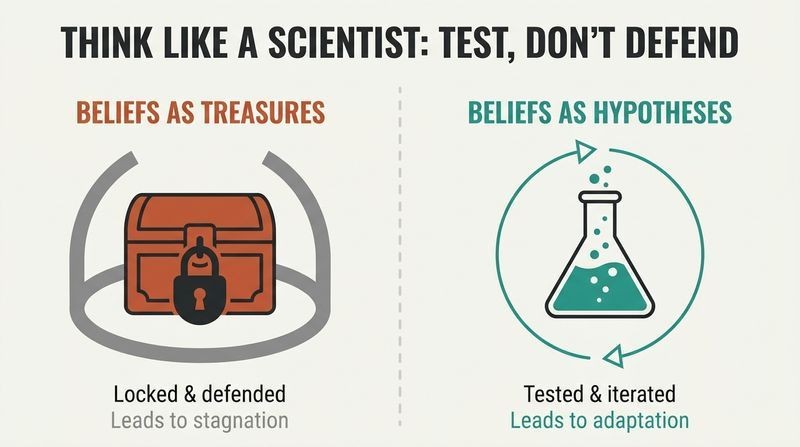
The scientist mindset beats conviction. Grant identifies four modes we slip into. In preacher mode we defend sacred beliefs, in prosecutor mode we attack others' flaws, in politician mode we court approval, and in scientist mode we search for truth through experiment. Only the last one invites rethinking. When European researchers trained over a hundred Italian startup founders to view strategies as theories and products as experiments, those founders earned over $12,000 in revenue versus under $300 for the control group, and they pivoted twice as often.
Rethinking is a skill and a mindset. BlackBerry inventor Mike Lazaridis thought like a scientist when designing the device but refused to rethink whether people wanted a computer in their pocket. His market share collapsed from nearly half to under 1%.
What's striking is how the four-mode taxonomy maps onto identity threat. Preaching, prosecuting, and politicking all protect the ego, while science demands surrendering it. This dovetails with Karl Popper's falsificationism, which held that a theory earns respect only when it risks being wrong. The startup study is compelling but worth scrutinizing: teaching people to run experiments may simply make them faster at killing bad ideas, which is itself the mechanism. One tension Grant acknowledges elsewhere is that constant rethinking has costs. A surgeon mid-operation or a firefighter mid-blaze cannot pause to hypothesize. The scientist mode is for updating views, not for every split-second action.
The less you know, the more certain you feel
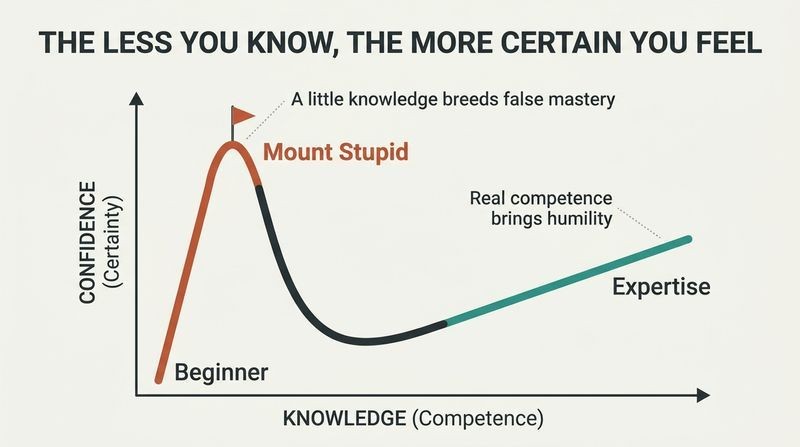
Incompetence hides itself. The Dunning-Kruger effect describes how people who score lowest on tests of logic, grammar, and humor most wildly overestimate themselves. In the original studies, bottom performers believed they beat 62% of peers while actually outperforming only 12%. The reason is metacognitive: the skills needed to do something well are the same skills needed to judge whether you did it well.
Overconfidence spikes for amateurs, not beginners. Total novices know they know nothing. It is the jump from novice to amateur that strands us at the summit of what Grant playfully calls Mount Stupid, where a little knowledge breeds false mastery. This may explain why hospital patient deaths appear to rise in July, when overconfident new residents arrive believing they are ready.
The metacognitive framing is what elevates this beyond a punchline. It is not arrogance alone but a genuine blind spot: you cannot see the gap because seeing it requires the very expertise you lack. There is ongoing statistical debate about how much of the Dunning-Kruger curve is a measurement artifact of regression to the mean, and honest summaries should note the effect's magnitude is contested even if its existence is not. The practical antidote Grant offers is elegant: try explaining a topic mechanistically. The moment you attempt to detail how something works, the illusion of understanding tends to evaporate on contact.
Anchor your identity in values, not opinions, so you can update freely
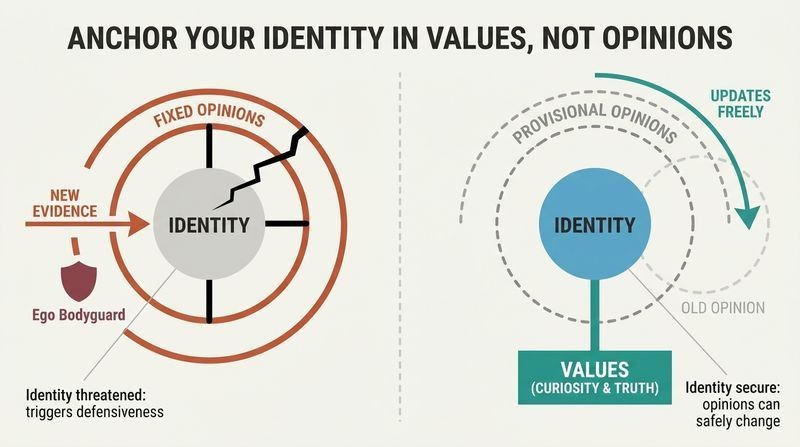
Detach who you are from what you think. When a core belief is attacked, Grant says an inner totalitarian ego rushes in like a bodyguard, triggering a fight-or-flight response that shuts down learning. The fix is two kinds of detachment: separating your present self from your past self, and separating your opinions from your identity. Nobel laureate Daniel Kahneman reacted to being proven wrong with delight, saying it meant he was now less wrong than before, because his attachment to ideas was provisional.
Define yourself by principles. You want a doctor whose identity is protecting health, not one wedded to a specific procedure. When identity rests on values like curiosity and integrity rather than fixed positions, you keep the flexibility to revise your methods as evidence changes.
This reframes intellectual humility as an identity-management strategy rather than a personality trait, which is empowering because strategies can be practiced. It resonates with Carol Dweck's growth mindset and with Stoic thought, where Epictetus distinguished what is truly ours (our judgments) from what merely feels like ours. The contrast between Kahneman's joy and Ted Kaczynski's rigid conviction, both surfacing in Grant's material, is haunting: the same intelligence can serve discovery or delusion depending on attachment. One caution is that values themselves can calcify into dogma. A person certain of their virtue can prosecute dissenters just as fiercely as any ideologue.
Impostor syndrome can be rocket fuel, not just a curse
Doubt has an upside. Where the overconfident overestimate themselves (armchair quarterback syndrome), impostors underestimate themselves despite real competence. Grant argues moderate impostor feelings deliver three benefits: they motivate harder work, they push us to work smarter by adopting a beginner's questioning mindset, and they make us better learners by knocking us off our pedestal so we seek advice. Research on medical students found those with impostor thoughts scored higher on bedside manner, and investment professionals with more impostor feelings earned better performance reviews.
Iceland's near-president proved it. Halla Tomasdottir, polling at 1%, rode her self-doubt to second place with 28% of the vote, using it to stay humble, run a positive campaign, and ask everyone for advice.
This is a genuinely counterintuitive contribution, since impostor syndrome is usually pathologized. The nuance matters: Grant is careful to say chronic, crippling doubt is destructive, and the benefit lives in a narrow band of moderate uncertainty. The distinction he draws is between confidence in your capacity to learn versus confidence in your current tools. Spanx founder Sara Blakely embodied this: sure she could figure it out, aware she knew nothing about hosiery. Emerging research suggests gender differences in how impostor feelings play out, which complicates blanket advice. The deeper insight is that confidence often follows achievement rather than causing it, inverting the usual self-help sequence.
Build a challenge network of critics, not just a support network of cheerleaders
Disagreeable givers make the best critics. Grant distinguishes relationship conflict (personal, emotional friction) from task conflict (clashes about ideas). A meta-analysis of over 8,000 teams shows relationship conflict hurts performance while moderate task conflict boosts creativity and decision quality. Pixar director Brad Bird deliberately recruited disgruntled misfits he called pirates to make The Incredibles, which grossed over $631 million and won an Oscar while lowering per-minute production costs.
Seek people who challenge because they care. A challenge network is a group you trust to expose your blind spots. The ideal members are disagreeable givers, who dish out tough feedback to elevate the work rather than feed their egos. The Wright brothers argued for months, calling it scrapping, and enjoyed it because it sharpened their thinking.
The task versus relationship conflict distinction is one of organizational psychology's most robust findings, and Grant applies it usefully. What deepens it is the personality layer: disagreeable people speak up more, especially when leaders are unreceptive, making them structurally valuable even when unpleasant. Amy Edmondson's psychological safety research pairs with this, showing that dissent only helps when people feel safe voicing it. A limitation is that task conflict reliably spills into relationship conflict under stress, as the Wright brothers' shouting matches showed. The practical lever Grant offers, framing a clash as a debate rather than a disagreement, is a small linguistic move with outsized effects on receptivity.
In a debate, offer fewer reasons and more questions to win minds
A weak argument dilutes a strong one. Studying expert negotiators, researcher Neil Rackham found they devoted a third of planning to common ground, presented fewer reasons rather than piling them on, and asked far more questions. When Grant's team sent university alumni two separate reasons to donate, each worked at 6.5%, but combining them dropped giving below 3%, because multiple arguments trigger a persuasion alarm and let people reject your weakest point.
Debate like a dance, not a war. Champion debater Harish Natarajan beat IBM's data-loaded AI on preschool subsidies by emphasizing agreement, focusing on two reasons, and posing six questions to the audience. He used the steel man, engaging the strongest version of the opponent's case rather than a straw man.
This inverts the intuitive scales model of argument, where more evidence tips the balance. The finding that quantity backfires connects to reactance theory: people defend their autonomy when they sense manipulation, and an avalanche of reasons feels like an ambush. Grant's alumni experiment is a clean demonstration that persuasion is not additive. The self-persuasion angle, that the most convincing voice is your own, echoes decades of research from Elliot Aronson. One boundary condition worth flagging: with a receptive audience that already cares, more reasons can help, since people read quantity as quality. The technique is context-dependent, most powerful against skeptical, invested, stubborn listeners.
Ask people how their policy works, not why they believe it
The illusion of explanatory depth. People think they understand bicycles, toilets, and tax policy far better than they do. Ask them to explain the mechanism step by step and their confidence collapses along with their extremism. When researchers asked people how policies on taxes or sanctions would actually function, participants noticed gaps in their knowledge, grew less certain, and became more curious about alternatives. Asking why simply lets them rehearse existing convictions.
Question origins to dissolve stereotypes. Grant's experiments with Yankees and Red Sox fans found that prompting people to reflect on how arbitrary their rivalry was (you would root for the other team if born elsewhere) reduced hostility. They chose milder hot sauce and easier quiz questions for rival fans.
The how versus why distinction is deceptively powerful because it shifts the cognitive task from motivated defense to mechanical accounting, and the machinery of belief rarely holds up under inspection. This links to the work of Frank Keil and Leonid Rozenblit, who coined the explanatory depth illusion, and to Philip Fernbach's political extremism research. The counterfactual origins technique is subtler and arguably more profound: it attacks not a specific belief but the legitimacy of holding group opinions at all. A caveat is that these effects are often modest and temporary in lab settings. Sustained attitude change usually requires repeated, relational contact rather than a single clever question.
Stop persuading and start interviewing to help people change themselves
Motivational interviewing flips the script. Developed by psychologist Bill Miller for addiction treatment, this method rests on the premise that we rarely motivate others to change; we help them find their own motivation. It uses open-ended questions, reflective listening, and affirming a person's freedom and ability to change. It has been validated in over a thousand trials and works in roughly three of four studies.
A vaccine whisperer proved it. Rather than lecturing frightened parents, Quebec doctor Arnaud Gagneur asked open questions, listened, and affirmed their right to choose. Vaccination intentions rose from 72% to 87% after a single maternity-ward conversation, and children were 9% more likely to be fully vaccinated two years later. Betty Bigombe used the same listening to coax a Ugandan warlord toward peace talks.
Motivational interviewing's evidence base is genuinely one of the strongest in behavioral science, spanning smoking, diet, and even conflict mediation. The mechanism aligns with self-determination theory: people commit to changes they author themselves and resist changes imposed on them. What's ethically sharp in Grant's treatment is the warning that these techniques must not be weaponized manipulatively, because people have sophisticated defenses that flip a sincere question into a perceived tactic. The counterintuitive core, that listening persuades more than talking, challenges a culture that equates influence with eloquence. E.M. Forster's inverse charisma, the magnetism of being deeply heard, captures why this works better than the most polished argument.
Complexify polarizing issues into a prism, not a two-sided coin
Binary bias fuels polarization. We crave clarity by collapsing complex continua into two camps. In Peter Coleman's Difficult Conversations Lab, pairs who read a gun-control article framed as a black-and-white clash reached consensus on abortion 46% of the time. Pairs who read the same facts framed as a complex problem with many viewpoints reached consensus 100% of the time.
Nuance signals credibility, not weakness. Adding caveats and contingencies keeps readers engaged and open-minded. On climate change, media give contrarians 49% more coverage than expert scientists, making denial seem more common than it is (under 10% of Americans). Grant urges distinguishing skeptics, who ask questions and update, from deniers, who reject anything from the other side. Emotional range matters too: productive conversations show more varied feelings.
Coleman's 46% to 100% jump is one of the most quietly radical findings in conflict research, because it shows the framing of information, not the information itself, drives whether people can talk. This connects to Amanda Ripley's journalism work on complicating the narrative and to Tetlock's finding that the best forecasters think in shades of probability. The skeptic versus denier distinction is crucial and often blurred in public discourse, sometimes weaponized to dismiss legitimate questioning. A challenge: complexity does not go viral, and attention economics reward the binary sound bite. The structural incentives of social media run directly against the cognitive medicine Grant prescribes, which limits how far individual technique can scale.
Teach kids to rethink by having them rewrite the textbook
Knowledge evolves, and students should feel it. Award-winning teacher Erin McCarthy assigns a 1940 history textbook so eighth graders discover that authoritative facts change, then has them rewrite chapters to include marginalized histories. Active learning outperforms lectures: a meta-analysis of 225 studies and 46,000 students found learners scored half a letter grade worse under traditional lecturing and were 1.55 times more likely to fail.
Confusion is a feature, not a bug. Teacher Ron Berger turned his classroom into a challenge network, having first graders produce multiple drafts with peer critiques. A six-year-old named Austin transformed a crude butterfly sketch into a stunning scientific drawing over successive revisions. Lectures can produce a dumbstruck effect, where charismatic delivery makes audiences scrutinize less and remember less while feeling they learned more.
The dumbstruck effect is a sobering correction to education's love affair with the charismatic lecturer and the viral TED talk. It aligns with desirable difficulty research from Robert Bjork, showing that learning which feels harder and less enjoyable often sticks better. Austin's butterfly is a moving proof of concept for iterative craftsmanship, and it generalizes: mastery is revision. One tension is scalability, since Berger's intensive critique culture demands small classes and enormous teacher time. The finding that students prefer lectures even while learning less from active methods also creates a real adoption problem, because student evaluations, which drive teacher incentives, reward the very format that teaches least.
Judge decisions by process quality, not just outcomes
Build learning cultures on safety plus accountability. Grant contrasts performance cultures, where flawless execution reigns, with learning cultures, where growth is the core value. NASA's performance culture normalized small anomalies, contributing to the Challenger and Columbia disasters and a near-drowning when water filled astronaut Luca Parmitano's helmet during a spacewalk. Psychological safety, the freedom to take risks without punishment, is the foundation, but it needs process accountability.
Keep a rethinking scorecard. A good outcome from shallow thinking is just luck; a bad outcome from deep thinking is a smart experiment. Leaders build safety by sharing their own past criticism, not merely asking for feedback. When Melinda Gates read harsh employee comments aloud on video, staff reached out more and adopted a stronger learning orientation.
Decoupling decision quality from outcome quality is one of the most valuable and least practiced ideas in management, because hindsight and results bias are relentless. Annie Duke's work on resulting makes the same case from poker: good decisions can yield bad outcomes and vice versa. NASA's normalization of deviance, a term from sociologist Diane Vaughan's Challenger analysis, shows how performance pressure erodes rethinking incrementally until catastrophe. Grant's experimental finding that leaders build more lasting safety by modeling vulnerability than by requesting feedback is practically important, since the request often rings hollow. The Amazon six-page memo and disagree-and-commit principle show process accountability can be institutionalized, not just exhorted.
Schedule career and life checkups to escape identity foreclosure
Stop asking kids what they want to be. Fixing on a single career identity early causes identity foreclosure, settling prematurely without due diligence. Grant's cousin Ryan escalated commitment to becoming a neurosurgeon for sixteen years, burned out, and later regretted foreclosing so early. Grit can become foolish stubbornness; gritty mountaineers are likelier to die pushing for summits.
Run checkups twice a year. Just as you visit the dentist when nothing hurts, schedule reflection: When did I form these goals, and how have I changed? Passions are developed, not discovered, so pursue learning and contribution over happiness. Chasing happiness directly can backfire and predict depression, because you evaluate life instead of living it, and changing your actions beats changing your surroundings.
Identity foreclosure, drawn from developmental psychologist James Marcia, reframes premature certainty as a developmental failure rather than admirable focus. The escalation-of-commitment research explains why sunk costs trap us psychologically, not just economically: we defend past decisions to protect our self-image. Grant's most counterintuitive claim here challenges positive psychology's own excesses, that valuing happiness too highly undermines it, echoing Viktor Frankl's insight that meaning must be pursued indirectly. The career-checkup ritual is a lightweight intervention against a heavyweight bias. One caveat is privilege: pivoting freely assumes economic and social latitude many lack. Grant nods to this, noting that job crafting, redesigning your current role, offers rethinking even to a hospital custodian.
Analysis
Think Again is a thesis-driven work of organizational and social psychology arguing that in a volatile world, the capacity to rethink and unlearn matters more than raw intelligence. Its structure is elegant and recursive: individual rethinking (updating your own views), interpersonal rethinking (opening others' minds), and collective rethinking (building learning cultures in classrooms, workplaces, and public discourse). The organizing device is the preacher-prosecutor-politician-scientist framework, borrowed from Grant's colleague Philip Tetlock, which gives the book a memorable spine.
The book's genuine contribution is not any single finding but the reframing of confidence, doubt, and being wrong as tools rather than states. Grant's most original moves are counterintuitive inversions: impostor syndrome as fuel, fewer arguments as more persuasive, listening as stronger than speaking, complexity as credibility, and process as the true measure of decisions. These land because they are backed by cited experiments, many Grant ran himself, and illustrated with vivid, well-chosen stories (smokejumpers, BlackBerry, a Black musician disarming Klansmen, a vaccine whisperer).
The difficulty in summarizing lies in the book's density of studies and anecdotes; the risk is reducing it to a listicle that loses the connective argument. The through-line worth preserving is the rethinking cycle (humility, doubt, curiosity, discovery) versus the overconfidence cycle (pride, conviction, confirmation bias, validation).
Where the book is vulnerable: it is relentlessly optimistic about individual agency in a world where structural incentives (social media virality, performance-based evaluation, tribal identity) push hard against rethinking. Grant acknowledges these but treats them as surmountable through technique. The evidence he marshals is strong but skews toward WEIRD populations and lab settings, where effects are often modest and short-lived. Some findings he cites, like Dunning-Kruger, carry live statistical controversies he glosses. Still, the practical toolkit is unusually actionable, and the meta-move of a rethinking book that models its own rethinking (the blank-page epilogue, the FDR reveal) is intellectually honest. Its lasting value is cultural: normalizing I was wrong as a phrase of strength.
Review Summary
Think Again receives mostly positive reviews for its engaging exploration of rethinking beliefs and assumptions. Readers appreciate Grant's storytelling and practical advice on cultivating mental flexibility. Some find the content repetitive or lacking novelty, while others praise its timeliness and relevance. The book's structure, covering individual, interpersonal, and collective rethinking, resonates with many. Critics note potential oversimplification of complex issues. Overall, readers find value in Grant's call for intellectual humility and openness to changing one's mind.
People Also Read





FAQ
What's Think Again: The Power of Knowing What You Don't Know about?
- Core Theme: The book by Adam M. Grant emphasizes the importance of rethinking our beliefs and assumptions. It encourages adopting a mindset of intellectual humility, curiosity, and doubt.
- Four Parts: It is divided into four parts: Individual Rethinking, Interpersonal Rethinking, Collective Rethinking, and a Conclusion, each offering insights into updating views and fostering a culture of learning.
- Real-World Examples: Grant uses stories and research from various fields to illustrate how rethinking can improve decision-making and relationships.
Why should I read Think Again?
- Enhance Critical Thinking: The book helps develop critical thinking skills by encouraging questioning of assumptions and beliefs, crucial in a world of misinformation.
- Improve Relationships: It offers insights into engaging in constructive conflict and improving communication, fostering healthier relationships.
- Adapt to Change: Provides tools to navigate change effectively, making informed decisions in a constantly evolving world.
What are the key takeaways of Think Again?
- Value of Rethinking: Rethinking is a vital skill for personal and professional growth, with openness to change being a strength.
- Constructive Conflict: Engaging in task conflict, rather than relationship conflict, fosters creativity and innovation.
- Motivational Interviewing: Encourages people to find their own motivation for change, effective in various contexts.
What are the best quotes from Think Again and what do they mean?
- “Progress is impossible without change...”: Emphasizes adaptability and open-mindedness as essential for progress.
- “Ignorance more frequently begets confidence...”: Highlights the Dunning-Kruger effect, reminding us to remain humble.
- “What I believe is a process...”: Encourages viewing beliefs as fluid and open to change, not absolutes.
How does Adam Grant define rethinking in Think Again?
- Cognitive Flexibility: Rethinking involves questioning and updating beliefs, essential for navigating a complex world.
- Mindset Shift: Encourages valuing curiosity and humility over certainty, viewing mistakes as learning opportunities.
- Practical Application: Strategies include seeking diverse perspectives and engaging in constructive conflict.
What are the four mindsets discussed in Think Again?
- Preacher Mindset: Advocates for a belief, often leading to rigidity and hindering open dialogue.
- Prosecutor Mindset: Focuses on winning arguments, creating defensiveness and limiting constructive conversations.
- Politician Mindset: Seeks approval, leading to inauthenticity and reluctance to challenge views.
- Scientist Mindset: Encourages curiosity and testing hypotheses, fostering learning and open-mindedness.
How does Think Again suggest we handle disagreements?
- Reframe Disagreements: View them as opportunities for dialogue, not battles, fostering collaboration.
- Seek Common Ground: Finding shared values can bridge divides and promote understanding.
- Use Questions Effectively: Open-ended questions encourage reflection and facilitate productive conversations.
How can I apply the concepts from Think Again in my daily life?
- Practice Rethinking: Regularly question beliefs and consider alternative viewpoints before concluding.
- Engage in Constructive Conflict: Encourage environments where constructive conflict leads to better problem-solving.
- Use Motivational Interviewing: Focus on open-ended questions and active listening to help others find motivation for change.
How does Think Again address the issue of bias?
- Cognitive Biases: Discusses biases like confirmation bias and Dunning-Kruger effect, emphasizing recognition for better decision-making.
- Encouraging Open-Mindedness: Advocates for a mindset valuing curiosity, acknowledging biases to engage in productive discussions.
- Practical Strategies: Offers strategies like seeking diverse perspectives and reflective listening to mitigate bias.
What role does listening play in the concepts presented in Think Again?
- Active Listening: Crucial for fostering understanding and encouraging rethinking, helping others feel heard.
- Motivational Interviewing: Relies on listening, using open-ended questions to explore beliefs and motivations.
- Building Trust: Effective listening builds trust, making it easier to engage in difficult conversations.
How can organizations create a culture of rethinking as suggested in Think Again?
- Encourage Open Dialogue: Foster environments where open dialogue and constructive conflict are encouraged.
- Provide Training: Implement training on rethinking skills like critical thinking and motivational interviewing.
- Model Rethinking: Leaders should demonstrate humility and curiosity, setting a tone for the organization.
What is the significance of the "joy of being wrong" in Think Again?
- Embracing Mistakes: Recognizing mistakes leads to valuable learning experiences, viewing errors as growth opportunities.
- Fostering Curiosity: Embracing being wrong cultivates curiosity, encouraging exploration and seeking new information.
- Building Resilience: Accepting mistakes as part of learning enhances resilience, helping bounce back from setbacks.
About the Author



Download PDF
Download EPUB
.epub digital book format is ideal for reading ebooks on phones, tablets, and e-readers.








































