Key Takeaways
1. The Barbary threat challenged the sovereignty of the young American republic
Our sufferings are beyond our expression or your conception...
A vulnerable nation. Following the Revolutionary War, the newly independent United States found itself stripped of the British Royal Navy's protection. American merchant vessels, which relied heavily on Mediterranean trade routes to export dried salt cod, grain, and lumber, became easy prey for the corsairs of the Barbary States—Morocco, Algiers, Tunis, and Tripoli.
The horror of captivity. In July 1785, Algerian pirates captured the American ships Dauphin and Maria, enslaving their crews under brutal conditions. The sailors were stripped of their clothing, forced into hard labor breaking rocks, and fed a starvation diet of stale bread and vinegar.
Economic strangulation. The threat of piracy had devastating economic consequences for the young republic:
- Marine insurance rates for American ships skyrocketed to twenty times the rate of European vessels.
- A quarter of New England's dried salt cod exports and one-sixth of its grain exports were put at risk.
- The young nation, heavily burdened with Revolutionary War debt, faced a choice between paying ruinous tributes or abandoning vital trade routes.
2. Diplomatic efforts revealed a deep ideological divide and extortionate demands
Money is their God and Mahomet their Prophet.
Ideological clash. In March 1786, Thomas Jefferson and John Adams met with Sidi Haji Abdrahaman, the Tripolitan envoy to London, to negotiate a peaceful resolution. When asked why the Barbary States made war on nations that had done them no harm, Abdrahaman explained that their holy book, the Qur'an, gave them the right and duty to plunder and enslave non-believers.
Extortionate demands. The financial cost of purchasing peace was far beyond the reach of the empty American treasury. Abdrahaman demanded 30,000 English guineas ($120,000) for Tripoli alone, not including his personal 10 percent gratuity.
A divided response. The diplomatic impasse highlighted a fundamental disagreement between America's leading diplomats:
- John Adams argued that paying tribute was cheaper and more practical than building a navy to fight an endless war.
- Thomas Jefferson believed that buying peace was dishonorable and unsustainable, advocating instead for the creation of a navy to project force.
- The failure of early negotiations left American sailors languishing in slave pens for over a decade.
3. The humiliation of the USS George Washington exposed the cost of weakness
I hope I shall never again be sent to Algiers with tribute, unless I am authorized to deliver it from the mouth of our cannon.
A subverted mission. In September 1800, Captain William Bainbridge sailed the USS George Washington to Algiers to deliver overdue tribute. Although the warship was meant to project American strength, Bainbridge made the tactical error of anchoring directly beneath the harbor fortress's guns, leaving his ship hopelessly trapped.
Forced into submission. The Dey of Algiers, Bobba Mustapha, declared the Americans his slaves and ordered Bainbridge to carry an Algerian ambassador, a retinue of 200 passengers, and a cargo of exotic animals to Constantinople. Under threat of immediate war and the enslavement of his crew, Bainbridge was forced to lower the American flag and hoist the Algerian colors.
National outrage. The incident became a symbol of national humiliation and galvanized public opinion in the United States:
- The USS George Washington was effectively turned into a "floating zoo" and a Barbary ferry service.
- William Eaton, the consul to Tunis, furiously declared that "nothing but blood can blot the impression out."
- The humiliation proved that paying tribute did not guarantee safety, but rather invited further abuse and contempt.
4. Jefferson shifted American policy from paying tribute to projecting naval power
I should prefer the obtaining of it by war.
A new administration. Upon taking office as the third President of the United States in March 1801, Thomas Jefferson immediately confronted the escalating Barbary crisis. When the Bashaw of Tripoli, Yusuf Qaramanli, chopped down the American consulate flagpole to declare war, Jefferson decided that the policy of appeasement must end.
Constitutional precedent. Jefferson bypassed the need for a formal congressional declaration of war by dispatching a "squadron of observation" to protect American commerce. This move established a powerful executive precedent for using military force to defend national interests abroad without waiting for legislative action.
The first squadron. Under the command of Commodore Richard Dale, the first American naval flotilla crossed the Atlantic:
- The squadron consisted of the frigates President, Philadelphia, Essex, and the schooner Enterprise.
- The ships were ordered to blockade Tripoli and defend American merchantmen, though early rules of engagement restricted them from taking prizes.
- The deployment marked the birth of the United States Navy as an active instrument of foreign policy.
5. The loss of the USS Philadelphia threatened to derail the American campaign
It would have been a merciful dispensation of Providence if my head had been shot off by the enemy, while our vessel lay rolling on the rock.
A catastrophic grounding. On October 31, 1803, the USS Philadelphia, commanded by Captain William Bainbridge, ran aground on an uncharted reef while chasing a Tripolitan corsair near Tripoli harbor. The massive frigate was left stranded and listing, unable to bring her guns to bear on the approaching enemy gunboats.
Surrender and capture. After failing to lighten the ship or back her off the reef, Bainbridge ordered the guns thrown overboard, the gunpowder dampened, and the ship surrendered. The Bashaw's forces captured the intact frigate and imprisoned Bainbridge and his 307-man crew, subjecting them to harsh labor and public humiliation.
A shift in leverage. The capture of the Philadelphia completely altered the strategic balance of the war:
- The Tripolitans successfully floated the frigate off the reef, giving them the most powerful warship in the region.
- The Bashaw held 307 American hostages, demanding a massive ransom of $200,000 for their release.
- The disaster severely damaged American prestige and threatened to collapse the blockade of Tripoli.
6. Stephen Decatur’s daring raid on the Philadelphia restored national honor
The fewer the number the greater the honor.
A desperate plan. To prevent the Tripolitans from using the captured USS Philadelphia against the American squadron, Commodore Edward Preble authorized a highly dangerous covert mission. Lieutenant Stephen Decatur volunteered to lead a small crew into the heavily fortified Tripoli harbor to destroy the frigate.
The stealth assault. On the night of February 16, 1804, Decatur and seventy-five volunteers sailed the Intrepid, a captured Tripolitan ketch, alongside the Philadelphia. Disguised as Maltese merchants, the Americans boarded the frigate, overwhelmed the guards in a silent hand-to-hand struggle, and set the ship ablaze.
A legendary exploit. The raid was executed with flawless precision and became one of the most celebrated actions in naval history:
- The Philadelphia was burned to the waterline, denying the enemy a powerful weapon.
- Decatur's crew escaped without a single American fatality, despite being under fire from shore batteries.
- British Admiral Lord Nelson famously called the raid "the most bold and daring act of the age."
7. Edward Preble’s aggressive leadership forged a legendary naval tradition
I know that nothing will stop the eternal increase of demand from these pirates but the presence of an armed force.
A commander of action. Commodore Edward Preble took command of the Mediterranean squadron in 1803, bringing a disciplined, aggressive style of leadership that contrasted sharply with his lazy predecessor, Richard Valentine Morris. Preble believed that only relentless military pressure would force the Barbary powers to respect American sovereignty.
The bombardment of Tripoli. Throughout the summer of 1804, Preble led a series of fierce naval bombardments against Tripoli. He deployed gunboats and mortar ships to attack the harbor defenses, engaging the Tripolitan fleet in brutal, close-quarters combat that tested the courage of his young officers.
Preble's Boys. Preble's mentorship of a talented group of young officers established a lasting legacy for the U.S. Navy:
- He trained future naval heroes like Stephen Decatur, Charles Stewart, and Isaac Hull.
- His aggressive tactics proved that the U.S. Navy could match the fighting prowess of any European power.
- The intense combat experience forged a professional officer corps that would later lead the Navy to victory in the War of 1812.
8. William Eaton’s desert march executed the first American land victory abroad
We rushed forward against a host of savages more than ten to our one.
A daring strategy. William Eaton, the former consul to Tunis, conceived a bold plan to overthrow the Bashaw of Tripoli by allying with his exiled brother, Hamet Qaramanli. Eaton secured the backing of the Jefferson administration to launch a land offensive from Egypt to capture the Tripolitan city of Derne.
The epic march. Eaton, accompanied by Marine Lieutenant Presley O'Bannon and a handful of Marines, assembled a diverse mercenary army of 400 to 1,200 Arabs and Greeks. They marched over 500 miles across the brutal Libyan desert, surviving starvation, dehydration, and repeated mutinies.
The fall of Derne. On April 27, 1805, Eaton's forces launched a coordinated land-and-sea assault on the fortified city of Derne:
- Lieutenant O'Bannon led a daring charge that breached the city's walls and captured the harbor batteries.
- O'Bannon raised the American flag over the fortress, marking the first time the Stars and Stripes flew in victory over foreign soil.
- The victory immortalized the Marines' courage, inspiring the famous line "to the shores of Tripoli" in the Marines' Hymn.
9. A compromised peace treaty left a legacy of betrayal and unfinished business
Certainly they, and perhaps the world, will place an unjust construction on this retreat: at any rate it is a retreat—and a retreat of Americans!
A diplomatic betrayal. Just as Eaton's land campaign threatened to march on Tripoli and depose the Bashaw, American consul general Tobias Lear negotiated a hasty peace treaty. Fearing that a military victory would undermine his diplomatic authority, Lear agreed to pay Yusuf Qaramanli a $60,000 ransom for the Philadelphia captives.
Abandoning allies. The treaty required the immediate evacuation of American forces from Derne, forcing Eaton to abandon his loyal Arab allies and betray Hamet Qaramanli. Eaton and the Marines were forced to slip away under the cover of darkness, leaving the citizens of Derne to face the wrath of the Bashaw.
A controversial peace. The compromised treaty was met with fierce criticism and debate back in the United States:
- William Eaton bitterly condemned the retreat as an inglorious act of treachery that tarnished American honor.
- A Senate committee heavily criticized Lear's conduct, though the treaty was ultimately ratified to secure the prisoners' release.
- The payment of ransom proved that the Barbary threat was suppressed but not entirely eliminated, leaving the door open for future conflict.
10. The Barbary Wars established the United States as a credible global power
I most ardently pray that the example, which you have given, of rescuing our country from the disgrace of a tributary treaty, may become our irrevocable law for all future times.
A defining conflict. The Barbary Wars served as the crucible in which the young American republic proved its willingness to defend its sovereignty on the global stage. By refusing to submit to state-sponsored piracy and extortion, the United States did what established European powers had long failed to do: stand up to intimidation.
The final resolution. The peace of 1805 proved temporary, as the Barbary States resumed attacking American ships during the War of 1812. In 1815, Stephen Decatur returned to the Mediterranean with a massive fleet, capturing Algerian warships and forcing the Dey to sign a treaty that ended all tribute payments forever.
A lasting legacy. The conflict left an indelible mark on the military and diplomatic identity of the United States:
- It established the U.S. Navy and Marine Corps as essential, permanent military forces.
- It proved that the American experiment could project power across the globe to defend its ideals.
- The victory earned the young nation the respect of the global community, demonstrating that in America, failure was not an option.
I confirm that I have written detailed takeaways for ALL 10 key takeaways in the format requested.
Review Summary
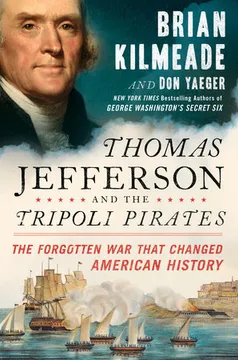
Thomas Jefferson and the Tripoli Pirates receives mixed reviews. Some praise it as an engaging account of early American naval history, highlighting forgotten heroes and events. Others criticize it as simplistic, biased, and potentially Islamophobic. Supporters appreciate the book's accessibility and relevance to current events, while detractors argue it lacks historical depth and nuance. Many reviewers note the authors' conservative background influences the narrative. Despite divided opinions, most agree the book sheds light on an often-overlooked period of American history and raises interesting questions about diplomacy, military action, and religious conflict.
People Also Read