
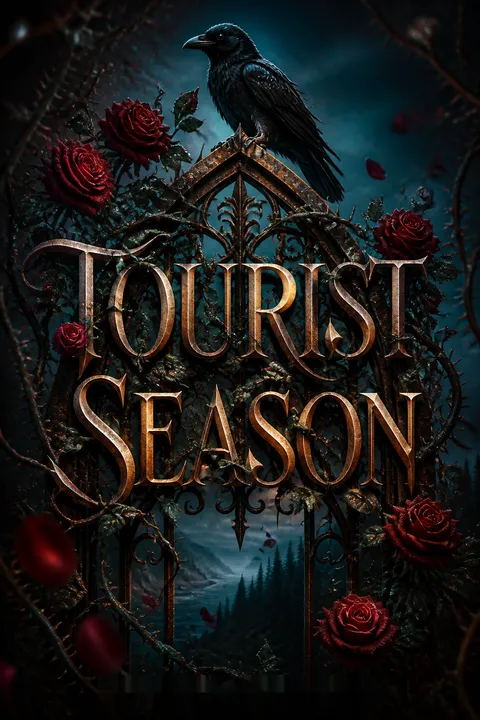


Plot Summary
Woodchipper in the Garden
In Cape Carnage, a Maine town that sells its morbid name to vacationers, the gardener called Harper1 dismembers a predatory visitor and feeds him through her blue woodchipper, scattering the remains across her flowerbeds and tossing scraps to Morpheus,8 a hand-raised raven trained to beg in her own voice.
For four years she has hidden here under a borrowed name, dyeing her blond roots dark, appointing herself the town's secret protector against its cruelest tourists.
Each day she also tends Arthur Lancaster,3 a wealthy, acid-tongued octogenarian sliding into Alzheimer's who is himself a lifelong serial killer. She hides his bag of weapons to stop his failing judgment from claiming the undeserving. Murder, mercy, and caretaking braid together into the only peace she knows.
The opening fuses the cozy and the grotesque, framing vigilante murder as gardening and nourishment, a loop where predators feed creatures and flowers. Harper's dyed roots literalize a self in tension with itself, a constructed identity straining against buried origins. Weaver establishes a morality inverted but internally coherent: the protagonist kills only those who prey on others. Arthur's dementia introduces the book's tender counterweight, the terror of losing personhood, ensuring the reader invests in a killer's humanity before any romance begins.
The Scrapbook of Vengeance
Nolan Rhodes2 checks into the Capeside Inn, run by ancient, snooping Irene.6 Four years earlier a hit-and-run on a dark Maryland road killed his younger brother Billy11 and shattered Nolan2's own body. Rather than healing, he nurtured his rage, and each anniversary he hunts one of the four people he blames, preserving their skin as trophies in a scrapbook.
Three are already dead. His final prize is the driver who fled the scene, a woman he has tracked obsessively: Harper Starling,1 presumed drowned but secretly alive. Arriving with knives and a garrote, he intends a slow, savoring kill. Grief has hollowed him into something patient and predatory, sustained not by light but by the retribution he believes he is owed.
Nolan is the dark mirror of Harper: both transformed loss into lethality. The scrapbook externalizes obsession as craft, a literal binding of trauma into pages. Weaver complicates the revenge thriller by making the avenger a serial killer indistinguishable from his quarry, collapsing the moral distance between victim and monster. His Memento Mori trophies announce the novel's preoccupation with mortality and memory, themes echoed in Arthur's vanishing mind. The reader already suspects, through dramatic placement, that his certainty about his target may be dangerously misplaced.
Flirting Over Ballmeat
At the local cafe, Nolan2 banters with a woman1 clutching a foil-wrapped object she flusters into calling a meatball sub, though it is actually a victim's leg bone. The chemistry is instant and disarming, and he fails to recognize her from years of obsessive research. They walk the quirky downtown together, past a build-your-own-corpse novelty shop.
Then the barista calls her name, Harper,1 and the warmth bleeds from his face as he grasps that he has been charmed by his quarry. She senses the predator beneath his easy smile and severs the encounter, walking off rattled. Both retreat shaken: he furious at how easily she enchanted him, she alarmed by an instinct screaming that this tourist is far more dangerous than the rest.
The meet-cute weaponizes dramatic irony: attraction ignites before recognition, suggesting their bond precedes and transcends the vendetta. The comedic mortification over the bone deflates the gothic tension, signaling Weaver's tonal signature, laughter braided with menace. The moment her name lands, desire flips to dread, dramatizing how identity itself is the hinge of the entire plot. Two apex predators clock each other, and the reader watches the hunt become reciprocal, a courtship conducted in the grammar of threat assessment.
A Head in the Feeder
That night Nolan2 slips onto the Lancaster grounds to kill Harper1 but finds a local creep named Jake masturbating outside her window. Enraged, he garrotes the voyeur, dismembers him, and wedges the severed head in Harper1's bird feeder as a psychological terror tactic.
Morpheus8 promptly pecks out the eyes. Come morning, instead of screaming, Harper1 calmly phones Arthur3 to ask whether he did it, then examines and even sniffs the head with mild irritation. When Nolan2 reveals himself, her unflappable composure dismantles his fantasy of conquest.
Maya,7 the town's chemist-shopkeeper, interrupts the standoff. Two killers now openly recognize each other; he vows she can never escape him, and she answers that she isn't going anywhere either. The hunt has become a mutual obsession.
The scene subverts the slasher's gaze: the woman meant to be terrorized is the most dangerous person present. Jake's voyeurism and Nolan's surveillance rhyme, indicting the predatory male gaze even as Nolan punishes it. Harper's bored autopsy of the head is grotesque comedy that also asserts her agency, refusing the victim role assigned to her. Their mutual vow reframes obsession as a perverse intimacy, the only language either fluent killer can speak, and the first sign that annihilation and attraction share the same circuitry.
Stealing the Killer's Trophies
While Nolan2 jogs, Harper1 slips into his hotel room with a master key, cracks his safe, and discovers the scrapbook of skinned trophies. Turning the pages, she finds photographs of Billy11's grave and a handwritten list naming the four people in the fatal car, with herself, Harper Starling,1 marked as the fleeing driver and his ultimate target.
She recognizes him as a killer like La Plume, the legend that haunts the town. She steals his weapons and book, leaves a taunting note, knifes his tire, and entrusts the bag to Lukas, Arthur's earnest grandson,5 with orders to mail it to the FBI if she dies. The leverage protects her, yet she knows he will kill her the instant he reclaims it.
Information asymmetry inverts the predator-prey dynamic: knowledge becomes the deadliest weapon. The scrapbook, his most intimate object, passes into her hands, a symbolic disrobing that foreshadows physical intimacy. Her decision to weaponize evidence rather than flee marks her refusal to be a fugitive again, a reclamation of power born from past helplessness. The reader, sensing the list's fragility, feels the irony tighten: she accepts a death sentence for a crime the narrative will eventually reveal was never hers.
Sixteen Bodies, Three Weeks
Sam Porter,4 a fame-hungry documentarian and amateur sleuth, arrives convinced Arthur3 is La Plume, and worse, he once tracked Harper1's vanishing. When Nolan2 mentions Sam,4 Harper1's defenses splinter. They strike a bargain: he helps shield Arthur3 and drive Sam4 from town, and she returns his book.
The clock is brutal. Lukas5 unknowingly sold the Lancaster land along the Ballantyne River to a developer, and the sale closes in three weeks, atop sixteen of Arthur3's buried victims that must be exhumed first.
Night after night the enemies dig together, Nolan2 swimming the frigid river to triangulate each grave. He begins gifting her a better shovel, bug spray, hot chocolate, kindnesses he camouflages as cold practicality while something unwanted takes root.
The exhumation premise literalizes the novel's thesis: the past will not stay buried, and someone always profits from digging. The ticking deadline converts antagonism into forced collaboration, the engine of enemies-to-lovers, while Sam embodies the predatory media impulse to expose trauma for clout. Nolan's disguised generosity reveals desire outpacing intention; he rationalizes care as logistics. Weaver stages romance as logistics of complicity, intimacy accreting through shared guilt, sweat, and the strange domesticity of grave-digging by lantern light.
Mushrooms in the Hot Chocolate
Fed up with Nolan2's needling and his cruel jabs about Arthur,3 Harper1 spikes his hot chocolate with Maya7's psilocybin-laced fake blood. When Sam4 prowls the riverbank, the two hide neck-deep in the cold water, where Harper1 admits she cannot swim. In the dark current, Nolan,2 hallucinating and unguarded, tells her she is beautiful and that learning who she was changed everything.
Back at her cottage, washing his river-soaked clothes, the long-banked hostility finally combusts into violent, tender sex that neither can dismiss. Afterward she withdraws upstairs to sleep beneath two burning lamps, leaving him alone on the couch, unsettled by how right it felt. The boundary between hunter and lover has dissolved past any clean recovery.
The drugging is both prank and confession: chemically lowered defenses let buried feeling surface, with the hallucinogen functioning as truth serum. Water, the element she fears, becomes the womb of their first real intimacy, foreshadowing the literal drowning to come. Her two lamps quietly encode trauma, a need to banish darkness that the narrative will later explain. Weaver frames consummation as inevitable collapse rather than choice, suggesting that suppressed truth, like desire, exerts a gravitational pull no rationalization can resist.
Lawn Aerators and an Axe
Arthur3 collapses and is hospitalized with a B12 deficiency aggravating his dementia, and Harper1 blames herself for missing the signs. In the ER, a drunk named McMillan shoves a pregnant nurse to the floor. Harper1 plants her old mementos at an abandoned farmhouse to misdirect Sam4 from Arthur,3 then abducts McMillan at gunpoint and tortures him with garden aerators in her yard, half vengeance, half an alibi staged while Arthur3 lies hospitalized.
When McMillan tears loose and attacks, Harper1 buries her axe in his neck, saving Nolan,2 who has just arrived. He explodes, not in anger but in raw fear for her safety, and privately confesses to himself that he is falling for the very woman he came to destroy.
Caretaking and killing converge as expressions of the same fierce loyalty; Harper's self-blame over Arthur reveals the crushing weight of dementia caregiving the author treats with rare seriousness. The torture scene, justified by the nurse's harm, tests reader allegiance while preserving the vigilante code. Nolan's terror, not rage, when she is endangered is the hinge of his transformation: his obsession metamorphoses from a wish to kill her into a need to keep her alive, vengeance curdling into protectiveness.
Beauty, Beast, and a Threat
At the town's gleefully gory staging of Beauty and the Beast, with Lukas5 cast as the Beast, Nolan2 holds Harper1's hand through the bloody spectacle while Arthur3 sits beside them, and the evening feels disarmingly like a true date. But at the concession line Sam4 corners Harper,1 naming her as the Harper Starling1 presumed dead after the Maryland crash and revealing he found her hidden keepsakes at the farmhouse.
Rattled, she returns to her seat, where a drifting Arthur3 mistakes her for his murdered daughter Poppy, then lucidly warns her to guard her identity lest the world consume her. Afterward Nolan2 takes her to a playground and a seaside dinner, and their bond deepens into something dangerous neither dares to name aloud.
The fairy tale staged as gore literalizes the book's premise, monstrous love that is also tender. Sam's ambush escalates the identity stakes, his hunger for a story indistinguishable from predation. Arthur's slippage between Poppy and Harper devastates, collapsing past and present grief and revealing the surrogate father-daughter bond at the novel's heart. His warning, born of his own catastrophic exposure, frames secrecy as survival, setting the tragic logic that her truth, once known, invites destruction.
The Cliff and the Sea
For the Carnival of Carnage gravity race, Harper1 pilots a refurbished soapbox car whose brakes suddenly snap. She careens through the crowd, off the path at Widow's Point, and over the cliff into the sea, screaming Nolan2's name. He gives chase on a child's bicycle, fails to reach her grasping hand, then dives from the cliff after the sinking car.
Underwater he watches the light leave her eyes before he cuts her free of the harness. Pulled aboard a passing sailboat, he performs frantic CPR until she coughs back into life. Cradling her revived body, the man who arrived to murder her2 finally understands he is hopelessly in love. He refuses to leave her hospital bedside for three days.
The drowning enacts a symbolic death and rebirth, mirroring the staged death that birthed her current life and the crash that defined Nolan. Water, established as her terror, becomes the crucible of his salvation rather than her doom, inverting the novel's opening logic of sending a car into the sea. CPR, his hands restoring breath rather than stealing it, completes Nolan's conversion from executioner to protector. Love is here defined as the refusal to let the sea finish what fate began.
Arthur's Cemetery Mistake
As Harper1 recovers, devotion replaces hostility, and she even braves the cellar that mirrors her worst memories to return Nolan2's book and weapons, wanting to keep suspicion off him. Then Arthur,3 exploiting Nolan2's trust, cons him into fetching his confiscated murder bag, slips away to the cemetery, and kills a tourist whose dog fouled his prized roses, leaving the dead man's skin imprinted with the unmistakable shape of his wolf-headed cane.
Harper1 and Nolan2 find Arthur3 bloodied and disoriented, calling her Poppy once more. They soothe him with talk of topiaries and his gardening rival, then quietly take charge of the body. The cleanup becomes one more thread binding the lovers, and one more secret the tightening net could expose.
Harper's voluntary descent into the cellar dramatizes trauma confronted for love's sake, the body remembering what the mind avoids. Returning his trophies inverts her earlier theft, signaling trust as the surrender of leverage. Arthur's cane-stamp evidence renders dementia not just poignant but operationally dangerous, the loss of judgment becoming a forensic liability. The recurring Poppy confusion deepens the tragedy: the man she protects is forgetting the daughter he failed to save, and increasingly forgetting her too.
Kidnapped at the Distillery
As Nolan2 loads his car to move in with Harper1 rather than abandon her, Sam4 ambushes him with a gun, kicks his ruined knee, and drives him to the half-restored Lancaster Distillery. There Sam4 handcuffs him and films an interrogation, threatening to expose everything about Harper1 unless he confesses.
Meanwhile Harper,1 convinced Nolan2 ghosted her, finds the cemetery corpse untouched and then spots Sam4's operator Vinny10 leaving the inn, talking about the distillery. She knocks Vinny10 senseless with an antique three-hole punch and races to the scene. Freeing Nolan,2 the two overpower Sam,4 heave him over the landing railing, and when his snagged foot dislocates with a sickening pop, Harper1 unlaces his dangling boot and lets him drop to his death.
The kidnapping pays off Sam's escalating menace, the documentarian finally crossing into the criminality he chases, exposing the thin membrane between true-crime obsession and atrocity. Harper's misreading of Nolan as a deserter reveals her abandonment wound, the deeper fear beneath her toughness. Their coordinated kill consummates the partnership in violence, lovers fighting as one organism. The boot-unlacing, blackly comic and merciless, crystallizes Weaver's tonal balance and Harper's refusal to extend the mercy her enemies never offered her own dead.
The Van Beneath the Waves
Chasing the secret Sam4 died pursuing, Nolan2 dives at the spring tide to a camper van submerged off the coast and recovers its identification number. His research unspools the truth: the van belonged to van-life influencers Autumn Bower1 and Adam Cunningham.12
The woman he loves is not Harper Starling, the hit-and-run driver he came to murder, but Autumn,1 who survived a different serial killer, Harvey Mead,13 the man who butchered Adam,12 then vanished and assumed dead Harper Starling's name. The engraved bracelet his raven once fetched, marked A2BC, was theirs. He came to annihilate the wrong woman,1 and she never told him. As he reels, the Sleuthseekers discover Sam4 and Vinny10 are dead and declare war, vowing to descend on Cape Carnage.
The central reversal recontextualizes the entire vendetta as tragic error, indicting the certainty that fueled Nolan's grief-rage and exposing memory as unreliable architecture. Identity, the novel's obsession, resolves into a stolen name and a survivor's reinvention. Adam and the bracelet supply the emotional ballast beneath Harper's two lamps and aversion to darkness. Crucially, her silence reframes every cruelty he inflicted: she absorbed punishment for a stranger's sins. The Sleuthseekers' war launches the sequel hook, fame-driven mobs as the next predator swarm.
Epilogue
Sheriff Yates,9 the lazy lawman the town routinely underestimates, enters the distillery alone and finds Sam4's broken body. When Vinny,10 who survived Harper1's blow, arrives searching for his boss, Yates9 plays the kindly officer, then slams the operator's skull into the wall.
As Vinny10 babbles about Nolan,2 the Ballantyne River, and a woman who isn't who she claims, Yates9 calmly reveals the truth: he is La Plume, the poetry-quoting quill killer who murdered Poppy Lancaster decades ago and let the town blame a ghost. He presses his own knife into Vinny10's hand, stabs himself to manufacture self-defense, and shoots Vinny10 dead, murmuring that he knows the gardener is really Autumn Bower.1 The hunter everyone hunts has worn a badge all along.
Analysis
Tourist Season weaponizes the cozy-town cozy-romance template against itself, staging a love story between two serial killers in a hamlet that monetizes its own morbidity. Weaver's central provocation is moral inversion: vigilante murder is rendered as gardening, caretaking, and even ecological stewardship, daring readers to root for predators whose code targets only other predators. The novel's deepest seriousness lies in Arthur3's dementia, where the horror is not the body count but the erosion of personhood, the terror of a self dissolving. Against that backdrop, the romance argues that being truly seen, including one's darkest interior, is the only durable intimacy, that love is acceptance of the monster one has chosen to become. Identity is the book's obsessive theme, dramatized through a stolen name, dyed roots, a constructed persona, and the climactic revelation that Nolan2's entire vendetta rested on mistaken certainty. This twist functions as a critique of grief-driven righteousness: the avenger, so sure of his target, has been punishing the wrong woman,1 exposing memory as malleable and vengeance as a story we tell to make pain bearable. Weaver also indicts the true-crime industrial complex through Sam Porter4 and the Sleuthseekers, whose hunger to expose trauma for fame mirrors the killers' predation, suggesting the spectator and the slasher share a gaze. The recurring imagery of tides, ouroboros tattoos, and cycles, death feeding flowers, the hunter becoming the hunted, insists that nothing stays buried and everything consumes itself. Tonally, the book braids slapstick with atrocity, refusing to let either dominate, so that a severed head in a bird feeder coexists with a tender deathbed of memory. The result reframes the redemption arc: not forgiveness or healing, but transformation, two ruined people building a future from the wreckage of who they were forced to become.
Review Summary
Tourist Season is a dark romantic comedy about two serial killers in a small coastal town. Readers praise the witty banter, steamy romance, and morally grey characters. Many found it hilarious and addictive, with a perfect balance of gore and humor. The small-town setting and side characters were highlights. Some criticisms include overuse of miscommunication and pacing issues. Most reviewers eagerly anticipate the sequel, as the book ends on a cliffhanger. Overall, fans of the author's previous work will likely enjoy this new series.
People Also Read







Characters
Harper
Hidden killer gardenerThe dark-haired gardener of Cape Carnage, beloved by locals and feared by no one who should fear her. Beneath the borrowed name lives a woman remade by catastrophe: she lost her partner12 and nearly her life to a serial killer13, then reinvented herself in a town built on death. She murders predatory tourists, tends the public gardens, and devotedly cares for an ailing old man she loves like family3. Fiercely loyal, sardonic, and self-sufficient, she sleeps with the lights on and keeps her heart fortified behind walls of grief and vigilance. Her central wound is survivor's guilt and the conviction that she is too broken to be loved. What she craves, beneath the armor, is to be fully seen and accepted, not as a victim but as the formidable creature she chose to become.
Nolan Rhodes
Vengeful grieving brotherA search-and-rescue specialist and former firefighter whose body and soul were shattered when a hit-and-run killed his younger brother Billy11. Rather than seeking peace, Nolan cultivated the void inside him, becoming a methodical killer who hunts those he blames and preserves their skin in a scrapbook. He is charming when he chooses to be, stoic and observant otherwise, drawing magnetism from a deep well he keeps carefully hidden. His Southern warmth masks a predator's patience. Driven by a need for retribution he mistakes for justice, he is psychologically imprisoned by the past, unable to grieve because grieving would mean forgiving. His arc tests whether obsession can transform into devotion, and whether a man defined by an avenger's purpose can build a future instead of feeding on an unhealed wound.
Arthur Lancaster
Aging serial-killer mentorThe imperious, impeccably dressed patriarch of Cape Carnage, master of a generational fortune and a lifetime of secret killing in the name of protecting his town. Now Alzheimer's steals his memory, judgment, and selfhood, terrifying him with the slow erasure of who he is. Harper1's mentor and dearest friend, he is curmudgeonly, witty, and fiercely proud, prone to misplacing sugar bowls and inventing phantom thieves. Haunted above all by the long-ago murder of his daughter Poppy, he clings to grief even as other memories dissolve. He represents both danger and profound tenderness, a brilliant mind unraveling, a killer reduced to needing help with his cane, and the emotional anchor proving that monsters can love and be loved.
Sam Porter
Fame-hungry documentary sleuthA polished, ambitious filmmaker and founding member of the amateur investigative group the Sleuthseekers, who comes to Cape Carnage chasing the legend of the serial killer La Plume. Beneath his affable, country-club exterior lies a hunter's relentlessness; he craves recognition and the story of a lifetime, willing to trespass, surveil, and worse. He is a dark twin to the true killers around him, justifying any rule he breaks as service to justice and fame.
Lukas Lancaster
Arthur's earnest grandsonArthur3's handsome, kindhearted grandson, restoring the family distillery while shouldering quiet heartbreak over a first love who vanished. Largely unaware of his family's darkest truths, he is the warm, decent soul of the Lancaster line, devoted to his grandfather3 and trusting of Harper1. His banter with Harper1, especially their game of sabotaging each other with chores, supplies levity and a window into the found-family bonds anchoring her life.
Irene
All-knowing innkeeperThe ancient, half-deaf proprietor of the Capeside Inn, who demands guests ring her bell and claims to read the cut of a person's jib. Endlessly nosy, she tracks every romance and rumor in town and harbors a soft spot for Arthur3. Her seeming frailty hides sharp instincts, and her gossip repeatedly shifts the plot.
Maya
Quirky chemist shopkeeperAn MIT-trained chemist who runs Maya's Magical Mixtures, selling whimsically named stain removers, bug repellents, and edible fake blood, some of it laced with psilocybin. Observant and unflappable, she supplies tools that prove crucial to several of Harper1's schemes.
Morpheus
Talking trained ravenHarper1's hand-raised raven, trained with fresh meat to mimic her voice and beg for human snacks. Equal parts comic relief, lookout, and harbinger, he ferries shiny objects across town, including a bracelet that ultimately helps unravel the central mystery.
Sheriff Yates
Underwhelming town lawmanThe silver-haired sheriff of Cape Carnage, more invested in tourism revenue than real investigation, with a habit of fishing-trip photos and folksy menace. He projects fatherly warmth while watching everyone a beat too closely, and his lazy reputation conveniently keeps the town's many disappearances uninvestigated.
Vinny
Sam's drone operatorSam Porter4's surly assistant and drone pilot, who arrives to aid the documentary and quickly grows suspicious of Nolan2. A loyal collaborator in Sam4's increasingly reckless pursuit of the town's secrets.
Billy
Nolan's slain brotherNolan2's beloved younger brother, an aspiring pastry chef, killed in the Maryland hit-and-run that nearly took Nolan2 too. His death is the engine of Nolan2's vengeance, his last scream the wound around which Nolan2 organized his entire ruined life.
Adam
Harper's lost partnerHarper1's joyful, generous former love, with whom she lived a van-life adventure before a serial killer13 destroyed everything. His memory, a watch and an engraved bracelet, embodies the grief and survivor's guilt she has carried into her reinvented life.
Harvey Mead
Killer from her pastThe sadistic serial killer who lured Harper1 and her partner12 to a remote house, imprisoned them in a cellar, and murdered her love12. Surviving and escaping his horrors forged the hardened woman she became, and the cellar that mirrors his still triggers her deepest terror.
Plot Devices
The Skin Scrapbook
Leverage and obsession objectNolan2's handmade book preserves photographs, crimes, and patches of tattooed skin from each person he has killed, with a final list naming his last intended target. It externalizes his grief-fueled obsession and his methodical record-keeping. When Harper1 steals it from his hotel safe, the book flips the power dynamic, becoming the leverage that forces their alliance and the prize he cannot kill her without retrieving. Its eventual return signals trust, and its contents drive the central irony, because the name written as his ultimate target belongs to someone the woman before him only pretends to be. The scrapbook is both confession and contract, binding hunter and hunted in mutual hostage-taking until violence and intimacy rewrite its meaning.
Cookie Monster and Morpheus
Body disposal and comic motifHarper1's blue woodchipper, nicknamed Cookie Monster, and her talking raven, Morpheus8, form a recurring loop of grotesque disposal and dark comedy. The chipper grinds victims into garden fertilizer; the raven eats the scraps and parrots Harper1's voice begging for more. Together they establish the novel's tonal signature, horror domesticated into routine, and characterize Harper1's twisted ecology of murder feeding life. The motif recurs as both threat and punchline, from the head in the bird feeder to Morpheus8 warning of intruders. Crucially, the raven also ferries trinkets across town, including an engraved bracelet whose innocent appearance later becomes a thread that helps unravel the book's largest secret.
The Exhumation Deadline
Ticking-clock forced allianceA property sale of the Lancaster land along the Ballantyne River, closing in three weeks, sits atop sixteen of Arthur3's buried victims. The countdown converts mortal enemies into nightly collaborators who must dig up and dispose of the dead before bulldozers arrive. This device structures the middle of the novel, generating sustained proximity that fuels the enemies-to-lovers romance while raising stakes around discovery. Each excavation deepens trust and complicity, transforming gravedigging into courtship. The shared labor, lantern light, river swims, and quiet conversation, lets affection accrete under pressure, making the relationship feel earned through guilt and effort rather than simple attraction.
The Stolen Identity
Dramatic-irony mistaken targetThe woman Nolan2 hunts as Harper Starling, the hit-and-run driver who fled, is not that person at all. She is a survivor of a different serial killer13 who assumed the dead Harper Starling's drained bank account and name to disappear. This concealed truth powers the novel's dramatic irony: Nolan2 punishes, threatens, and obsesses over a stranger for crimes she never committed, while she silently absorbs it to protect her secret and her promise to Arthur3. The revelation, surfaced through a sunken van's identification number, recontextualizes the entire vendetta as tragic error and reframes every cruelty between the lovers, exposing certainty itself as the deadliest delusion.
The Sunken Van and Bracelet
Revelation triggerA camper van rusting on the seabed, visible only at extreme spring tides, is the obsession that draws Sam Porter4 to his death and the key Nolan2 later pursues. Diving to it, Nolan2 recovers its identification number and traces it to van-life influencers whose initials match the engraved bracelet his raven8 once fetched from a memorial grave. The van and bracelet together detonate the identity revelation, linking the woman he loves1 to a survivor's hidden past. The device elegantly converts an ominous local legend into the personal disclosure that upends Nolan2's understanding of everything, proving the past always resurfaces when the tide pulls back far enough.
The Seasons of Carnage Trilogy Series

About the Author
Download PDF
Download EPUB
.epub digital book format is ideal for reading ebooks on phones, tablets, and e-readers.








































