Key Takeaways
1. The Paradox of Suffering for the Blameless
"By and large people who do not care about God live happier, longer lives with less suffering than do believers. Why? What kind of God runs a world like this?"
The "Why" Question. The book of Job confronts the agonizing "wheelchair questions" of suffering, not the detached "armchair questions" of philosophy. Job, a man described as blameless, upright, God-fearing, and turning away from evil, experiences catastrophic loss:
- His vast wealth is destroyed.
- All his children are killed.
- His health disintegrates into loathsome disease.
This stark contrast between his righteousness and his suffering forces an honest inquiry into divine justice.
Undeserved pain. Job's suffering is not a punishment for unconfessed sin, a point explicitly stated by the narrator and God himself. This challenges the common human assumption that good people are always blessed and bad people always suffer. The world, as Job observes, often appears to operate contrary to this simple moral logic.
Moral fabric. The core dilemma for Job, and for any believer, is how to reconcile a just and sovereign God with a world where the righteous suffer terribly and the wicked often prosper. This tension threatens the very moral fabric of the universe, prompting Job's desperate cries for understanding.
2. God's Sovereignty and Satan's Limited Influence
"The scandal is that the supreme God does give Satan permission to cause God’s blameless servant to suffer."
Heavenly council. The narrative opens with a glimpse into a heavenly council where God, the supreme sovereign, converses with "the Satan," an accuser or adversary. Satan challenges Job's integrity, suggesting his piety is merely a transactional response to God's blessings.
Satan's leash. God, in His absolute sovereignty, grants Satan permission to test Job, but with strict limitations:
- First, Satan can destroy Job's possessions and children, but not touch Job himself.
- Second, Satan can afflict Job's body, but not take his life.
This reveals that while Satan has real influence and power to inflict evil, he operates entirely within the confines of God's sovereign decree. God is not a chess grandmaster unsure of the outcome; He is in ultimate control.
The unseen hand. Job, unaware of these heavenly dialogues, perceives God's hand directly in his suffering. However, the reader knows that the monstrous acts were carried out by Satan, albeit with divine permission. This distinction is crucial: God permits evil, but He is not the direct author of the evil acts themselves, and He always maintains control over its extent.
3. The Emptiness of Superficial Comfort
"Miserable comforters are you all."
Flawed theology. Job's three friends—Eliphaz, Bildad, and Zophar—arrive to comfort him but quickly become his accusers. Their theology is simple and rigid: God is just, therefore suffering must be a direct punishment for sin. They insist Job must have committed some grievous, unconfessed sin to deserve his plight.
Pastoral insensitivity. The friends' approach is marked by:
- Lack of honesty: They refuse to acknowledge the reality of Job's blamelessness, clinging to their dogma despite evidence.
- Lack of sympathy: They are more attached to their theories than to Job's pain, offering lectures instead of empathy.
- Lack of love: They fail to truly listen to Job's cries, engaging in repetitive arguments rather than compassionate dialogue.
Their "well-swept answers" add a cruel burden to Job's grief, tormenting him with false accusations.
Critical omissions. Their theological system is flawed by three vital omissions:
- No Satan: They have no concept of a spiritual adversary influencing events, attributing all suffering directly to God's punitive action.
- No waiting: They believe in immediate retributive justice, failing to grasp that ultimate judgment and vindication are often delayed until the end of time.
- No cross: They have no place for innocent suffering, missing the profound truth that the righteous can suffer, a truth ultimately fulfilled in Christ.
4. True Faith Embraces Both Anguish and Longing
"Though he slay me, I will hope in him."
Unique pain of the believer. For Job, suffering is uniquely sharp because he believes in a sovereign, just God. The pain is not just physical or emotional; it's the profound perplexity of a good God seemingly acting as an enemy. Job rails against this perceived injustice, accusing God of being a "cosmic sadist" and destroying both the blameless and the wicked.
Paradoxical longing. Despite his anger and accusations, Job's faith is revealed in his passionate, desperate longing to bring his case directly to God. He yearns for a divine encounter, an arbiter, a Redeemer who will vindicate him. This tension—simultaneously accusing God and desperately seeking Him—is a hallmark of true worship.
Beyond wishful thinking. Job's declaration, "I know that my Redeemer lives, and at the last he will stand upon the earth," is an extraordinary insight of faith. It's not wishful thinking but a profound hope in ultimate vindication. This hope finds its ultimate assurance in the bodily resurrection of Jesus Christ, the blameless one whom God publicly vindicated after undeserved suffering.
5. The Humbling Path to True Wisdom
"Behold, the fear of the Lord, that is wisdom, and to turn away from evil is understanding."
The elusive "Wisdom". Job 28, a contemplative poem, interrupts the heated debates to explore the search for "Wisdom" (with a capital W)—the fundamental, underlying architecture and moral order of the universe. This Wisdom is portrayed as:
- Priceless: More valuable than all the world's gold, silver, and precious jewels.
- Inaccessible: Hidden from all living creatures, beyond human discovery through mining or intellectual pursuit.
Job's desperate "Why?" questions are a search for this ultimate understanding.
God's sole domain. The poem concludes that only God "understands the way to it, and he knows its place." He alone established the cosmic order, from the weight of the wind to the path of lightning. Human beings cannot grasp this ultimate Wisdom.
True human wisdom. God's direct voice, for the first time to humanity in the book, defines true human wisdom (with a small w) not as intellectual comprehension of all mysteries, but as a humble, relational posture: "the fear of the Lord, that is wisdom, and to turn away from evil is understanding." This affirms Job's initial character (1:1) and redirects focus from knowing all answers to knowing the Answerer.
6. God's Power Over the Problem of Evil
"No one is so fierce that he dares to stir him [Leviathan] up. Who then is he who can stand before me?"
The Lord's challenge. God finally answers Job "out of the whirlwind," not with explanations for his suffering, but with a series of rhetorical questions about creation. He challenges Job's capacity to manage the cosmos, from stars and clouds to wild animals. This first speech humbles Job, forcing him to acknowledge God's unmatched creative power.
The problem of evil. The second divine speech introduces Behemoth and Leviathan, not merely as hippos and crocodiles, but as symbolic representations of cosmic evil and chaos, even Satan himself. Leviathan is depicted as a terrifying, supernatural beast, "king over all the sons of pride," embodying the undiluted power of evil.
Evil on a leash. God's point is clear: Job cannot tame Leviathan; he cannot even begin to confront the problem of evil on his own. But God can. This awesome monster is a creature, ultimately on God's leash. This reassures Job (and the reader) that while evil is terrifying, it is not ultimate. God is stronger still, controlling even the forces that seek to destroy.
7. The Purpose of Suffering: Humbling, Justification, and Future Blessing
"Therefore I despise myself, and repent in dust and ashes."
Job's humble response. In the face of God's majesty, Job repents—not for secret sins, but for his presumption in questioning God's governance and speaking beyond his understanding. This humbling is a mark of God's compassion, bringing Job to a right posture before his Creator.
Divine vindication. God explicitly affirms Job, declaring that "You have not spoken of me what is right, as my servant Job has." This vindicates Job's integrity, confirming he was indeed righteous and not suffering for unconfessed sin. God accepts Job, calling him "my servant" and even instructing the friends to seek Job's intercession, signifying Job's restored standing.
Blessing in the end. The book concludes with Job's restoration: his wealth is doubled, he receives a new family, and lives a long, blessed life. This blessing is not a reward for his perseverance but an act of grace, demonstrating God's ultimate compassion and mercy. It underscores that while suffering is real, God's purpose is ultimately good, and "the end comes at the end"—a promise of future, abundant blessing.
8. The Christian Life as Warfare and Patient Waiting
"You have heard of the steadfastness of Job, and you have seen the purpose of the Lord, how the Lord is compassionate and merciful."
Expect spiritual warfare. Job's story reveals that the Christian life is inherently a battlefield. Believers, precisely because of their faith, become targets for Satan's attacks, which God permits within limits. This "dark warfare" is an inescapable element of following Christ, as Jesus himself warned his disciples about being "sifted like wheat."
Active, prayer-filled waiting. Job's perseverance is not passive resignation but an active, prayer-filled yearning for God. Unlike his friends who relied on rigid theological systems, Job passionately sought a personal encounter with the living God. This "directed, prayer-filled waiting" is the integrating arrow of hope that sustains authentic Christian life amidst unanswered questions.
God's compassionate purpose. James highlights that God's "compassionate and merciful" purpose is revealed in the end of Job's story. This teaches believers to expect that while suffering and unanswered questions are part of the present, God's ultimate plan is good and will be fully unveiled at Christ's return. The blessings received now are but a foretaste of the abundant, rock-solid realities of the new heavens and new earth.
9. Job as a Foreshadowing of Jesus Christ
"The drama, the pain, and the perplexity of Job reach their climax at the cross of Jesus Christ."
Blameless sufferer. Job, as the blameless believer who endures undeserved suffering, profoundly foreshadows Jesus Christ. Jesus, the ultimate "servant of the Lord," perfectly fulfilled Job's integrity and experienced an even deeper, more solemn darkness and agony on the cross.
Victory over Leviathan. The monstrous power of Leviathan, representing Satan and cosmic evil, reaches its vicious depths in the life and death of Jesus. Yet, paradoxically, it is on the cross that Christ, through his death, "destroyed the one who has the power of death, that is, the devil." This victory over evil was not won from a distance but through incarnate suffering.
Justification and vindication. Job's desperate longing for justification and vindication finds its ultimate fulfillment in Christ's resurrection. As the blameless one accused and despised by humanity, Jesus was publicly vindicated by God on the third day. Thus, Job's journey becomes a powerful paradigm for every believer's path of faith, where present suffering leads to ultimate justification and glory in Christ.
Review Summary
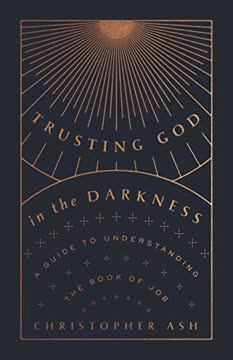
Trusting God in the Darkness receives overwhelmingly positive reviews, averaging 4.53 out of 5. Readers consistently praise its pastoral sensitivity, accessibility, and Christ-centered approach to the book of Job. Many appreciate its concise yet profound exploration of suffering, divine providence, and true worship. Reviewers highlight Ash's ability to connect Job's suffering to Jesus Christ, making it spiritually enriching beyond mere academic study. While some wish for greater depth, most recommend it as an excellent introduction, particularly for those experiencing personal suffering or preparing to study Job.
People Also Read