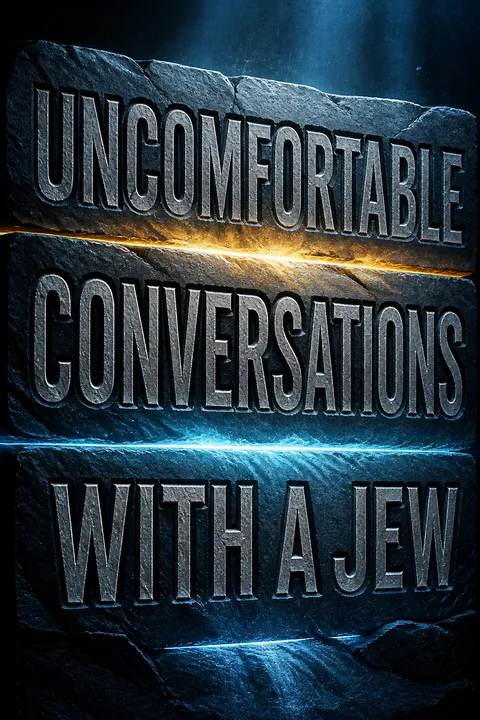
Key Takeaways
1. Judaism is an ethno-religion and a shared peoplehood, not just a faith
Meaning being Jewish is not solely about being observant or practicing daily rituals. It’s about a shared story and history, a shared culture, and a shared ancestral homeland—in Hebrew, it’s an Am and Uma, a peoplehood and a nation.
A unique identity. Judaism defies simple categorization because it is not merely a set of theological beliefs, but an ethno-religion. One can be a devout atheist, like Noa's father, and still be entirely Jewish because of a shared lineage, culture, and historical narrative.
The non-missionary covenant. Unlike Christianity or Islam, Judaism is not a missionary religion seeking to convert the world. It traditionally makes conversion difficult because joining the Jewish people means entering a binding covenant and sharing in a long history of collective struggle.
Core cultural pillars. The essence of Jewish life is built on community, continuous questioning, and action in the present world. This is reflected in:
- Tikkun Olam: The mandate to actively repair and heal the world.
- Minyan: The requirement of ten people to recite holy prayers, ensuring no one grieves alone.
- Exigidity: A unique blend of rigidity in values and flexibility in practice that has sustained the community for millennia.
2. Jews are not a biological race, and their "whiteness" is highly conditional
Because to some people, we are not white enough. And to others, we are too white.
The racial myth. Jews are not a biological race, a dangerous misconception that was weaponized by the Nazis to justify systematic extermination. In reality, the global Jewish community is incredibly diverse, encompassing Ashkenazi (European), Sephardic (Spanish), Mizrahi (Middle Eastern/North African), and Beta Israel (Ethiopian) heritages.
Conditional white privilege. While many American Jews of European descent are "white-passing" and benefit from racial privilege in daily encounters, this status is highly conditional. White supremacists explicitly reject Jewish whiteness, while some progressive spaces dismiss Jewish vulnerability by labeling them as part of the dominant oppressor class.
The assimilation trap. Historically, Jews in America were forced to assimilate—changing names, hair, and cultural practices—to escape overt discrimination. However, this assimilation has never served as a permanent shield against hate, as evidenced by:
- The disproportionate percentage of religiously motivated hate crimes targeted at Jews.
- The necessity of armed security guards at synagogues and Jewish day schools.
- The sudden stripping away of "white" status whenever antisemitic conspiracy theories resurface.
3. Jewish success in finance and entertainment stems from historical exclusion, not a global conspiracy
But the jump from representation to control is where you start to dabble in stereotypes and dangerous mythology.
Forced professional niches. The stereotype of the wealthy, money-obsessed Jew is a direct byproduct of medieval Christian laws. Because Jews were banned from owning land and joining trade guilds, they were forced into urban commerce and moneylending—professions Christians deemed spiritually unclean but economically necessary.
Building from exclusion. Similarly, the prominent Jewish presence in early Hollywood occurred because Jews were excluded from established "white-shoe" industries. Blocked from elite law firms, hospitals, and theater circuits, enterprising Jewish immigrants built their own movie studios, turning their exclusion into a cultural powerhouse.
Representation versus control. While Jews have achieved remarkable success and hold positions of influence, equating over-representation with a coordinated "cabal" is a dangerous antisemitic trope. The reality of Jewish achievement is characterized by:
- A cultural obsession with education, literacy, and rigorous debate.
- The fact that Jews control only a tiny fraction (1.1%) of global wealth.
- The historical survival instinct of keeping a low profile to avoid being targeted for success.
4. Antisemitism is a shape-shifting conspiracy theory that functions like a layer cake
Antisemitism is both looking down at a Jew as inferior (Hi, Nazis!) but also kinda looking up at them, mostly with fear or resentment, and attributing to them a larger-than-life power and control...
A unique hatred. Unlike standard forms of racism that punch down at a group deemed entirely inferior, antisemitism is a complex, shape-shifting conspiracy theory. It simultaneously views Jews as subhuman pests and as an all-powerful, puppet-master elite pulling the strings of global events.
The layer cake. Over thousands of years, societies have added new layers of justification to hate Jews, adapting the prejudice to fit whatever a given culture despises most at any historical moment. Under religious empires, they were "God-killers"; under racial regimes, they were "race polluters"; and under modern political frameworks, they are labeled "imperialist oppressors."
Enduring historical tropes. These layers of prejudice rely on a recurring set of toxic myths that continue to circulate on social media and in mainstream discourse:
- Blood Libel: The ancient, horrific lie that Jews murder children for ritual purposes.
- Dual Loyalty: The accusation that Jews are untrustworthy citizens loyal only to a hidden global agenda or Israel.
- The Octopus: The visual and conceptual trope of Jewish tentacles controlling global finance, media, and governments.
5. The Holocaust was a systemic escalation of hate, not a sudden historical accident
How it was a series of subtle, almost imperceptible incidents that eventually added up to this catastrophic moment in our global history...
The slow boil. The Holocaust did not begin with gas chambers; it began with words, legal restrictions, and societal complicity. The Nazi regime systematically chipped away at Jewish humanity over a decade, utilizing economic frustration and nationalistic pride to turn neighbors against one another.
Dismantling democracy. Hitler's rise to power was facilitated by exploiting democratic loopholes, silencing political opponents, and spreading state-sanctioned disinformation. Once the constitutional checks and balances were destroyed, the regime easily codified discrimination through the Nuremberg Laws, stripping Jews of citizenship and property.
The danger of forgetting. Today, a shocking lack of historical awareness among younger generations creates a fertile ground for Holocaust denial and revisionism. This collective amnesia is dangerous because:
- 63% of American millennials and Gen Z do not know that six million Jews were murdered.
- Multiple states do not require Holocaust education to avoid causing student "discomfort."
- The same rhetorical patterns of dehumanization and scapegoating are actively reappearing in modern digital spaces.
6. Zionism is simply the right of the Jewish people to self-determination in their ancestral homeland
Zionism is the Jewish people’s right to have self-determination and self-governance on parts of their ancestral land.
An ancient connection. Zionism is not a modern colonial project, but an ancient movement deeply rooted in Jewish history and indigenous connection to the Land of Israel. For over two thousand years, since their forced exile by the Romans, Jews have prayed daily to return to Zion (Jerusalem).
A progressive survival plan. The political Zionist movement of the late 19th century, championed by Theodor Herzl, arose as a direct response to relentless European antisemitism. Herzl realized that assimilation would never protect Jews, and that they required a sovereign state to guarantee their physical survival.
The reality of decolonization. When Israel declared independence in 1948, it was a process of decolonizing the land from the British Empire, which had restricted Jewish immigration even during the height of the Holocaust. The foundational vision of the state was built on:
- Equal rights for all citizens, regardless of race, religion, or gender.
- A safe haven for refugees fleeing persecution from both Europe and Arab nations.
- A democratic framework where Arab citizens have voted and served in parliament since its inception.
7. Anti-Zionism becomes antisemitism when it crosses into demonization, double standards, and delegitimization
Israel became the Jew of the world.
The new face of hate. While criticizing the policies of the Israeli government is a normal part of democratic discourse, anti-Zionism frequently crosses the line into antisemitism. It does this by applying the same ancient, conspiratorial tropes once used against individual Jews to the collective Jewish state.
The 3D test. To distinguish legitimate political critique from deep-seated prejudice, human rights activist Natan Sharansky developed the "3D Test." If the rhetoric surrounding Israel involves Demonization, Double Standards, or Delegitimization, it is antisemitic.
Selective prosecution. The international community routinely holds Israel to standards of conduct expected of no other nation, while ignoring severe human rights abuses elsewhere. This double standard manifests in:
- The UN Human Rights Council issuing more condemnatory resolutions against Israel than North Korea, Iran, and China combined.
- Activists calling for the complete dismantlement of Israel, a demand made of no other sovereign country.
- The romanticization of violent slogans like "From the river to the sea," which explicitly call for the erasure of Jewish self-determination.
8. The historical alliance between Black and Jewish communities can be restored through proximity and honest dialogue
Larger powers win when the minorities are too busy duking it out with each other to pay attention to the bigger picture.
A shared legacy. The Black and Jewish communities share a deep, historical bond forged during the Civil Rights Movement, where Jewish activists marched alongside Dr. Martin Luther King Jr. and helped fund crucial organizations like the NAACP. Both groups understand the trauma of systemic oppression, enslavement, and being viewed as "the other."
The roots of friction. In recent decades, tension has grown as Jews were integrated into white-passing American society, creating a sense of resentment among Black Americans who continue to face skin-color-based oppression. This friction has been actively exploited by external propaganda campaigns designed to divide marginalized groups and weaken their collective political power.
Rebuilding the bridge. Healing this rift requires moving past superficial assumptions and engaging in raw, uncomfortable conversations. We must recognize that:
- Black and Jewish struggles are not in competition; one group's progress does not diminish the other's pain.
- Proximity breeds care, while distance and isolation breed fear and misunderstanding.
- True solidarity means locking arms to fight the shared opponents of white supremacy, fascism, and systemic hate.
9. True allyship requires moving past silence to actively speak up and show up for one another
The hate that begins with Jews never ends with the Jews.
Active engagement. Allyship is not a passive state of mind; it is defined by finding a need and filling it. It does not require becoming a full-time activist, but rather using whatever unique platform, voice, or resources you possess to stand up for others when they are under attack.
The canary in the coal mine. History has repeatedly proven that unchecked antisemitism is a warning sign of a decaying democracy and a sick society. When a culture tolerates the demonization of Jews, it inevitably expands its hatred to target other marginalized communities, making collective defense a matter of mutual survival.
Practical steps for allies. Showing up as a true "mensch" (an honorable person) involves concrete actions that bridge cultural divides:
- Educating oneself on the history and modern realities of other communities rather than expecting them to do the emotional labor.
- Speaking up against casual bigotry, microaggressions, and digital disinformation in your own social circles.
- Building real-life connections, such as inviting non-Jewish friends to a joyful Shabbat dinner to foster mutual understanding.
Review Summary
People Also Read


Download PDF
Download EPUB
.epub digital book format is ideal for reading ebooks on phones, tablets, and e-readers.








































