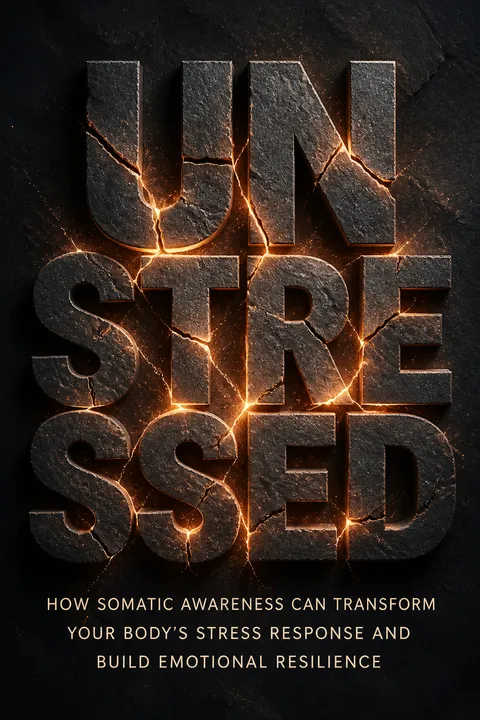
Key Takeaways
1. Stress is a state of physical and emotional disequilibrium driven by the fear-response system
Stress is a cyclical and escalating dance of emotional distress between your mind’s perception and your all-consuming bodily response; it is the embodied experience of emotional chaos.
Defining the stress response. Stress is not merely an external event but a profound state of mind-body disequilibrium. When we perceive a threat, our fear-response system runs rampant, flooding our bodies with adrenaline and cortisol. This biochemical cascade causes cortical inhibition, making it physically impossible to think clearly, make rational decisions, or access stored memories.
The physiological toll. Chronic activation of this system leads to devastating long-term health consequences. High cortisol levels damage our immune, cardiovascular, and gastrointestinal systems, while creating a jagged, incoherent heart rate variability pattern.
- Adrenaline spikes heart rate and blood pressure rapidly to prepare for fight-or-flight.
- Cortisol remains in the body with a twelve-hour half-life, prolonging the feeling of threat.
- Incoherent heart rhythms signal the brain to maintain a state of hyperalert alarm.
The illusion of separation. We often operate under the false assumption that our minds and bodies are separate entities. In reality, they function as an integrated whole, meaning every stressful thought leaves a physical imprint that shapes our future emotional baseline. To truly heal, we must address stress as an all-consuming, embodied experience of emotional chaos.
2. The "Spiral of Becoming" dictates how we adapt to our dominant emotional experiences
Every moment of every day, you are transforming to your dominant emotional experience, whether you know it or not and whether you like it or not.
The mechanism of adaptation. The "spiral of becoming" is a continuous psychophysiological feedback loop of perception, meaning-making, and physiological imprinting. When we experience an emotion, our neural, biochemical, and electrical systems record it, creating a template for future reactions. This means we literally program ourselves to become better at whatever emotional state we routinely practice.
The role of the amygdala. Our subconscious mind filters current events through past emotional memories stored in the amygdala. The amygdala acts as a hyper-reactive fire alarm, matching present stimuli to past threats without rational discernment.
- It triggers immediate, nonconscious emotional appraisals based on past trauma.
- It generalizes responses, making us overreact to minor, unrelated triggers in the present.
- It drives repetitive, negative inner chatter that reinforces the downward spiral.
Reversing the spiral. Because this loop is self-perpetuating, a downward spiral of anxiety can only be broken by introducing a different emotional experience. By consciously shifting our physiological state, we can transform this cycle into an upward spiral of calm and connection. We must actively choose which emotional seeds we feed into this powerful system of adaptation.
3. Mindful awareness subdues the fear response through the Power of Pause and present-moment focus
Mindful awareness quiets an out-of-control fear-response system, a necessary first step in being able to shift the system that is dominating your awareness...
Cultivating the witness. Mindful awareness allows us to observe our thoughts and physical sensations from a nonjudgmental, nonreactive posture. By becoming the "observer" of our own stress, we create a psychological distance that prevents us from being swallowed by emotional highjacks. This disengagement is the essential foundation for calming an overactive amygdala.
The Power of Pause. Pausing in the moment of reactivity breaks the automatic neural chain of stimulus and response. This simple act of stopping allows our physiology to settle and prevents us from falling into habitual, destructive behaviors.
- It interrupts the immediate "whoosh" of the stress response.
- It reduces the production of stress hormones like cortisol.
- It opens up the mental space needed to choose a conscious, constructive response.
Anchoring in the present. Present-moment awareness redirects our attention away from future worries and past regrets. By hyperfocusing on our immediate physical senses and breathing, we signal to our nervous system that we are safe, allowing our bodies to return to equilibrium. This presence is the gateway to emotional freedom and resilience.
4. Somatic awareness unlocks and releases trapped emotional residue from the body
Because so much of your emotional life is an embodied experience, paying attention to and releasing residual somatic buildup is essential for emotional equilibrium.
The body keeps score. Unresolved emotional distress often becomes trapped within our nervous system and muscle tissues as somatic residue. Even when we try to cognitively suppress our stress, our bodies continue to carry the physical imprint of threat. Somatic mindfulness allows us to tune into these physical sensations to access and release buried emotional truths.
Somatic dialoging. By resting our attention on vague physical sensations—what Eugene Gendlin called a "felt sense"—we can bridge the gap between the subconscious and conscious mind. Dialoging with our bodily sensations allows our brains to translate physical tension into emotional insights.
- It bypasses analytical thought to access intuitive, somatic wisdom.
- It identifies where specific emotions are physically stored in the body.
- It facilitates a physical "shift" or release of tension once the emotional message is understood.
Somatic clearing. We can actively calm our brains by intentionally relaxing the muscle groups most closely associated with emotion. Releasing tension in the face, eyes, shoulders, and diaphragm sends immediate feedback to the amygdala that the threat has passed, effectively resetting our nervous system. This physical release clears the space for positive emotions to emerge.
5. Heartful engagement actively cultivates the calm-and-connection system to rewire the brain
True and effective stress management requires reducing chaotic emotion, for sure, but then also requires actively cultivating heartful emotion as a necessary second step.
Activating calm and connection. Merely reducing stress is not enough to achieve true well-being; we must actively cultivate life-generating, heartful emotions. Emotions like love, gratitude, compassion, and hope activate our calm-and-connection system, which is dominated by the parasympathetic nervous system. This system promotes healing, bonding, and social engagement.
The power of neuroplasticity. Our brains are highly plastic, meaning they physically restructure themselves based on our repeated experiences. When we intentionally practice heartful emotions, we strengthen the neural pathways associated with peace and resilience while weakening those associated with fear.
- "Nerve cells that fire together, wire together," cementing positive emotional habits.
- Heartful emotions stimulate the production of oxytocin, the "bonding hormone."
- It increases "happy chemicals" like serotonin, dopamine, and endorphins.
The 3:1 positivity ratio. To tip our emotional baseline toward flourishing, we must aim for a three-to-one ratio of positive to negative emotional moments. We can achieve this by intentionally creating "micromoments of connection" throughout our day, such as sharing a genuine smile or appreciating natural beauty. These small moments accumulate to create massive, long-term changes in our brain chemistry.
6. HEART (Heartful Emotion Affect Regulation Training) is a systematic tool for emotional self-regulation
HEART intentionally cultivates heartful engagement often enough, and deep enough, that through routine experience, heartful emotion becomes the new 'programming' from which you engage the world.
The HEART protocol. HEART is a structured, three-step affect regulation training program designed to transition our physiology from stress to calm. The protocol consists of three sequential steps: Notice, Refocus, and Nurture. It can be practiced "in the moment" during times of acute stress or as a "sustained" daily meditation to build long-term emotional resilience.
The three steps of HEART. Each step of the HEART protocol has a specific, scientifically validated psychophysiological purpose.
- Notice: Mindfully observe thoughts, emotions, and body sensations without judgment to break the chain of reactivity.
- Refocus: Release physical tension in the eyes and shoulders while establishing a slow, deep breathing pattern to calm the amygdala.
- Nurture: Intentionally generate and bask in the felt, somatic experience of a chosen heartful emotion.
Affect regulation in action. Practicing HEART in the moment of reactivity completely changes our immediate physiological state and alters the outcome of stressful situations. Over time, sustained practice acts like a workout for our "emotional muscles," permanently shifting our baseline state to one of calm and connection. This systematic training allows us to reprogram our emotional operating system from the inside out.
7. Authentic gratitude counteracts loneliness and expands our selective attention to notice hidden graces
The true expression of gratitude is not a superficial Band-Aid with cursory practices that include light engagement... It is a deep, honest, and heartful engagement with those things in your life for which you are most grateful.
Overcoming in-attentional blindness. When we are consumed by stress, our selective attention hyperfocuses on threats, making us blind to the positive aspects of our lives. This phenomenon, akin to missing a "gorilla" in plain sight, keeps us trapped in a narrative of lack. Gratitude training rewires our attention to actively seek out and appreciate these overlooked daily graces.
The requirement of authenticity. For gratitude to be biologically transformative, it must be felt deeply and authentically within the body. Perfunctory gratitude lists written out of obligation or guilt are counterproductive, as the body adapts to the underlying feelings of resentment or inadequacy rather than appreciation.
- True gratitude activates brain regions associated with social connection and bonding.
- It reduces cortisol levels while boosting oxytocin and heart coherence.
- It must be practiced with a focus on a few deeply felt experiences rather than many superficial ones.
Counteracting loneliness. Gratitude naturally directs our awareness outward, highlighting our connection to others and the world. By recognizing the "goodness" that exists outside of ourselves, we stimulate our brain's social circuitry, effectively dismantling the physiological foundations of loneliness and isolation. It transforms our relationship with our environment and those around us.
8. Self-empathy and self-compassion heal and rescript painful implicit memories
You hold your difficult emotion in a mindful presence without reactivity and without judgment, and this 'witnessing' begins to heal you.
Holding and healing. Painful implicit memories from our past often act as emotional landmines, triggering intense, out-of-context reactions in the present. Healing these deep-seated patterns requires a two-step process of self-empathy and self-compassion. We must first "hold" our difficult emotions with nonjudgmental empathy before we can "heal" them with compassionate action.
Memory reconsolidation. Through the science of memory reconsolidation, we can actually rewrite the emotional charge of past memories. By bringing a painful memory to mind (unlocking it) and immediately introducing a deeply felt experience of love and safety (a mismatch), we physically rewire the neural networks associated with that trauma.
- Self-empathy involves witnessing our own pain as we would a beloved friend's.
- Self-compassion actively provides the emotional nurturing we needed in the past but did not receive.
- Imagery rescripting alters the emotional impact of a memory without erasing the factual details.
Extending compassion to others. Once we have cultivated empathy and compassion for ourselves, we can naturally extend them to others. Recognizing that the difficult behaviors of those around us are often driven by their own painful implicit programming allows us to respond with understanding rather than defensive reactivity. This dual practice fosters profound relational and personal healing.
9. True hope requires cultivating personal agency, clear pathways, and a vision of a flourishing future
Hope is not merely wishing for something different; rather, it is a better sense of the future, a sense of confidence in it.
The components of hope. True hope is a cognitive and emotional state that directly counteracts feelings of helplessness and depression. Unlike passive wishful thinking, scientifically validated hope requires three distinct elements: personal agency, clear pathways, and a vivid vision of a flourishing future. Cultivating these elements gives us the confidence and motivation to actively shape our lives.
Building agency and pathways. We build agency by recognizing our personal power and the role we play in our own successes. Establishing clear pathways involves gaining absolute clarity on what we want our future to look like, rather than obsessing over what is currently going wrong.
- Reflecting on "What went well, and why?" reinforces our sense of personal agency.
- Discerning clarity on our goals maps out the practical pathways to achieve them.
- Focusing on solutions rather than problems naturally reveals creative pathways forward.
The best possible future self. Vividly imagining our "best possible future self" activates and restructures the perceptual centers of our brain. By practicing HEART for Hope, we mentally and physically align ourselves with this positive future, making it our new physiological and behavioral reality. This practice bridges the gap between where we are and where we want to be.
10. Personal restoration is achieved by rewriting our narratives, managing our energy, and living our deepest values
You are constantly constructing your reality with your words, thoughts, and stories... and the only way to restore new life is to be open to and tell new stories.
Rewriting our narratives. The stories we tell about ourselves, our relationships, and our life events act as self-fulfilling prophecies. If we constantly narrate our lives through a lens of victimhood or inadequacy, we write scripts that force us and others to play those exact roles. Personal restoration begins when we consciously choose to write new, empowering stories that leave room for growth.
Managing our time and energy. Every moment of our lives is an investment in who we are becoming. To maintain a state of calm and connection, we must audit our "time budget" and prioritize energy-enhancing activities over energy-draining ones.
- Maximize time spent with people who nurture and support our well-being.
- Limit exposure to negative media and environmental clutter that trigger stress.
- Dedicate daily time to self-care, silence, nature, and contemplative practices.
Living our deepest values. True flourishing is achieved when we align our daily actions with our core values. By reflecting on how we want to be remembered and how we would spend our time if it were finite, we gain the clarity needed to let our lives speak. Embodying this new self-image through the practice of HEART for a New You cements our transformation, allowing us to step forward into the world with resilience, peace, and vitality.
Download PDF
Download EPUB
.epub digital book format is ideal for reading ebooks on phones, tablets, and e-readers.








































