Key Takeaways
1. Solve the Right Problem: The Power of Reframing
The way you frame a problem determines which solutions you come up with.
Fundamental insight. We often rush to solve problems without deeply considering if we're addressing the correct one. This book argues that the initial framing of a problem profoundly shapes the range and quality of solutions generated. By consciously shifting how you perceive a challenge—a process called reframing—you can unlock radically better and more elegant solutions.
The slow elevator. Consider the classic "slow elevator problem": tenants complain about a slow elevator. Most immediately jump to solutions like upgrading the motor or installing a new elevator. However, reframing the problem as "tenants are annoyed by waiting" opens up a different solution space, such as installing mirrors, which distracts people and reduces complaints without making the elevator faster.
Beyond analysis. Reframing is distinct from mere analysis. Analysis delves into why the elevator is slow, focusing on details and numbers. Reframing, conversely, asks if the elevator's speed is the right thing to focus on, demanding a big-picture view and the ability to consider multiple perspectives. This higher-level thinking is crucial for innovation and effective decision-making.
2. Frame the Problem: Start with Clarity, Not Assumptions
Writing it down is important.
Initial framing. Before you can reframe a problem, you must first clearly articulate it. This involves creating a short, full-sentence problem statement, ideally written down, and mapping out the key stakeholders involved. This simple act slows down the rush to solutions, forces specificity, creates mental distance, and provides a tangible anchor for discussion.
Problem types. Problems manifest in various forms, each presenting unique challenges:
- Ill-defined mess or pain point: Vague issues like "Our culture is the problem," leading to premature solutions.
- Hard-to-reach goal: A clear objective without a clear path, like "We need to generate three million more in revenue."
- Solution someone fell in love with: Being presented with a desired solution ("We should build an app!") rather than the underlying problem it aims to solve.
Review your frame. Once framed, quickly review the problem statement for common pitfalls. Ask: Is it true? Are there self-imposed limitations? Is a solution "baked in"? Is it clear? With whom is the problem located? Are strong emotions present? Are there false trade-offs? This initial scrutiny helps prevent getting trapped by a flawed starting point.
3. Look Outside the Frame: Broaden Your Perspective
Everything outside the frame, however, receives zero attention.
Narrow vision. Our subconscious mind often draws a narrow frame around problems, causing us to scrutinize what's inside while completely ignoring crucial elements outside. The New York–Le Havre ship problem, where most miss six ships already at sea, perfectly illustrates this cognitive blind spot.
Zoom out first. Expert problem solvers deliberately "zoom out" before diving into details. They ask: What's missing from this statement? What elements are we not considering? This habit helps avoid the "law of the instrument," where we frame problems to fit our favorite tools or expertise, potentially overlooking better approaches.
Tactics for broadening:
- Beyond your expertise: Involve outsiders (like an HR exec in a finance meeting) to bring fresh perspectives.
- Prior events: Look at what happened before the problem became visible (e.g., a teenager's breakfast before a fight).
- Hidden influences: Uncover underlying factors (e.g., poverty in the marshmallow test, office building aesthetics in hiring).
- Nonobvious aspects: Consider overlooked properties of objects or situations (e.g., light bulbs emit heat, Disneyland guests remember arrival times).
4. Rethink the Goal: Question Your Objectives
Are we pursuing the right goal?
Goals as obstacles. We often treat problems as obstacles preventing us from reaching a desired goal, but rarely question the goal itself. Many goals—like "beating the competition" or "driving innovation"—are assumed to be inherently good, leading us to pursue them without critical examination.
Higher-level goals. Clarify the "goal behind the goal." Mateo's team, tasked with cutting response time in half, reframed their objective from "making our team faster" to "reducing the time for the business to make database changes." This led to a direct-access interface, vastly exceeding the original goal by reducing workload by 80%.
- Why is this important? Uncover the deeper motivations.
- What else will this achieve? Identify additional benefits.
Challenge assumptions. Examine the causal links in your goal model. Are your assumptions about how the world works truly accurate? For instance, the belief that "longer payment terms are always better" for large companies can be flawed if it limits access to cheaper, smaller suppliers. Questioning obvious goals, like "faster" or "more authentic," can also reveal counterintuitive insights, as Stephen Hawking's request for a slower communication system demonstrated.
5. Examine Bright Spots: Learn from Successes
When do we not have the problem?
Positive exceptions. Instead of solely focusing on what's going wrong, the "bright spots" strategy directs attention to situations where the problem is absent or less severe. Tania and Brian Luna, for example, realized their bitter arguments stemmed from being tired and hungry after 10 PM, leading to their "Ten O'Clock Rule."
Finding bright spots:
- Past successes: Have you (or your team) solved this problem, or a similar one, before? Steve de Shazer's solution-focused therapy helps clients identify and reapply past successful behaviors.
- Positive outliers: Are there individuals or groups within your peer network who are handling the problem better? Jerry Sternin's team found that certain schools in Argentina had higher retention rates for illiterate parents by engaging them differently.
- Other industries: How do other fields or industries deal with analogous problems? Pfizer's team, facing cross-cultural communication issues, found solutions by studying international hotel chains.
- Broadcast widely: Share your problem with diverse groups (colleagues, friends, online communities) to uncover unexpected bright spots, as DSM did to solve their glue problem.
Negativity bias. We are naturally wired to focus on negative outcomes, often overlooking existing solutions or effective coping mechanisms. Actively seeking bright spots helps counteract this bias, providing fresh perspectives and actionable insights.
6. Look in the Mirror: Acknowledge Your Role
What is my own role in creating this problem?
Self-blindness. We are notoriously bad at objectively assessing our own contribution to problems. Like drivers blaming hedges for accidents, we instinctively tell stories that conveniently omit our own agency. This "fundamental attribution error" leads us to blame others' personalities or external circumstances, rather than our own actions.
Explore your contribution. When facing a problem, honestly ask: Is it possible that my (or our) own behavior is, on some level, contributing to this? This can be uncomfortable, but recognizing your part is often the most liberating path to a solution. Avoid the word "blame" and instead focus on "contribution," which is more forward-looking and acknowledges that problems usually have multiple causes.
Tactics for self-reflection:
- Scale down the problem: If a problem seems too big (e.g., "corporate culture is rigid"), ask what you can do at your level. Ukrainian civil servants tackled corruption by outsourcing medicine purchasing.
- Get an outside view: Seek feedback on how others perceive you (external self-awareness). Heidi Grant suggests asking a friend: "When people first meet me, what impression do you think they get—and how do you think it differs from the way I really am?" Leaders, in particular, benefit from neutral outsiders to overcome "power blindness."
7. Take Their Perspective: Understand Others' Worlds
There is no more immediate barrier to accurate perspective taking than failing to use it in the first place.
Beyond empathy. Perspective taking is the cognitive effort of understanding another person's context and worldview, not just their emotions. It's crucial because our "other-people simulator" is often crude, leading to misjudgments about what friends, customers, or colleagues truly think and feel.
Anchoring and adjustment. When trying to understand others, we first "anchor" by imagining ourselves in their shoes. The critical second step is "adjustment"—consciously moving away from our own preferences and experiences to consider how they might see things differently. The "pilot launch" poster failed because the team assumed others shared their pioneer enthusiasm, ignoring that most people prefer social proof.
Tactics for effective perspective taking:
- Make it happen: Actively list stakeholders and dedicate mental energy to understanding each one's needs, goals, beliefs, and context.
- Escape your emotions: Remind yourself and others that personal preferences can bias understanding.
- Look for reasonable explanations: Assume people are trying to do good (or at least not actively trying to pester you). Rosie Yakob discovered her client's insistence on a "viral video" was tied to a bonus structure, not ignorance. This benevolent view helps reframe "people problems" into "systems problems."
8. Move Forward: Validate Your Problem, Not Just Solutions
Before you test your solution, you should make sure to test your problem.
Test the problem. Just as doctors confirm a diagnosis before treatment, good problem solvers validate their problem framing before committing to solutions. Kevin's dream of a gelato store was crushed by Ashley Albert, who simply took him to existing stores to see their struggles, saving him years of wasted effort.
Methods for problem validation:
- Describe to stakeholders: Present your problem framing to those involved and observe if it resonates. Cisco's "Startup Cisco" team validated a refinery problem by directly asking high-level executives if it was their problem and how much it cost them.
- Get outsiders to help: Use neutral third parties to assess your problem framing, especially for intangible issues like branding. Georgina de Rocquigny helped a consulting firm realize their perceived weakness (hands-on approach) was actually a strength to clients.
- Devise a hard test: Go beyond verbal affirmation. Managed by Q, a cleaning service startup, asked potential clients for a down payment to gauge genuine interest, revealing that residential clients weren't urgent enough, but office managers were.
- Pretotyping the solution: If quick and low-risk, simulate the solution to see if customers will "buy" it, as BarkBox did with a fake wine stopper website, selling one in 73 minutes.
Revisit regularly. Problem framing isn't a one-time event. Like an EMT's ABC checks, regularly reassess your problem diagnosis. Problems evolve, and new information emerges. Schedule check-ins, assign a "reframing role," or integrate it into existing routines to maintain a "double vision" of both problem and solution.
9. Choose Your Focus: Prioritize Surprising, Simple, Significant Frames
If you come up with multiple different framings of the problem, how do you decide which frames to explore and which to ignore?
Too many frames. A common frustration with reframing is generating too many potential problem statements. While this indicates successful exploration, it necessitates a strategy for prioritizing which frames to pursue. You can't chase every possibility.
Selection criteria:
- Surprising: Prioritize framings that elicit a sense of "Oh, I hadn't thought of that!" These often break existing mental models and hold high potential for breakthrough.
- Simple: Gravitate towards straightforward framings. Good solutions often have a "retrospective inevitability" – once found, they seem obvious. Occam's razor suggests the simplest explanation is usually the best.
- Significant-if-true: Explore framings that, even if initially counter-intuitive, would have a massive impact if proven correct. The Bolsa Familia program, which gave money directly to the poor despite expert skepticism, significantly reduced poverty because its underlying assumption (poor people spend money wisely) was true.
Parallel exploration. For critical problems, consider exploring two or three promising framings concurrently. Even if some avenues fail, they can provide valuable learning or evidence to counter future resistance. The goal is not to find the single correct frame, but a better one.
10. Uncover Causes: Engage in Discovery and Experimentation
Is there something else we can do to learn more about the problem? Something we haven’t tried before?
When clues are scarce. If initial analysis and reframing don't reveal the problem's cause, you need proactive methods to uncover hidden factors. Beyond broadcasting the problem widely, two powerful approaches are discovery-oriented conversations and learning experiments.
Discovery-oriented conversations:
- Listen deeply: Engage in conversations with stakeholders, not to tell, but to listen and learn. Sir Kensington's ketchup sales mystery was solved when an investor casually mentioned still having the original bottle, leading to the "fridge problem" insight.
- Learning mindset: Approach conversations with genuine curiosity, creating a safe space for others to share.
- Seek discomfort: Be prepared to hear potentially painful truths about your product, service, or even yourself.
Learning experiments:
- Shake things up: When stuck, deliberately try something different to gain new insights. Nickelodeon's app team, frustrated by A/B testing, invited kids into the office. They discovered the problem wasn't usability, but kids' fear of asking parents for passwords.
- Focus on learning: Unlike traditional tests aimed at confirming a solution, learning experiments are designed to cast new light on the problem itself. This shift in focus can reveal emotional or contextual factors missed by data-driven approaches.
11. Overcome Resistance: Navigate Skepticism and Denial
It is difficult to get a man to understand something, when his salary depends upon his not understanding it!
Client skepticism. Even with a robust reframing process, you'll encounter resistance. Clients may doubt your competence, suspect conflicts of interest, or simply not see the need for reframing. This often stems from a "closure-seeking" mindset (wanting quick solutions) or "closure-avoidant" tendencies (fear of moving forward).
Tactics for process resistance:
- Formal frameworks: Use tools like the reframing canvas to lend legitimacy.
- Educate in advance: Share articles or stories (like the slow elevator) to prime understanding.
- Tell stories: Use anecdotes from other clients to illustrate the value without direct advice.
- Frame by focus: Position reframing as either a "promotion" (gain) or "prevention" (avoid loss) opportunity.
- Invite outsiders: Bring in "boundary spanners" (like Marc Granger's assistant, Charlotte) who understand the context but offer fresh perspectives.
Dealing with denial:
- Self-check: First, ask: "Could I be wrong?" Client resistance might signal a valid point you've missed.
- Reframe denial: Understand why they're in denial (e.g., avoiding unpleasant truths, conflicting incentives). Rosie Yakob's client needed a viral video for her bonus.
- Let data speak: Present evidence (like Chris Dame's video of the CEO jamming a floppy disk into an exhaust vent).
- Embrace their logic: Acknowledge their viewpoint, then gently expose inconsistencies (e.g., "Why would the CIA send such incompetent killers?").
- Strategic retreat: Sometimes, you must let them fail (if the cost is low) or win a smaller battle to build trust for future, more impactful changes.
Review Summary
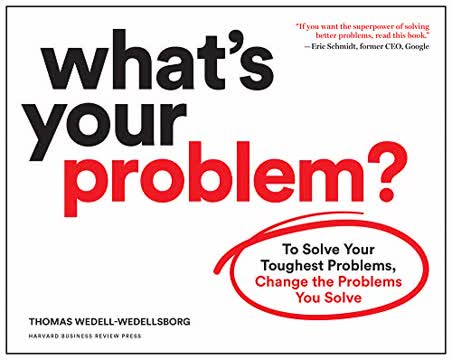
What's Your Problem? is highly praised for its practical approach to problem-solving through reframing. Readers appreciate the engaging writing style, real-world examples, and actionable techniques. Many found the book's insights applicable to both professional and personal challenges. The concept of examining problems from different perspectives resonated with readers, who felt it improved their decision-making skills. While some noted repetition and structural issues, most reviewers considered the book valuable for anyone seeking to enhance their problem-solving abilities.
People Also Read