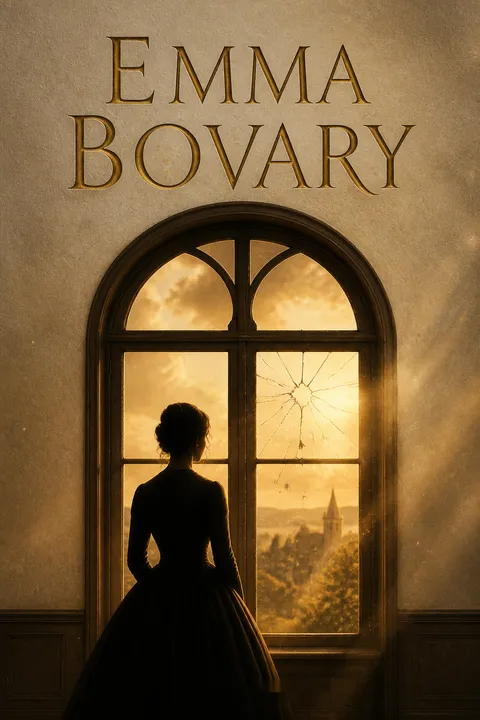
Summary Temporarily Unavailable
This summary is temporarily unavailable and is currently being updated. You can still explore the FAQs and other metadata below.
Résumé de l'intrigue
Rêves provinciaux et mécontentement
Emma Bovary, jeune femme aux rêves ambitieux, se retrouve prisonnière de la vie monotone d’une petite ville provinciale après avoir épousé Charles Bovary, un médecin de campagne bon mais terne. Ses idéalismes romantiques, nourris par les romans et les fantasmes, s’opposent brutalement à la réalité de son existence routinière. Le mécontentement d’Emma grandit, car elle aspire à la passion et au luxe qu’elle estime mériter, préparant ainsi le terrain de sa chute inévitable.
Mariage et monotonie
D’abord pleine d’espoir, Emma se lasse rapidement de son union avec Charles, qui ne répond pas à ses attentes romantiques. Sa vie devient une succession de journées répétitives et sans éclat, ce qui la pousse à nourrir du ressentiment envers son mari et leur existence simple. Cette désillusion incite Emma à chercher ailleurs un épanouissement, alors qu’elle devient de plus en plus agitée et malheureuse.
Tentation et infidélité
En quête d’excitation, Emma s’engage dans une série d’aventures amoureuses, d’abord avec le séduisant Rodolphe Boulanger, qui la considère comme un amusement passager. Malgré ses espoirs, Rodolphe finit par l’abandonner, brisant le cœur d’Emma. Son infidélité est une tentative désespérée d’échapper à une vie insatisfaisante, mais elle ne fait qu’accentuer son vide intérieur et son désespoir.
Désir et tromperie
Non découragée par son échec avec Rodolphe, Emma s’implique avec Léon Dupuis, un jeune clerc de notaire partageant ses idéaux romantiques. Leur relation est passionnée mais vouée à l’échec, car les désirs insatiables d’Emma et ses dépenses inconsidérées la plongent davantage dans la tromperie et la ruine financière. Ses efforts pour maintenir l’illusion d’une vie glamour ne font qu’aggraver ses ennuis.
Dettes et désespoir
Le style de vie extravagant d’Emma et ses dettes croissantes la rattrapent, les créanciers se rapprochant inexorablement. Désespérée de préserver son rang social et d’éviter le déshonneur, elle adopte des mesures de plus en plus imprudentes, allant jusqu’à falsifier la signature de son mari. Ses difficultés financières deviennent le reflet de son tourment intérieur et des conséquences de ses désirs incontrôlés.
Chute et désespoir
Alors que ses dettes deviennent insurmontables et que ses relations se délabrent, la vie d’Emma sombre dans le chaos. Ses rêves autrefois grandioses se réduisent à une série d’actes désespérés, tandis qu’elle lutte pour trouver une issue à sa situation. Le poids de ses choix et la dure réalité deviennent insupportables, la conduisant à une décision tragique.
Fins tragiques et réflexions
Accablée par ses échecs et l’effondrement de ses rêves, Emma met fin à ses jours, laissant derrière elle un Charles dévasté et un héritage de ruine. Sa fin tragique sert d’avertissement sur les dangers des désirs incontrôlés et de la poursuite d’idéaux inaccessibles. Dans le sillage de cette tragédie, Charles doit affronter la perte et prendre conscience, trop tard, de ses propres manquements.
Personnages
Emma Bovary
Emma Bovary est l’héroïne dont les fantasmes romantiques et le mécontentement face à la vie provinciale animent le récit. Sa quête de passion et de luxe la conduit à une série de choix destructeurs, qui aboutissent à sa fin tragique. Le personnage d’Emma incarne le conflit entre idéalisme et réalité, sa poursuite acharnée de rêves inaccessibles menant à sa chute.
Charles Bovary
Charles est le mari d’Emma, un médecin de campagne au grand cœur mais sans imagination. Il aime sincèrement Emma mais ne parvient ni à comprendre ni à satisfaire ses désirs. Sa complaisance et son manque d’ambition contribuent au mal-être d’Emma, et il est laissé dévasté par sa mort, réalisant trop tard l’ampleur de son malheur.
Rodolphe Boulanger
Rodolphe est un riche propriétaire terrien qui devient le premier amant d’Emma. Attiré par sa beauté et sa passion, il la considère cependant comme une distraction passagère. Son abandon d’Emma après leur liaison souligne son égoïsme et alimente son désespoir croissant.
Léon Dupuis
Léon est un jeune clerc de notaire partageant les idéaux romantiques d’Emma et devient son second amant. Leur relation est intense mais vouée à l’échec, car Léon manque de maturité et de ressources pour soutenir le style de vie extravagant d’Emma. Son départ marque un nouveau tournant dans la spirale descendante d’Emma.
Monsieur Homais
Homais est le pharmacien local qui se lie d’amitié avec Charles et Emma. Poussé par l’ambition et le désir de statut social, il utilise souvent les autres pour servir ses propres intérêts. Son personnage incarne une critique des valeurs bourgeoises et de la superficialité de l’ascension sociale.
Berthe Bovary
Berthe est la jeune fille d’Emma et de Charles. Elle est largement négligée par sa mère et devient orpheline après la mort d’Emma et le déclin ultérieur de Charles. Le destin de Berthe souligne les dommages collatéraux des choix d’Emma et l’impact des échecs parentaux.
Mécanismes narratifs
Idéalisme romantique
Le moteur principal de l’intrigue est l’idéalisme romantique d’Emma, qui nourrit son insatisfaction et sa poursuite de rêves inaccessibles. Ses attentes irréalistes, façonnées par les romans et les fantasmes, la conduisent à des choix qui la mènent inévitablement à sa chute. Ce mécanisme met en lumière les dangers de vivre dans un monde imaginaire et les conséquences du refus de la réalité.
Critique sociale
Le roman se présente comme une critique de la société bourgeoise de l’époque, en exposant sa superficialité et son matérialisme. À travers des personnages comme Homais et la description de la vie provinciale, l’histoire dénonce le vide de l’ascension sociale et la quête du statut. Cette critique est tissée tout au long du récit, servant de toile de fond aux luttes personnelles d’Emma.
Ironie tragique
L’ironie tragique imprègne le récit, puisque les tentatives d’Emma pour échapper à sa vie monotone ne font qu’accroître son malheur. Sa quête de passion et de luxe aboutit à la ruine financière et au désespoir personnel, culminant dans sa fin tragique. Cette ironie souligne la futilité de ses rêves et l’inéluctabilité de sa chute.
Analyse
"Emma Bovary" se présente comme un récit d’avertissement sur les dangers des désirs incontrôlés et de la poursuite d’idéaux inaccessibles. À travers l’histoire tragique d’Emma, le roman explore les thèmes de l’idéalisme romantique, du conflit entre fantasme et réalité, et des conséquences de vivre au-delà de ses moyens. Il critique la superficialité de la société bourgeoise et le vide de l’ascension sociale, tout en soulignant l’impact des choix personnels sur soi-même et autrui. La chute d’Emma rappelle avec force les périls de l’ignorance de la réalité et l’importance de trouver la satisfaction dans ses propres circonstances. La pertinence durable du roman réside dans son exploration de thèmes universels et sa critique des valeurs sociales, en faisant une réflexion intemporelle sur la nature humaine et les complexités du désir.
Dernière mise à jour:
Report IssueRésumé des avis
Les lecteurs ont aussi lu

FAQ
Synopsis & Basic Details
What is Emma Bovary about?
- Yearning for more: Emma Bovary, a young woman trapped in a dull marriage and provincial life, seeks passion and excitement beyond her reality.
- Pursuit of fantasy: Driven by romantic ideals from novels, she engages in affairs and extravagant spending, leading to her downfall.
- Tragic consequences: The story explores the destructive nature of unchecked desires and the clash between fantasy and reality, ending in tragedy.
Why should I read Emma Bovary?
- Timeless human drama: The novel explores universal themes of desire, disillusionment, and the consequences of choices, making it relatable across time.
- Complex character study: Emma's character is a nuanced portrayal of a woman struggling against societal constraints and her own inner turmoil.
- Social critique: The book offers a sharp critique of bourgeois society, its values, and the emptiness of social climbing, providing historical and social context.
What is the background of Emma Bovary?
- 19th-century France: The novel is set in provincial France during the mid-1800s, reflecting the social and cultural norms of the time.
- Bourgeois society: It portrays the rise of the middle class, their aspirations, and the superficiality of their values, which contrasts with Emma's romantic ideals.
- Romanticism vs. Realism: The novel is a bridge between Romanticism and Realism, showcasing the clash between idealized notions and the harsh realities of life.
What are the most memorable quotes in Emma Bovary?
- "She wanted to die, but she also wanted to live in Paris.": This quote encapsulates Emma's internal conflict, her desire for escape and her romanticized view of a better life.
- "Human speech is like a cracked kettle on which we tap crude rhythms for bears to dance to, while we long to make music that will melt the stars.": This quote highlights the inadequacy of language to express deep emotions and desires, a central theme in the novel.
- "She was like a ship that had lost its rudder, drifting aimlessly on the sea of life.": This quote captures Emma's lack of direction and her vulnerability to the whims of fate, foreshadowing her tragic end.
Hidden Details & Subtle Connections
What are some minor details that add significant meaning?
- The wedding bouquet: Emma's wedding bouquet, preserved and later found, symbolizes the decay of her initial hopes and the passage of time, highlighting the contrast between her dreams and reality.
- The blind beggar: The recurring presence of the blind beggar, singing a vulgar song, serves as a grim reminder of the harsh realities of life and a foreshadowing of Emma's own tragic fate.
- The dusty attic: The attic where Emma hides her love letters and other mementos represents her secret life and the hidden desires that she cannot openly express, a space of both refuge and confinement.
What are some subtle foreshadowing and callbacks?
- Charles's hat: Charles's ridiculous hat, a symbol of his social ineptitude, foreshadows his inability to understand or fulfill Emma's desires, setting the stage for her discontent.
- Rodolphe's cigar case: Rodolphe's cigar case, a gift from Emma, is later found by Charles, revealing the affair and highlighting the consequences of Emma's actions.
- The recurring waltz: The waltz that Emma dances with Rodolphe is a callback to her initial romantic excitement, contrasting with the later despair of her life.
What are some unexpected character connections?
- Homais and Rodolphe: Homais's admiration for Rodolphe, despite their different social classes, reveals the pervasive influence of social status and the desire for upward mobility.
- Léon and Charles: Léon's initial admiration for Charles, before his affair with Emma, highlights the naivety of youth and the shifting dynamics of relationships.
- Emma and her mother-in-law: The strained relationship between Emma and her mother-in-law, though seemingly minor, underscores the lack of understanding and support in Emma's life.
Who are the most significant supporting characters?
- Monsieur Homais: Homais, the pharmacist, embodies the superficiality and self-interest of the bourgeois class, serving as a foil to Emma's romanticism and a critique of societal values.
- Rodolphe Boulanger: Rodolphe, Emma's first lover, represents the callousness and selfishness of men who exploit women for their own pleasure, highlighting the power dynamics of relationships.
- Léon Dupuis: Léon, Emma's second lover, embodies the romantic idealism that Emma seeks, but his immaturity and lack of resources contribute to her downfall, showing the limitations of romantic fantasies.
Psychological, Emotional, & Relational Analysis
What are some unspoken motivations of the characters?
- Emma's escape: Emma's unspoken motivation is to escape the boredom and limitations of her provincial life, seeking passion and excitement to fill the void in her existence.
- Charles's complacency: Charles's unspoken motivation is to maintain a comfortable and predictable life, avoiding conflict and change, which ultimately contributes to Emma's unhappiness.
- Rodolphe's ego: Rodolphe's unspoken motivation is to satisfy his ego and desires, viewing Emma as a conquest rather than a genuine partner, revealing his manipulative nature.
What psychological complexities do the characters exhibit?
- Emma's romantic delusion: Emma's psychological complexity lies in her inability to distinguish between romantic fantasy and reality, leading to her constant dissatisfaction and destructive choices.
- Charles's obliviousness: Charles's psychological complexity is his inability to perceive Emma's unhappiness and his own shortcomings, highlighting his emotional blindness.
- Léon's immaturity: Léon's psychological complexity is his struggle between his romantic ideals and his lack of maturity, revealing his inability to handle the complexities of a passionate relationship.
What are the major emotional turning points?
- Rodolphe's abandonment: Rodolphe's abrupt departure is a major emotional turning point, plunging Emma into despair and highlighting the fragility of her romantic illusions.
- The opera scene: The opera scene, where Emma is reminded of her romantic dreams, intensifies her dissatisfaction with her life and fuels her desire for escape.
- The discovery of debts: The discovery of her mounting debts is a major emotional turning point, leading to her desperation and ultimately her tragic decision.
How do relationship dynamics evolve?
- Emma and Charles: The relationship between Emma and Charles evolves from initial hope to disillusionment, highlighting the incompatibility of their desires and expectations.
- Emma and Rodolphe: The relationship between Emma and Rodolphe evolves from passionate infatuation to callous abandonment, revealing the power dynamics and the superficiality of their connection.
- Emma and Léon: The relationship between Emma and Léon evolves from romantic idealism to unsustainable passion, highlighting the limitations of their shared fantasies and the consequences of their choices.
Interpretation & Debate
Which parts of the story remain ambiguous or open-ended?
- Emma's true feelings: The extent of Emma's genuine love for Rodolphe and Léon remains ambiguous, leaving readers to question whether she was truly capable of deep emotional connection.
- Charles's understanding: The depth of Charles's understanding of Emma's unhappiness and his own role in her tragedy is open to interpretation, raising questions about his culpability.
- The novel's moral stance: The novel's moral stance on Emma's actions and the societal forces that contributed to her downfall is open to debate, inviting readers to consider the complexities of her situation.
What are some debatable, controversial scenes or moments in Emma Bovary?
- Emma's suicide: Emma's suicide is a controversial moment, raising questions about whether it was an act of despair or a final act of defiance against her circumstances.
- The depiction of adultery: The novel's depiction of adultery is controversial, challenging societal norms and inviting readers to consider the complexities of desire and morality.
- The critique of bourgeois society: The novel's critique of bourgeois society is debatable, with some arguing that it is a valid commentary on societal values, while others see it as overly critical.
Emma Bovary Ending Explained: How It Ends & What It Means
- Emma's tragic death: Emma's suicide by arsenic poisoning is a tragic end, highlighting the destructive consequences of her unchecked desires and her inability to reconcile fantasy with reality.
- Charles's devastation: Charles's devastation and eventual death after discovering Emma's affairs underscore the collateral damage of her choices and the tragic impact on those around her.
- A cautionary tale: The ending serves as a cautionary tale about the dangers of romantic idealism, the pursuit of unattainable dreams, and the importance of finding contentment within one's circumstances, leaving a lasting impact on the reader.
À propos de l'auteur
Autres livres de Harold Bloom


Télécharger le PDF
Télécharger l'EPUB
.epub digital book format is ideal for reading ebooks on phones, tablets, and e-readers.








































