重要ポイント
1. 人類史の定説に挑む
本書の目的は、まだ誰も完全なパズルの全ピースを持っていないことを自覚しつつ、その断片を組み合わせ始めることである。
支配的な物語。 従来の人類史は、小規模で平等主義的な狩猟採集社会から、農業や都市、国家を持つ複雑で階層的な社会へと直線的に進化したと描かれてきた。この物語は、ルソーやホッブズの思想に基づき、不平等や支配は社会発展の必然的な結果であると示唆している。
誤った前提。 本書は考古学や人類学などの証拠を示し、この馴染み深い物語に反論する。農業以前の社会が小規模で平等主義的な集団に限定されていなかったこと、農業が必ずしも私有財産や不平等をもたらしたわけではないことを論じる。
新たな視点。 著者たちは、人類史をより繊細で希望に満ちたものとして捉え、社会実験や自己創造の可能性を強調する。現状の理解が不完全であることを認めつつ、新たな世界史の構築を目指し、さらなる研究と議論を促す。
2. 先住民の批判:啓蒙の基盤として
「先住民の批判」と呼ぶものを再考することは、ヨーロッパの正典外からの社会思想への貢献を真剣に受け止めることを意味する。
ヨーロッパ知的史。 啓蒙思想は純粋にヨーロッパの現象と見なされがちだが、実際には先住民によるヨーロッパ社会への批判が大きな影響を与えた。例えば、ネイティブアメリカンのフーロン=ウェンダット族の政治家カンディアロンクは、自由、平等、合理性についての洞察を示し、当時のヨーロッパの規範に挑戦した。
ユーロセントリズムへの挑戦。 本書は、先住民の論者や観察者を「高貴な野蛮人」や「悪魔」といった単純なイメージから脱却させ、対等な対話者としての知的主体性と影響力を認めることを目指す。
啓蒙思想への影響。 「先住民の批判」は人間解放の可能性を示し、ヨーロッパの聴衆に衝撃を与え、新たな自由と平等の理想を鼓舞した。この批判はヨーロッパ社会の基盤を脅かし、それを否定する理論の発展を促した。
3. ホッブズとルソーを超えて:先史時代のより正確な理解
農耕の出現以前の人類社会が小規模で平等主義的な集団に限定されていなかったことは明らかである。
単純なモデルの否定。 ホッブズの「残忍で短い自然状態」とルソーの「平等な無垢の状態」という二分法は不正確であり、人類の多様で複雑な先史社会を捉えきれていない。
考古学的証拠。 考古学は、農耕以前の社会が小規模で平等主義的な集団に限定されず、大胆な社会実験を行い、多様な政治形態や社会構造を持っていたことを示している。
政治のカーニバル。 狩猟採集民の世界は、進化論的な抽象概念が示すよりもはるかに多様で動的であり、「政治形態のカーニバル」とも言える実験と革新に満ちていた。
4. 初期人類社会の多様性:実験と柔軟性
私たちは集合的な自己創造のプロジェクトである。
自己創造の能力。 社会組織の多様な形態を試みる能力は、人間性の本質的な一部であり、自己創造と自由の表れである。
時間をかけた実験。 数十万年にわたり、地球上のすべての人が同じ理想的な社会形態を共有していたと考えるのは非現実的である。社会組織の多様な形態を試みる能力こそが、人間を人間たらしめている。
自由と意思決定。 人類史の究極の問いは、物質的資源への平等なアクセスではなく、共に生きる方法についての意思決定に平等に参加する能力である。その能力を行使するには、まず意味のある決定事項が存在しなければならない。
5. 進歩の神話:先住民批判を無力化する道具
前章でまとめた、人類文明の進歩が両義的であり、社会が大きく複雑になるにつれて自由が失われるという標準的な歴史的メタナラティブは、主に先住民批判の脅威を無力化するために作られたものである。
社会進化の発明。 人類社会を発展段階(狩猟採集、農耕、都市・工業社会など)に分類する考えは、ヨーロッパ文明批判に対する保守的な反動に起源を持ち、18世紀初頭に勢いを増した。
批判の無力化。 ホッブズやルソーの現代的な支持者たちが共有する歴史の「大きな絵」は、事実とはほとんど関係がなく、先住民批判の脅威を無力化するために発明された。
先住民批判。 その批判の起源は啓蒙思想の哲学者ではなく、ネイティブアメリカン(フーロン=ウェンダット族)の政治家カンディアロンクのような先住民の論者や観察者にある。
6. 不平等の罠:私たちが陥った理由
すべての者は自らの鎖に向かって走り、自由を確保していると信じていた。彼らは市民秩序の利点を理解する理性はあったが、危険を予見する経験はなかった。
資本の集中。 社会問題を「不平等」として捉えることは、中途半端な対策や妥協を促し、人々が実際に問題視する社会構造の根本原因に手をつけることを妨げる。
必然性の幻想。 無垢で平等な原初状態の物語や「不平等」という言葉の使用は、人間の状況に対する哀愁を帯びた悲観主義を常識のように見せかける。真に平等な社会は、大規模で複雑かつ技術的に高度な社会では不可能だと示唆する。
自由の再発見。 私たちの種の未来が何か新しいものを創造する能力にかかっているなら、最も重要なのは、人間たる自由を再発見できるかどうかである。
7. 農業の起源を再評価する:単なる食料生産以上のもの
すべての者は自らの鎖に向かって走り、自由を確保していると信じていた。彼らは市民秩序の利点を理解する理性はあったが、危険を予見する経験はなかった。
「農業革命」を超えて。 農業は私有財産の始まりを意味せず、不平等への不可逆的な一歩でもなかった。多くの初期農耕社会は、比較的階層や序列のない自由な共同体であった。
先住民批判。 その批判の起源は啓蒙思想の哲学者ではなく、ネイティブアメリカン(フーロン=ウェンダット族)の政治家カンディアロンクのような先住民の論者や観察者にある。
概念の転換。 その転換は、社会進化の現代的概念、すなわち人類社会を発展段階(狩猟採集、農耕、都市・工業社会など)に分類する考えの初期段階を再検討することを意味する。
8. 初期都市の複雑性:王や官僚を超えて
世界最古の都市の多くは、権威的な支配者や野心的な戦士政治家、厳格な管理者を必要としない、堅固な平等主義的な構造で組織されていた。
平等主義的な都市。 多くの初期都市は、権威主義的な支配者や野心的な戦士政治家、厳しい管理者を必要としない、堅固な平等主義的な形態で運営されていた。
先住民批判。 その批判の起源は啓蒙思想の哲学者ではなく、ネイティブアメリカン(フーロン=ウェンダット族)の政治家カンディアロンクのような先住民の論者や観察者にある。
概念の転換。 その転換は、社会進化の現代的概念、すなわち人類社会を発展段階(狩猟採集、農耕、都市・工業社会など)に分類する考えの初期段階を再検討することを意味する。
9. 想像力の力と人間の自由の再発見
もし私たちが、種としての平等な理想状態から堕ちた物語を語る代わりに、自己を再発明する可能性すら想像できなくなった厳しい概念的束縛にどうして囚われたのかを問うならば、どうなるだろうか。
想像力の重要性。 社会組織の多様な形態を試みる能力は、人間性の本質的な一部であり、自己創造と自由の表れである。
究極の問い。 人類史の究極の問いは、物質的資源(土地、カロリー、生産手段)への平等なアクセスではなく、共に生きる方法についての意思決定に平等に参加する能力である。
意味ある決定。 その能力を行使するには、まず意味のある決定事項が存在しなければならない。多くの人が示唆するように、私たちの種の未来が何か新しいものを創造する能力にかかっているなら、最も重要なのは、人間たる自由を再発見できるかどうかである。
10. 正しい問いを立てる重要性:新たな歴史科学へ
本書は単に新たな人類史を提示するだけでなく、読者を祖先の人間性を完全に回復する新しい歴史科学へと招くものである。
焦点の転換。 なぜ「不平等」が問題となったのかを問い直し、現在の知見により近い代替的な物語を徐々に構築していく。
新たな世界史。 本書は、1930年代にゴードン・チャイルドが「新石器革命」や「都市革命」といった言葉を生み出したように、新たな世界史の基盤を築こうとする試みである。
正しい問い。 本書はまた、正しい問いを見つける探求でもある。「不平等の起源は何か?」が歴史における最大の問いでないならば、では何がそうであるべきかを問う。
レビューまとめ
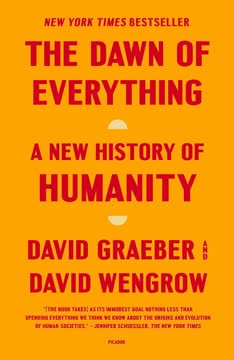
『The Dawn of Everything』は、人類の歴史に関する従来の通説に異議を唱える一冊である。著者らは、初期の社会がこれまで考えられていたよりも多様で複雑であったことを主張し、人気のある歴史家たちの見解を批判している。彼らは、平等主義的な都市、柔軟な農業形態、そして多様な社会組織の形態が先史時代を通じて存在したことを示す証拠を提示する。本書は、その壮大な視野と刺激的なアイデアにより高く評価される一方で、推測的で難解だと感じる読者もいる。総じて、人類の発展に関する新たな視点を提供し、不平等や自由、そして現代の社会構造が必然であるという前提に疑問を投げかけている。
他の人が読んだ本



よくある質問
1. What is The Dawn of Everything: A New History of Humanity by David Graeber and David Wengrow about?
- Radical re-examination of history: The book challenges traditional narratives about the origins of inequality, civilization, and the state, arguing that human societies have always experimented with a wide variety of social and political forms.
- Diversity and complexity: Graeber and Wengrow emphasize that human social arrangements are not a linear progression from primitive to advanced, but rather a tapestry of diverse and complex experiments.
- Indigenous critique and influence: The authors highlight the importance of indigenous critiques of European civilization, showing how these perspectives shaped Enlightenment thought and offer alternative ways to understand freedom and equality.
- Interdisciplinary approach: Drawing on archaeology, anthropology, history, and ethnography, the book reconstructs a new understanding of humanity’s past, focusing on social freedoms and political self-consciousness.
2. Why should I read The Dawn of Everything by David Graeber and David Wengrow?
- Challenges orthodox views: The book questions deeply ingrained assumptions about social evolution, inequality, and the inevitability of hierarchical states, inviting readers to reconsider what is possible in human social organization.
- Broad scope and rich detail: Covering a vast temporal and geographic range, it provides detailed case studies from the Americas, Eurasia, Africa, and Oceania, enriching understanding of diverse social forms.
- Relevance to contemporary issues: By uncovering forgotten histories of freedom, democracy, and egalitarianism, the book offers insights that resonate with current debates about social justice and governance.
- Engaging and accessible: Written with clarity and intellectual rigor, it combines scholarly research with compelling storytelling, making complex ideas accessible and thought-provoking.
3. What are the key takeaways from The Dawn of Everything by David Graeber and David Wengrow?
- Inequality is not inevitable: The book argues that social inequality and hierarchical states are not natural or necessary outcomes of human development; many societies maintained egalitarian or flexible structures for millennia.
- Human societies as experiments: Early humans engaged in a "carnival parade of political forms," experimenting with various social organizations, including large egalitarian cities and societies that alternated between hierarchy and equality.
- Freedom and autonomy as central: The authors emphasize three primordial freedoms—freedom to disobey, freedom of movement, and freedom to make commitments—as foundational to human social life.
- No single origin of the state: Sovereignty, bureaucracy, and state power emerged gradually and unevenly, often rooted in patrimonial households or charismatic leadership rather than centralized, coercive institutions.
4. How does The Dawn of Everything by David Graeber and David Wengrow challenge conventional views of human prehistory and the ‘Agricultural Revolution’?
- Rejection of ‘revolution’: The transition to farming was not a sudden revolution but a protracted, uneven process involving experimentation, partial adoption, and resistance.
- Complexity before farming: Monumental architecture, social complexity, and ritual life often predate or exist independently of agriculture, undermining linear models of social evolution.
- Gardens of Adonis: Many Neolithic peoples avoided full-scale agriculture, maintaining foraging lifestyles supplemented by cultivation, challenging the idea that farming was universally embraced.
- Ecology of freedom: Early farming spread through diverse ecological and social contexts, with societies adapting cultivation to maintain social freedoms and avoid inequality.
5. What does The Dawn of Everything by David Graeber and David Wengrow reveal about early cities and urban life?
- Cities without kings: Early urban centers in Mesopotamia, the Indus Valley, Ukraine, and China often lacked centralized monarchies or rigid hierarchies, instead featuring collective governance and self-organization.
- Social housing and neighborhoods: Ancient cities like Teotihuacan had apartment compounds and neighborhood autonomy, with diverse ethnic groups enjoying considerable self-governance.
- Imaginary cities and public spaces: Early cities were designed with communal spaces for festivals, rituals, and assemblies, reflecting participatory social life rather than top-down control.
- Mega-sites and social complexity: The Trypillia mega-sites in Ukraine demonstrate large-scale population aggregation without clear evidence of state formation or elite domination.
6. How does The Dawn of Everything by David Graeber and David Wengrow reinterpret the role of indigenous peoples in history?
- Indigenous critique of European thought: Indigenous peoples actively challenged European ideas of progress, civilization, and property, offering alternative visions of social freedom and governance.
- Political self-consciousness: Many indigenous societies exhibited sophisticated political self-awareness, debate, and consensus decision-making, contradicting stereotypes of primitiveness.
- Influence on modern democracy: The book highlights indigenous contributions to concepts of democracy and social organization, including the influence of the Haudenosaunee (Iroquois) Confederacy on the US Constitution.
- Diverse social forms: Indigenous societies practiced a wide range of social arrangements, including communal land tenure, seasonal social structures, and forms of slavery distinct from European chattel slavery.
7. What are the three primordial freedoms discussed in The Dawn of Everything by David Graeber and David Wengrow?
- Freedom to move: The ability of individuals or groups to relocate or escape from oppressive or undesirable social situations, a fundamental aspect of human autonomy.
- Freedom to disobey: The capacity to ignore or resist commands or orders from others, ensuring that no authority is absolute and that social relations remain negotiable.
- Freedom to create social relationships: The power to form, transform, or dissolve social ties and institutions, enabling societies to experiment with different forms of organization and governance.
- Historical significance: These freedoms were central to early human societies and were gradually constrained by the emergence of states and hierarchies.
8. How does The Dawn of Everything by David Graeber and David Wengrow explain the origins and nature of private property?
- Property as social relation: Private property is understood not merely as ownership of things but as a set of social relations involving rights, responsibilities, and communal recognition.
- Indigenous property concepts: Many indigenous societies had complex ideas of property, including communal land tenure, sacred places, and asymmetric relations of ownership that differ from European legal traditions.
- Property and freedom: The book discusses how property rights can both enable and constrain social freedoms, with early societies experimenting with various forms of possession and redistribution.
- Rejection of linear progress: The emergence of private property did not follow a simple trajectory from communal to individual ownership but involved diverse and context-dependent practices.
9. What insights does The Dawn of Everything by David Graeber and David Wengrow provide about slavery in forager and early societies?
- Forager slavery distinct: Slavery among forager societies, such as those on the Pacific Coast of North America, was often limited, ritualized, and integrated into social life differently from chattel slavery in later states.
- Seasonal exploitation and slavery: The book links forager slavery to seasonal exploitation of aquatic resources, with captives often assimilated rather than permanently enslaved.
- Slavery and social inequality: While slavery existed, it did not necessarily produce rigid social hierarchies or economic dependency as seen in classical civilizations.
- Multiple abolitions: Slavery was abolished and reintroduced multiple times in history, reflecting complex social negotiations rather than a one-way march toward freedom.
10. How does The Dawn of Everything by David Graeber and David Wengrow describe the origins and nature of the state, sovereignty, and bureaucracy?
- No single origin: The state did not emerge from a singular event or cause but developed gradually from patrimonial households, charismatic leadership, and collective assemblies.
- Sovereignty as social relation: Sovereignty is understood as a form of social authority that can exist without centralized coercive power, often intertwined with ritual and cosmology.
- Bureaucracy and knowledge: Bureaucratic administration arose to manage complex social and economic relations but was not synonymous with state power; it often involved esoteric knowledge and social hierarchies.
- Seasonal and variable state: Early states were often seasonal institutions with fluctuating power, challenging the notion of the state as a constant, all-encompassing authority.
11. What role do rituals, festivals, and play have in human social and political life according to The Dawn of Everything by David Graeber and David Wengrow?
- Rituals as social glue: Rituals and festivals serve to create and reinforce social bonds, collective identities, and political legitimacy without necessarily relying on coercion.
- Play and political experimentation: The book highlights how ritual play and seasonal gatherings allowed societies to experiment with different social roles, hierarchies, and freedoms.
- Public spectacles and power: In some societies, spectacular rituals and ceremonies functioned as ‘theatre states’ where power was performed and negotiated rather than imposed.
- Ritual violence and care: The authors explore the paradoxical relationship between ritual violence (e.g., human sacrifice) and social care, showing how violence was often embedded in complex social and symbolic systems.
12. How does The Dawn of Everything by David Graeber and David Wengrow redefine the concept of egalitarianism and freedom in human societies?
- Egalitarianism as freedom: The book argues that many so-called egalitarian societies prioritized individual autonomy and freedom over formal equality of wealth or status.
- Varied meanings of equality: "Egalitarian" can mean different things in different cultures, such as equality before the law, equal access to resources, or equal participation in decision-making.
- Complex social realities: Societies