Principais Lições
1. Estratégia e execução são inseparáveis; ambas envolvem tomar decisões sob incerteza
Estratégia trata de receita, não de custo; a perfeição é um padrão impossível.
Estratégia é sobre escolhas. A visão tradicional de que formular e executar estratégia são processos distintos está equivocada. Na prática, ambos envolvem decisões tomadas sob incerteza e pressão competitiva. Os líderes devem concentrar-se em:
- Definir onde atuar e como vencer
- Reconhecer que a estratégia reduz as chances de fracasso, mas não as elimina
- Tornar explícita a lógica por trás das escolhas para que possam ser testadas e aprimoradas
Em vez de criar planos detalhados, os líderes devem capacitar os colaboradores em toda a organização a fazer escolhas alinhadas dentro de um quadro estratégico claro. Isso permite adaptação mais rápida conforme as condições mudam.
2. Fidelidade do cliente é superestimada; foque em criar vantagem cumulativa
Clientes não fazem escolhas conscientes; eles caem em hábitos.
Construa comportamentos habituais. Programas tradicionais de fidelidade frequentemente falham porque ignoram como as pessoas realmente decidem. Em vez de tentar criar clientes fiéis por meio de recompensas, as empresas devem focar em:
- Tornar-se a escolha mais fácil e familiar
- Projetar produtos e experiências que reforcem hábitos
- Manter consistência na marca, embalagem e interfaces de usuário
O objetivo é criar uma "vantagem cumulativa" onde cada interação aumenta a probabilidade das futuras. Por isso, líderes de categoria como o detergente Tide mantêm participação dominante no mercado por longos períodos, mesmo com diferenças mínimas no produto.
3. Funções corporativas precisam de suas próprias estratégias para agregar valor
Funções corporativas também atendem clientes: as unidades de negócio que usam seus serviços.
Evite a estratégia servil. Muitas empresas tratam funções como RH, TI e finanças como centros de custo que apenas apoiam as unidades de negócio. Isso gera um serviço reativo e sem diferenciação, que não cria valor. Em vez disso, as funções devem:
- Definir seus clientes principais e proposta de valor central
- Determinar quais capacidades desenvolver internamente e quais terceirizar
- Criar métricas para medir seu impacto na vantagem competitiva
Ao articular uma estratégia clara, as funções podem focar em atividades de alto valor, atrair talentos de ponta e evitar a ameaça da terceirização. Tornam-se parceiros estratégicos, não meros executores de ordens.
4. Organize o trabalho do conhecimento em torno de projetos, não de cargos permanentes
O trabalho do conhecimento ocorre principalmente em projetos, não em tarefas rotineiras diárias.
Adote o fluxo para o trabalho. Estruturas tradicionais de cargos pressupõem trabalho constante e previsível, mas trabalhadores do conhecimento enfrentam variações grandes na carga. Para aumentar a produtividade:
- Organize em torno de projetos com prazo definido, não cargos fixos
- Crie um pool de recursos que possam ser alocados com flexibilidade
- Desenvolva sistemas para casar habilidades com necessidades dos projetos
Essa abordagem, usada com sucesso por consultorias e estúdios de Hollywood, reduz o tempo ocioso e permite que as empresas enfrentem iniciativas de maior valor. Também cria oportunidades para os colaboradores desenvolverem novas habilidades em múltiplas áreas.
5. Mudar a cultura exige alterar como as pessoas trabalham juntas
Só se muda cultura alterando como as pessoas interagem.
Foque nas interações. Grandes declarações sobre novos valores raramente mudam a cultura. A transformação real acontece por meio de pequenas mudanças nas práticas diárias. Os líderes devem:
- Redesenhar estruturas de reuniões e normas de comunicação
- Modificar como decisões são tomadas e recursos alocados
- Criar oportunidades para colaboração entre áreas
Essas "micro-mudanças" alteram gradualmente as regras não escritas que guiam o comportamento. Com o tempo, criam novas suposições compartilhadas sobre "como as coisas funcionam aqui".
6. Crie ótimas escolhas com imaginação, não apenas análise de dados
Criar boas escolhas exige mais imaginação do que dados.
Equilibre análise e criatividade. Muitos executivos dependem demais de dados e análises ao tomar decisões estratégicas. Embora a análise rigorosa seja importante, estratégias inovadoras frequentemente surgem de saltos imaginativos. Para gerar opções novas:
- Use pesquisa qualitativa para descobrir necessidades não expressas dos clientes
- Aplique analogias de outras indústrias ou domínios
- Crie narrativas envolventes sobre possibilidades futuras
O objetivo é ampliar o conjunto de escolhas além de melhorias incrementais ao status quo. Os dados servem então para testar e refinar as ideias mais promissoras.
7. O design da intervenção é tão crucial quanto a inovação em si
O design da intervenção é tão importante quanto a própria inovação.
Planeje a adoção. Muitas inovações transformadoras fracassam porque não se dedica atenção suficiente à forma como serão introduzidas e integradas. Um bom design de intervenção envolve:
- Mapear os principais stakeholders e seus interesses
- Prototipar e iterar abordagens de implementação
- Criar narrativas que construam apoio e superem resistências
Ao tratar o lançamento com o mesmo cuidado da inovação, as empresas aumentam as chances de que suas ideias sejam adotadas e gerem impacto duradouro.
8. Em fusões e aquisições, dê valor para receber valor
É preciso dar valor para receber valor.
Foque em aumentar a competitividade. A maioria das aquisições fracassa porque os compradores se concentram no que podem obter da empresa-alvo, e não no que podem contribuir. Aquisições bem-sucedidas:
- Identificam formas específicas de tornar a empresa-alvo mais competitiva
- Evitam pagar demais baseados em projeções otimistas
- Investem na integração para realizar sinergias rapidamente
O objetivo é criar uma entidade combinada mais forte do que cada empresa isoladamente. Isso exige compreensão clara dos pontos fortes de cada parte e como aproveitá-los para gerar novas fontes de valor.
Resumo das Resenhas
Uma Nova Forma de Pensar desafia os modelos empresariais tradicionais, apresentando perspetivas inovadoras sobre estratégia, gestão de talentos e estrutura organizacional. Os leitores valorizam as ideias de Martin, embora reconheçam que algumas não sejam totalmente inéditas. O formato do livro, uma compilação de artigos da HBR, gera opiniões divididas. Enquanto uns o consideram algo fragmentado, outros apreciam os seus quadros práticos e conceitos que estimulam a reflexão. Destacam-se especialmente as secções dedicadas à estratégia, fusões e aquisições, e gestão de talentos. O livro revela-se mais pertinente para executivos e consultores de grandes empresas, embora os empreendedores também encontrem valor nas suas perspetivas corporativas.
Outros Também Leram

Perguntas Frequentes
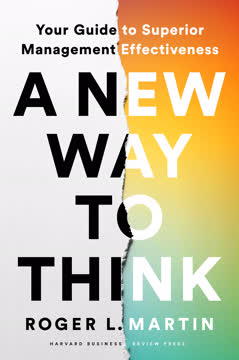
What's "A New Way To Think" about?
- Author and Purpose: "A New Way To Think" by Roger L. Martin is a guide to improving management effectiveness by challenging traditional business models and introducing new ways of thinking.
- Core Concept: The book argues that many existing management models are flawed and persist despite their ineffectiveness, and it offers alternative models that promise better outcomes.
- Structure: The book is divided into four parts, each focusing on different aspects of management: context, making choices, structuring work, and key activities.
- Target Audience: It is aimed at executives, managers, and anyone interested in enhancing their strategic thinking and management practices.
Why should I read "A New Way To Think"?
- Challenge Existing Models: The book encourages readers to question and rethink established management models that may not be delivering desired results.
- Practical Frameworks: It provides practical frameworks and alternative models that can be applied to real-world business challenges.
- Expert Insights: Written by a renowned management thinker, the book offers insights from Roger L. Martin's extensive experience advising top companies.
- Broad Applicability: The concepts are applicable across various industries and organizational levels, making it a valuable resource for a wide audience.
What are the key takeaways of "A New Way To Think"?
- Rethink Management Models: Many traditional management models are outdated and need to be replaced with more effective alternatives.
- Focus on Human Value: New ways of thinking should prioritize human value over organizational structures.
- Strategy and Execution: Strategy and execution are not separate; they are intertwined and should be treated as such.
- Customer-Centric Approach: To create shareholder value, businesses should focus on putting customers first.
What are the best quotes from "A New Way To Think" and what do they mean?
- Tom Peters on the Book: "I would pay 10 or 110 times the cover price for just the table of contents of this extraordinary book." This highlights the book's value in providing actionable insights.
- Julia Hartz on Simplification: "Roger Martin has an undeniable gift for simplifying the complex and nuanced scenarios of management." This emphasizes the book's ability to distill complex management issues into understandable concepts.
- Zhang Ruimin on Human Value: "New ways of thinking must shift from centering around the organization to centering around human value." This quote underscores the book's focus on prioritizing human-centric approaches in management.
How does Roger L. Martin suggest we rethink competition in "A New Way To Think"?
- Frontline Focus: Martin argues that competition happens at the front line, not at the head office, emphasizing the importance of customer interactions.
- Value Maximization: The book suggests that every corporate level should help the level below it to serve customers better, maximizing value at the front lines.
- Organizational Structure: It challenges traditional hierarchical structures, advocating for a more customer-centric approach that empowers frontline employees.
- Net Value Addition: Each organizational layer should add more value than it costs, ensuring competitiveness at the front line.
What does "A New Way To Think" say about stakeholder value?
- Customer First: The book argues that to create shareholder value, businesses should prioritize customers over shareholders.
- Long-Term Focus: It suggests that focusing on customer satisfaction leads to long-term shareholder value, as demonstrated by companies like Johnson & Johnson and Procter & Gamble.
- Compensation and Culture: The book discusses how compensation structures and corporate culture should align with a customer-first approach.
- Critique of Shareholder Primacy: It critiques the traditional focus on maximizing shareholder value, highlighting its limitations and potential for short-termism.
How does "A New Way To Think" address customer decision-making?
- Habit Over Loyalty: The book posits that customer decisions are often driven by habit rather than conscious loyalty, emphasizing the power of cumulative advantage.
- Ease of Choice: It suggests that offering customers the easiest choice, rather than the perfect one, can lead to sustained competitive advantage.
- Innovation and Familiarity: While innovation is important, maintaining familiarity and ease of use is crucial for customer retention.
- Behavioral Insights: The book draws on behavioral psychology to explain how processing fluency and repeated experiences influence customer preferences.
What is the "possibilities-based approach" in "A New Way To Think"?
- Strategic Possibilities: The approach involves generating multiple strategic possibilities and assessing what would have to be true for each to succeed.
- Testing and Choice: It emphasizes testing the conditions for success and making informed choices based on feasibility and potential outcomes.
- Collaborative Process: The approach encourages collaboration and input from diverse team members to generate creative and viable strategic options.
- Focus on Conditions: Instead of focusing on what is true, it asks what would have to be true, shifting the focus to potential and opportunity.
How does "A New Way To Think" redefine the role of data in decision-making?
- Imagination Over Data: The book argues that creating great choices requires imagination more than data, challenging the over-reliance on data-driven decisions.
- Possibility vs. Necessity: It distinguishes between situations dominated by possibility (changeable) and necessity (unchangeable), advocating for a design and imagination-driven approach in the former.
- Breaking the Frame: The book encourages breaking conventional frames and exploring new narratives to drive innovation and strategic thinking.
- Prototyping and Testing: It highlights the importance of prototyping and testing new ideas to create data and insights for decision-making.
What does "A New Way To Think" suggest about changing organizational culture?
- Indirect Change: The book emphasizes that culture can only be changed by altering how individuals work with each other, not by direct mandates.
- Interpersonal Mechanisms: It highlights the role of interpersonal interactions in aligning cultural and formal mechanisms within an organization.
- Microinterventions: Small changes in how meetings are structured and conversations are framed can lead to significant cultural shifts.
- Case Study: The book provides examples, such as the cultural transformation at the Rotman School of Management, to illustrate successful culture change.
How does "A New Way To Think" propose organizing knowledge work?
- Project-Based Organization: The book advocates for organizing knowledge work around projects rather than permanent jobs to improve productivity and flexibility.
- Flow-to-Work Model: It suggests a flow-to-work model where knowledge workers are assigned to projects based on demand, reducing downtime and inefficiencies.
- Knowledge Codification: The book emphasizes the importance of codifying knowledge to advance from heuristics to algorithms, enhancing knowledge transfer and productivity.
- Professional Services Model: It draws parallels with professional services firms, which successfully manage knowledge work through project-based structures.
What is the book's perspective on mergers and acquisitions (M&A)?
- Value Exchange: The book argues that successful M&A requires giving value to get value, focusing on what the acquirer can offer the target.
- Four Ways to Enhance Value: It outlines four ways to enhance an acquisition's competitiveness: smarter growth capital, better managerial oversight, skill transfer, and capability sharing.
- Avoiding the Take Mode: The book warns against acquisitions driven by a desire to enter attractive markets without understanding or enhancing the target's value.
- Perverse Incentives: It discusses the perverse incentives that drive M&A activity, such as stock-based compensation and accounting standards, leading to value-destroying deals.