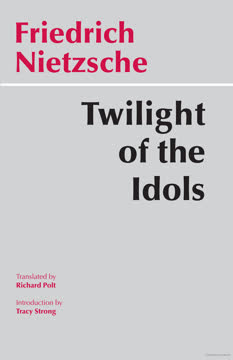
核心要点
1. 拒绝智者共识:质疑一切
古往今来,最智慧的人们对生命的评价始终如一:生命毫无价值……
挑战既定智慧。 尼采认为,历代智者对生命消极的共识不应被视为真理的证明,而应被看作一种共同的生理状态或颓废视角的表现。真正的洞见源于质疑,而非盲目接受既定规范。
智慧即症状。 尼采暗示,智慧本身可能是衰败的象征,如同乌鸦被腐肉吸引。他质疑最智慧的人是否必然是最健康、最肯定生命的。这一观点促使我们重新审视传统价值,寻找新的力量与活力源泉。
以苏格拉底为例。 尼采以苏格拉底为例,指出其虽有影响力,却可能代表希腊文化的颓废转折。通过质疑苏格拉底的动机与方法,尼采鼓励读者批判性地审视西方思想的根基。
2. 颓废即症状:理解衰落
苏格拉底的颓废不仅体现在其本能的混乱与无政府状态,也体现在逻辑的过度堆积和其标志性的偏执恶意。
颓废是生理与文化的衰退。 尼采将颓废定义为一种衰退状态,表现为本能的衰弱、逻辑的过度强调以及普遍的怨恨感。这种衰退既体现在个体,也体现在整个文化中。
颓废的症状包括:
- 本能的无政府状态
- 逻辑的过度堆积
- 偏执的恶意
- 怨恨情绪
- 对本能的不信任
苏格拉底作为颓废典型。 尼采视苏格拉底为颓废人物的典范,其对理性和辩证法的强调反映了更深层的生理与文化危机。通过识别颓废症状,尼采旨在诊断并克服威胁生命的力量。
3. 哲学家的错误:去历史化与因果颠倒
他们以为去历史化、从永恒视角审视事物是一种尊重,实则是将其制成木乃伊。
缺乏历史感。 哲学家常犯的错误是忽视思想与价值的历史背景,试图将其提升为永恒真理。这种去历史化导致对其起源和意义的误解。
因果颠倒。 另一常见错误是将结果误认为原因,如科纳罗将长寿归因于节食,实则节食是其新陈代谢缓慢的结果。这种错误导致对幸福与美德的错误指导。
哲学错误包括:
- 去历史化
- 因果颠倒
- 抽象概念优先于感官体验
认识这些错误,尼采力图发展更细致且具历史意识的哲学方法。
4. “真实世界”的寓言:解构形而上幻象
“真实世界”——我们已摒弃它:那还剩下什么?或许是表象世界……但不!连表象世界也一并摒弃了!
错误的历史。 尼采追溯“真实世界”概念的演变,从柏拉图到基督教再到康德,指出这是贬低尘世存在价值的虚构。
“真实世界”的终结。 尼采宣告“真实世界”及其依赖的表象世界的死亡。这一宣言标志着对形而上二元论的否定,以及对当下价值的肯定。
解构的后果:
- 拒绝形而上二元论
- 肯定当下时刻
- 拥抱“表象”世界
通过拆解“真实世界”的幻象,尼采旨在解放个体,摆脱传统道德与形而上学的束缚。
5. 道德即反自然:重新评价本能与激情
所有自然主义的道德,即每一种健康的道德,皆由生命本能支配——生命的某条法令通过特定的“应当”与“不应当”得以实现……
道德反对生命。 尼采认为传统道德,尤其是基督教道德,反自然,因为它压抑了生命的本能与欲望。这种压抑导致生命力的衰弱和尘世存在的贬值。
激情的精神化。 尼采主张对激情进行重新评价,提倡其“精神化”而非消灭,即将欲望转化为更高形式的表达,如爱与创造力。
敌人的价值。 尼采还重新评价敌意,认为冲突与对立是成长与活力的必要条件。这一观点挑战基督教的“灵魂平安”理想,拥抱对立力量的动态张力。
6. 四大错误:揭露虚假因果
没有比将结果误认为原因更危险的错误了:我称之为理性的真正毁灭。
虚假因果的错误。 尼采指出,将因果颠倒是传统道德与形而上学的根本错误。这导致对人类行为和现实本质的扭曲理解。
虚构的原因。 人们常为不快感受编造虚构原因,将其归咎于外部力量或道德缺陷。这种依赖虚构原因阻碍了对生理与心理根源的真正理解。
自由意志的幻觉。 尼采否定自由意志,认为它是神学发明,用以使个体对行为负责并受惩罚。他提出决定论观点,认为个体是环境与本能的产物。
7. “改良者”:道德议程的批判
人们熟知我呼吁哲学家超越善恶——拥有置身道德判断之上的幻觉。
道德意志。 尼采批判“改良”人类的冲动,认为这常伴随对自然本能的压制和任意价值的强加。他区分“繁育的道德”与“驯服的道德”,两者皆有问题。
繁育的道德。 试图创造特定类型的人,如印度种姓制度。尼采认为此法较为诚实,但终究误入歧途。
驯服的道德。 试图控制和压制人类本能,如基督教道德。尼采视其为尤为有害,导致生命力衰弱和尘世存在贬值。
8. 德国困境:缺乏“精神”
当今德国人仅有激情之心还不够:你还必须掌握它,抓住这种精神……
德国文化的衰落。 尼采哀叹德国文化的衰败,归因于缺乏涵盖智力、精神与创造力的“精神”。他批评德国对政治与权力的痴迷,认为这扼杀了智力与艺术表达。
麻醉剂的影响。 尼采指出酒精与基督教是麻痹德国心智的两大“麻醉剂”。他还批评德国音乐,尤其瓦格纳的作品,因其沉闷与压抑。
教育者的需求。 尼采呼吁改革德国教育,强调培养批判性思维与创造力的重要性。他主张更全面的教育,兼顾智力与体能发展。
9. 侦察突袭:对文化与现代性的非时宜观察
我的志向是用十句话说出别人用一本书才能说出的——以及别人书中未曾言及的……
对现代性的批判。 尼采对现代文化的艺术、文学、政治与道德等方面提出尖锐见解,批判现代价值的浅薄与表面,倡导回归更真实、更肯定生命的原则。
艺术家的心理。 尼采探讨艺术创作的心理根源,认为艺术源于陶醉状态和改造现实的渴望。他区分艺术中的阿波罗尼亚与狄俄尼索斯冲动,强调两者对完整理解人类经验的重要性。
古人的价值。 尼采深切钦佩古希腊与罗马人,尤其他们的勇气、现实主义与非道德主义。他将其生活态度与现代文化的颓废与道德主义形成鲜明对比。
10. 我对古人的债务:承认哲学渊源
最后,谈谈我试图接近并或许找到新途径的古代世界。
罗马风格。 尼采承认对罗马作家萨卢斯特与贺拉斯的敬仰,欣赏其简洁严肃的文风,视其为自己写作的榜样,追求类似的简练与力量。
对柏拉图的不信任。 尼采深刻不信任柏拉图,视其为基督教的前驱,其理想主义导致对现实真相的误解。他将柏拉图与修昔底德对比,后者以现实主义和面对真相的勇气赢得钦佩。
狄俄尼索斯的奥秘。 尼采强调狄俄尼索斯奥秘对理解古希腊世界观的重要性,视其为生命、性与永恒回归的肯定,与基督教的生命否定倾向形成对照。
读者评价
《偶像的黄昏》是一部对西方哲学与文化进行深刻批判的著作。读者普遍认为尼采的文风既引人入胜又颇具挑战性,书中充满了格言式的警句和对备受尊崇思想家的尖锐批评。许多人欣赏他对道德、宗教及人性的非传统见解,然而也有部分读者对他关于平等与社会问题的观点持不同意见。此书被视为尼采哲学的浓缩精华,提供了理解其世界观的独特视角,但同时需要细致揣摩。有人觉得它启迪心智,有人则感到困惑,但大多数人都认同这是一部发人深省的著作。
其他人还在读
常见问题
What's "Twilight of the Idols" about?
- Philosophical Critique: "Twilight of the Idols" by Friedrich Nietzsche is a wide-ranging critique of European philosophical and cultural values. It challenges traditional beliefs and moralities, questioning their validity and origins.
- Iconoclasm: The book aims to "philosophize with a hammer," meaning it seeks to dismantle the "idols" or false truths that have been revered in Western thought.
- Socratic Criticism: Nietzsche specifically targets figures like Socrates and Plato, whom he sees as symptomatic of a decline in Greek culture, and critiques their emphasis on reason over instinct.
- Cultural Analysis: The work also examines contemporary European culture, particularly German and French, and critiques the decadence and decline he perceives in them.
Why should I read "Twilight of the Idols"?
- Challenging Norms: The book offers a provocative challenge to conventional wisdom and encourages readers to question deeply held beliefs.
- Philosophical Insight: It provides insight into Nietzsche's mature philosophical themes, such as the critique of morality, the concept of decadence, and the idea of the "will to power."
- Cultural Critique: Nietzsche's analysis of European culture and its values offers a historical perspective that remains relevant in understanding modern Western thought.
- Stylistic Mastery: The book is a showcase of Nietzsche's stylistic prowess, blending aphorisms, polemics, and philosophical discourse in a compelling manner.
What are the key takeaways of "Twilight of the Idols"?
- Critique of Reason: Nietzsche argues that the traditional emphasis on reason and logic has led to a devaluation of life and instinct.
- Decadence and Decline: He identifies signs of cultural and philosophical decadence in Western society, particularly in its moral and religious values.
- Revaluation of Values: The book calls for a revaluation of all values, challenging readers to reconsider what they hold as true and valuable.
- Affirmation of Life: Nietzsche advocates for a life-affirming philosophy that embraces instinct, creativity, and the "will to power."
What are the best quotes from "Twilight of the Idols" and what do they mean?
- "What does not kill me makes me stronger." This famous aphorism suggests that adversity can lead to personal growth and resilience.
- "The will to system is a lack of integrity." Nietzsche criticizes the tendency to impose rigid systems of thought, arguing that it stifles creativity and truth.
- "Without music, life would be a mistake." This quote highlights Nietzsche's belief in the essential role of art and aesthetics in enriching human life.
- "The most perfidious way of harming a cause consists of defending it deliberately with faulty arguments." Here, Nietzsche warns against insincere or poorly reasoned defenses of beliefs, which can ultimately undermine them.
How does Nietzsche critique Socrates in "Twilight of the Idols"?
- Socrates as Decadent: Nietzsche views Socrates as a symptom of Greek cultural decline, arguing that his emphasis on reason over instinct represents a departure from healthier, more instinctual values.
- Dialectics as a Tool of the Weak: He suggests that Socrates' use of dialectics was a tool for those who lacked other means of asserting power, equating it with a form of intellectual revenge.
- Irony and Resentment: Nietzsche interprets Socratic irony as a form of resentment, a way for Socrates to assert dominance over the noble Athenians who were fascinated by him.
- Misunderstanding of Rationality: He argues that Socrates' belief in rationality as a cure for decadence was itself a misunderstanding, as it was merely another expression of decadence.
What is Nietzsche's view on morality in "Twilight of the Idols"?
- Morality as Anti-Nature: Nietzsche criticizes traditional morality as being anti-natural, arguing that it suppresses instinct and life-affirming values.
- Moral Judgement as Misinterpretation: He claims that moral judgments are interpretations, often misinterpretations, of phenomena and do not correspond to any objective reality.
- Critique of Christian Morality: Nietzsche sees Christian morality as a form of decadence, promoting weakness and denying the instincts that affirm life.
- Revaluation of Values: He calls for a revaluation of values, advocating for a morality that embraces life, strength, and the will to power.
How does Nietzsche address the concept of "decadence" in "Twilight of the Idols"?
- Cultural Decline: Nietzsche identifies decadence as a cultural decline characterized by a loss of vitality and an overemphasis on rationality and morality.
- Symptoms of Decadence: He sees the prevalence of certain philosophical and religious ideas, such as those of Socrates and Christianity, as symptoms of decadence.
- Physiological Basis: Nietzsche often links decadence to physiological decline, suggesting that it manifests in both the body and the mind.
- Opposition to Decadence: He advocates for a return to more instinctual, life-affirming values as a way to combat the effects of decadence.
What is the "will to power" as discussed in "Twilight of the Idols"?
- Fundamental Drive: The "will to power" is a fundamental drive that Nietzsche believes underlies all human actions, surpassing even the will to survive.
- Creative Force: It is a creative force that seeks to assert and enhance one's power and influence over oneself and the world.
- Beyond Good and Evil: The concept challenges traditional moral values, suggesting that power and strength are more fundamental than conventional notions of good and evil.
- Life-Affirming Philosophy: Nietzsche sees the will to power as central to a life-affirming philosophy that embraces change, growth, and self-overcoming.
How does Nietzsche critique German culture in "Twilight of the Idols"?
- Cultural Stagnation: Nietzsche criticizes German culture for its stagnation and lack of intellectual vitality, attributing it to the influence of Christianity and alcohol.
- Anti-Intellectualism: He laments the decline of intellectual seriousness and passion in Germany, noting a shift towards mediocrity and conformity.
- Critique of German Music: Nietzsche is critical of what he sees as the constipating effect of German music, particularly Wagner's, on the German spirit.
- Call for Renewal: He calls for a cultural renewal that embraces creativity, strength, and a revaluation of values.
What role does art play in Nietzsche's philosophy as presented in "Twilight of the Idols"?
- Art as Life-Affirming: Nietzsche views art as a vital, life-affirming force that can counteract the nihilism and decadence of modern culture.
- Dionysian Art: He emphasizes the importance of Dionysian art, which celebrates chaos, instinct, and the irrational aspects of life.
- Critique of Purposeful Art: Nietzsche criticizes art that serves moral or didactic purposes, advocating instead for art that exists for its own sake (l'art pour l'art).
- Art and the Will to Power: Art is seen as an expression of the will to power, a means of imposing one's vision and values onto the world.
How does Nietzsche's style in "Twilight of the Idols" contribute to its philosophical message?
- Aphoristic Style: The book is written in an aphoristic style, with short, pithy statements that challenge the reader to think critically and independently.
- Polemic and Provocation: Nietzsche's style is polemical and provocative, designed to unsettle and provoke thought rather than provide easy answers.
- Use of Metaphor: He employs rich metaphors, such as "philosophizing with a hammer," to convey complex ideas in a vivid and memorable way.
- Engagement with the Reader: The style invites active engagement, encouraging readers to question their assumptions and explore new perspectives.