

Key Takeaways
The Greeks were culturally one but politically many, and never united
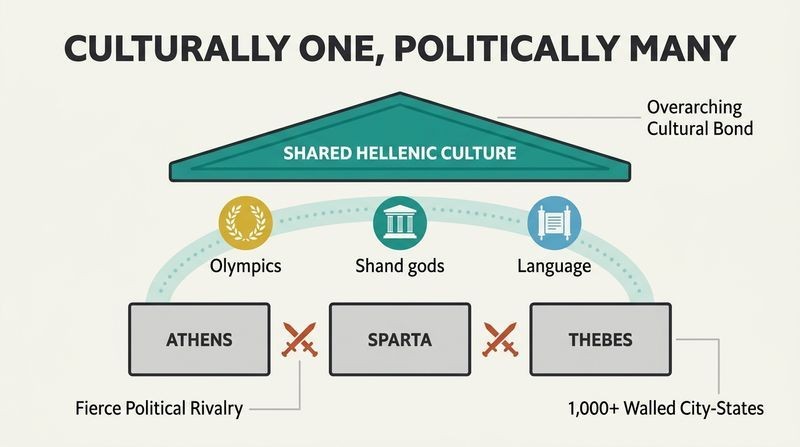
The thread that binds Greek history. Waterfield frames all of ancient Greece around a single paradox: Greeks everywhere shared a language, gods, festivals, and a sense of kinship, yet they organized into over a thousand fiercely independent city-states that warred against one another constantly.
They recognized their common Greekness (worshipping together at Delphi and Olympia, tracing descent from a mythical ancestor named Hellen) but gave their deepest loyalty to their particular city: a man was Athenian or Spartan first, Greek second. This inability to convert cultural unity into political unity meant they never formed a nation on their own. Ironically, unity was ultimately imposed from outside, first by Macedon, then by Rome, which finally recognized the Greeks as a single people by making them a province.
What's striking is how this maps onto modern debates about identity and federalism. The European Union wrestles with the same tension: shared culture and currency, but member states guarding sovereignty. Political scientists call this the collective action problem, where rational self-interest by each unit produces a worse outcome for all. The Greeks had blueprints for federation (their confederacies) but rarely scaled them to the whole. Benedict Anderson's concept of the imagined community illuminates the point: nationhood requires a shared story powerful enough to override local loyalty. The Greeks had the story but chose the smaller tier almost every time, until conquest made the choice for them.
Ninety percent of Greeks were farmers whose lives left almost no trace
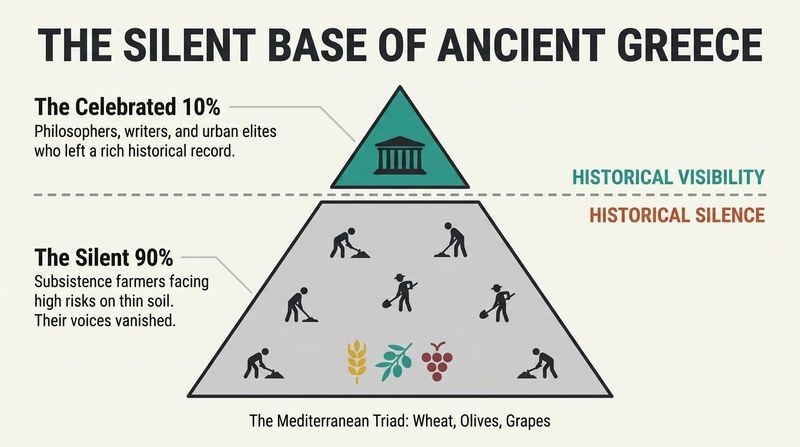
The silent majority ran the world we admire. We celebrate the Parthenon, the philosophers, and the vase-painters, but nearly all surviving literature was written by elite urban men. The overwhelming majority (perhaps 90% at the start, 60% by the end) were subsistence farmers whose voices vanished.
Greek farming meant relentless risk-management on thin soil and capricious rainfall (annual variation up to 60%). Farmers diversified crops (the Mediterranean triad of grain, olives, and grapes plus legumes), scattered plots to spread risk, stored food, and traded surpluses. Life was hard: men averaged 170cm tall, died in their mid-forties, women in their mid-thirties. Even heroic Achilles, in Homer's underworld, says he would rather be a landless laborer alive than king of the dead.
This is a corrective worth internalizing. The tendency to equate a civilization with its monuments is what historians call survivorship bias, mistaking what endured for what mattered. Brecht's poem asking who built the seven gates of Thebes makes the same point Waterfield does. Modern archaeology (field survey, pollen analysis, skeletal studies) is slowly recovering these lives, echoing the Annales School's shift from kings and battles to the longue duree of ordinary existence. The sobering statistic on life expectancy also reframes Greek achievement: the philosophy and art we prize emerged from a society where malnutrition and early death were routine, not from comfortable abundance.
Greeks invented power-sharing, replacing kings with rotating equals under law
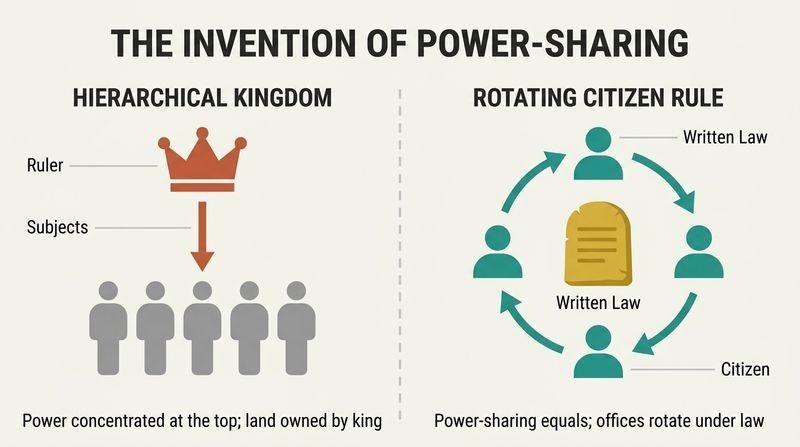
A genuinely new political form. For millennia, the standard model across the Near East was the hierarchical kingdom, with land owned by king or temple. During the Archaic period (750 to 480 BCE), Greek communities evolved something different: property held by private individuals, and political offices shared among a group of roughly equal citizens who ruled and were ruled in turn.
Early written laws reveal the assumption of isonomia (fair shares, equality under the law) baked in from the start. Many stipulate that an office can be held only once per decade, preventing any one man from monopolizing power. This sharing of authority, rather than concentrating it in one ruler, was the foundational seed. The central question dividing Greek states for centuries became whether power should be shared among all citizens or only a wealthy few.
This is arguably Greece's most consequential export, more durable than any temple. The idea that legitimate authority rotates among peers under written, impersonal law is the ancestor of constitutional government. Political theorists from Hannah Arendt to modern institutional economists (Daron Acemoglu and James Robinson's inclusive versus extractive institutions) trace prosperity and stability to exactly this distribution of power. Worth noting, though, that isonomia coexisted with mass slavery and the total exclusion of women, so this was equality within a narrow club. The radical move was less equality itself than depersonalizing power, detaching authority from a single sacred body and attaching it to rules.
Athens ran the most direct democracy ever: citizens were the government
Not representation, but participation. Modern democracies elect people to govern for us. In Athens after Cleisthenes' reforms of 508 BCE, the people literally were the government. Any citizen over twenty could speak and vote in the Assembly; juries numbered in the hundreds or thousands; up to a quarter of male citizens over thirty served on the Council in a given period.
Three features made it radical:
1. Sortition (selection by lottery) for most offices, assuming any citizen could do the job.
2. Term limits (most posts once per lifetime) to spread experience and block power bases.
3. Pay for public service, so poverty did not bar participation.
Ostracism let the Assembly exile any man deemed too dangerous for ten years, no crime required, if six thousand votes were cast.
The Athenian system challenges a modern assumption that direct democracy cannot scale. Athens governed a population of 340,000 and an Aegean empire this way for nearly two centuries. Critics then and now (Plato foremost) called it rule by the ignorant and fickle mob, and the execution of Socrates and the condemnation of the Arginusae generals are cited as evidence. Yet political scientist Josiah Ober argues Athens outperformed rivals precisely because sortition and rotation aggregated dispersed knowledge, an ancient anticipation of the wisdom-of-crowds effect. The exclusions remain glaring: women, slaves, and foreigners had no vote. Still, the participatory ideal it modeled remains a benchmark democracies measure themselves against.
Sparta built battlefield supremacy by manufacturing terror over its own slaves
A society engineered for war on a knife's edge. After conquering neighboring Messenia around 610 BCE, Spartans found themselves vastly outnumbered by resentful serfs called helots, who worked their farms and handed over half the produce so Spartiate men could train full-time as soldiers.
This dependency shaped everything. Spartan citizens underwent the agoge, a brutal state education from age seven emphasizing endurance, theft, and violence. They ate in communal messes, and losing the ability to contribute meant losing citizenship. To keep helots terrified, Sparta formally declared war on them each year (so killing one was not murder) and sent young men to hunt them by night. The system produced Europe's finest soldiers and a paranoid, xenophobic state that reinvented its own history, attributing everything to a possibly mythical lawgiver, Lycurgus.
Sparta is history's cautionary tale about optimizing for a single metric. By engineering the perfect warrior society, it created a demographic trap: Spartiate numbers collapsed from 8,000 in 479 to about 1,000 by the mid-fourth century, partly because rigid landholding and inheritance rules (and women accumulating property) concentrated wealth in ever fewer families. The state that could not lose a battle for three centuries was undone by arithmetic, not defeat. There is a management lesson here about brittle systems. Waterfield also performs valuable myth-busting: much of what we think we know about Sparta was propaganda, retrofitted onto Lycurgus to justify contemporary reforms. Skepticism toward tidy origin stories is warranted.
Greek religion was about doing rituals correctly, not believing doctrines
No scripture, no church, no creed. Greek religion had no sacred text, no commandments, no priesthood with a vocation, and no institution to enforce orthodoxy. It was overwhelmingly a matter of performing the right rituals at the right times, an obligation you assumed as a member of a community.
The gods were approached through reciprocity, not love: you sacrificed and prayed expecting a return, reminding the deity of your good record. This flexibility made the system tolerant of new gods and easy to merge with foreign pantheons. It also made religion this-worldly, concerned with good harvests and safety now rather than salvation later, which is precisely why the state ran it. Lacking a church, the polis organized worship, decided orthodoxy, and funded festivals. Athens alone sacrificed over 6,000 oxen a year.
This orthopraxy (right practice) versus orthodoxy (right belief) distinction is one of the most useful lenses for understanding pre-Christian religion, and it dissolves anachronistic questions like whether Greeks really believed their myths. Anthropologists studying ritual (Roy Rappaport, for instance) argue that public performance, not private conviction, is what binds communities, which fits Greece precisely. The separation of church and state we take for granted was literally unthinkable here because there was no church to separate. The trial of Socrates gains clarity in this light: charging him with impiety was less about theology than about signaling he was an uncommitted, potentially subversive citizen.
Greek warfare followed etiquette that kept fellow-Greek casualties surprisingly low
A ritualized contest, not total war. For much of the Classical period, hoplite battle between Greek city-states followed unwritten conventions. Both sides deployed openly, fought a brief clash (often minutes to a couple of hours), and the loser signaled defeat by requesting a truce to collect the dead. The winner erected a trophy and everyone usually went home. Victory was rarely followed up with conquest or regime change.
Casualty rates stayed relatively modest: roughly 5% for winners, 15 to 20% for losers, most of the latter dying in flight. Waterfield argues this restraint reflected a recognition that this was Greeks fighting Greeks. Atrocities (massacres, enslavement) were far more common in naval battles, sieges, and wars against non-Greeks. The Peloponnesian War shattered these norms, introducing year-round campaigns, garrisons, and mercenaries.
The idea of a limited, rule-bound war feels almost quaint against modern total war, but it echoes what military historian Victor Davis Hanson called the Western way of war and what game theorists recognize as a tit-for-tat equilibrium among repeated players who expect to meet again. When the players stopped being neighbors bound by shared norms (as in the drawn-out Peloponnesian War, where mercenaries and distant theaters replaced citizen-farmers), the restraints collapsed. The pattern generalizes: conventions of restraint survive only among adversaries who share identity and anticipate future interaction. Strip away shared identity, as in wars against barbarians, and the brakes come off, a grim continuity across history.
Colonizing the Mediterranean is what first made scattered Greeks feel Greek
Dispersal, paradoxically, created identity. In the eighth and seventh centuries BCE, roughly 40,000 Greeks emigrated, founding trading posts and cities from Spain to the Black Sea, driven by land hunger and profit. A new overseas settlement was founded roughly every two years in the late eighth century.
The key insight: these colonies mixed settlers from many different Greek cities, who suddenly noticed what they had in common versus the non-Greeks (barbaroi, literally other-language-speakers) surrounding them. Rhodian settlers in Sicily discovered they were all Rhodians; back home the three Rhodian towns then began identifying as one. At the emporium of Naucratis in Egypt, nine Greek communities jointly worshipped at a shrine to the gods of the Greeks. Ethnicity, Waterfield stresses, is a construct, aggregated from perceived shared traits and then glued together with invented myths of common descent.
This is a sophisticated, modern take on ethnogenesis: identity forms at boundaries, through contact with an out-group, not in isolation. It aligns with Fredrik Barth's influential anthropology, which located ethnicity in the maintenance of boundaries rather than in cultural content itself. The manufactured genealogy (inserting a man named Hellen at the head of the family tree, complete with sons Dorus and Aeolus) is a textbook case of what scholars call invented tradition, a fiction that felt true because it explained a real experience of kinship. The diaspora point also inverts intuition: we assume identity precedes migration, but here migration forged the identity. Trade networks, not blood, wove the Greek world together.
Coined money and rational argument both emerged from the same civic ferment
Two revolutions with a shared root. Coinage appeared around 600 BCE in Lydia and neighboring Greek cities, spreading fast because it simplified how states collected and disbursed revenue while advertising civic prestige. Within a century, over a hundred states minted their own.
Almost simultaneously, in sixth-century Miletus, thinkers like Thales and Anaximander launched what later scholars called the Greek miracle: explaining the world through single natural substances rather than gods (reductionism), and backing claims with argument and evidence rather than divine authority. Waterfield links these to the city-state itself. In assemblies and councils, citizens weighed competing proposals and demanded speakers justify themselves. Rational argument became the civic norm; the philosophers simply extended it to the cosmos. He even speculates coinage seeded the idea of infinite substitutability, one thing becoming many.
The claim that democratic deliberation and philosophy share a root is one of the book's boldest and most fertile. It resonates with classicist G.E.R. Lloyd's argument that Greek science's adversarial style (proof, refutation, open debate) mirrored the courtroom and assembly, a feature absent in contemporary China where knowledge flowed through bureaucratic consensus. The coinage-cognition link is more speculative and philosopher Richard Seaford has pushed it hardest, arguing money's abstraction (universal value in a token) primed abstract metaphysical thinking. Skeptics reasonably object that correlation is not causation, and Egypt and Babylon did sophisticated math without either. Still, the environmental explanation (institutions shape minds) beats the old lazy answer of individual genius.
Alexander's conquests exploded the Greek world and birthed the individual
A new world demanded new selves. When Alexander conquered the Persian Empire (334 to 323 BCE), he flung Greeks across Egypt and Asia, ruling perhaps 40 million people. Hundreds of thousands emigrated, uprooted from ancestral homes, kinship groups, and the collective identity of the old city-state.
The Hellenistic period (323 to 30 BCE) that followed saw a striking cultural shift toward the individual. Classical art had portrayed idealized types (the noble warrior, the modest woman); Hellenistic art embraced realism and ordinary people: hunchbacks, exhausted boxers, children, slaves. Comedy dropped politics for domestic soap opera. New philosophies (Stoicism, Epicureanism, Cynicism, Skepticism) promised personal tranquility and self-improvement rather than civic virtue. Religion turned toward personal salvation cults like Isis and Serapis. Even women gained more freedom and, occasionally, real power.
Waterfield's thesis that Western individualism was born here is provocative and largely persuasive. When the polis no longer defined you and distant kings held power, the person became a unit of meaning in a way Classical collectivism resisted. This tracks with sociological accounts (Emile Durkheim on the division of labor) linking individualism to social complexity and the erosion of tight communal bonds. The Hellenistic philosophies read almost like ancient self-help, offering portable inner peace to the deracinated, much as Stoicism enjoys a revival today among people navigating another era of dislocation. One caveat: individualism here meant a private inner life, not political rights, which if anything shrank under the kings.
Rome conquered Greece by dividing Greeks and weaponizing the word freedom
Terror plus the freedom slogan. Rome took Greece not through overwhelming occupation but through repeated, calculated intervention between 229 and 146 BCE. Its method was to keep Greeks divided and cheaply controlled. Roman armies would win, impose terms, then withdraw entirely, relying on their fearsome reputation and the implied threat of return.
The cynical masterstroke was the freedom slogan. At the Isthmian Games of 196 BCE, the general Flamininus dramatically declared the Greeks free from Macedon, to ecstatic celebration. But real freedom, as the Aetolians pointed out, would mean freedom from Rome too. In practice, Greeks now needed the Roman Senate's approval for anything significant. When the Achaean Confederacy finally defied Rome, Corinth was destroyed in 146 BCE, its people killed or enslaved, ending Greek independence for nearly 2,000 years.
Rome's playbook is a case study in hegemony versus empire, the difference between controlling behavior and controlling territory. By bribing local elites with power and outsourcing administration, Rome practiced what the British later perfected in India, indirect rule, cheaper and more durable than boots on the ground. The freedom slogan is a masterclass in what political scientists call legitimation: dressing domination in the target's own cherished values. Waterfield's point that Rome deliberately cultivated a reputation for brutality (terror as an economical tool) anticipates modern deterrence theory. The tragedy the book underlines is that Greek disunity, the one-many problem, made them exploitable. A united Greece might have resisted; a fragmented one could be picked off.
A nation needs a homeland, which is why Greece stayed an idea for millennia
The one missing ingredient. Waterfield closes by asking why Greeks, so obviously a people, took until 1832 CE to become a nation-state. They shared language, kinship, gods, dress, and even a sense of common history (the Trojan War, the Persian Wars). Over time, especially after Alexander, they increasingly acted on this shared Greekness, using kinship diplomacy where cities appealed to distant cities for help based on mythical shared ancestors.
But one thing was always absent: a common territory. Most definitions of ethnicity require a shared or claimed homeland, and the Greeks never had one. They were scattered around a sea they could not possess. Fourth-century orators fantasized about Greece as a common fatherland, but it was rhetoric. Political unification stayed partial and cultural, held only in the imagination, until the 1832 War of Independence finally gave Greece territory, government, and nationhood.
This is an elegant capstone that connects antiquity to modern nationalism. The insistence on territory as constitutive of nationhood echoes Anthony Smith's work on ethnic origins of nations and the broader recognition that maps make nations as much as nations make maps. There is poignancy in the observation that Greeks shared a sea rather than a land, since the sea connected but could never be owned or bounded. The two-millennia gap between cultural and political nationhood is a powerful reminder that peoplehood and statehood are distinct achievements, a lesson visible today in stateless peoples like the Kurds. Waterfield resists romantic teleology: unification was never inevitable, and when it came, outsiders and a homeland, not Greek will alone, made it real.
Analysis
Waterfield's achievement is structural: he threads 700 years of dizzyingly fragmented history onto a single conceptual spine, the tension between cultural unity and political plurality, the one-many problem. This is not merely an organizing device but an argument about why Greek history unfolded as it did, and why it ended in foreign conquest. It gives narrative coherence to material that usually reads as a bewildering procession of battles and tyrants.
Methodologically, the book reflects the discipline's modern turn. Waterfield leans on survey archaeology, skeletal and pollen data, inscriptions, and papyri to recover the silent 90% (farmers, slaves, women, metics) rather than only the literate elite. He treats ethnicity as a constructed, boundary-formed phenomenon (drawing implicitly on Barth and Anderson) rather than a primordial given, and he is admirably skeptical of ancient sources' self-mythologizing, particularly on Sparta and Lycurgus. His giving equal weight to the Archaic, Classical, and Hellenistic periods corrects a longstanding bias that treated everything after the fourth century as decadent afterthought.
The interpretive boldness sits in the causal claims: that democratic deliberation and rational philosophy share a civic root, that coinage may have primed abstract thought, and that Western individualism was born in the Hellenistic dislocation. These are contestable (correlation-causation worries abound, and Egypt and Babylon achieved much without Greek institutions), but they are the kind of arguments that make a survey intellectually alive rather than a chronicle.
The book's limits are the flip side of its virtues. The relentless focus on political culture means economic and intellectual history get compressed, and the eastern Hellenistic world is deliberately underweighted. The one-many frame, while illuminating, can flatten cases that resist it. Still, for a reader wanting to understand not just what the Greeks did but why they never became a nation until 1832, this is a lucid, current, and unsentimental guide, resisting both Victorian idealization and cynical debunking.
Review Summary
Creators, Conquerors, and Citizens by Robin Waterfield receives mixed reviews (3.92/5 stars). Readers appreciate its comprehensive coverage of Greek history from archaic to Hellenistic periods, with even attention to often-overlooked eras. Many praise its accessibility and readability, calling it an excellent introduction. However, critics note it can be dry, chronologically confusing with its thematic organization, and relies exclusively on primary sources without secondary citations. Some find it repetitive if already familiar with Greek history. The political focus disappoints those seeking more intellectual history, though cultural aspects receive attention.
People Also Read

About the Author
Other books by Robin Waterfield
Download PDF
Download EPUB
.epub digital book format is ideal for reading ebooks on phones, tablets, and e-readers.








































