

Key Takeaways
Under every bad behavior is a good kid having a hard time
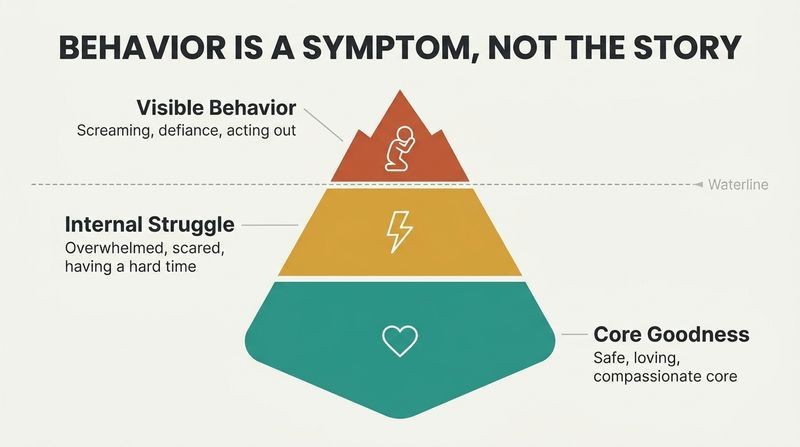
Behavior is a symptom, not the story. Kennedy's foundational belief is that children (and parents) are good inside, meaning compassionate and loving at their core. When a child denies knocking down a tower you watched him topple, or screams "I hate you," the misbehavior signals dysregulated feelings, not a flawed character. This assumption lets parents get curious about the why instead of reacting to the what.
Goodness enables sturdy leadership. Seeing your child as good inside is not permissive. It lets you separate the person from the behavior, so you can set firm boundaries while preserving the relationship. Kennedy warns that two forces sabotage this: our evolutionary negativity bias (we fixate on what is wrong) and the harsh scripts we inherited from our own childhoods, which repeat unless we consciously break the cycle.
The "good inside" premise echoes Carl Rogers's unconditional positive regard and humanistic psychology's belief in an innate drive toward growth. It also aligns with attribution theory: labeling a child "manipulative" is a dispositional attribution that shapes how we respond, often worsening the behavior through self-fulfilling prophecy. Kennedy's contribution is translating this into split-second parenting moments. A fair challenge: separating person from behavior is cognitively demanding when you are exhausted and triggered, and the book sometimes underplays how much regulated bandwidth this requires. Still, as a default lens, assuming goodness is a demonstrably better starting hypothesis than assuming defiance.
Hold two truths at once instead of choosing sides
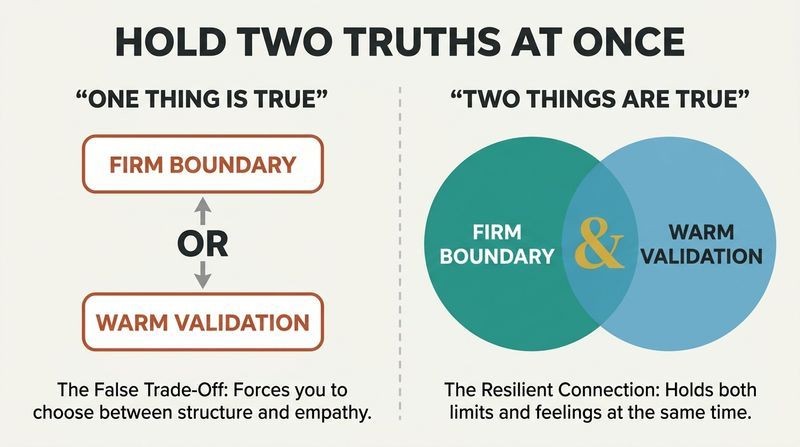
Multiplicity resolves parenting's false trade-offs. Kennedy's "two things are true" principle says you never have to pick between firmness and warmth. You can hold a boundary (no, you can't watch that movie) and validate the protest (you're allowed to be furious about it). Both are real. This mirrors the Gottman Method's finding that healthy couples accept two valid perspectives, and psychologist Philip Bromberg's idea that health means standing in the spaces between realities without losing any.
Understanding beats convincing. In "one thing is true" mode, you argue to prove you're right, which leaves the other person feeling unseen and combative. In "two things are true" mode, you stay curious. Kennedy's example: a boss who cancels your promised raise feels very different if she says "I get why you're disappointed" versus "Just be grateful you have a job."
This is dialectical thinking, the same core skill in Marsha Linehan's Dialectical Behavior Therapy, where "dialectics" means synthesizing opposites (acceptance and change) rather than collapsing into either. Kennedy smartly ports a clinical concept into everyday parenting. The deeper value is emotional: most conflict escalation is not about content but about each party defending that their experience is real. Naming both realities defuses that. One nuance worth adding: "two things are true" is not moral relativism. A parent still makes the decision. The principle governs how you hold feelings, not whether boundaries bend to them.
Your job is safety and boundaries; your child's job is feelings
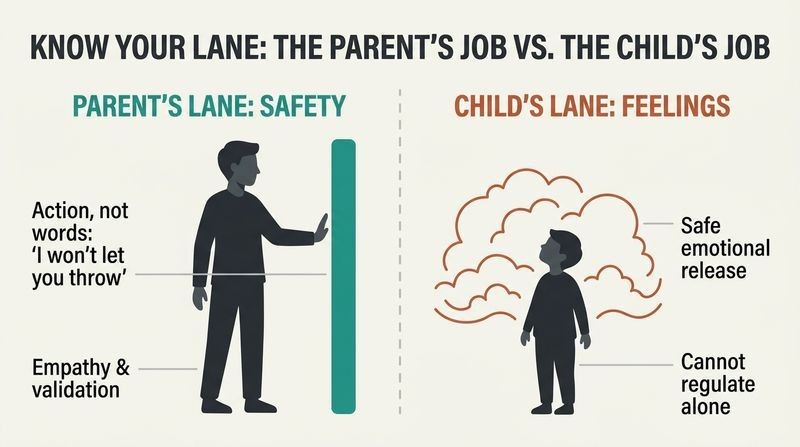
Know your lane. Kennedy borrows from family systems theory: parents establish safety through boundaries, validation, and empathy, while children explore and express emotions. Trouble starts when roles blur, when kids dictate boundaries or parents dictate feelings. A boundary is what YOU will do ("I won't let you throw these blocks" as you move them), not what you beg the child to do ("please stop throwing!").
Children can't regulate what they feel. Drawing on Siegel and Bryson's two-story-house model, the "downstairs brain" (impulses, emotions) is fully built at birth while the "upstairs brain" (planning, self-control, empathy) stays under construction into the twenties. Asking a flailing child to calm himself puts him in charge of a job he can't do, which terrifies him. The parent is the staircase linking the two floors.
The neuroscience is simplified but directionally sound: prefrontal maturation genuinely extends into the mid-twenties, which is why expecting adult-grade impulse control from a four-year-old is developmentally illiterate. The reframing of boundaries as self-directed statements ("I won't let you") rather than commands is quietly radical and solves a real problem: you can always control your own actions, never someone else's. This is essentially the serenity-prayer logic applied to discipline. A limitation: some children with sensory or neurodevelopmental differences need heavily individualized approaches, and blanket "containment" language could misfire without attunement to the specific child.
Build resilience, not happiness, by sitting in the hard feelings
Happiness is downstream of regulation. Kennedy argues the parents who say "I just want my kids happy" are usually trying to eliminate distress, which backfires. Picture emotions floating in a jar: when frustration and sadness can't be tolerated, they crowd out everything else and trigger a stress response. Anxiety, she says, is the intolerance of discomfort, the feeling that you shouldn't feel how you feel.
Prepare kids for feelings, don't protect them from feelings. When a child isn't invited to a party, rushing to say "they like you, the party was small" teaches that discomfort must be escaped immediately. Instead, jump into the emotional hole with them: "Everyone else got invited. That stinks. I get it." Resilience, per Brooks and Goldstein's research, grows from empathy, safe presence, allowing mistakes, and problem-solving, not from engineered wins.
This tracks tightly with exposure-based cognitive behavioral therapy, where avoidance is the engine that maintains anxiety and tolerating distress extinguishes it. Kennedy's "jar" is a folk version of affect tolerance and window-of-tolerance models. The counterintuitive claim, that pursuing happiness undermines it, is supported by research on experiential avoidance predicting worse mental health outcomes. There is also a cultural critique embedded here worth naming: intensive, snowplow parenting that removes all friction is associated with reduced emotional coping in emerging adults. The caution: "sit with the feeling" can tip into neglect if not paired with genuine warmth and, eventually, skill-building. Presence is necessary but not always sufficient.
It's never too late; get great at repair after the rupture
Rupture is inevitable; repair is the skill. No parent stays regulated all the time. Kennedy insists the goal isn't perfection but repair, returning to a child after you yelled and reconnecting. Neuroplasticity means the brain rewires throughout life, and research she cites concludes parenting interventions work at every age: "it's never too early, never too late."
Repair rewrites the body's memory. When left alone after a blowup, kids default to self-doubt ("did that really happen?") or self-blame ("I'm bad"), because believing they're bad feels safer than believing the world is unsafe. A repair layers connection onto the old memory. Kennedy's four-part script: share that you've reflected, acknowledge their experience, say what you'd do differently, and reconnect through curiosity. Crucially, own it: "My yelling was my feeling to manage, never your fault."
The repair concept comes straight from attachment research, notably Ed Tronick's Still Face experiments, which showed infants distressed by a blank parental face rapidly recover when the parent re-engages. Tronick found normal interactions are "messy" and mismatched most of the time; secure attachment comes from repeated repair, not flawless attunement. Kennedy operationalizes this beautifully for guilt-ridden parents. The reframe that self-blame is a child's protective strategy (better a bad me in a safe world than a good me in a dangerous one, per Fairbairn) is genuinely illuminating. The empowering flip side: because kids blame themselves, your repair directly protects their self-worth.
Ask your most generous interpretation before you react
MGI shifts your nervous system. Kennedy's practical tool is a single question: "What is my most generous interpretation of what just happened?" When a younger child screams "you're the worst mom!" upon hearing his brother gets a solo birthday lunch, the MGI is: he desperately wishes he were included, and the pain explodes as cruel words. This reframe softens your body and changes your intervention.
Kids become the version you reflect back. Tell a child he's selfish and he acts in self-interest; tell him "you're a good kid having a hard time" and he gains the security to regulate. Kennedy recounts pausing while her son decided whether to share a snack, resisting the urge to guilt him. She left the room saying she trusted his generosity, and overheard him offering his sister pretzels. Not perfect, but growth.
MGI is essentially a cognitive reappraisal technique, the most evidence-backed emotion-regulation strategy in affective science, applied preemptively to another person's behavior. It also functions as a Pygmalion effect intervention: expectations shape outcomes, and children internalize the identity narrated to them. Worth flagging a tension the framework invites: MGI is not the same as excusing. The generous interpretation explains the feeling underneath while the behavior still gets a boundary. Where MGI could be misused is chronic self-gaslighting, generously interpreting genuinely harmful patterns (in a partner, say) rather than addressing them. For young children, though, the assumption of benign intent is almost always the accurate one.
Tantrums are biological floods, so contain the fire, don't extinguish it
Aggressive meltdowns are threat states, not defiance. When a child hits, bites, or throws, his prefrontal cortex has gone offline and cortisol, heart rate, and breathing spike. He is in fight-or-flight, terrified of the sensations inside his own body. Kennedy's job description here narrows to two things: keep yourself calm, keep your child safe.
Containment is an act of love. Say "I won't let you" and follow through physically (blocking a hit, carrying him to a small, safe room). Sit at the door, breathe audibly, say almost nothing, and avoid eye contact, which reads as threat mid-flood. Reframe "I hate you!" as the child yelling at his own overwhelming feelings, not at you. Later, when calm, "tell the story" of what happened to layer coherence and connection onto the chaos, which builds regulation for next time.
This maps onto polyvagal theory and the concept of co-regulation: a dysregulated nervous system borrows calm from a regulated one nearby. Kennedy's insistence on staying present rather than the traditional "go to your room until you calm down" is significant, because isolation during a threat state can compound the child's sense of abandonment. The counterpoint some behaviorists raise: for certain children, an audience can inadvertently prolong episodes, and planned ignoring has decades of efficacy data for attention-maintained behavior. Kennedy's approach likely works best when tantrums are emotionally driven rather than instrumentally reinforced, a distinction parents must diagnose honestly in the moment.
Lying is a wish, a shield, or a bid for independence
Reframe the lie to see the child. Kennedy argues lying is almost never sociopathic scheming. Kids lie because fantasy and reality blur, because truth-telling threatens their attachment ("if I confess, they'll see me as bad and push me away"), or because deception is one of the few levers of independence they control. Treating a lie as a "wish" opens a gray zone: "I bet you wish that tower were still standing."
Aim for future honesty, not present confession. Demanding "don't lie to my face!" triggers shame, which freezes kids further. Kennedy's strategies: pause and say nothing, offer an opening later ("if a kid in this family ever did X, I'd want to understand, not punish"), and ask directly what the child needs from you to feel safe telling the truth. The goal is a home where truth doesn't feel dangerous.
Developmental research (Kang Lee's work on children and deception) actually frames early lying as a cognitive milestone requiring theory of mind, not a moral failing. Kennedy's attachment framing complements this: Talwar and Lee's "punishment paradigm" studies show that punitive environments produce better liars, not more honest kids, because the stakes of getting caught rise. So the counterintuitive claim (stop hunting confessions) has empirical teeth. The practical risk is that some parents may hear "never address lies directly" and abdicate, whereas Kennedy is prescribing patient, safety-building engagement, which is more work than a quick punishment, not less.
Believe your child's body so they learn to trust their gut
Consent circuitry is wired in childhood. Kennedy's boldest claim: a teenager's ability to say "no, I'm not comfortable with that" in a hookup, or an adult's ability to resist peer pressure, traces back to whether early feelings were believed. Every time you say "you're not cold, you just ate, stop being dramatic," you teach the child that others know their body better than they do, wiring self-doubt.
Validate the signal, keep the boundary. When a child refuses to hug a disappointed grandpa, Kennedy backs the child: "You're the only one in your body, only you know what feels right." She has parents strike gaslighting words (dramatic, hysterical, overly sensitive, ridiculous) from their vocabulary. Believing a perception ("there's something about this that feels bad to you, I believe you") is separate from granting every demand.
This connects consent education to interoception, the neurological sense of one's internal bodily state, which research links to emotional awareness and decision-making. Kennedy's insight that self-trust is somatic, built through years of having sensations validated rather than overridden, is more sophisticated than the standard "teach kids to say no" advice. It reframes body autonomy as a developmental capacity, not a vocabulary lesson. The strongest version of this claim would benefit from acknowledging that self-trust must eventually coexist with reality-testing; some childhood fears are genuinely miscalibrated, and validating the feeling should not mean endorsing every conclusion the feeling generates.
Confidence isn't feeling good; it's feeling okay while feeling bad
Redefine confidence as self-trust. Kennedy rejects the idea that confidence means pride or happiness. It's the ability to feel at home with yourself across the widest range of emotions, to think "this feeling is real, it's allowed, and I'm still good." When a child cries "I'm the slowest kid," convincing him otherwise ("but you're great at chess!") teaches him he can't trust his own perceptions.
Praise the process, not the product. Generic praise ("good job! you're so smart!") builds dependence on external validation, which evaporates and leaves emptiness. Instead, Kennedy suggests curiosity about the inside: "How'd you think to solve it that way?" and focusing on effort, attitude, and enthusiasm over grades, goals, and labels. This orients a child to gaze inward and value who they are over what they produce.
The praise critique is well-supported by Carol Dweck's research, where children praised for intelligence became risk-averse and crumbled after failure, while those praised for effort persisted. Kennedy extends Dweck by attacking even positive praise as validation-seeking fuel, which is more radical and somewhat contestable, since specific, genuine acknowledgment can build competence. The redefinition of confidence as affect tolerance rather than positive self-regard is philosophically closer to self-compassion research (Kristin Neff) than to the self-esteem movement, which produced disappointing outcomes. The distinction matters: durable confidence comes from knowing you can survive your worst feelings, not from believing you're exceptional.
You can't pour from an empty cup, so refuse to parent selflessly
Self-care is sturdy leadership, not selfishness. Kennedy reframes the martyr ideal: kids don't feel safe with a depleted, resentful, self-erasing leader. A child craves a parent who can be located, who isn't easily overrun. Practicing self-assertion ("I'm allowed to have things for myself even if they inconvenience others") models boundaries the child will one day need.
Concrete, small strategies. Kennedy offers deep "hot cocoa breaths" (smell the cocoa in, blow gently so marshmallows don't scatter out) to activate the vagus nerve and calm the nervous system. Her AVP formula for any hard feeling: Acknowledge it, Validate that it makes sense, Permit it to exist. Her tennis-court image: your needs are on your side of the net, someone else's feelings about them are on theirs, and you don't have to make their discomfort disappear.
The book grounds this in genuine physiology: slow, extended exhalation does stimulate vagal tone and shift the body toward parasympathetic "rest and restore," a mechanism validated in heart-rate-variability research. AVP is essentially a self-directed version of the validation Kennedy prescribes for children, consistent with self-compassion literature showing self-kindness outperforms self-criticism for behavior change. The tennis-court metaphor is a clean articulation of emotional differentiation from family systems theory (Bowen). The honest caveat Kennedy herself gestures at: self-care advice can feel hollow for parents working multiple jobs without childcare. The framework's real strength is reframing tiny acts (drinking coffee hot, two minutes of breath) as legitimate rather than trivial.
Analysis
Good Inside is a thesis-driven parenting manual dressed as a compassion manifesto. Its structure is deliberate: ten principle chapters build a worldview, then eighteen behavior-specific chapters apply it, each following an identical arc (vignette, reframe, strategies, resolution). This makes it easy to summarize the philosophy but hard to compress the applied half, where the value lives in repetition and scripts.
What distinguishes Kennedy from the crowded positive-parenting shelf is her explicit rejection of behaviorism. Where most "evidence-based" programs measure success by behavior reduction (sticker charts, time-outs, planned ignoring), she argues that optimizing observable compliance can corrupt the parent-child relationship and leave underlying needs unmet, resurfacing Whack-a-Mole style. Her intellectual lineage is transparent and legitimate: Bowlby and attachment theory, Schwartz's Internal Family Systems, Siegel's interpersonal neurobiology, Dweck's mindset research, and the Gottmans. Her original contribution is synthesis and translation, converting clinical constructs into pocket-sized, in-the-moment tools (MGI, two things are true, connection capital, hot cocoa breaths).
The book's greatest strength is also its vulnerability. By locating nearly every misbehavior in unmet emotional need and parental regulation, Kennedy empowers parents to change the one variable they control (themselves) but risks over-indexing on connection while under-specifying when clear limits, natural consequences, or professional intervention are warranted. Critics from the behaviorist tradition would note that some behaviors are attention-maintained and that her approach demands enormous parental bandwidth that stressed families lack. She partially preempts this with the "good parent having a hard time" mantra and honest acknowledgment that deeper work is a privilege.
Methodologically, the citations are real but selectively deployed, and the anecdotes are constructed exemplars, not data. Read as a values-and-mindset framework rather than a controlled-trial protocol, it succeeds. Its deepest insight is intergenerational: parenting is self-reparenting, and the cycle-breaker who learns to hold their own goodness while struggling is the one who can offer it to a child. That reframe, more than any single script, is what readers will carry.
Review Summary
Good Inside receives mostly positive reviews, with readers praising its practical advice and compassionate approach to parenting. Many find it helpful for understanding children's emotions and behaviors. Some appreciate its emphasis on connection and validating feelings. Critics argue it can be too permissive and lacks consequences for misbehavior. The book's core message of seeing children as inherently good resonates with many, though some disagree with this worldview. Overall, readers find it a valuable resource for improving parent-child relationships and fostering emotional intelligence.
People Also Read









FAQ
What's Good Inside about?
- Focus on Connection: Good Inside by Dr. Becky Kennedy emphasizes prioritizing emotional connection over behavioral correction in parenting.
- Behavior as a Window: It presents behavior as a signal of a child's internal struggles, encouraging parents to understand underlying emotions.
- Resilience Over Happiness: The book advocates for fostering resilience in children, preparing them to cope with life's challenges.
Why should I read Good Inside?
- Practical Strategies: Offers evidence-based strategies that are easy to implement for improving parent-child relationships.
- Empowerment for Parents: Aims to empower parents by enhancing their self-awareness and emotional responses.
- Community Support: Reading the book connects you with a community of parents committed to raising emotionally healthy children.
What are the key takeaways of Good Inside?
- Good Inside Principle: Emphasizes that both parents and children are fundamentally "good inside," promoting compassion.
- Two Things Are True: Highlights the duality of setting boundaries while validating feelings, fostering healthier relationships.
- Importance of Repair: Stresses the need to repair relationships after conflicts, essential for emotional growth.
What is the Good Inside method?
- Connection Over Correction: Prioritizes building strong emotional connections with children over correcting behavior.
- Understanding Emotions: Encourages recognizing behavior as a signal of unmet needs for more effective responses.
- Building Resilience: Aims to equip children with resilience skills through supportive parenting.
What does Dr. Kennedy mean by "behavior is a window"?
- Insight into Emotions: Behavior is a window into a child's emotional state, not just a problem to fix.
- Addressing Underlying Issues: Understanding behavior as a reflection of deeper feelings helps address root causes.
- Encouraging Empathy: This perspective encourages empathetic responses, leading to stronger bonds.
What are some practical strategies from Good Inside?
- Play No Phone (PNP) Time: Involves distraction-free time to engage with your child, building connection and trust.
- Emotional Vaccination: Prepares children for emotional challenges by discussing potential difficulties in advance.
- The Fill-Up Game: Encourages acknowledging children's emotional needs, helping them feel secure and valued.
What is the "I Won't Let You" strategy in Good Inside?
- Assertive Authority: Involves stating “I won’t let you” to assert authority and ensure safety during dysregulation.
- Containment Focus: Aims to contain emotional outbursts rather than teach during the moment, providing security.
- Empathy in Action: Helps children understand their feelings are valid, but certain behaviors are unacceptable.
How does Good Inside address sibling rivalry?
- Understanding Attachment Needs: Explains that rivalry often stems from attachment needs and fears of abandonment.
- Individual Needs Over Fairness: Focuses on meeting each child's individual needs to reduce competition.
- Play No Phone (PNP) Time: Suggests dedicated one-on-one time with each child to help them feel valued.
How does Good Inside define and approach perfectionism?
- Emotional Regulation Struggle: Perfectionism is linked to difficulty managing disappointment and frustration.
- Separating Identity from Behavior: Emphasizes that worth is not tied to performance, encouraging mistake acceptance.
- Encouraging Growth Mindset: Advocates for seeing challenges as growth opportunities, not threats to self-worth.
What are some effective strategies for handling emotional tantrums in Good Inside?
- Validate the Magnitude: Acknowledge the intensity of feelings to help children feel seen and understood.
- Name the Wish: Articulate what the child might be wishing for to foster emotional awareness.
- Remind Yourself of Your Own Goodness: Practice self-compassion, reminding yourself of your inherent goodness.
How does Good Inside suggest parents build connection capital?
- Prioritize Relationships: Emphasizes building strong emotional connections over behavior modification.
- Engage in Playfulness: Encourages incorporating playfulness to strengthen bonds and create a positive atmosphere.
- Use Emotional Vaccination: Prepares children for emotional challenges, enhancing security and connection.
What is the significance of the mantra "You’re a good kid having a hard time" in Good Inside?
- Reinforces Self-Worth: Helps children understand that difficult emotions do not define their character.
- Encourages Empathy: Fosters empathy for the child's feelings, creating a supportive environment.
- Promotes Emotional Regulation: Reminds both parents and children that hard moments are part of growing up.
Download PDF
Download EPUB
.epub digital book format is ideal for reading ebooks on phones, tablets, and e-readers.








































