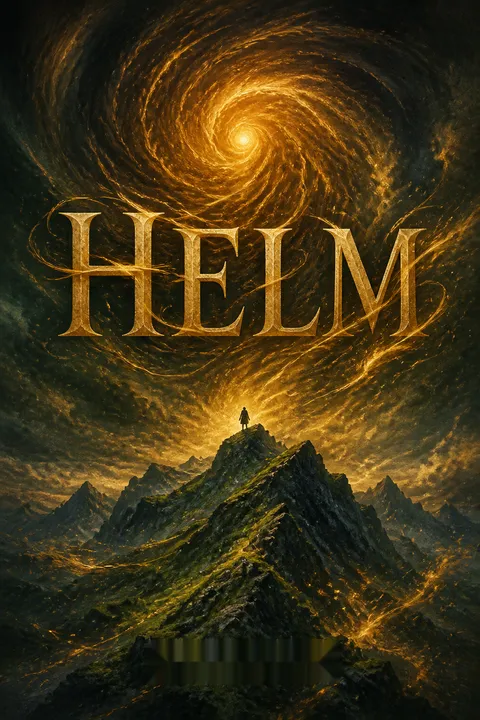

Plot Summary
Helm's Birth and Solitude
Before anything had a name, Helm—the wind of the Pennines—comes into being, a consciousness forged from atmospheric chaos and geological upheaval. Helm is both elemental and self-aware, experiencing time as a blur, existing only when manifesting as wind. For eons, Helm is solitary, observing the slow drama of evolution from the mountain's summit, practicing its powers, longing for recognition. The arrival of humans changes everything: they notice, fear, and worship Helm, giving it identity and purpose. Yet, even as Helm becomes a force in their world, it remains fundamentally alone, a spirit defined by fleeting presence and the attention of others.
First Humans, First Names
With the coming of humans, Helm finds itself at the center of myth and ritual. Early people, awed and terrified by the wind's power, create stories, trinkets, and ceremonies to appease or harness it. Helm relishes this attention, even as it is misunderstood—sometimes a god, sometimes a demon, always a mystery. The landscape changes as humans settle, farm, and build, their lives shaped by the wind's unpredictable moods. Over generations, Helm's identity is cemented in language and lore, its name repeated until it becomes a permanent feature of the valley's consciousness, both loved and blamed for every misfortune.
NaNay's Vision and Exile
NaNay, a young woman of the herding tribe, survives a deadly illness and, in her fever, receives a vision of the magstone—a sacred red stone that will mark time and bring unity to her people. Her revelation is met with suspicion and violence; she is beaten and exiled, but her resolve only hardens. Alone, she journeys into the wild, seeking her third mark and a place in the world. Her ordeal on the mountain, facing the Halron (Helm), becomes a rite of passage, forging her into a leader and prophet. Her scars become symbols of survival, and her vision shapes the destiny of her tribe.
Medieval Fears, Sacred Stones
Centuries later, the valley is a place of medieval superstition and religious conflict. Michael Lang, a feared exorcist with a metal skullcap, arrives to confront the demon wind. The villagers, battered by poverty and the wind's violence, are both desperate and skeptical. Lang's rituals—building a cross, invoking relics, and confronting Helm—reflect the era's blend of faith, fear, and brutality. The sacred stones of the valley, remnants of older beliefs, become battlegrounds for control and meaning. Helm, ever the observer, delights in the spectacle, its power undiminished by human attempts at mastery.
Railways and Industrial Invasion
The industrial age brings a new kind of invasion: railways, navvies, and machines carve through the landscape, indifferent to ancient powers. The construction of viaducts and tunnels is both a marvel and a tragedy, claiming lives and reshaping communities. The wind is now an engineering challenge, a hazard to be measured and conquered. Yet, even as progress marches on, the old rituals persist—accidents are blamed on Helm, and the wind remains a force that resists full understanding or control. The valley becomes a microcosm of human ambition and suffering, with Helm as its eternal witness.
Bodger's Meteorological Quest
Thomas Bodger, a Victorian meteorologist, arrives with dreams of capturing Helm's essence through scientific experiment. Armed with instruments and ambition, he seeks to reveal the wind's secrets, believing that knowledge will bring mastery. His encounters with the locals—especially the enigmatic Rebecca Brooke—challenge his assumptions. The valley's weather is not just data but lived experience, woven into the fabric of daily life and memory. Bodger's project, the Revelation Machine, becomes a symbol of both human ingenuity and hubris, as he struggles to reconcile the measurable with the magical.
Selima's Modern Isolation
In the present, Selima Sutar, a climate scientist, conducts research at the remote field station atop Great Dun Fell. The isolation is both a refuge and a source of anxiety, as she contends with failing technology, hostile weather, and the ghosts of past relationships. Online harassment from climate deniers—the Endtrepreneurs—intrudes on her solitude, blurring the line between real and imagined threats. The wind, now laden with microplastics and pollution, becomes a metaphor for the world's contamination and her own vulnerability. Selima's struggle is both personal and planetary, a fight for truth in an age of denial.
NaNay's Ordeal on the Mountain
NaNay's ascent of the Halron's mountain is a trial by wind and violence. Battling the storm, she is battered, bloodied, and nearly broken, but refuses to yield. Her confrontation with the Halron is both physical and spiritual—a test of courage, identity, and destiny. Emerging with a third mark, she returns to her people transformed, her scars a testament to her vision and strength. She becomes a leader, guiding her tribe through hardship, loss, and renewal. The magstone remains her quest, a symbol of hope and continuity in a world of change.
Michael Lang's Exorcism
Michael Lang's journey to exorcise Helm is a descent into obsession and martyrdom. Bearing a heavy cross up the mountain, he confronts both the physical and metaphysical forces that haunt the valley. His rituals—mirrors, relics, and incantations—are acts of faith and desperation, as he seeks to banish the demon wind and redeem his own sins. The struggle is as much with himself as with Helm, and the outcome is ambiguous: victory, defeat, or simply another chapter in the endless dance between humans and the elements.
Balloonists and Voyeurs
The arrival of balloonists—aristocrats seeking pleasure and spectacle—offers Helm a new kind of entertainment. Their airborne antics, both daring and absurd, highlight the human desire to conquer and consume the sky. Helm is both envious and amused, watching as they flirt with disaster and each other. The episode is a microcosm of human hubris, sexuality, and the eternal allure of the forbidden. Helm's voyeurism is tinged with longing, a reminder of its own incorporeal nature and the fleetingness of all things.
Rebecca Brooke's Resistance
Rebecca Brooke, the sharp-witted mistress of Grange House, embodies the valley's resistance to change. Her battles—with her husband, with Bodger, with the wind—are fights for autonomy and meaning in a world that seeks to define and confine her. Her grief is private, her intelligence formidable, her alliances uneasy. Through her, the narrative explores the limits of science, the persistence of magic, and the complexities of human connection. Her eventual collaboration with Bodger hints at the possibility of understanding, if not control.
Janni and the Wind's Friendship
Janni, a troubled girl in the twentieth century, finds solace and companionship in Helm. Their friendship is a refuge from abuse, neglect, and misunderstanding—a space where difference is cherished and pain is shared. But the world is not kind to those who do not fit; Janni is institutionalized, medicated, and returned home altered, her spirit dulled. Helm, bereft, mourns the loss of its only true friend, questioning the nature of reality, memory, and love. Their story is a lament for all that is lost in the name of normalcy.
Helm's Blame and Human Folly
Helm becomes the valley's scapegoat, blamed for every misfortune—illness, injury, madness, and moral failing. The litany of complaints is endless, absurd, and revealing: Helm is both cause and excuse, a convenient target for human anxiety and guilt. The wind's power is both real and symbolic, a force that exposes the fragility of bodies, minds, and societies. Yet, beneath the blame, there is a grudging respect, even love, for the wind that shapes and defines the valley's life.
The Revelation Machine
Bodger's grand experiment—to reveal Helm's anima with steam and dye—culminates in anticlimax. The machine is built, the pipes laid, but the wind refuses to cooperate. Human ambition meets the limits of nature, and the project is abandoned, its remnants reclaimed by the land and its people. Bodger departs, chastened but wiser, his dreams of mastery tempered by the valley's enduring mystery. The episode is a meditation on the limits of knowledge, the persistence of wonder, and the humility required to live with forces beyond control.
The Magstone's Birth
After years of labor and sacrifice, the magstone is finally born—torn from the cliff by storm and time, its face marked by NaNay's hand. The event is both triumph and farewell: NaNay, now old and frail, witnesses the fulfillment of her vision before passing into legend. The magstone becomes a new center for the valley's rituals, a symbol of endurance and renewal. The people gather, celebrate, and mourn, their lives woven into the stone's story. NaNay's legacy endures, her marks a testament to survival and hope.
Crosses, Demons, and Endings
As the narrative nears its end, old conflicts resurface: Michael Lang's final ascent, Isa's loyalty and rebellion, the valley's ongoing struggle with the wind and with itself. The boundaries between past and present, myth and reality, blur. The wind's power is both destructive and redemptive, a force that tests and transforms all who encounter it. The valley's history is a tapestry of violence, love, ambition, and loss, each generation repeating and revising the stories of those who came before.
The Last Storm
In the present, Selima faces her own ordeal: stranded, threatened, and pursued, she must navigate both the literal and metaphorical storms that beset her. Her flight across the fells is a test of endurance and will, echoing the trials of NaNay and Janni. The wind is both adversary and ally, shaping her path and her fate. In the end, survival is not triumph but acceptance—a recognition of vulnerability, interdependence, and the necessity of hope.
Helm's Lament and Legacy
As the story closes, Helm reflects on its own mortality and the uncertain future of the world it has shaped and been shaped by. The wind's lament is both personal and universal—a meditation on change, loss, and the persistence of memory. Whether Helm endures or vanishes, its legacy is written in the land, the stories, and the hearts of those who have named and loved it. The final note is one of ambiguity and grace: as long as there is Helm, there is possibility.
Analysis
Sarah Hall's Helm is a sweeping, polyphonic meditation on the relationship between humans and the elemental forces that shape their world. By personifying the Pennine wind as a sentient, self-reflective being, Hall explores themes of identity, belonging, and the limits of human understanding. The novel's nonlinear structure and multiplicity of voices create a tapestry of overlapping stories, each era grappling with the same fundamental questions: how to survive, how to find meaning, how to live with forces beyond control. The recurring motif of blame—Helm as scapegoat for every ill—serves as a critique of human denial and projection, while the persistence of ritual and myth underscores the need for connection and continuity. The novel is also a meditation on change: the transformation of landscape, the contamination of air, the loss of innocence, and the possibility of renewal. In its modern sections, Helm confronts the anxieties of the Anthropocene—pollution, denial, isolation—while insisting on the necessity of hope, humility, and collective action. Ultimately, Helm is a lament for all that is lost and a celebration of all that endures: memory, story, and the enduring mystery at the heart of existence.
Review Summary
Helm receives mixed but generally positive reviews, averaging 3.81/5. Readers praise Hall's originality in anthropomorphizing Britain's only named wind, drawing comparisons to North Woods and Cuddy. The novel's sweeping historical scope—from Neolithic times to the present—and experimental structure earn admiration, though some find the fragmented narratives difficult to engage with. Helm's distinctive voice is widely celebrated, while the modern climate-scientist storyline divides opinion. Most agree the concept is ambitious and creative, even if the execution doesn't fully satisfy every reader.
People Also Read

Characters
Helm
Helm is the wind of the Pennines, a sentient force that exists only when manifesting, defined by attention and belief. Both playful and melancholic, Helm is solipsistic, narcissistic, and deeply lonely, longing for recognition and relationship. Over millennia, Helm becomes a god, a demon, a scapegoat—blamed for every ill, yet essential to the valley's identity. Helm's psychological arc is one of existential uncertainty: what does it mean to be, to be seen, to be loved or feared? Helm's relationships with humans are fraught with misunderstanding, desire, and loss, especially in its bond with Janni. Ultimately, Helm is a mirror for human anxieties and hopes, a symbol of the uncontrollable forces that shape existence.
NaNay
NaNay is a seer and leader of her tribe, marked by survival, suffering, and vision. Her childhood illness and near-death experience grant her a prophetic vision of the magstone, setting her apart and making her both revered and persecuted. Her journey—from exile to confrontation with the Halron, to leadership and old age—is one of resilience and transformation. NaNay's scars are both literal and symbolic, evidence of her trials and her authority. Her relationships—with Second Mother, Irla, her children—are complex, shaped by love, loss, and duty. She embodies the persistence of memory and tradition, her legacy enduring in the rituals and stories of her people.
Michael Lang
Michael Lang is a medieval priest and exorcist, infamous for his iron skullcap and ruthless methods. Driven by faith, guilt, and a desire for redemption, he becomes obsessed with banishing the demon wind. His journey up the mountain, bearing a cross, is both a literal and spiritual ordeal—a confrontation with his own sins and the limits of human power. His relationship with Isa, his adopted son and servant, is fraught with ambiguity: love, domination, and the possibility of betrayal. Michael's psychological complexity lies in his oscillation between conviction and doubt, violence and vulnerability. His fate is a cautionary tale about the dangers of fanaticism and the costs of seeking mastery over the uncontrollable.
Thomas Bodger
Thomas Bodger is a Victorian meteorologist, earnest and ambitious, seeking to capture and explain the Helm wind through science. His quest is both noble and quixotic, marked by ingenuity and naiveté. Bodger's interactions with the valley's inhabitants—especially Rebecca Brooke—challenge his assumptions and force him to confront the limits of knowledge. His project, the Revelation Machine, becomes a symbol of human ambition and the humility required to face nature's mysteries. Bodger's psychological arc is one of gradual disillusionment and acceptance, as he learns to value experience and relationship over mastery.
Rebecca Brooke
Rebecca Brooke is the enigmatic mistress of Grange House, fiercely intelligent and emotionally guarded. Her resistance to Bodger's project and to the changes sweeping the valley is rooted in grief, autonomy, and a deep connection to the land. Her relationships—with her husband, with Bodger, with the valley—are marked by conflict and complexity. Rebecca's psychological depth lies in her ability to hold contradictory truths: the necessity of science and the persistence of magic, the pain of loss and the possibility of renewal. She is both a foil and a partner to Bodger, embodying the valley's enduring spirit.
Selima Sutar
Selima is a contemporary climate scientist, isolated at the field station atop Great Dun Fell. Her work is both a refuge and a source of anxiety, as she contends with technological failures, online harassment, and the ghosts of past relationships. Selima's psychological journey is one of vulnerability and endurance, as she navigates threats both real and imagined. Her relationships—with her family, her colleagues, and the landscape—are shaped by longing, loss, and the search for meaning. Selima embodies the challenges of living and working in a world marked by denial, contamination, and uncertainty.
Janni Calder
Janni is a troubled girl in the twentieth century, marginalized by her family and community for her difference. Her friendship with Helm is a lifeline, a space of acceptance and joy in a world that seeks to erase her. Janni's psychological arc is one of trauma and loss: institutionalized, medicated, and returned home altered, she becomes a shell of her former self. Her story is a lament for all who are punished for their uniqueness, and a testament to the enduring power of love and memory.
Isa
Isa is Michael Lang's adopted son and servant, a figure of loyalty, silence, and hidden strength. His relationship with Michael is complex: gratitude, dependence, and the possibility of rebellion. Isa's psychological depth lies in his capacity for endurance and his eventual assertion of agency. He is both witness and participant in Michael's ordeal, embodying the costs and possibilities of devotion.
Peg
Peg is the formidable leader of the railway fitters, a woman of indeterminate age and immense authority. Her presence is both comic and commanding, her methods ruthless and effective. Peg's psychological strength lies in her adaptability and her refusal to be defined by gender or circumstance. She is a survivor, a maker, and a keeper of secrets, embodying the resilience of those who labor in the margins.
The Magstone
The magstone is both object and character—a sacred red stone prophesied by NaNay, sought and struggled for by generations. Its birth is the fulfillment of vision and the catalyst for unity and conflict. The magstone embodies the persistence of memory, the power of ritual, and the possibility of renewal. It is a symbol of endurance, hope, and the enduring mystery at the heart of the valley's story.
Plot Devices
Nonlinear, Polyphonic Narrative
The novel's structure is nonlinear and polyphonic, weaving together voices from prehistory, medieval times, the Victorian era, and the present. Each era is given its own narrative style and focal characters, creating a tapestry of overlapping stories and themes. The use of Helm as a semi-omniscient narrator allows for commentary, irony, and emotional resonance across time. This structure emphasizes the continuity of human experience, the persistence of myth, and the cyclical nature of history.
Personification and Anthropomorphism
Helm is personified as a sentient, self-aware being, capable of emotion, desire, and reflection. This device blurs the line between natural force and character, allowing the wind to serve as both observer and participant in the human drama. Helm's shifting identities—as god, demon, scapegoat—mirror the changing beliefs and anxieties of the valley's inhabitants. The personification of the wind also enables a meditation on the limits of human understanding and the persistence of mystery.
Ritual, Myth, and Folklore
Rituals—solstice ceremonies, exorcisms, scientific experiments—are central to the narrative, serving as points of connection and conflict between characters and eras. Myths and prophecies shape the actions of individuals and communities, providing meaning in the face of uncertainty. Folklore is both a source of wisdom and a tool of control, reflecting the valley's ongoing negotiation between tradition and change.
Intertextuality and Metafiction
The novel incorporates a range of textual forms—letters, court records, scientific diagrams, object catalogues—creating a sense of layered reality and historical depth. These documents serve as both evidence and commentary, inviting readers to question the reliability of narrative and the construction of history. The metafictional elements—Helm's direct address, the author's mark—underscore the novel's self-awareness and its meditation on storytelling itself.
Foreshadowing and Recurrence
Events, images, and phrases recur across the novel's timelines, creating a sense of foreshadowing and resonance. The struggles of NaNay, Michael Lang, Bodger, Selima, and Janni mirror and echo each other, suggesting that the challenges of survival, understanding, and belonging are universal and enduring. The cyclical structure reinforces the themes of continuity, loss, and the possibility of renewal.
Download PDF
Download EPUB
.epub digital book format is ideal for reading ebooks on phones, tablets, and e-readers.








































