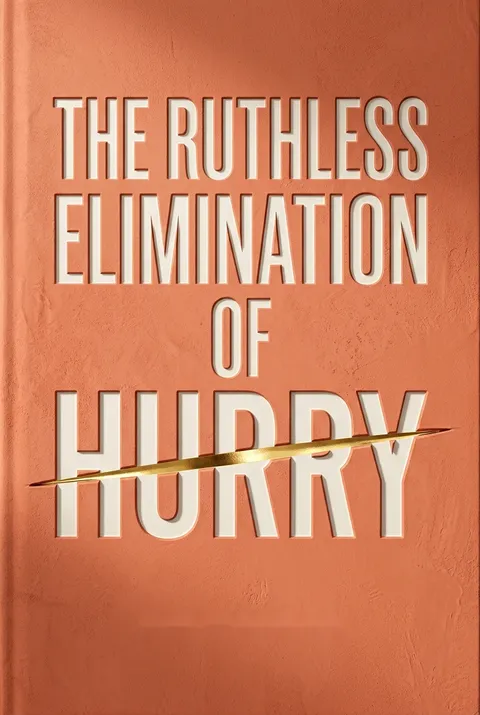
Key Takeaways
1. Hurry is the Great Enemy of Spiritual Life and Emotional Health.
There is nothing else. Hurry is the great enemy of spiritual life in our day. You must ruthlessly eliminate hurry from your life.
Root problem identified. The author, reflecting on his own burnout as a megachurch pastor, realized that hurry is the underlying cause of many modern ailments. His mentor, Dallas Willard, profoundly stated that "hurry is the great enemy of spiritual life in our day," suggesting it's not just a symptom but the core issue preventing a vibrant connection with God and personal well-being. This insight challenges conventional thinking that often blames other factors for spiritual decline.
Incompatible with core values. Hurry is fundamentally at odds with the virtues central to Jesus's teachings: love, joy, and peace. When we are rushed, our interactions often devolve into agitation, anger, or critical nagging, making genuine love impossible. Similarly, true joy stems from presence to the moment, which hurry actively prevents, and peace is antithetical to a frantic, overscheduled existence.
Pathological busyness. This constant state of urgency, dubbed "hurry sickness" by psychologists, manifests in symptoms like irritability, hypersensitivity, restlessness, and workaholism. It leads to emotional numbness, out-of-order priorities, neglect of physical health, and reliance on escapist behaviors. Ultimately, hurry isolates us from God, others, and our own souls, leaving us "too alive to die, and too dead to live."
2. Modern Culture and Technology Drive Pathological Busyness.
The world has radically changed in a few short years.
Historical acceleration. Our current frenetic pace is not natural; it's a relatively recent phenomenon. From ancient sundials to medieval mechanical clocks, and then Edison's light bulb extending our waking hours, society has steadily accelerated. Labor-saving devices, ironically, haven't given us more leisure but more things to fill our time with, leading to a paradox where we feel busier than ever.
Digital age's impact. The launch of the iPhone in 2007 marked a critical inflection point, ushering in the digital age. Smartphones, social media, and the 24/7 news cycle have created an "attention economy" where devices are intentionally designed for distraction and addiction. Studies show:
- The average iPhone user touches their phone 2,617 times a day.
- Our attention span has dropped to eight seconds, less than a goldfish.
- Just being near our phones reduces working memory and problem-solving skills.
Conspiracy against interior life. This constant digital bombardment and the cultural glorification of busyness (where leisure is now a sign of low status) constitute a "virtual conspiracy against the interior life." It drowns out the voice of God and prevents self-reflection, leading to "spiritual oblivion." This relentless noise makes us deaf to what truly matters, leaving our souls vulnerable and unfed.
3. The Solution Isn't More Time, But Accepting Our Human Limitations.
The solution to an overbusy life is not more time. It’s to slow down and simplify our lives around what really matters.
The time paradox. Wishing for more hours in a day is a flawed desire, as we would likely just fill them with more activities, leading to even greater exhaustion. The core issue isn't a lack of time, but how we manage our finite resources—time, money, and attention—and our unwillingness to accept our inherent human limitations.
Image and dust. We are created in God's image, full of potential, but also "from the dust," meaning we are finite beings with inherent limitations. Modern culture, however, pushes us to transgress all limits, leading to:
- "Entertainment anxiety" from an overwhelming array of choices.
- A constant chase to "do it all," from travel to career achievements.
- A pervasive sense of FOMO (fear of missing out) and YOLO (you only live once).
Saying "no" to live deliberately. True wisdom lies in accepting our limitations—physical, mental, emotional, social, and temporal. Every "yes" to an activity is a "thousand nos" to other possibilities. We must learn to "live deliberately," as Thoreau advocated, making conscious choices about how we spend our precious, fleeting time, rather than squandering it on trivial pursuits.
4. Adopt Jesus's Lifestyle: The Secret of the Easy Yoke.
If you want to experience the life of Jesus, you have to adopt the lifestyle of Jesus.
Apprenticeship to Jesus. Jesus, as a rabbi, offered an "easy yoke"—a way to shoulder the weight of life with grace and rest. To be his apprentice (talmidim) means organizing your life around three goals:
- Be with Jesus.
- Become like Jesus.
- Do what he would do if he were you.
This apprenticeship is about holistic healing and salvation, not just intellectual assent or moral rules.
The paradox of the easy yoke. Jesus's invitation to "Come to me, all you who are weary and burdened, and I will give you rest" (Matthew 11:28-30) seems counterintuitive, as a yoke implies work. However, it's not an escape from life's burdens but "equipment"—a new way to carry responsibilities with ease, with Jesus doing the heavy lifting. This means adopting his overall lifestyle, not just his theology or ethics.
Lifestyle over willpower. Many Christians desire Jesus's joy and peace but are unwilling to adopt his lifestyle. The author compares this to wanting an athlete's physique without the discipline of their training. Our current "system" of living often produces anxiety and burnout. To achieve the "life to the full" that Jesus offers, we must intentionally integrate his habits and practices into our daily existence, allowing them to transform our experience of life.
5. Cultivate Silence and Solitude to Reconnect with God and Self.
Without solitude it is virtually impossible to live a spiritual life.
The lost art of boredom. In the pre-digital era, moments of boredom served as natural "portals to prayer," opportunities to connect with God and our inner selves. Today, these moments are instantly filled by smartphones, robbing us of the ability to be present and making us "deaf to the voice of God." This constant noise threatens our souls, making us forget we even have them.
Jesus's "eremos" practice. Jesus consistently withdrew to "solitary places" (eremos), often before dawn or for extended periods, to pray and reconnect with his Father. This wasn't a sign of weakness but a source of strength and clarity, enabling him to navigate a demanding ministry without hurry. His frequent withdrawals demonstrate that even Jesus needed dedicated time in the quiet.
Silence and solitude defined:
- Silence: Involves both external quiet (no noise) and internal quiet (taming mental chatter, worry, fantasies). External silence is easy; internal silence is a wild beast.
- Solitude: Being alone with God and your soul, distinct from isolation (which is escape). It's a space for inner fulfillment, connection to God, and emotional healing, where we confront our true selves in the Father's love.
This practice is considered by many spiritual masters to be the most important for spiritual life, as it fosters attention and connection to God, transforming our "spiritual malaise" into a felt experience of His presence.
6. Embrace Sabbath as a Weekly Rhythm of Rest, Delight, and Resistance.
The Sabbath was made for man, not man for the Sabbath.
Infinite desire, finite soul. Human desire is infinite, constantly seeking satisfaction that finite earthly things can never provide. This leads to chronic restlessness, exacerbated by a culture of accumulation and accomplishment fueled by advertising and social media. The Sabbath offers an antidote to this "cancerous restlessness."
God's rhythm of creation. The Sabbath, meaning "to stop" and "to delight," is a divine gift woven into the fabric of creation. God rested on the seventh day, blessing it and making it holy, establishing a rhythm of six days of work and one day of rest. Fighting this rhythm leads to "splinters"—mental lethargy, emotional unhealth, and physical exhaustion.
Sabbath as resistance. Beyond rest and worship, the Sabbath is an act of resistance against the "Pharaoh" of modern consumerism and empire. It's a weekly rebellion against the relentless lust for more, a refusal to participate in a system built on endless consumption and often, the oppression of the poor. By stopping commerce and simply delighting in what we have, we declare:
- "Enough."
- "I lack nothing."
- "Ordinary life is enough."
This practice cultivates a spirit of restfulness that permeates the entire week, transforming our lives from a hurried chase to a grateful enjoyment of God's good world.
7. Practice Simplicity to Counter Materialism and Find True Contentment.
Life does not consist in an abundance of possessions.
The gospel of America vs. the gospel of the Kingdom. Jesus's teachings on wealth are often jarring to Westerners, who are conditioned to believe that "more money and more stuff equal more happiness." This "gospel of America" is a lie, a propaganda machine designed to monetize our restlessness and make us believe our wants are needs. In reality, happiness plateaus around $75,000 income, and beyond that, more money often brings "mo problems."
Simplicity defined. Simplicity (or minimalism) is "the intentional promotion of the things we most value and the removal of everything that distracts us from them." It's not about poverty or a specific aesthetic, but about living with less to gain more freedom, focus, and joy. It's a conscious choice to declutter not just our physical spaces but our entire lives, aligning our resources with what truly matters.
Principles for simple living:
- Question true cost: Consider time, maintenance, and ethical implications before buying.
- Avoid impulse buys: Allow time for rational thought and prayer.
- Fewer, better things: Invest in quality or used items, and share resources when possible.
- Give generously: Experience the "blessedness" of giving away what you don't need.
- Budget intentionally: Align spending with values, not whims.
- Enjoy without owning: Appreciate free pleasures like nature, libraries, and simple moments.
- Recognize propaganda: Critically evaluate advertising's manipulative messages.
- Cheerful revolt: Embrace simplicity with joy, not legalism, as a path to contentment.
This practice helps us break free from the "engine for hurry" that materialism creates, allowing us to grasp "the life that is truly life."
8. Deliberately Slow Down Your Body and Mind to Unhurry Your Soul.
The basic idea behind the practice of slowing is this: slow down your body, slow down your life.
Embodied apprenticeship. Our spiritual journey is a whole-person endeavor, involving both mind and body. The practice of "slowing" involves intentionally placing ourselves in situations where we have to wait, cultivating patience and allowing our souls to catch up. This is a counter-habit against "hyperliving," which skims along the surface of life.
Practical "rules" for slowing:
- Driving: Drive the speed limit, use the slow lane, come to full stops, avoid texting.
- Waiting: Choose the longest checkout line, arrive early for appointments (without your phone).
- Digital detox: Turn your smartphone into a "dumbphone" by removing non-essential apps, disabling notifications, and setting screen time limits.
- Morning routine: Keep your phone off until after your quiet time, letting prayer and Scripture set your emotional equilibrium.
- Email/Social Media: Set specific, limited times for checking, rather than constant engagement.
- Entertainment: Reduce TV/streaming intake, recognizing its potential for distraction and negative influence.
- Single-tasking: Focus on one activity at a time, rejecting the myth of multitasking that leads to a "divided self."
- Physical pace: Deliberately walk slower, challenging the ingrained urge to rush.
- Regular retreats: Schedule monthly or quarterly days alone for silence and solitude.
- Mindfulness/Meditation: Practice focusing on breath and filling the mind with truth.
- Long vacations: Take extended breaks to truly decompress and find deep rest.
- Cook and eat at home: Prioritize shared meals as a cornerstone of family and community life.
The goal of slowing. These practices are not legalistic but "gameful" ways to create guardrails for our lives. They help us to be fully present—to God, to people, and to the moment—where all the "best stuff" is found. By slowing down our bodies and minds, we create space for our souls to "taste and see that the LORD is good."
9. A Rule of Life Provides the Structure for an Unhurried Existence.
What we’re really talking about here is a rule of life.
Intentional living. Jesus's unhurried life was not accidental; it was the outgrowth of a deliberate "rule of life." He regularly injected margin into his schedule, rose early to pray, enjoyed long meals with friends, and practiced Sabbath and simplicity. This intentionality allowed him to remain grounded and present amidst constant demands.
The trellis metaphor. A "rule of life" is a schedule and set of practices that act as a "trellis" for our spiritual "vine." Just as a trellis supports a vine to grow and bear fruit, a rule of life provides the structure necessary for abiding in Jesus and cultivating emotional health and spiritual vitality. Without such a structure, our spiritual lives risk withering away.
Beyond excuses. Many claim they "don't have time" for spiritual practices, but this often masks a misallocation of time to trivial pursuits. The hard truth is that following Jesus requires intentional action and time investment, just like any other relationship. If we are genuinely too busy to engage in these practices, then we are, by definition, too busy to follow Jesus.
The fight for a quiet life. The journey to an unhurried life is a continuous "fight," a "calm rebellion against the status quo." It involves ruthlessly eliminating hurry, accepting limitations, and letting go of envy and cancerous restlessness. When we inevitably fail, the mantra is to "Slow down. Breathe. Come back to the moment. Receive the good as gift. Accept the hard as a pathway to peace. Abide." This ongoing process, though challenging, leads to a "reasonably happy" life, marked by love, joy, and peace.
People Also Read








Download PDF
Download EPUB
.epub digital book format is ideal for reading ebooks on phones, tablets, and e-readers.








































