


Key Takeaways
You can't stop the enemy from prowling, but you control who sits down
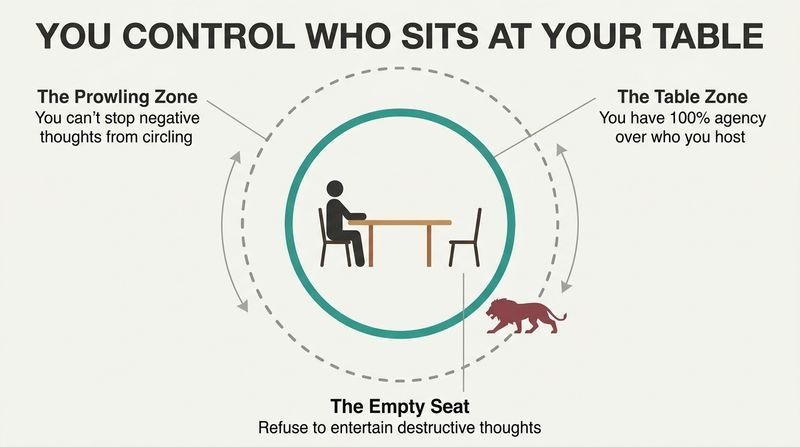
The book's founding moment was a text. Pastor Louie Giglio, mid-crisis during a brutal church-planting season, fired off a long, self-justifying message to a friend, hungry for validation. The reply was nine words: don't give the enemy a seat at your table. It reframed everything. His real fight was not against the people who wounded him but against destructive thoughts he was entertaining.
The distinction is agency, not immunity. Drawing on the image of a prowling lion from 1 Peter 5:8, Giglio argues you cannot prevent negative thoughts from circling. What you can do is refuse to host them. The enemy needs only a sliver of doubt, an unguarded moment, to pull up a chair. Recognizing his presence is the first act of taking back control.
The reframe echoes cognitive behavioral therapy's core move: separating the thinker from the thought. CBT teaches that a thought is not a command and not a fact, merely mental content you can examine and dismiss. Giglio spiritualizes this, attributing intrusive thoughts to an external adversary rather than distorted cognition. That externalization can be double-edged. It relieves shame (this isn't the real you) but risks outsourcing responsibility. The book's strength is insisting the reader still chooses. Viktor Frankl's famous space between stimulus and response lives in the same territory: the gap where freedom hides.
Grow an "even though, I will" faith that inflates under pressure
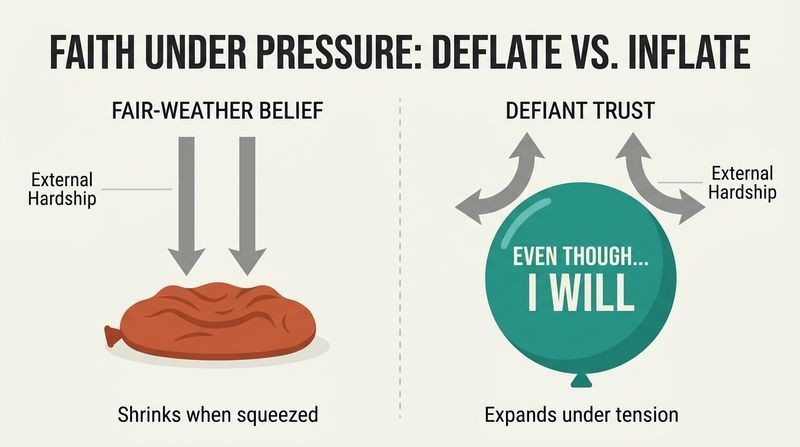
Faith that deflates versus faith that inflates. Giglio contrasts fair-weather belief with a defiant posture modeled on the prophet Habakkuk, who declared that even though the crops fail and the livestock die, he will still rejoice. The grammatical pattern matters: even though (acknowledge the hardship honestly), I will (choose praise anyway).
Real examples anchor it. Jay and Katherine Wolf, married and thriving, faced a massive brain-stem stroke when Katherine was twenty-six, requiring removal of half her cerebellum and years of relearning to walk. She personalized Habakkuk's words: though confined to a wheelchair, though her face is paralyzed, yet she will rejoice. Shadrach, Meshach, and Abednego told the king their God could rescue them from the furnace, but even if not, they would not bow.
This is post-traumatic growth dressed in scripture. Research by psychologists Tedeschi and Calhoun documents how a subset of trauma survivors emerge with deepened purpose, stronger relationships, and greater resilience, not despite suffering but partly through wrestling with it. The "even though, I will" structure resembles what Stoics called the dichotomy of control: separate what happens to you from your response to it. One caution worth naming: the framework can slide into toxic positivity if praise becomes a way to suppress legitimate grief rather than hold it alongside hope. Giglio's better instinct is that lament and faith coexist, not that pain gets papered over.
God sets your table inside the conflict, not after it
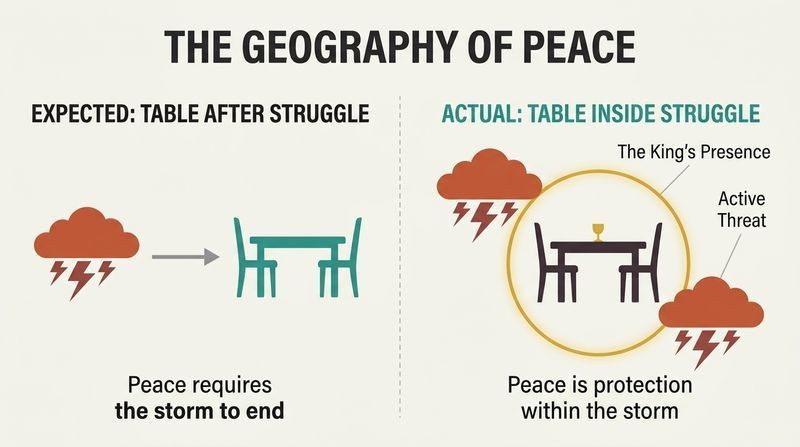
The counterintuitive geography of Psalm 23. The verse says God prepares a table in the presence of enemies, not in their absence. Giglio admits he would have written it differently: a table safely away from trouble, enemies vanquished first. Instead the feast sits at the epicenter of the chemo ward, the collapsing marriage, the job stress.
The point is presence, not rescue. God does not promise to remove the valley; he promises to walk through it with you. Giglio reframes prayer accordingly. Instead of begging God to end the storm, you thank him for being in the storm with you. The real reward at the table is not the lavish food but the dinner companion: the King of the universe choosing intimacy with you amid the chaos.
The insight cuts against a prosperity-gospel expectation that faith should eliminate hardship. Here suffering is not a sign of divine absence but the very setting of divine nearness. This aligns with what theologians call a theology of the cross rather than a theology of glory: God meets people in weakness, not by exempting them from it. Psychologically, the shift from petition (fix this) to gratitude (you are here) mirrors acceptance-based therapies, which reduce suffering by changing one's relationship to circumstances rather than the circumstances themselves. The table image also does real work: it converts a battlefield into a place of nourishment without denying the battle.
Learn the enemy's five lies so you can spot his voice fast
Deception masquerades as help. Giglio catalogs the recurring lies that signal the enemy has sat down. Each sounds reasonable, even caring, which is why they slip past our defenses.
1. The lie of comparison: it's better at another table (the grass is greener elsewhere).
2. The lie that you're doomed: you won't make it through this.
3. The lie of worthlessness: you're not good enough.
4. The lie of me against the world: everybody is against you.
5. The lie that there's no way out: you're surrounded and trapped.
Counter each with truth. For the trapped feeling, Giglio invokes Elisha's servant, who saw an enemy army surrounding their city and panicked, until Elisha prayed that his eyes be opened to the hills full of horses and chariots of fire. You are surrounded, but the besiegers are themselves besieged.
Naming distortions is straight out of cognitive therapy, where clinicians teach patients to label patterns like catastrophizing, mind-reading, and all-or-nothing thinking. Giglio's five lies map neatly onto these: "everybody is against you" is mind-reading and overgeneralization; "you won't make it" is catastrophizing; "you're not good enough" is labeling. The value of a named taxonomy is speed. Once a distortion has a name, recognition becomes almost automatic, which shortens the window in which it can take root. The Elisha story adds a reframe technique: the situation is unchanged, but a wider field of vision transforms its emotional meaning.
A thought entertained becomes a thought obeyed, so intercept it early
The spiral has predictable stages. Giglio traces temptation from thought to action using the fishing metaphor: the enemy never advertises the hook, only the shiny lure. Sin promises relief, comfort, or justice, then underdelivers. The book of James describes desire being lured and enticed, then conceiving sin, which grows into death.
The thought itself is not sin, but hosting it is. Jesus was tempted yet never entertained the tempter's words. The danger is what Giglio calls letting a thought pitch a tent in your mind. Crucially, he argues harmful thoughts harbored over time always eventually get acted out, or at minimum soften your attitude toward the sin. And once you take the bait, the enemy flips roles from enticer to accuser, crushing you with condemnation for the very thing he sold you.
The claim that entertained thoughts inevitably become action is stronger than the evidence supports. Plenty of people harbor intrusive thoughts for decades without acting, and clinical work on obsessive-compulsive disorder shows that fighting or catastrophizing intrusive thoughts often intensifies them. That said, the broader mechanism is sound: rumination deepens neural pathways, and repeated mental rehearsal lowers the activation threshold for behavior, a principle behind both habit formation and relapse. The enticer-to-accuser flip is psychologically astute. It describes the shame cycle addiction researchers know well, where the same craving that promised escape returns as self-loathing, fueling the next round.
Stop rededicating and start surrendering, because willpower keeps failing
Rededication is a treadmill. Giglio critiques the church culture of walking the aisle to promise God this is the last time, then breaking the vow the next week. The flaw is that rededication relies on self-generated willpower and earnest promises, which repeatedly collapse until people conclude the gospel doesn't work or they are broken.
Surrender replaces the vow. Instead of pledging to try harder, you admit you cannot change the situation and lean on Christ's finished work. Giglio distinguishes condemnation from conviction: condemnation comes from hate, drives you to conceal sin, and leads to future failure; conviction comes from love, urges confession, and produces real change. The promise anchoring this is 1 Corinthians 10:13: God will always provide a way out.
The rededication critique lands hard for anyone raised in revival culture, and it parallels findings in behavior-change science. Ego-depletion research (however contested) and decades of relapse data suggest that raw willpower is a poor engine for lasting change; environmental design, identity shift, and support systems outperform gritted teeth. Giglio's surrender is not passivity. It resembles the first steps of twelve-step recovery, admitting powerlessness and relying on a higher power, which has helped millions precisely because it stops treating addiction as a willpower problem. The condemnation-versus-conviction distinction also tracks shame researcher Brene Brown's finding that shame (I am bad) predicts worse outcomes than guilt (I did bad).
Fight from victory already won, like a soldier on D-Day Plus One
Identity precedes the battle. Giglio insists believers are not merely sinners saved by grace but new creations. He challenges what he calls flawed identity theology, the sermon that reminds you weekly that you are only a worm and a wretch. When you stand before the door marked Temptation believing that is all you are, you walk through it because you have been conditioned to.
The D-Day analogy reframes the war. June 6, 1944, decided World War II in Europe even though fierce battles (the Bulge, liberating Paris) continued for a year. Fighting on D-Day Plus 1 means fighting from a beachhead of already-secured victory. Jesus said it is finished; the outcome is settled. Skirmishes remain, but you battle from won ground, not toward uncertain ground.
The psychological principle here is that self-concept drives behavior, a well-documented finding. Identity-based habit change, popularized by James Clear, argues that acting from a chosen identity (I am a runner) outperforms outcome-chasing (I want to run). Giglio applies this theologically: act from who you already are rather than striving to earn it. The D-Day framing captures the theological tension of already-but-not-yet that scholars like Oscar Cullmann described, the decisive victory won while mopping-up continues. The risk in overemphasizing settled victory is presumption, treating growth as automatic. Giglio guards against this by insisting the believer must still actively partner, agree, and fight.
Take every thought captive by naming, binding, and replacing it
A three-step drill for intrusive thoughts. Built on 2 Corinthians 10:5 (take captive every thought), Giglio offers a repeatable process:
1. See the lie: examine whether a thought aligns with scripture. If it calls you pathetic, it did not come from a shepherd who leads you to green pastures.
2. Bind it in Jesus' name: refuse it authority, sometimes out loud, since the enemy cannot read your mind.
3. Change the narrative with scripture: replace the lie with memorized truth, becoming what he calls the DJ of your own thoughts.
Then play offense. Rather than only defending, deliberately fill your mind with what Philippians 4:8 lists as true, noble, right, pure, lovely, and admirable. Giglio suggests a daily anchor verse, a different truth for each day of the week.
This is essentially a spiritual cognitive-restructuring protocol, and the sequence mirrors evidence-based practice: catch the automatic thought, challenge its validity, replace it with a balanced alternative. Memorization as a tool has genuine support; retrieval practice strengthens recall, so rehearsed verses become accessible under stress when reasoning capacity narrows. The "DJ of your thoughts" metaphor is memorable and true to attention research: you cannot leave the mental stage empty, so curating what plays there beats merely trying to stop the noise. Speaking aloud adds an embodied dimension that some therapies use to externalize and defuse thoughts. The offense move matters most, since suppression alone tends to backfire.
Grace redefines you from failure to family, silencing shame
Guilt and shame are different problems. Guilt says I did something wrong; shame says I am something wrong. Guilt is a verdict; shame fuses the sin to your identity. Both dissolve in grace, but shame is the more insidious because it drives you to hide, as Adam and Eve hid behind fig leaves.
Peter's restoration is the template. After denying Jesus three times, Peter returned to his old fishing job, wearing the identity of betrayer. Jesus did not interrogate or shame him. He cooked breakfast on the beach, asked three times if Peter loved him, and recommissioned him to feed my sheep. The enemy defines you by your scars; Jesus defines you by his. Peter went on to preach a sermon that converted three thousand people.
The guilt-shame distinction is one of the most validated ideas in moral psychology. June Tangney's research shows guilt motivates repair and pro-social behavior, while shame predicts withdrawal, defensiveness, and even aggression. Giglio's pastoral instinct is precisely aligned: attack shame, keep healthy guilt. The Peter narrative functions as a case study in non-shaming accountability, the same principle behind restorative justice, which separates the offense from the offender's worth and thereby makes genuine change more likely. The three-fold questioning mirroring three denials is a subtle detail of symbolic repair. One nuance: real restoration usually also involves consequences and restitution, which the breakfast scene understates but the book acknowledges elsewhere.
Trade a teacup knowledge of God for an oceanic one
Knowing about versus truly knowing. Giglio distinguishes information from revelation using Mount Rainier: he aced a college geography test on the volcano, then collapsed in tears when he actually stood before it, staggered by its scale. Knowing facts about God is not the same as experiencing him.
The best defense is a captivated gaze. Rather than obsessing over the enemy's tactics, fix your attention on the host at the table. Giglio explores two attributes: God is holy (from the Hebrew qadash, meaning sacred and set apart, in his own league) and full of glory (kabod, meaning weight and worth). Psalm 34:5 promises those who look to God are radiant and never covered with shame. You become what you worship, so a transfixed gaze crowds out the enemy entirely.
The information-versus-experience gap maps onto philosopher Bertrand Russell's distinction between knowledge by description and knowledge by acquaintance. You can memorize every fact about swimming and still drown; embodied, first-person knowing is categorically different. Giglio's move to defeat the enemy through fascination rather than combat is strategically clever and echoes attention research: the mind cannot fully attend to two things at once, so a compelling positive focus displaces rumination more effectively than direct suppression. The Hebrew word studies add depth without pedantry. C.S. Lewis's line, cited by Giglio, that our desires are too weak rather than too strong, reframes holiness not as restriction but as invitation to greater joy.
Cultivate your mind like a garden by planting scripture daily
You are the gardener of your thoughts. Seeds blow in from everywhere, but you decide what gets watered and what gets pulled. Romans 12:2 calls this being transformed by the renewing of your mind. Giglio offers seven truth-seeds to plant, each paired with a verse to memorize:
1. I am in God's story (bigger than me).
2. I am fearfully and wonderfully made (intentional, not accidental).
3. My life has purpose (created for good works).
4. The cross has the final word (I am a new creation).
5. I serve at the pleasure of the King (dispatched on kingdom assignments).
6. Jesus is Lord, and my Lord.
7. My God turns evil into good.
Start small. Take one thought and verse per day or per week. Realigning thinking is a process, not a switch.
The garden metaphor and the incremental prescription align with how durable change actually happens. Neuroplasticity research confirms that repeated attention physically reshapes neural pathways, so daily rehearsal is not mere sentiment but mechanism. The "start small" counsel reflects behavior-design wisdom: tiny, consistent inputs beat heroic bursts, because they clear the activation-energy barrier that sinks ambitious resolutions. Framing identity statements in the present tense (I am, not I will be) leverages the self-fulfilling power of self-concept documented across social psychology. The one weakness of any such list is that reciting affirmations without emotional engagement can become rote; the practice works best when the truths are wrestled with, not merely repeated.
Analysis
Don't Give the Enemy a Seat at Your Table is a thesis-driven Christian self-help book that expands a single memorable phrase into a full framework for mental discipline, structured almost entirely around Psalm 23:5. Its genius is economy: one image (a table set for two, with an uninvited third party trying to sit) carries the entire argument, making the abstract battle of the mind concrete and repeatable.
What distinguishes the book from generic devotional fare is how closely its spiritual method tracks evidence-based cognitive therapy without naming it. Giglio's sequence, identify the distorted thought, refuse it authority, replace it with rehearsed truth, and proactively fill attention with the good, is functionally cognitive restructuring plus attentional deployment. The guilt-versus-shame distinction anticipates moral-psychology research; the surrender-over-willpower critique parallels relapse and behavior-change science; the identity-first insistence mirrors modern habit theory. This convergence is the book's underappreciated strength: it dresses well-supported psychological mechanisms in a narrative believers already trust, which likely increases adherence for that audience.
The book's contestable moves are worth flagging. The claim that entertained thoughts always eventually become actions overstates the evidence and could induce anxiety in readers with intrusive-thought disorders, for whom fighting thoughts backfires. Externalizing all negativity onto a personal devil relieves shame but risks diffusing responsibility, a tension Giglio partly resolves by insisting the reader still chooses who sits down. And the framework presupposes a supernatural worldview; its practical value for a secular reader depends on translating the devil into cognitive distortion and God into a chosen source of meaning and worth.
As craft, the book excels at metaphor: quicksand for the futility of struggling against sin, fishing lures for temptation's disguise, D-Day Plus 1 for fighting from settled victory, and the garden for mental cultivation. These images are the real delivery vehicles. The central takeaway endures because it converts an amorphous struggle into a single, decidable question: who is allowed at my table right now?
Review Summary
Don't Give the Enemy a Seat at Your Table by Louie Giglio received mixed reviews. Many readers found it inspiring and helpful for spiritual growth, praising its practical advice on combating negative thoughts and temptation. They appreciated Giglio's use of metaphors and personal anecdotes. However, some critics felt the book was repetitive, lacking depth, and overly focused on its central metaphor. The audiobook narrated by Giglio was well-received. Overall, readers found the book's message on spiritual warfare and mental battles valuable, despite some criticisms of its execution.
People Also Read










Glossary
Don't give the enemy a seat at your table
Refuse destructive thoughts admissionThe book's central maxim, originally a nine-word text message to the author during a crisis. It means you cannot stop negative or tempting thoughts from circling, but you have authority through Christ over which ones you entertain and dwell on. The table image comes from Psalm 23:5, where God prepares a feast in the presence of enemies.
Even though, I will faith
Defiant faith amid hardshipA pattern of belief modeled on Habakkuk's prayer, where one honestly acknowledges the hardship (even though the crops fail) and then chooses praise and trust anyway (I will rejoice). Giglio contrasts this inflating faith, which grows bolder under pressure, with deflating fair-weather faith that collapses when circumstances turn difficult.
The table
Fellowship with God amid troubleGiglio's reading of Psalm 23:5, pictured as a feast set for two, you and the Good Shepherd, positioned deliberately in the middle of your enemies and troubles rather than after they are removed. The point is that the reward is not the food but the dinner companion, God himself, present in the conflict.
Take every thought captive
Arrest and replace intrusive thoughtsA three-part practice drawn from 2 Corinthians 10:5: identify a thought as a lie by testing it against scripture, bind it in Jesus' name to strip its authority (sometimes spoken aloud), and replace it with memorized biblical truth. The goal is making each thought obedient to Christ rather than letting it take root and drive behavior.
Condemnation versus conviction
Hateful accusation versus loving correctionGiglio's distinction between two inner voices. Condemnation comes from the enemy and hate, drives you to conceal sin, produces mere remorse, and leads to future failure. Conviction comes from God and love, urges confession, calls for surrender, and produces real change. Recognizing which voice is speaking determines whether guilt heals or destroys.
Guilt versus shame
Wrong act versus wrong identityGuilt is accountability for a specific wrong (I did something bad), a legal and spiritual state calling for confession. Shame fuses the wrong to your identity (I am bad), an emotional state that drives hiding and self-definition by sin. Both are answered by grace, but Giglio treats shame as the more destructive because it distorts who you believe you are.
D-Day Plus 1
Fighting from already-won victoryAn analogy for the believer's spiritual position. Just as the June 6, 1944 invasion decided World War II in Europe though battles continued for a year, Jesus' finished work on the cross secured ultimate victory over sin. Believers fight remaining skirmishes from a beachhead of established victory rather than struggling toward an uncertain outcome.
The garden of your mind
Mind cultivated by planting scriptureA closing metaphor in which your mind is a garden where thought-seeds constantly blow in, but you as gardener decide what to water and what to weed. Giglio offers seven truth-seeds paired with verses to memorize and cultivate daily, based on Romans 12:2's call to be transformed by the renewing of your mind.
FAQ
1. What is "Don't Give the Enemy a Seat at Your Table" by Louie Giglio about?
- Battle for the Mind: The book centers on the idea that the greatest battle in life is fought in the mind, and that negative, destructive thoughts are often the result of letting the "Enemy" (the Devil) influence our thinking.
- Psalm 23 as Foundation: Giglio uses Psalm 23, especially verse 5 ("You prepare a table before me in the presence of my enemies"), as a metaphor for the intimate relationship God offers, and the need to keep the Enemy from intruding.
- Practical Spiritual Guidance: The book provides practical, biblical strategies to recognize, resist, and reject harmful thoughts, replacing them with God’s truth.
- Personal and Universal Application: Through personal stories and scriptural examples, Giglio shows how anyone can reclaim peace, purpose, and victory in their thought life.
2. Why should I read "Don't Give the Enemy a Seat at Your Table" by Louie Giglio?
- Break Free from Negative Thinking: The book offers actionable steps to break cycles of anxiety, fear, shame, and self-defeating thoughts.
- Biblical Encouragement: It grounds its advice in Scripture, making it especially relevant for Christians seeking spiritual growth and mental resilience.
- Relatable and Practical: Giglio shares personal struggles and victories, making the content accessible and applicable to everyday life.
- Empowerment for Change: Readers are encouraged to take authority over their thoughts and emotions, leading to greater peace, joy, and fulfillment.
3. What are the key takeaways from "Don't Give the Enemy a Seat at Your Table"?
- You Control the Table: You have the power, through Christ, to decide who influences your thoughts—don’t let the Enemy have a voice.
- Recognize Enemy Lies: Identifying and rejecting the Devil’s lies (comparison, hopelessness, worthlessness, paranoia, etc.) is crucial for mental and spiritual health.
- Victory is Already Won: Jesus has already secured victory over sin and darkness; your role is to live out that victory in your mind and actions.
- Scripture is Essential: Regularly meditating on and memorizing Scripture is a key tool for renewing your mind and resisting negative thoughts.
4. What does Louie Giglio mean by "not giving the Enemy a seat at your table"?
- Metaphor from Psalm 23: The "table" represents the intimate fellowship God offers, even in the midst of life’s battles and enemies.
- Enemy’s Influence: Allowing the Enemy a "seat" means letting negative, destructive, or deceptive thoughts take root in your mind.
- Active Resistance: You must be vigilant and intentional in refusing to entertain thoughts that don’t align with God’s truth.
- Table for Two: The table is meant for you and God; the Enemy is not invited to participate in your inner dialogue.
5. How does "Don't Give the Enemy a Seat at Your Table" use Psalm 23 as its foundation?
- Verse 5 Focus: The book centers on "You prepare a table before me in the presence of my enemies," emphasizing God’s provision and presence amid adversity.
- Shepherd Imagery: Giglio explores the Good Shepherd’s role in leading, protecting, and providing for us, drawing parallels to Jesus in John 10.
- Table in the Conflict: The table is set not in the absence of enemies, but in their presence, teaching that peace and victory are possible even in hard times.
- Personal Application: Readers are encouraged to see themselves as invited to this table, with the choice to focus on God rather than surrounding troubles.
6. What are the main lies or tactics the Enemy uses, according to Louie Giglio?
- Comparison and Envy: The Enemy tells you it’s better at another table, leading to dissatisfaction and jealousy.
- Hopelessness and Doom: He whispers that you’re not going to make it, fostering despair and defeat.
- Worthlessness: The lie that you’re not good enough or lovable undermines your identity in Christ.
- Paranoia and Isolation: The Enemy convinces you that everyone is against you, fueling mistrust and loneliness.
- No Way Out: He tries to make you believe you’re trapped with no escape, ignoring God’s promise of deliverance.
7. What practical steps does "Don't Give the Enemy a Seat at Your Table" recommend for winning the battle of your mind?
- Recognize and Reject Lies: Identify thoughts that don’t align with God’s truth and refuse to entertain them.
- Take Every Thought Captive: Use the biblical principle from 2 Corinthians 10:5 to actively bind and replace harmful thoughts.
- Memorize and Meditate on Scripture: Fill your mind with God’s Word to renew your thinking and resist the Enemy’s influence.
- Surrender and Seek Accountability: Admit when you’ve failed, confess to God, and seek support from trusted friends or mentors.
8. How does Louie Giglio define and address the "spiral of sin" in the book?
- Temptation Starts in the Mind: Sin begins with a thought or desire that is not from God, often introduced by the Enemy.
- Unchecked Thoughts Lead to Actions: Entertaining harmful thoughts eventually results in sinful actions or attitudes.
- Condemnation vs. Conviction: The Enemy condemns and accuses, leading to shame and hiding; God convicts, leading to repentance and restoration.
- Surrender, Not Rededication: True change comes from surrendering to God’s power, not just making repeated promises to do better.
9. What is the significance of identity in "Don't Give the Enemy a Seat at Your Table"?
- New Creation in Christ: Believers are not just "sinners saved by grace" but are saints, new creations with a new identity.
- Victory Flows from Identity: Understanding and embracing your identity in Christ empowers you to resist temptation and live victoriously.
- Rejecting False Labels: The book urges readers to reject labels of failure, shame, or worthlessness, and to accept God’s definition of who they are.
- Living from Victory: Your actions and mindset should flow from the truth that you are already victorious in Christ.
10. How does "Don't Give the Enemy a Seat at Your Table" suggest using Scripture to transform your mind?
- Scripture as a Weapon: God’s Word is described as living and active, able to demolish strongholds and lies.
- Memorization and Meditation: Regularly memorizing and meditating on key verses helps replace negative thoughts with truth.
- Offensive and Defensive Use: Scripture is both a shield against harmful thoughts and a source of positive, life-giving focus.
- Practical Examples: The book provides specific verses and categories (Philippians 4:8) to guide your thinking toward what is true, noble, right, pure, lovely, admirable, excellent, and praiseworthy.
11. What role does grace play in overcoming guilt and shame, according to Louie Giglio?
- Grace Cancels Guilt: Through Jesus’ sacrifice, believers are forgiven and set free from the penalty of sin.
- Grace Redefines Identity: Instead of being defined by past failures or shame, you are redefined as a beloved child of God.
- Restoration after Failure: Even after giving the Enemy a seat, confession and repentance restore your fellowship with God.
- No Condemnation: Romans 8:1 is emphasized—there is no condemnation for those in Christ, only restoration and purpose.
12. What are the seven key truths or "seeds" Louie Giglio recommends planting in your mind from "Don't Give the Enemy a Seat at Your Table"?
- I am in God’s story: Your life is part of God’s greater narrative, not just about you.
- I am fearfully and wonderfully made: You are intentionally created and valued by God.
- My life has purpose: God has specific good works prepared for you to do.
- The cross has the final word: Your identity and worth are defined by Jesus’ sacrifice, not your failures.
- I serve at the pleasure of the King: Your work and life are assignments from God to reflect His light.
- Jesus is Lord, and Jesus is my Lord: Christ’s authority and victory are central to your life.
- My God turns evil into good: God can redeem any circumstance for your good and His glory.
Bonus: What are some of the best quotes from "Don't Give the Enemy a Seat at Your Table" and what do they mean?
- "Don’t give the Enemy a seat at your table." – The central message: you have the authority to refuse negative, destructive thoughts.
- "The table is set right in the middle of your enemies." – God’s peace and provision are available even in the midst of trouble.
- "The Enemy wants to define you by your scars. Jesus wants to define you by His scars." – Your identity is found in Christ’s finished work, not your past wounds.
- "You will bind the thought, or the thought will, in time, bind you." – Taking control of your thoughts is essential; otherwise, they will control you.
- "Those who look to him are radiant; their faces are never covered with shame." (Psalm 34:5) – Focusing on God brings freedom from shame and a transformed life.
About the Author


Download PDF
Download EPUB
.epub digital book format is ideal for reading ebooks on phones, tablets, and e-readers.








































