


Key Takeaways
Your entire lifetime builds toward one verdict: serve others or serve self
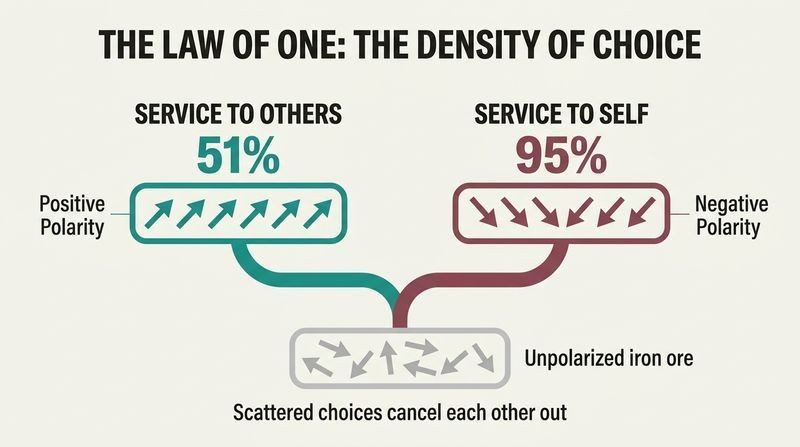
The Choice is the point of life. Rueckert, channeling the "Confederation" and "Ra group," argues we live in the "Density of Choice" (third density), a roughly 76,000-year school whose single graduation requirement is committing to a polarity. She uses a magnet analogy: raw iron ore has scattered magnetic crystallites that cancel out, but contact with a polarized magnet aligns them into power. Our scattered ethical choices work the same way.
The math is specific and lopsided. To graduate positive ("service to others") you need only 51% orientation toward others. To graduate negative ("service to self") you need 95%. The first wholehearted Choice is a cornerstone, like baptism, and each consecutive loving choice doubles your polarity. Stumble, and you simply start the streak again.
The binary feels reductive, since most human action is mixed-motive, yet the asymmetry is the genuinely interesting claim: goodness is the default gravity, requiring only a bare majority, while sustained selfishness demands near-fanatical purity. This echoes findings that chronic cruelty is psychologically costly and rare. The framework rhymes with Erich Fromm's productive versus nonproductive orientations and Viktor Frankl's meaning-through-self-transcendence. Where conventional ethics fixates on individual acts, this model fixates on cumulative orientation, an idea closer to virtue ethics and identity-based behavior change than to rule-following. Treat the literal soul-physics as metaphor and a usable life-design principle remains: pick a direction and let consistency compound.
The only spiritual failure is refusing to pick a side
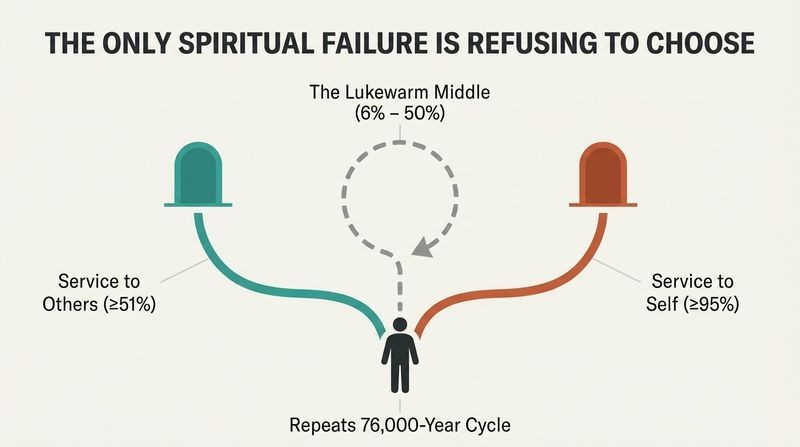
Lukewarm is the lone losing move. In this model, both the saint and the tyrant "graduate." The only people who repeat the 76,000-year grade are those scoring between 6% and 50% service to others, the comfortable, uncommitted middle. The negative path is called "the path of that which is not," because one self against the world contradicts a unified creation.
Conviction and self-deception matter. Genghis Khan, whose campaigns killed perhaps 30 million people, reportedly graduated negative because his ruthlessness was pure. Hitler did not graduate, because he believed he was righteously saving Germany, and that moral self-justification diluted his negative polarity. The unsettling lesson: clear-eyed commitment to a path, even a terrible one, beats drifting through life numb to ethical stakes.
That a committed villain "succeeds" while a self-justifying one fails is theologically provocative and reframes Hannah Arendt's banality of evil: most atrocity is committed by people convinced of their own decency, which here counts as spiritual incoherence rather than achievement. Kierkegaard made a parallel case that passionate commitment outranks aesthetic drifting. Skeptics will reject the harvest mechanics outright, and reasonably so. But strip the metaphysics and a sharp practical claim survives, supported by research on goal commitment and identity: ambivalence, not opposition, is the true enemy of growth. The person who wants two contradictory things with half a heart accomplishes neither.
Reframe every annoyance as catalyst, raw fuel for your soul
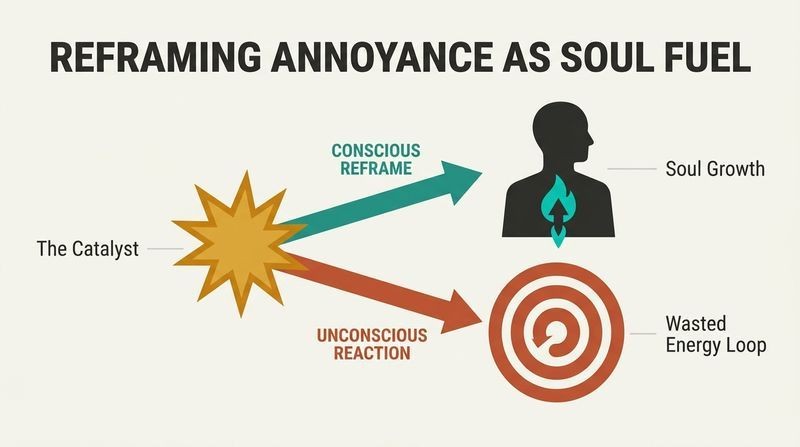
Catalyst is the engine of growth. Borrowing from chemistry, where a catalyst speeds a reaction without being consumed, Rueckert calls every incoming experience "catalyst." Most is neutral (sun in your eyes). The emotionally charged kind, especially negative catalyst, reveals who you are by how you respond.
Response is everything. When a car cut off the author's saintly Uncle Marion, he calmly said, "Here's some room for you, Buddy," while she would have cursed. Same event, opposite use of catalyst. She notes a counterintuitive trap: pleasant catalyst is hardest to use well because we get lost enjoying it and forget gratitude. "Giving thanks lifts that catalyst to the level of the Gameboard," she writes. Gratitude metaphysically "seats" good experiences so they actually advance you.
This is Stoicism in spiritual dress. Epictetus held that we are disturbed not by events but by our judgments of them, and modern cognitive behavioral therapy operationalizes exactly this through reappraisal. The gratitude point has empirical teeth: Robert Emmons's studies link deliberate gratitude practice to measurable gains in wellbeing, and the book's insight that good times slip by ungratefully matches the "hedonic adaptation" literature. The catalyst frame's quiet power is that it removes victimhood without denying pain. Nothing that happens is wasted material. The risk is spiritual bypassing, using "it's all catalyst" to suppress legitimate grief rather than process it.
See yourself as a Player above the board, never a pawn on it
Two gameboards, two lives. Rueckert distinguishes the lowercase "gameboard" (ordinary survival: amass resources, win, get by) from the capitalized "Gameboard" (spiritual seeking and ethical choice). The Player deliberately steps off the flat board by an act of will to view his life whole, the way one reads a symphony rather than a single note.
A practical perspective trick. When despair shrinks her world, she imagines her life is a film and she is the director, asking the camera to dolly back from the miserable close-up to the wide shot. Suddenly she notices the sunlight, the birds, the small beauties. The depression's defining feature, she argues, is its lack of perspective, a "merry-go-round" of repetitive thought. Widening the frame breaks the spell.
The director's-chair technique is psychologically validated. Ethan Kross's research on "self-distancing" shows that viewing your own situation from an observer's vantage, even shifting to third-person self-talk, measurably reduces emotional reactivity and improves problem-solving. Contemplative traditions call this decentering, and it is a core mechanism of mindfulness-based therapies. The Player/pawn distinction also maps onto metacognition: the difference between having a thought and noticing yourself having it. One nuance worth flagging: perpetual self-observation can tip into dissociation or detachment from genuine feeling. The book's own safeguard, that the Player must first fully feel the emotion before widening the lens, keeps the technique grounded.
Keep love flowing up your chakra pipeline from groin to crown
The body as energy pipeline. Rueckert presents a seven-center "energy body" running up the spine, each center a color of the rainbow: red (survival and sexuality), orange (relationship to self and others), yellow (formal groups like family, marriage, work), green (the heart and unconditional love), blue (honest communication), indigo (faith and inner work), violet (a read-out of the whole). The Creator's "love/light" enters at the feet and exits the crown.
The heart is the bottleneck. If worry, shame, or resentment blocks the lower three centers, insufficient energy reaches the green-ray heart, and the heart cannot stay open. So the daily job is not solving every problem but keeping the lower centers unblocked enough that love reaches the heart. A quick check: Am I at peace with being sexual? With living on Earth?
The chakra map is lifted from yogic tradition and reinterpreted energetically, and there is no physical evidence for a literal energy body. Read instead as a somatic atlas of where stress actually registers, and it becomes surprisingly useful: anxiety in the gut, a tight throat when afraid to speak, a heavy chest in grief. Polyvagal theory and interoception research increasingly treat bodily states as central to emotion rather than downstream of it. The framework's real contribution is sequencing. It insists you cannot leap to higher "spiritual" work while survival and relationship fears are screaming, a priority order that mirrors Maslow more than mysticism.
You can't open your heart until you forgive yourself first
The heart has two rooms. Rueckert splits the green-ray center into an "outer courtyard" and an "inner sanctum." The courtyard is where you meet your shadow self, every trait you have repressed or judged unworthy. You cross it only by greeting, understanding, accepting, and finally forgiving those darker parts.
Owning the ugly material. She confesses her own shadow: a "shopping gene" rooted in childhood scarcity, and even a "murderer gene," recalling two moments she instinctively tried to attack an assailant. The point is not to fix these flaws but to stop condemning yourself for having them. Self-condemnation constricts the energy body; self-acceptance relaxes it. We did not come to Earth to repair ourselves, she argues, but to learn to love, starting with the self we actually are.
This is Jungian shadow work with a softer landing. Jung argued that disowned parts of the psyche do not vanish but leak out as projection and compulsion, and that integration, not suppression, is the path to wholeness. The self-forgiveness emphasis is well supported by Kristin Neff's research showing that self-compassion predicts resilience and motivation better than self-esteem, partly because it does not depend on being above average. The counterintuitive claim, that you grow by accepting flaws rather than attacking them, runs against perfectionistic self-improvement culture. The caution: acceptance must not curdle into complacency, and the book holds the tension by pairing accepting yourself with still choosing to act better.
Forgiveness is the master key that dissolves karma
Forgiveness stops the inertia of action. Per the Ra material, forgiveness halts what is commonly called karma, the momentum of unresolved action. Jesus on the cross, praying "forgive them, for they know not what they do," models the principle: people who hurt us literally do not see us as souls, so reciprocating keeps you trapped on the flat board.
The mirror exercise. Rueckert's "bad landlord" technique: instead of stewing over someone who cheated you, locate that same capacity within yourself. In a unitary creation you contain every human trait, including the cheater's. Work on it internally rather than externally. She also borrows Ken Keyes's idea of downgrading "addictions" (responses that compel anger) back into mere "preferences," so the landlord earns a shrug, not a grudge, and your energy keeps flowing.
Forgiveness research strongly backs the practical payoff. Studies by Everett Worthington and Robert Enright link forgiveness to lower cortisol, reduced blood pressure, and better cardiovascular and mental health, framing grudges as a self-administered toll. The "find the fault in yourself" mirror is essentially Jungian projection: what enrages us in others often flags something disowned in ourselves. The addiction-to-preference downgrade anticipates cognitive defusion in acceptance and commitment therapy, loosening the grip of an automatic reaction without denying it. The strongest version of the claim is not that the offender deserves forgiveness but that you cannot afford the metabolic and attentional cost of withholding it.
Build faith by acting as if you already had it
Faith is a leap, then a landing. Rueckert defines faith not as faith in something but as a working certainty that all is well, even when evidence says otherwise. You step off the cliff of known things into "the mid-air of unknowing," and only after leaping do you find solid footing. Faith is circular: you build it by behaving as though you already have it.
The boss who became beloved. Her first librarian job was torture under a difficult supervisor. She decided to act as if she adored the woman, cheerfully calling her "Chief." Within a month the fiction became real, and they parted as friends. The mechanism: invoke love and love flows. She compares it to smiling on purpose until the body's chemistry produces a genuine smile.
This is William James's "as if" principle and Daryl Bem's self-perception theory in plain clothes: we often infer our internal states from our own behavior rather than the reverse. The smile example invokes the facial-feedback hypothesis, where adopting an expression nudges the corresponding emotion, a finding that has survived replication scrutiny in moderated form. Clinically, behavioral activation treats depression by having patients act before they feel motivated, trusting feeling to follow action. The honest limit: "act as if" can shade into forced positivity or self-gaslighting if used to paper over real danger. The book's framing as building a muscle, gradually and through chosen repetition, keeps it from magical thinking.
Speak only from an open heart, then listen all the way through
Blue-ray communication demands honesty. The throat center governs communication, which the book treats as a sacred act and which requires the quality humans most lack: honesty, with self and others. We routinely speak from half-knowledge, projecting assumptions onto others, then aiming our words at a target that was never there.
Concrete tools. Borrowing from Ken Keyes, she suggests beginning charged sentences with "I create," as in "I create that we are not hearing each other," to own your subjectivity instead of accusing. Listen all the way through rather than composing your reply at the halfway mark. Speak from the chest, not the throat or nose, to carry warmth. And gauge your listener: the Confederation aims its messages so the least informed person present can understand.
The "I create" device is functionally identical to the I-statements at the heart of Marshall Rosenberg's Nonviolent Communication, which reframes blame ("you did X") into ownership of one's own experience and needs, defusing defensiveness. Full listening before responding aligns with Carl Rogers's active listening, shown to build the psychological safety that lets people speak candidly. The book's quieter insight is that most communication failures are upstream of words: they stem from acting on an inaccurate read of the other person. The practical antidote it offers, asking someone to simply repeat what they said before reacting, is a low-tech but reliable guard against the misunderstandings that detonate relationships.
Meditate by practicing the presence, then balance emotions nightly
Two daily disciplines. For meditation, Rueckert prefers Brother Lawrence's phrase "practicing the presence," a continual quiet conversation with the Creator held mostly in silence. Crucially, success does not depend on clearing your mind, which she admits she has never managed in 40-plus years of practice. What matters is the purity of desire and intention. Start with two or three minutes, build slowly, and do not overdo it.
The balancing exercise. Each evening, review the day for moments that "hooked" you. Take a disturbing emotion, deliberately intensify it until you feel it fully, then summon its exact opposite (dislike, then love) and let that flood in just as strongly. This places the original reaction in context, restores perspective, and reopens the heart, teaching you your own recurring triggers along the way.
The reassurance that meditation works even with a noisy mind corrects a common beginner's misconception and matches what teachers across traditions emphasize: the practice is the returning, not the staying. Research suggests consistency outperforms marathon sessions, validating the small-and-daily counsel. The balancing exercise, fully feeling an emotion then deliberately evoking its counterweight, resembles the dialectical thinking trained in Dialectical Behavior Therapy, which builds the capacity to hold opposites without collapsing into either. The nightly review itself is an old contemplative technique, echoed in the Stoic evening examen and Ignatian practice. One caveat: artificially manufacturing the opposite emotion risks invalidating the first if rushed, so the sequencing, feel fully first, matters.
Analysis
This is a channeled metaphysical text, the entry-level volume of Carla Rueckert's effort to translate the famously dense "Law of One" / Ra material into plain language. Its difficulty for a summarizer is twofold: the content is unfalsifiable cosmology (densities, harvests, extraterrestrial Confederations), and its genuine practical wisdom is braided inseparably with that cosmology. The honest move is to extract the usable psychology while flagging the speculative scaffolding.
Structurally, the book is a guided ascent through a seven-chakra "energy body," bracketed by a metaphysics of polarity (service to others versus service to self) and a method (clearing each center so love reaches an open heart). What is striking is how much of the practical core is reinvented Stoicism, Jungian shadow work, contemplative Christianity, and what would later be formalized as cognitive behavioral therapy, all predating or paralleling the pop-psychology that now sells these ideas secularly.
The framework's most original contribution is its polarity asymmetry: positive graduation needs 51%, negative needs 95%, and the uncommitted middle is the only true failure. This reframes the spiritual problem from sin to drift, a genuinely useful inversion.
Intellectual honesty deserves note. The book stakes everything on a 2012 harvest date, and that date passed. To their credit, the publishers appended a preface conceding the prediction failed and urging readers to ignore it, modeling a falsifiability rare in the genre. That single act of correction arguably validates the book's own teaching about releasing attachment to known outcomes.
Read literally, it asks enormous credulity. Read as a phenomenology of inner life, with chakras as a somatic stress map and "catalyst" as Stoic reappraisal, it offers a coherent, compassionate, and unusually self-aware operating manual for becoming a kinder person under pressure.
People Also Read





Glossary
The Choice
Picking your soul's polarityThe central decision of "third density" life: to orient yourself toward service to others (positive) or service to self (negative). Making it wholeheartedly the first time is a cornerstone commitment, and every subsequent aligned choice strengthens it. Refusing to choose either path is the only outcome that prevents "graduation."
Polarity (service-to-others / service-to-self)
Two opposite ethical orientationsThe two valid spiritual paths. Service to others (positive) radiates unconditional love and sees all as one; graduating requires 51% orientation. Service to self (negative), the "path of that which is not," seeks control and sees others as resources; graduating requires 95%. Both progress; only the uncommitted middle stalls.
Catalyst
Experiences that provoke growthBorrowed from chemistry, the term for any incoming experience, person, or event that prompts a response and thereby reveals and develops the self. Much catalyst is emotionally neutral; charged catalyst, especially negative, is the raw material of spiritual evolution. How one responds, not what happens, determines its value.
The Gameboard / Game of Life
Spiritual seeking versus mere survivalRueckert's distinction between the lowercase "gameboard" of ordinary life (getting by, winning, accumulating) and the capitalized "Gameboard" of conscious ethical and spiritual seeking. Becoming a "Player" means rising above daily reactivity by an act of will to make deliberate, polarized choices.
Energy body / chakras (rays)
Seven spinal energy centersA pipeline of seven color-coded centers running up the spine: red (survival, sexuality), orange (self and one-to-one relationships), yellow (formal groups), green (heart, unconditional love), blue (honest communication), indigo (faith, inner work), violet (a read-out of the whole). "Love/light" energy flows up it and is blocked by fear and worry.
Harvest / graduation
Soul advancing to next densityThe transition, occurring at natural death, in which a sufficiently polarized soul moves from "third density" (the Density of Choice) to "fourth density" (the Density of Love), or its negative equivalent. Those who have not chosen a polarity repeat another roughly 76,000-year third-density cycle elsewhere.
Distortion
Any deviation from pure unityIn the Ra material, anything manifested is a "distortion" of the original undifferentiated Creator, beginning with free will, love, and light. The word is used non-judgmentally for all thoughts, feelings, and forms, since experiencing distortion is the very purpose of creation.
Outer courtyard of the heart
Where you face your shadowThe first of two levels of the green-ray heart center. Before entering the "inner sanctum" of unconditional love, a seeker must cross the courtyard by greeting, understanding, accepting, and forgiving the "shadow self," the repressed and disowned parts of one's own personality.
Practicing the presence
Silent continual contact with GodRueckert's preferred description of meditation, drawn from the 17th-century monk Brother Lawrence: an ongoing, mostly wordless inner communion with the Creator. Its effectiveness depends on the sincerity of intention and desire, not on successfully emptying the mind.
Magical personality / Higher Self
Future self that empowers ritualA version of oneself from sixth density, described as the Higher Self, which can be consciously invoked for advanced "work in consciousness" such as channeling, healing, or sacred sexuality. Balanced in power, love, and wisdom, it is deliberately put on for a working and taken off afterward.
Psychic greeting
Negative resistance to spiritual progressThe Confederation's term (preferred over "psychic attack") for disruptions, temptations, nightmares, or dread aimed at stopping a seeker's progress. Often it is internal psychic resistance from one's own embedded pain rather than an external negative entity. The remedy is fearless serenity, not contraction.
FAQ
1. What is Living the Law of One 101: The Choice by Carla Lisbeth Rueckert about?
- Comprehensive spiritual guide: The book distills over fifty years of L/L Research’s exploration into spiritual seeking, UFO contact, and metaphysical principles, focusing on the Law of One philosophy channeled by Carla Rueckert.
- Core metaphysical themes: It explains the universe as a unified creation, the nature of consciousness, and the spiritual “Game of Life” where souls evolve through ethical choices.
- Accessible entry point: Rueckert designed the book as an entry-level manual, making complex Law of One teachings understandable for newcomers to spiritual metaphysics.
- Practical and philosophical: The book blends metaphysical worldview with practical advice for living ethically and consciously, emphasizing the importance of making a spiritual choice or polarity.
2. Why should I read Living the Law of One 101: The Choice by Carla Lisbeth Rueckert?
- Simplifies complex teachings: The book makes the dense Law of One material approachable, offering clear explanations of spiritual evolution, densities, and the concept of harvest.
- Practical spiritual tools: Readers gain actionable guidance on working with chakras, energy bodies, and making ethical choices for personal growth and healing.
- Timeless spiritual relevance: While referencing the 2012 transition, its core message about free will, polarity, and conscious living applies to anyone seeking spiritual truth.
- Empowering and transformative: Rueckert’s work supports personal empowerment, self-reflection, and the cultivation of love and service in daily life.
3. What are the key takeaways from Living the Law of One 101: The Choice by Carla Lisbeth Rueckert?
- Unity of all creation: The Law of One teaches that all beings and things are interconnected as one organism, with the Creator’s essence as unconditional love.
- Importance of The Choice: Making a conscious decision to serve others or self is essential for spiritual graduation from third density.
- Energy body and chakras: Understanding, clearing, and balancing the seven chakras is crucial for spiritual growth and preparing for harvest.
- Practical spiritual living: The book offers a roadmap for living ethically, healing relationships, and opening the heart to unconditional love.
4. What is the Law of One philosophy as explained in Living the Law of One 101: The Choice by Carla Lisbeth Rueckert?
- All is one: The Law of One posits that the universe is a single, unified creation, and every being is a part of the Creator.
- Free will and polarity: The first distortion from unity is free will, allowing souls to choose between service to others (positive) or service to self (negative).
- Spiritual evolution: The philosophy centers on the soul’s journey through densities, making ethical choices to evolve and eventually reunite with the Creator.
- Practical application: Rueckert translates these metaphysical concepts into daily practices of love, acceptance, and conscious decision-making.
5. How does Carla Lisbeth Rueckert define “The Choice” in Living the Law of One 101: The Choice?
- Conscious spiritual decision: The Choice is the deliberate selection of a spiritual polarity—service to others (positive) or service to self (negative)—that determines one’s path to graduation.
- Cornerstone of evolution: This decision is the foundation for all further ethical actions and spiritual progress in third density.
- Urgency and timing: Rueckert emphasizes the importance of making The Choice, especially in the context of the planetary shift, but notes the opportunity remains as long as one is incarnate.
- Sustaining polarity: Consistent, conscious choices in alignment with one’s polarity increase spiritual polarization and readiness for harvest.
6. What is the “Game of Life” and “Gameboard” metaphor in Living the Law of One 101: The Choice by Carla Lisbeth Rueckert?
- Spiritual Game of Life: The Game of Life is a metaphor for the soul’s journey of ethical and spiritual evolution, distinct from mundane daily existence.
- Gameboard as reality field: The Gameboard represents the multidimensional, interconnected field of creation where souls make choices from a higher perspective.
- Objective of the Game: The aim is to polarize positively or negatively, uncover the true self, and respond to life’s catalysts with ethical decisions.
- Role of awareness: Players step outside consensus reality to observe, reflect, and make choices informed by higher consciousness.
7. How does Living the Law of One 101: The Choice by Carla Lisbeth Rueckert explain the energy body and chakras?
- Seven-chakra system: The energy body consists of seven chakras, each corresponding to different aspects of life and consciousness, from survival (red) to spiritual connection (violet).
- Interpenetration with physical body: The energy body channels the Creator’s love/light energy and connects the soul to the physical form.
- Chakra health and growth: Clearing and balancing chakras, especially the heart (green ray), is essential for spiritual development and harvest.
- Emotional and mental impact: Thoughts, emotions, and attitudes directly affect the flow of energy through the chakras, influencing spiritual progress.
8. What practical advice does Carla Lisbeth Rueckert offer for working with chakras and energy centers in Living the Law of One 101: The Choice?
- Acceptance and forgiveness: Embrace self and others without judgment to keep energy centers clear; forgiveness releases blockages and negative karma.
- Emotional awareness: Observe and process emotions like anger or fear to prevent constriction of chakras, facilitating healing and balance.
- Visualization and grounding: Use techniques such as visualizing energy flow from the Earth and practicing gratitude to strengthen and clear the energy body.
- Psychic self-defense: Employ methods like closing energy circuits (clasping hands and feet) to protect the aura in challenging relationships.
9. How does Living the Law of One 101: The Choice by Carla Lisbeth Rueckert describe the service-to-others and service-to-self paths?
- Service-to-others (positive): Characterized by compassion, love, and actions benefiting others; requires at least 51% polarity in service to others for graduation.
- Service-to-self (negative): Focuses on control, power, and manipulation for personal gain; demands a high threshold of 95% polarity for graduation.
- Non-judgmental understanding: Rueckert encourages recognizing both paths without emotional judgment, as all souls contain aspects of each.
- Necessity of choice: Failing to choose a polarity results in delayed graduation and further incarnations to learn the lessons.
10. What does Living the Law of One 101: The Choice by Carla Lisbeth Rueckert teach about family, relationships, and the yellow-ray chakra?
- Family as catalyst: Birth families, often with toxic patterns, are chosen pre-incarnation as ideal environments for spiritual learning and growth.
- Yellow-ray focus: The yellow-ray chakra governs formalized relationships (marriage, work) and ethical conscience, serving as the gateway to the heart.
- Healing relationships: Making peace with family, practicing forgiveness, and setting boundaries are essential for freeing energy and maintaining spiritual progress.
- Sexuality and energy flow: Yellow-ray sexuality involves complex energy exchanges, requiring tolerance and acceptance to keep relationships healthy.
11. How does Carla Lisbeth Rueckert explain the process of opening the heart and working with the green-ray energy center in Living the Law of One 101: The Choice?
- Two levels of the heart: The heart chakra has an outer courtyard (facing and accepting the shadow self) and an inner sanctum (unconditional love).
- Faith and forgiveness: Maintaining an open heart requires daily practices of faith, self-forgiveness, and forgiving others, especially when faced with challenging catalysts.
- Practical methods: Rueckert recommends setting intentions, practicing silence, and using prayer or meditation to connect with the Creator’s love/light energy.
- Gateway to higher work: An open heart is essential for accessing higher chakras and advancing on the spiritual path.
12. What advanced spiritual practices and warnings does Carla Lisbeth Rueckert provide in Living the Law of One 101: The Choice regarding indigo/violet rays, channeling, and psychic protection?
- Indigo and violet rays: These upper chakras form the gateway to intelligent infinity, enabling access to higher guidance and reflecting the integration of the entire energy body.
- Work in consciousness: Rueckert emphasizes self-discipline, meditation, prayer, and journaling as key practices for stabilizing the energy body and deepening spiritual connection.
- Channeling responsibility: Formal channeling is a serious commitment, requiring humility, discipline, and group support, as it exposes one to psychic greetings and energetic interference.
- Psychic protection: The book advises responding to psychic attacks with serenity, breath, prayer, and logical actions to maintain balance and keep the heart open.
Download PDF
Download EPUB
.epub digital book format is ideal for reading ebooks on phones, tablets, and e-readers.








































