
Plot Summary
Prologue
The book opens with a nameless woman who has memorized every cruel angle of the bone-white prison of Ilyzath rising from the surf. It has taken her most precious person, and she returns night after night to break its walls, collecting scars and failures, dragged half-dead from the sea by friends who barely escape.
On a storm-wracked final attempt the eyeless guards beat her down, yet through blood and lightning she feels a flicker of the soul buried within the stone, so close it cuts something feral loose. A haunting refrain threads the scene: tell me, little butterfly, what would you do for love? Her answer is the engine of everything that follows. Anything. Everything.
The prologue frames the novel as a meditation on love as obsession and sacrifice. Withholding the woman's name (clearly Tisaanah) universalizes her devotion, while the recurring address to a little butterfly lends a fairy-tale, almost predatory cadence, hinting that love itself can be a kind of haunting. Broadbent foregrounds failure as the engine of persistence: the heroine knows nothing if not how to fail and rise again. The storm, the blood, the eyeless guards establish a gothic register of futility against an implacable, semi-sentient structure, priming readers for a story where the most personal desire collides with world-scaled magic and unbearable cost.
The Wayfinder Brands Her Hand
Months after losing her magic, Tisaanah Vytezic1 poses as a servant named Roza in a Threllian lord's house, waiting to steal an artifact the Fey covet. When she touches the glass orb meant for King Caduan's4 emissaries, golden veins burn into her palm and her illusion dissolves. Cornered, she tries to flee with a frightened slave girl, Melina, killing a guard who blocks them.
The Fey general and the cruel Zorokovs16 trap them in the fields, and Melina's throat is opened before Tisaanah's1 eyes. Her winged ally Ishqa6 snatches her into the sky just in time. The theft makes her the most hunted person alive, and the artifact, she senses, is no mere trinket but a key to devastating power.
The opening reestablishes Tisaanah's defining contradiction: a woman who survived slavery by becoming whatever men wanted, now weaponizing that erasure of self for liberation. The illusion peeling away to reveal her Fragmented skin literalizes the impossibility of permanently hiding identity. Melina's death indicts Tisaanah's heroism with cost, the collateral damage of refusing to abandon anyone, a guilt-engine that recurs. The bonding of the wayfinder to her body collapses the personal and the cosmic: the quest for world-altering power begins as a desperate grasp for something strong enough to free one imprisoned man, establishing the book's central tension between saving the world and saving a single beloved.
The White Prison's Captive
Inside Ilyzath, a prison that erases every mark its inmates make, Maxantarius Farlione2 has lost fifteen years of memory and clings to sanity by redrawing three mysterious shapes. Queen Nura5 repeatedly drags him to her scientist Vardir,14 who tattoos binding glyphs across his skin and forces him to channel a power neither understands.
During one outing, Fey shadow-monsters slaughter Aran soldiers; Max2 saves a wounded boy named Moth,13 who insists everyone still remembers him and begs him to find someone called Tisaanah.1 Then his estranged brother Brayan,8 now in Aran uniform, appears and demands to know why Max2 rots in Ilyzath. Brayan's8 presence cracks a wall in Max's2 mind, and fifteen years of childhood memory come roaring back.
Max's amnesia inverts the trauma narrative: forgetting is mercy, the only thing that let him survive a prison built to torment with one's own past. His compulsive drawing becomes the book's slow-burn mystery and an emblem of how the self leaks through even when memory is sealed. The torture chamber, with its escalating tattoos, frames magic as something done to bodies, a colonization of flesh that mirrors slavery's logic from the parallel plot. Brayan's arrival functions as a key turning in the lock, suggesting that love and kinship, not interrogation, are what restore identity, and seeding the dread that recovered memory will bring unbearable knowledge.
A Soul Brought Back Wrong
In the copper city of Ela'Dar, the weapon once called Reshaye now inhabits a living body and a name she rejects: Aefe.3 King Caduan,4 who loved her five centuries ago, has somehow restored her, and his advisors press him to wield her against humanity. Aefe3 wakes screaming from nightmares, attacks a maid, and feels nothing but hollow loneliness now that she no longer shares another mind.
Caduan4 refuses to force her, instead handing her twin blades and walking her through the ruins of her old House, where her father once tried to kill her. Slowly she begins to trust the only person who treats her as more than a tool, even as grief and rage gnaw ceaselessly at her.
Aefe's resurrection is the book's most radical experiment in personhood: a being that existed only as others' rage and desire now confronts the terror of a single heartbeat, a single self. Her revulsion at softness, beds, names, dramatizes how trauma rewires the capacity for ordinary pleasure. Caduan's refusal to command her, set against his court's instrumentalizing pressure, stages the novel's recurring ethical fault line between loving a person and using a weapon. Her loneliness, sharpened precisely by the memory of shared minds, reframes the protagonists' telepathic bond as something she has been violently severed from, generating sympathy for the very entity that once destroyed the heroes.
The Rebellion Stops Trying
Back at the rebel encampment, the healer Sammerin7 reattaches Tisaanah's1 nearly severed hand while she absorbs the worst news. After eleven failed assaults on Ilyzath and the death of a beloved warrior, Filias12 and Serel9 rule that no more soldiers will die trying to free Max,2 and they will not let Tisaanah,1 magicless and irreplaceable, go alone.
She discovers even Sammerin,7 Max's2 closest friend, was overruled. The decision lands like betrayal; half her heart sits imprisoned across the sea. Hurling a bowl of overripe raspberries against the wall until they splatter like blood, she swallows her despair, buries it in work, and privately refuses to ever truly accept abandoning him.
This beat externalizes the cold math of leadership against the irrational arithmetic of love. The leaders are correct, and that correctness is its own cruelty, forcing Tisaanah into the lonely role of the one who will not be reasonable. The raspberries, a clumsy gift of condolence, become a perfect objective correlative for pity that scalds rather than soothes. Broadbent uses the scene to expose Tisaanah's core wound: she equates her own worth with usefulness and sacrifice, so being told she is too valuable to risk reads as a denial of the only love that has ever felt like hers to keep.
A Bargain with the Prison
A cataclysmic shudder tears through the deep layers of magic, felt by Max,2 Tisaanah,1 and Aefe3 at once, fracturing the boundaries that hold reality together. Sensing a soul calling to him, Max2 claws at his cell until Ilyzath, ancient and half-alive, offers a bargain: carry a piece of the prison and return when summoned, and he may leave to repair the damage being wrought.
A diamond-shaped mark sears into his palm, and a door simply opens. Outside, his brother Brayan8 waits with a stolen boat, having tried for days to reach him. They sail away unpursued, Brayan8 steering toward the remote land of Besrith, neither able to explain the forces now bleeding through the world.
The bargain reframes Ilyzath from passive torment device to a wanting entity, a crucial pivot that humanizes the inhuman and plants the climax's logic. Max's escape hinges not on strength but on the most human insight, that even a mountain may desire, echoing Tisaanah's own gift for reading hidden needs. The simultaneous shattering felt across three minds binds the protagonists' fates into one nervous system and announces the novel's escalation from personal rescue to cosmic emergency. Brayan's quiet, literal answer, I just had the boat, comically deflates the heroism while revealing a brother's stubborn, inarticulate love finally made action.
Reunion with a Stranger
A bulletin announcing Max's2 capture in Saroksa is obvious bait designed by Nura5 to lure Tisaanah,1 and she walks in anyway. Using a sympathetic slave-guard and a Fey explosive, she breaches the compound while letting herself be captured to free Max2 from inside. A reanimated Fey horror, one of Nura's5 failed experiments, rips the base apart; together Max,2 Tisaanah,1 Sammerin,7 Brayan,8 and Ishqa6 barely escape by Stratagram.
The reunion guts her: Max2 fights beside her with the old instinct, anticipating her every move, but when she throws her arms around him he stands frozen. He remembers nothing past seventeen, knows neither her name nor their love, only a bone-deep certainty that she is somehow home.
The long-deferred reunion weaponizes anticlimax: the embrace Tisaanah has bled for meets a stranger's stillness. Broadbent stages love as something deeper than recollection, the body and instinct remembering what the mind cannot, asking whether a relationship is the sum of its memories or something prior to them. For Tisaanah it is a fresh bereavement layered over rescue, the cruelest possible victory. The scene also reveals the cost of her singular focus: she risked exposing world-ending power for one man, validating Ishqa's fears and dramatizing how private devotion can imperil the collective, a tension the novel refuses to resolve cleanly.
Caduan Teaches Her to Create
Pressing Aefe's3 palm to his heartbeat, Caduan4 teaches her that her body is not an empty cell but a wellspring of life, and she conjures a single black rosebud, the first thing she has ever made rather than destroyed. As she falls for him, he reveals he revived her for justice, not as a weapon, and that the wayfinder Tisaanah1 stole leads to three Lejaras, pools of magic able to remake reality.
Touring Threll's scorched estates, the Zorokovs16 demand Fey armies to crush the slave rebellion while Caduan4 stalls. Standing in her ruined home before her murdered sister's bloodstain, Aefe3 agrees to help him find the Lejaras and end humanity, sealing her purpose with one word that tastes like blood.
The heartbeat lesson is the book's tenderest reversal: a being defined by destruction discovers creation as the proof of selfhood, the black rose a fragile emblem of agency. Yet Broadbent immediately complicates redemption by routing Aefe's awakening toward vengeance, showing how love and grief can be conscripted into atrocity. Caduan's framing, an offer rather than a command, lets Aefe experience choosing as liberation even as that choice is monstrous. The scene argues that the most dangerous violence is committed not by the heartless but by the wounded who have just learned to feel, and who mistake retribution for the justice they were denied.
Broken Chains in Zagos
Guided by Ishqa6 to Zagos, a fugitive city built into ancient ruins, Tisaanah1 and Max2 seek the eccentric Wielders Klasto and Blif.20 The pair shatter the binding tattoos caging Max's2 power, and for one glorious moment he summons fire before control slips away.
They explain that Max2 and Tisaanah1 broke magic's rules by drawing through each other, and the collapse severed them both; true healing requires opening their minds together. Locked in a dark closet with bled and joined hands, they push toward their power until they hit an impassable wall in Max's2 mind, a door he cannot open. The attempt nearly kills Tisaanah,1 and a furious, frightened Max2 refuses to try again.
Zagos externalizes the psychological architecture of repression as literal magical walls, making therapy a matter of survival rather than metaphor. The shared mind-work renders intimacy and violation indistinguishable: to heal, each must let the other into their most defended rooms. Max's refusal to keep going after Tisaanah is hurt enacts his protective love and his terror of the door alike, since opening his power means opening his guilt. Klasto and Blif's drug-hazed comedy leavens the dread while delivering the book's thesis on entanglement: power and selfhood here are relational, never solitary, so brokenness and repair are shared conditions, not private ones.
A City Burns, A Letter Bleeds
Driven from Zagos by bounty hunters, the group learns the Fey and Threllian Lords have launched a coordinated assault on all four rebel strongholds. Ishqa6 flies over Malakahn and returns shattered: the city is gone. He delivers a blood-soaked letter from Serel,9 written from a doomed bunker, telling Tisaanah1 he loves her and apologizing for ever giving up on Max.2
Worse, Ishqa6 reveals he saw Aefe3 there in the flesh, restored exactly as she looked five centuries ago, proof that Caduan4 commands a power that should not exist. Grief and dread crash over Tisaanah,1 yet she refuses to believe Serel9 is dead, clinging to hope that he escaped to the surviving stronghold of Orasiev.
The bleeding letter collapses the abstract war into one beloved hand's failing script, converting strategy into intimate terror. Serel's apology reframes the earlier abandonment of Max as collective guilt seeking absolution under fire. Ishqa's sighting of a flesh-and-blood Aefe is the structural hinge connecting the two plotlines, transforming the antagonists' resurrection magic from rumor into an existential threat the heroes can name. Tisaanah's refusal to mourn dramatizes hope as a willed, almost violent act of denial, the same stubbornness that kept her returning to Ilyzath, now bracing her against a grief she cannot yet afford to feel while the world unravels around her.
The Face He Always Drew
Ishqa6 argues they must reach a Lejara before Caduan;4 the group agrees to split, with Max2 and Brayan8 steered toward safety in distant Besrith. Heartbroken, Tisaanah1 insists Max2 go, telling him he deserves a clean slate free of his ruined past, and refuses to ask him to stay.
Walking away, Max2 idly draws the three shapes that obsessed him in Ilyzath, then realizes with a jolt they were never islands or a map. They are patches of pale and tan skin on a face, one green eye and one silver. They are Tisaanah.1 He turns and runs back, certain that whatever his mind lost, his soul never forgot her.
The payoff of the novel's central mystery doubles as its thesis on love: identity persists beneath amnesia, encoded in the body and the compulsions of the hands. Tisaanah's noble lie, that forgetting is mercy, exposes her self-erasing logic, she would rather grant Max a painless future than claim her own happiness, mistaking martyrdom for love. Max's recognition refutes her: a clean slate is not a gift if it costs him the one thing worth remembering. The sketch transforms from a symptom of trauma into a love letter the unconscious kept writing, insisting that the truest selves outlast the stories memory can hold.
The Petrified Heart
The wayfinder leads them into drowned Niraja, where both Caduan's4 Fey army and Nura's5 Aran forces descend at once. While Sammerin7 and a wounded Ishqa6 hold the entrance, Tisaanah1 wades alone into the flooded shrine, faces a vision of her dead master Esmaris insisting he marked her soul forever, and reaches the Lejara.
Max2 arrives and joins his mind to hers; together they shatter the final wall, and he relives the buried horror of slaughtering his own family while possessed by Reshaye.3 They wield the change-magic, rearranging the city's stone into mountains and driving both armies back. They escape clutching a petrified marble heart, and at last Max2 remembers everything, including the love they built.
Niraja fuses the external and internal climaxes of the first movement: claiming the Lejara requires Max to open the final door, so reclaiming power and reclaiming the unbearable truth are the same act. Tisaanah's confrontation with Esmaris dramatizes how oppressors colonize the psyche, her victory is choosing the necklace, her chosen self, over his inscribed narrative. The change-magic that turns wrought stone back into raw mountain literalizes the novel's interest in things returning to truer forms. That Max regains his whole self by surviving his worst memory, with Tisaanah holding it alongside him, argues that grief borne together is survivable where grief alone is not.
Tisaanah in Chains
Hunting near a market, Tisaanah1 and Sammerin7 are ambushed by slavers; she lets herself be taken to the Zorokov16 estate rather than slaughter the enslaved guards forced to fight her. Lady Zorokov16 tortures her, breaking fingers and peeling squares of skin from her back to test whether her spirit can be clipped.
Tisaanah1 endures it, secretly grinding her own wounds deeper to disguise how much magic she still hides, and turns the grieving house slaves to her cause. Through a sympathetic guard she once freed, she slips Sammerin7 a Zorokov16 armband, a deliberate message to Max:2 do not come to rescue me, bring an army and end them. Max2 reads it exactly as she intended.
This sequence crystallizes the difference between Tisaanah's leadership and ordinary heroism: her captivity is a deployed strategy, not a failure, and her refusal to slay enslaved guards even at her own peril defines her ethics under torture. The flaying scene is unflinching about the body as a site of domination, echoing both her slave past and Max's tattoos, scars as the language oppressors write in flesh. Crucially, the armband signal reframes love as trust in another's strength rather than the urge to save: Tisaanah asks Max not to rescue her but to fight beside her cause, the precise lesson she could not accept earlier when others denied her agency.
Threll's Empire Falls
Max2 rallies the surviving rebels at Orasiev, then strikes the Zorokov16 stronghold, where Tisaanah's1 drugged guards let them slip inside. Caduan's4 Fey army arrives the same night to punish the Lords for secretly courting Nura,5 barring the doors to massacre everyone, and his forces seize the wounded Aran queen5 herself.
Tisaanah1 confronts Aefe3 face to face, the two halves of a once-shared soul, before she and Max2 wield the petrified heart to rearrange the terrain and crush the attackers. Aefe3 holds back a wave of world-altering magic so the Fey can retreat, and Caduan4 carries her away. The Zorokovs16 die, Threll's empire collapses, and Filias12 is killed, leaving Serel9 to grieve.
The estate battle is a hinge of consequences: liberation arrives soaked in the very brutality it opposes, and victory and atrocity become indistinguishable in the locked-door massacre. Tisaanah's burning of Lady Zorokov, halted by Max from becoming sadism, tests whether justice can resist becoming vengeance, the question that defines Caduan and Aefe too. Filias's death insists that triumph is never a fair trade, that the world's cruel arithmetic can take the love of one's life on the day of greatest success. Aefe shielding her enemies' escape quietly foreshadows her capacity for choices beyond destruction, complicating the binary of hero and weapon.
An Alliance and a Borrowed Throne
From the rubble, Tisaanah1 persuades the freed nations to remain unified for six months as the Alliance of Seven Banners rather than fracture into old borders. Ishqa6 unveils a scheme to topple Caduan4 by installing Ezra,17 a half-mad ancient Fey king with rightful royal blood, to split Ela'Dar's loyalties.
Meanwhile a letter from councilor Iya11 urges Max2 to return to Ara, where the missing Nura5 has left a power vacuum only his name can fill. Newly whole in mind, Max2 reluctantly agrees to claim the title of Arch Commandant to end the war, and Tisaanah1 chooses to cross the sea with him, leaving her infant nation in the hands of Serel9 and Riasha.19
The political turn widens the lens from rebellion to governance, asking what victors owe the future. Tisaanah's argument against vengeance and fragmentation, take the unity forced upon us and make it ours, transforms trauma into civic design, the same transmutation the book champions everywhere. Ishqa's Ezra gambit reveals desperation curdling into the willingness to shatter his own people, a dark mirror to Tisaanah's nation-building. Max accepting a crown he despises completes his arc from glory-hungry youth to reluctant servant of others, while Tisaanah's choice to follow him marks her first real prioritization of love alongside duty, a fragile permission to want a future.
The Murdered Father, The Dying King
In Ela'Dar, Caduan4 and Aefe3 interrogate the captured Nura5 while Meajqa,10 son of the traitor Ishqa,6 hungers to kill her. When Ishqa6 flies in to beg Caduan4 for peace and to spare Ezra,17 Aefe3 ambushes him and at last slits the throat of the man who doomed her to five centuries of torment,6 feeling only emptiness afterward.
Then the truth she dreaded surfaces: the forbidden creation magic Caduan4 used to resurrect her is killing him, black rot spreading beneath his skin. He confesses he always knew the cost and spent his final days waging a war of vengeance in her name. Devastated, Aefe3 rages, unwilling to lose the one person she has learned to love.
Aefe's revenge delivers the book's bleakest insight: retribution fills nothing, the throat she has dreamed of cutting for centuries leaves only a hollow where she expected release. Killing Ishqa frees her of an old self without granting peace, dramatizing vengeance as a door that opens onto more emptiness. Caduan's death sentence reframes his entire campaign as grief and self-erasure, his annihilation of humanity a refusal to accept loss, the very lesson Aefe must learn. Their love becomes tragic precisely because it is real: she finally has something to lose at the moment she discovers it was always already lost, which terrifies her more than any battlefield.
The Brother's Reckoning
On the eve of the throne ceremony, Brayan8 discovers an Orders document placing Max2 at their family home the night everyone died. Confronted, Max2 finally confesses the truth he buried for a decade: Reshaye,3 the entity the Orders bound into him, seized control and used his hands and fire to murder their parents and siblings, including the little sister he adored.
He let Brayan8 believe Ryvenai rebels were responsible. Brayan,8 who executed innocents for the crime and grieved utterly alone, draws his sword in rage but cannot bring himself to kill his last brother.2 He leaves, unable to forgive, conceding only that Max2 is still his brother, perhaps someday, but not now.
The reckoning detonates the novel's longest-buried secret and tests the limits of confession. Max's earlier insight, that speaking the truth brings no catharsis, proves true: honesty fractures rather than frees, exposing the comforting fiction of justice Brayan built his decade upon. Broadbent refuses easy reconciliation, honoring how some wounds resist absolution and how love can coexist with the inability to forgive. The scene also recontextualizes Reshaye/Aefe across the entire book: the heroes' tragedy and the antagonists' origin share one act of magical violation, collapsing the moral distance between sides and insisting no one here holds clean hands.
The Towers Fall
Meajqa10 drunkenly tries to kill the captive Nura5 alone and fails; she escapes, using the stolen creation Lejara to raise Ela'Dar's countless dead and overrun the Fey city with reanimated corpses. She then reanimates the murdered Ishqa6 as a living bomb packed with Lightning Dust and sends him to Ara, where he detonates and collapses the already-broken Towers, nearly killing Max2 and Tisaanah1 and shattering the petrified heart into shards.
Amid the devastation, the surviving Council still names Max2 Arch Commandant, and he disowns the institution's cruelties. With armies converging and the sky cracking red, Max2 and Tisaanah1 steal one quiet moment to marry, binding their hands in a Nyzrenese rite before the war bells toll.
Nura's resurrection of the dead is the horrifying apex of the book's thesis that creation can be deadlier than destruction, life forced into being against the natural order. Her corpse-bomb made from Ishqa fuses cruelty and irony, the peacemaker weaponized into mass murder. Against this apocalyptic backdrop, the hurried wedding asserts the novel's deepest value: intimacy claimed in the teeth of annihilation. The five-gift Nyzrenese vow, conducted in Tisaanah's mother tongue amid rubble, reclaims her erased heritage and stages marriage not as fairy-tale closure but as defiant hope, a wager on a future that may not arrive.
The Death of Nura
Nura's5 corpse fleet and Caduan4 and Aefe's3 Fey armada both descend on Ara as the rebel Alliance and a returning Roseteeth force rally to defend it. Parleying first, Max2 drives a knife into Nura5 twice, but she clutches a second Lejara, an amber stone cradling a half-formed life, and detonates it before dying by Tisaanah's1 blade.
Vardir,14 defecting in terror, warns them that channeling the Lejaras has torn the boundaries between magic's layers; the world is bleeding and will collapse unless all three pools are wielded together and destroyed. The wayfinder and the broken heart point toward the final pool of death magic, sealable only at one ancient place: Ilyzath.
Nura's death is denied catharsis: Max kills the closest thing he had to a sister and feels nothing, a deliberate echo of Aefe's hollow revenge, binding the two plotlines' moral conclusions. Broadbent renders Nura tragic in her final lucidity, a frightened person who believed herself unforgivable and acted to confirm it, indicting the militarized world that forged her. Vardir's revelation elevates the stakes from war to cosmology and retroactively justifies Ilyzath's bargain, the prison's missing pieces and its appetite for death now snapping into place. The bleeding sky externalizes the cumulative cost of every grasp for power across the series.
Sealing the Wound
Inside the now-quiet Ilyzath, Max2 battles Caduan4 and is gravely wounded as the Fey king seizes the amber Lejara. Tisaanah,1 against all logic, presses the change-magic shards into Aefe's3 hands and begs her to choose creation over destruction. In the death-shrine beneath the prison, Aefe3 finds Caduan4 wielding the death Lejara, learns that sealing the magic will erase her along with it, and chooses to do it anyway.
Together she and Caduan4 stitch the torn world closed and step through death's door hand in hand. Above, Max2 and Tisaanah1 pour their joined magic into the working, sealing away the deep magic forever. They wake on Ilyzath's steps as a true dawn breaks over a saved world.
The climax resolves every thread through a single redefinition of love. Tisaanah's gamble, handing her enemy the tool of salvation, enacts radical faith that even Reshaye can choose to be more than death. Aefe's sacrifice, knowing it unmakes her, is the book's purest love, the willingness to relinquish rather than possess, an explicit rebuke of Caduan's and Nura's possessive devotions. That the antagonists save the world they tried to destroy honors their interiority without excusing their crimes. Ilyzath reclaiming its pieces frames the whole epic as a wound finally allowed to heal, and the literal dawn fulfills the title's promise of death giving way to beginning.
A World Worth Rebuilding
With the deep magic gone, Nura's5 corpse army simply vanishes and both sides stagger into a wary ceasefire. Caduan's4 rotted body is found in Ilyzath; Aefe's3 is gone, dissolved like everything the lost magic made. Meajqa10 emerges as the Fey's leader and, worn down by grief, accepts Tisaanah1 and Max's2 fragile offer to build trust brick by brick.
Max2 disbands the corrupt Orders rather than rebuild the Towers, learns the young queen Sesri secretly survived, and conceives of turning his haunted family estate into a school. Tisaanah1 envisions a global guild to reach enslaved children everywhere. Brayan8 departs, unable yet to forgive, while Tisaanah1 bids a wrenching farewell to Serel9 across the sea.
The resolution insists that peace is laborious, not granted, built brick by brick across distrust rather than declared. Dismantling the Orders completes Max's repudiation of the institution that made and unmade him, refusing to reconstitute the machinery of torture even when it would serve him. The school in his haunted home and Tisaanah's guild dramatize the novel's governing ethic: trauma is redeemed by transmutation into something generative, not by erasure. Brayan's unresolved estrangement and Serel's grief keep the ending honest, victory carries permanent losses. Aefe's vanished body lingers as a quiet ache, a person who finally mattered, gone the way the unnamed always go.
Epilogue
Years later, Max and Tisaanah2 have built a home inside a sprawling garden and a life inside each other. The old Farlione estate becomes a school where Max2 teaches, turning a house of nightmares into a place of growth, while Tisaanah1 builds a global guild reaching enslaved children across the world.
They raise a daughter with sun-through-leaves green eyes and a temperamental son. The past still leaves its marks: Max2 lies awake fearing all the ways the world can steal what he loves, and Tisaanah1 dreads the day her children ask about the scars on her back. But each morning they choose hope. She remembers her mother's charge to survive, and then to live, and she lives.
The dual-voiced epilogue answers the prologue's feverish question, what would you do for love, with a humbler verb: live. Broadbent resists a frictionless happy ending, insisting trauma persists even inside joy; Max's hypervigilance and Tisaanah's fear of her daughter's questions render healing as ongoing labor rather than cure. The estate-turned-school and the worldwide guild make the book's central ethic concrete: pain is not redeemed by forgetting but by transmutation into something that nourishes others. The recurring image of the wild, overgrown garden, beloved precisely because it is untamed and free, becomes a closing thesis on letting life flourish unclipped. Survival was the war; living is the harder, chosen peace.
Analysis
Mother of Death and Dawn closes a romantic-fantasy epic by insisting that the opposite of destruction is not stillness but creation. Broadbent structures the novel as a triptych of damaged consciousnesses, Tisaanah,1 Max,2 and Aefe,3 literally bound by a shared soul, so the central question, what would you do for love, is posed from three angles: the lover who would burn the world to free her beloved, the man who would rather forget himself than face his guilt, and the weapon learning, five centuries late, that she is a person at all. Their arcs rhyme deliberately. Tisaanah1 and Aefe3 mirror each other, hollowed survivors who confuse worth with usefulness; Max2 and Caduan4 mirror too, men who commit atrocity and must decide whether vengeance or restraint defines them. The Lejaras literalize the book's ethics. Magic is a wound: every act of taking tears the world, and the only cure is balance and sacrifice. Power that creates life, the resurrected Aefe,3 the corpse armies, proves more dangerous than any blade, dramatizing the hubris of refusing loss. The recurring motif of marks, scars, tattoos, bloodstains, the carvings Ilyzath erases, argues the past cannot be deleted, only transmuted; healing means building schools in haunted houses and guilds for enslaved children, not forgetting. Most strikingly, the novel redeems its antagonist-adjacent figures through interiority rather than absolution. Aefe's3 choice to seal the magic, knowing it erases her, reframes love as the willingness to relinquish rather than possess, an explicit rebuke of Caduan's4 and Nura's5 possessive loves. The dual epilogue answers the prologue's feverish anything, everything with a humbler imperative: survive, then live. Trauma persists inside happiness; choosing hope daily becomes the book's hardest, truest magic, and its final argument for what victory should mean.
Review Summary
Mother of Death & Dawn concludes Carissa Broadbent's War of Lost Hearts trilogy, receiving overwhelmingly positive reviews. Readers praise the intricate world-building, complex characters, and emotional depth. Many found the ending satisfying, though bittersweet. The book explores themes of love, sacrifice, and redemption. Some criticism focused on pacing and length. Overall, fans were deeply moved by the characters' journeys and consider the series a standout in fantasy romance. The epilogue left many readers in tears, cementing the trilogy's impact.
People Also Read
Characters
Tisaanah Vytezic
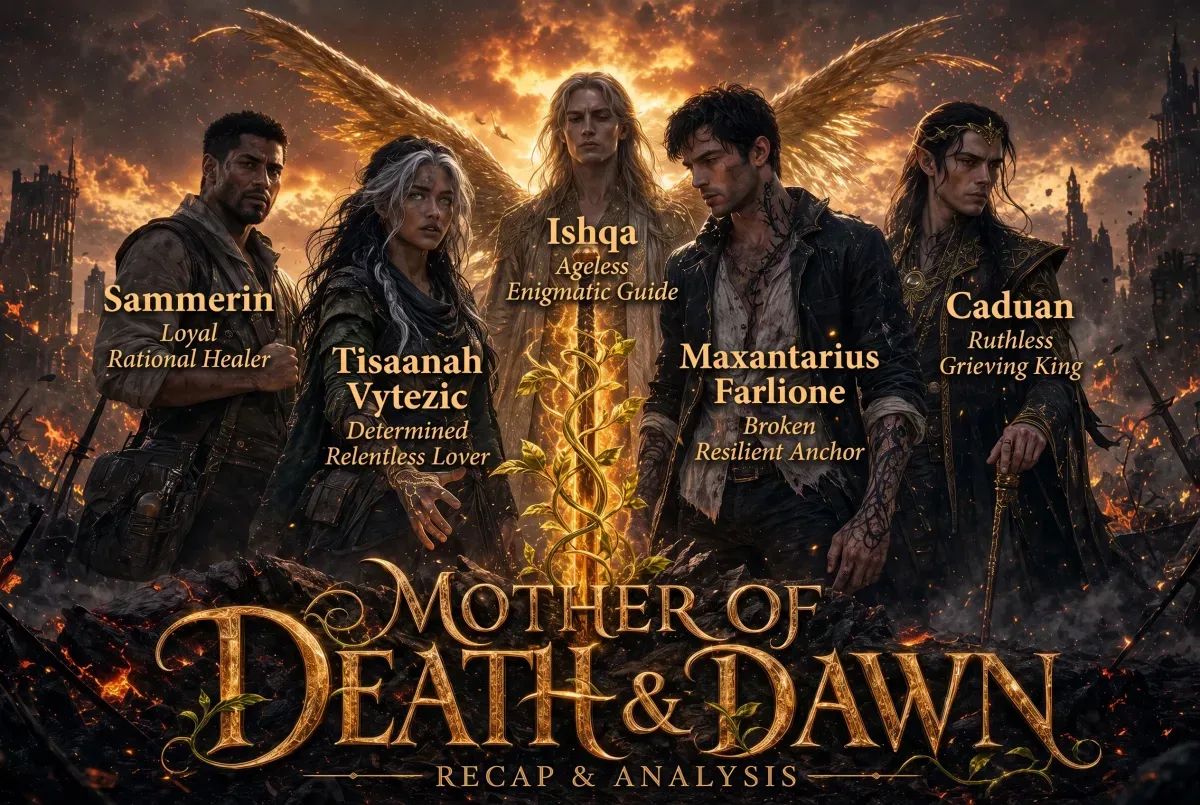
Former slave turned liberatorA Nyzrenese woman with Fragmented Valtain skin and mismatched silver and green eyes, sold into slavery as a child and risen to lead a continental rebellion. Driven by a ferocious need to protect others and a terror of her own selfishness, she equates worth with sacrifice and struggles to believe she deserves a future of her own. Her love for Max2 is the one desire she cannot subordinate to duty, and that hunger both frightens and humanizes her. Strategically brilliant and emotionally armored, she converts pain into plans and rarely lets anyone witness her unravel. Beneath the legend her people worship lies a woman quietly desperate for a home she never dared imagine she could keep.
Maxantarius Farlione
Amnesiac fire WielderOnce a celebrated and self-loathing military prodigy, Max begins the book imprisoned and stripped of fifteen years of memory. Sardonic, blunt, and allergic to false promises, he hides bottomless guilt behind dark humor. His magic, fire and the deeper streams beneath it, is bound to his fractured past, so reclaiming his power means confronting his worst memories. He measures himself against impossible standards inherited from his brother8 and a family tragedy he cannot face. What anchors him is Tisaanah1, whom he recognizes in his bones even when his mind is blank. He longs only for a quiet life of gardening and love, and is perpetually astonished that he might deserve one.
Aefe
Resurrected ancient weaponOnce a Fey princess, then the bodiless entity Reshaye that lived inside human hosts through five centuries of torment, she now occupies a new body and a self she does not recognize. Hollowed by loneliness and initially unable to read emotion or feel pleasure, she experiences the world as alternately overwhelming and empty. Rage is the only thing that feels real, and vengeance the only language she trusts. Yet under Caduan's4 patient attention she discovers heartbeat, hunger, music, and love, learning she can create rather than only destroy. Her arc is a wrenching study of personhood reclaimed from objecthood, and of the terrifying vulnerability of finally having something to lose.
Caduan Iero
The grieving Fey kingRuler of Ela'Dar, a scholar-king who built a flourishing civilization and pursues forbidden knowledge relentlessly. Frighteningly calm, he hides a fury and grief as deep as any he condemns. He loved Aefe3 five centuries ago and resurrected her out of love disguised as strategy. Believing humanity an existential threat, he wages annihilation while insisting it is justice rather than vengeance. His tenderness toward Aefe3 reveals a man at war with his own capacity for monstrousness, and his quiet courage masks a willingness to sacrifice everything, including himself.
Nura
The desperate queenArch Commandant and Queen of Ara, Max's2 childhood friend turned jailer, a Valtain forged by a military that taught her only ruthlessness keeps fear at bay. Scarred from the battle of Sarlazai and hardened by an unwinnable war, she loves Ara possessively and tortures Fey captives in pursuit of a weapon to save it. Her brilliance curdles into madness as she draws on magic too deep for her sanity. Beneath the ice is a frightened person who believes herself unforgivable and acts accordingly.
Ishqa
The guilt-ridden Fey allyAn ancient, near-immortal winged Fey who aids the rebellion against both the Threllians and the Fey king. Elegant, secretive, and emotionally armored, he comes and goes like a cat. Five centuries ago he betrayed Aefe3, a sin he can never undo, and his every choice is shaped by regret and a desperate desire to spare the world another catastrophe, even at the cost of his own people and son10.
Sammerin
The steady healerMax's2 closest friend and a gifted Valtain flesh-Wielder whose dry wit and unflappable calm anchor the group. Homesick for his quiet Aran practice, he follows Tisaanah1 into exile out of loyalty. He sees more than he says, gently naming the self-sacrificing tendencies of the people he loves, and serves as the moral and emotional ballast of the company.
Brayan Farlione
Max's estranged brotherA renowned warrior and former mercenary, the golden Farlione son who shaped Max2 with brutal training and impossible standards. Rigid, proud, and uncomfortable with magic and feeling, he solves pain with a blade. His decade-long search for Max2 and his solitary grief over their family reveal a man desperate for an order and justice the truth refuses to grant him.
Serel
Tisaanah's chosen brotherThe friend who once saved Tisaanah's1 life by sending her to seek freedom, now a rebel leader of warmth and grace. Beautiful, practical, and devoted, he loves Filias12 and treasures Tisaanah1 as family. His enduring belief in a future worth fighting for, even through devastating loss, becomes a quiet moral compass that helps her permit herself happiness.
Meajqa
The broken Fey diplomatIshqa's6 son and Ela'Dar's head diplomat, who lost a wing to Nura's5 experiments and can no longer shift forms. Charming, wine-soaked, and quietly devastated, he masks pain behind easy smiles and craves vengeance on the queen who maimed him. He becomes an unlikely friend to Aefe3, recognizing in her another broken thing trying to survive.
Iya
The pragmatic councilorA foreign-born Valtain member of Ara's Council who once backed Max's2 earlier bid for power. Wry, patient, and quietly idealistic, he engineers Max's2 return to Ara and still mourns the promise the Orders were always meant to fulfill, hoping to see something better built from their ruins.
Filias
Rebel commander and loverA tall, lean rebel leader who often clashes with Tisaanah1 yet would die for the cause, and who loves Serel9. Practical and gruff, he weighs the rebellion's survival above any single life, even Max's2.
Moth
The young soldierA blond Solarie boy whom Max2 saves on the battlefield and reunites with later, much grown. His earnest devotion reminds Max2 that Ara's ordinary people still believe in him.
Vardir
The amoral scientistThe elderly Valtain who tattoos and experiments on Max2 for Nura5, fascinated by deep magic and indifferent to suffering, until horror at the world's unraveling finally drives him to defect.
Luia
Caduan's military chiefA sharp, hawkish advisor who urges Caduan4 to use Aefe3 and strike humanity hard, fiercely loyal to Ela'Dar and impatient with any show of mercy toward humans.
The Zorokovs
Cruel Threllian LordsA porcelain-pretty Lady and her cold husband, slaveholding aristocrats who once sent Tisaanah1 a box of severed hands and who deal with both Fey and Aran powers to preserve their dying empire.
Ezra
The faded ancient kingA half-human former Fey king of Niraja, ruined by centuries of grief and memory loss, whom Ishqa6 hopes to install as a rival claimant to destabilize Caduan's4 throne.
Sareid
Aefe's lost motherOnce a meek, drugged queen who failed to protect her daughters, now lucid and grieving, she seeks to reach Aefe3 and turn her away from a path of vengeance and self-destruction.
Riasha
Rebel stateswomanA steady, maternal member of the rebellion's leadership who helps forge the Alliance and shoulders the daily work of governance during Tisaanah's1 absence.
Klasto and Blif
Eccentric Zagos WieldersA flamboyant part-Fey and his deadpan partner, drug-hazed but brilliant, who shatter Max's2 magical chains and diagnose the deeper rupture in his and Tisaanah's1 intertwined power.
Plot Devices
The Wayfinder and the Lejaras
Reality-warping magic engineThe artifact that bonds to Tisaanah's1 hand is a wayfinder, a key that detects and channels the Lejaras, three pools of deep magic embodying creation, change, and death. Its glow physically points toward each pool, driving the quest across continents. The change Lejara takes the form of a petrified marble heart, creation an amber stone cradling a half-formed life, death a luminous sapling beneath Ilyzath. Wielding them rearranges terrain, raises the dead, and reshapes life itself, but corrodes and eventually destroys the wielder. The devices escalate the stakes from a personal rescue to cosmic survival, since overuse tears the boundaries between magic's layers until reality itself begins to bleed.
The Shared-Soul Bond
Telepathic link between threeReshaye3, the entity that once lived inside Max2 and Tisaanah1, leaves an indelible connection between them and Aefe3, who is Reshaye reborn into a body. The bond lets them feel one another across vast distances, glimpse each other's eyes mid-battle, and sense shared catastrophes in the deep magic. It explains Max's2 instinctive recognition of Tisaanah1 despite his amnesia, allows Aefe3 to track them across the sea, and ultimately enables the climactic cooperation across enemy lines when Tisaanah1 entrusts Aefe3 with a Lejara. The device braids the three protagonists' arcs into a single nervous system, rendering intimacy and violation two faces of the same magic.
Ilyzath, the Sentient Prison
Living jailer with desiresAn ancient, semi-aware structure that erases any mark prisoners try to make and torments them with hallucinations drawn from their own minds. Ilyzath speaks in groans of stone and, crucially, wants something, allowing Max2 to bargain his freedom in exchange for carrying a piece of it and returning when called. Its mark on his palm and its hidden nature as a vessel of death magic pay off at the climax, when it proves to be the one place capable of channeling and sealing the Lejaras. The prison evolves from passive torment into an active player whose missing pieces are the key to mending the world.
The Three-Shape Drawing
Mystery of a forgotten faceMax's2 amnesiac mind, walled off to protect his sanity, manifests in a compulsive doodle of three shapes that others mistake for islands or a map. The recurring sketch seeds a slow-burn mystery resolved when Max2 suddenly recognizes the shapes as the patches of pale and tan skin on Tisaanah's1 face, with one green eye and one silver. The device dramatizes whether love survives memory, letting Max2 fall for Tisaanah1 a second time and forcing both to weigh whether a clean slate is mercy or theft. It externalizes the idea that the truest self persists beneath what memory can hold.
The Stratagram Tattoos
Chains that bind magicVisual magical glyphs inked across every inch of Max's2 body by Nura5 and Vardir14 to sever him from his power, layered atop one another whenever he finds a loophole. They are physical evidence of his torture, a lingering source of shame, and the obstacle that must be broken in Zagos before he can Wield again. Their persistence even after being shattered, since the ink remains forever, mirrors the book's recurring claim that the past marks the body permanently even once its power over the present is broken. They visually rhyme with Tisaanah's1 slave scars and Aefe's3 torment.
About the Author
Download PDF
Download EPUB
.epub digital book format is ideal for reading ebooks on phones, tablets, and e-readers.








































