Key Takeaways
1. Embrace Radical Honesty with God and Self
The psalms invite us, thus, to stand in the light, to see ourselves truly and to receive the reformative work of God through the formative words of the psalmist, so that we might be rehumanized in Christ.
Unveiling secrets. The Psalms offer a powerful aid to un-hide from ourselves, others, and ultimately God. Everyone carries secrets—addictions, fears, resentments, or past traumas—that lead to hiding, choosing darkness over light, and alienation. This hiding dehumanizes us, cutting us off from our divine source, our true selves, and community.
Gritty honesty. The Psalms model a "gritty, no-nonsense honesty" that is often uncomfortable but essential for freedom and flourishing. They invite us to confess our sins, not to be undone by them, but to be covered by God's grace. This honesty extends to all aspects of life, from shame and depression to hate, trust, and joy, allowing us to pray who we actually are, not who we think we should be.
Grace-filled transformation. This radical honesty is possible because God's grace precedes, undergirds, and follows our confessions and laments. We are forbidden to take sin more seriously than grace. By praying the Psalms, we become free to pray with abandonment, confident that Jesus, "full of grace and truth," will make us whole and holy, transforming our unedited emotions into something redemptive.
2. Find Wholeness and Identity in Community
The Psalter is a fundamentally communal book where individuals find their place in the world of faithfulness and faithlessness within the context of the community.
No autonomous spirituality. The Psalms reject the modern individualist notion of faith, emphasizing that our spiritual journey is always lived "before the face of the community." This means our praise, protest, petitions, and thanksgivings are shared, and the community bears witness to our experiences, ensuring we are never truly alone.
Interconnected identity. For the psalmist, personal identity is deeply intertwined with the community's identity. "My" faith exists in relation to "our" faith, tested and strengthened on a communal, social, and public stage. This includes:
- Friends and neighbors
- Past and future generations
- The "assembly" or "congregation" of God's people
Embracing the unlike. Unlike chosen friendships, congregations often include people with diverse preferences and convictions. This diversity is a deeply good thing, as it fosters a "capacious and hospitable 'I'" where individuals can confess sins and express joy without fear of judgment, cultivating sympathy and empathy for all. Jesus, as the Chief Worshiper, sings with many voices, forming a transhistorical, transcultural community.
3. Connect to a Rich, Universal History of Prayer
For over two thousand years, God’s people have learned how to hear from God and how to talk to God by praying the psalms.
Timeless treasure. The Psalms are a treasure house of prayers, profoundly influential for Jesus, the apostles, and Christians across all denominations and cultures for over two millennia. They are cited extensively in the New Testament, forming the principal worship book for the early church and shaping liturgical and devotional language throughout history.
A "little Bible." From Augustine to Luther, Bonhoeffer to Bono, the Psalms have served as a mirror of the soul and a guide for spiritual struggles. They were the first book published in the American colonies and inspired hymns like "A Mighty Fortress Is Our God" and "Joy to the World." This rich history underscores their invaluable role in Christian faith.
Global resonance. The Psalms continue to resonate globally, translated into diverse languages and musical styles, from Punjabi to South African Sotho, rap to classical compositions. They offer a universal language for faith, hope, and love, inviting contemporary readers to join a vast cloud of witnesses in a lifelong habit of prayer and praise.
4. Learn the Comprehensive Grammar of Prayer
It is not our prayers that interpret the Psalms but the Psalms that interpret our prayers.
School of prayer. The Psalms are "prayer masters," teaching us how to talk to and listen to God, providing the very words we need to pray well. They offer a beginning for novices, an increase for those advancing, and confirmation for those concluding their journey, making space for all forms of prayer—from spontaneous ramblings to formal liturgies.
Dialogical nature. Prayer in the Psalms is a dynamic dialogue, a rhythm of call and response between God and humanity. God initiates, and humans respond, but humans also call out, and God replies. This dialogue reveals a God who is both immanent (near, shepherd, refuge) and transcendent (far, King, Lord of Hosts), known through his specific words and deeds, not abstract speculation.
Whole soul, whole world. The Psalms give voice to "the whole anatomy of the soul," excluding no emotion or topic. They invite us to bring not just personal concerns but also the concerns of history, creation, neighbors, and the world to God. This comprehensive approach cultivates sympathetic and empathetic prayer, training us in self-care and neighborly care, as Jesus himself prayed.
5. Engage with the Psalms as Profound Poetry
Most emphatically the Psalms must be read as poems; as lyrics, with all the licenses and all the formalities, the hyperboles, the emotional rather than logical connections, which are proper to lyric poetry.
Language of the soul. The Psalms are poetry through and through, a medium through which God is encountered and a faithful life is formed. Poetry says more, and says it more intensely, using similes, metaphors, parallelisms, and rhythm to disclose truths about God and the world that prose cannot. It forces us to slow down and savor the words.
Metaphorical truth. In the Psalms, truth exists through metaphor, not beyond it. For example, "the Lord is my shepherd" evokes a rich tapestry of meaning beyond simple caretaking, connecting to Moses, the Exodus, and sovereign kingship. Metaphors are not decorative but essential, revealing aspects of God and reality that no other language can.
Particularity and presence. Poetry draws attention to the particularity of things—moss, rocks, stars, animals—reminding us there are no "dittos" in God's world. This care-filled attention, this "reverential posture," is core to faith, prayer, and worship. Reading the Psalms aloud, as they originated in an oral culture, allows us to experience their musicality and dense expression, helping us to "feel" justice, loss, and God's majestic character from the inside.
6. Express the Full Spectrum of Human Emotion
The psalmist is brutally honest about the explosive joy that he’s feeling and the deep sorrow or confusion, and it’s that that sets the Psalms apart for me.
Lamenting a broken world. The Psalms provide language for the seemingly unspeakable, giving coherent shape to incoherent feelings of sadness, loss, and disorientation. They acknowledge a broken world marked by personal pain (divorce, loneliness, sickness) and societal injustices (war, persecution, poverty). Lament psalms, whether individual or communal, follow a pattern of complaint, petition, and resolution, often ending in hope or grim reality.
Faithful anger. The "curse psalms" or "imprecatory psalms" offer a divinely approved way to express anger without being consumed by it. They are prayers of relinquishment, ceding vengeance to God's justice rather than taking it into human hands. This hyperbolic language, akin to profane speech, expresses the shocking violation of God's good order and the acute sense that God's character is at stake when injustice occurs.
Indestructible joy. The Psalms are ultimately a "Book of Praises," asserting God as the ultimate source of joy, grounded in his character, deeds, and abundant presence. Joy is a response to God's rescue, a choice even amidst sorrow, and an overflow of his faithful generosity. This "happy-sadness" marks our earthly pilgrimage, with joy often retaining a poignant residue of sorrow, always "moving towards praise" as our final end.
7. Confront Enemies and Seek God's Justice
In the Hebrew tradition, the execution of justice is the divine prerogative.
Enemies are real. The Psalms are "awash in enemies," acknowledging that hostile forces—human, societal, natural, demonic—are a real part of a fractured and cruel world. This "enemy talk" is not sub-Christian but faithfully honest, describing the world as it is, full of broken people and dark forces. It names the corrosive nature of life-destroying activity, from personal betrayal to systemic oppression.
God's justice, not ours. The purpose of praying against enemies is not personal vengeance but to entrust them to God's justice. This is a prayer of relinquishment, ceding our desire for violence to God's will. The psalmist's vivid, even shocking, language corresponds to the visceral nature of human reality, demanding that God intervene to rectify injustice and defend the vulnerable.
Jesus' example. Jesus never denies the reality of enemies but commands us to love them, bless those who curse us, and be merciful. He embodies God's perfect justice on the cross, showing how mercy and forgiveness are integral to God's commitment to justice. We are called to name our enemies, expose them, rebuke them, and then, by the Spirit, love, release, and serve them, trusting God to make all things right.
8. Face Mortality with Hope in Life
Precious in the sight of the LORD is the death of his faithful ones.
Death's pervasive reality. The Psalms confront us daily with our mortality, describing death as a shadowy underworld (Sheol), a ravenous enemy, and a great equalizer. Life is fragile and fleeting, like grass or a flower, reminding us of our creaturely nature—from dust to dust. Anything that depletes, diminishes, or corrupts life is akin to death.
God's sovereignty over death. Despite death's power, the Psalms assert God's decisive victory over it. God is the "fountain of life" who preserves, upholds, and redeems life, even from the "Pit." He is the only immortal one, capable of venturing into death's realm untouched and rescuing humanity from its grasp. Even in darkness, God's presence is a comforting, rescuing force.
Christ's definitive defeat. In Christ, death is definitively defeated and swallowed up once and for all. Jesus, the Resurrection and the Life, absorbs death's curse and pain, freeing us from its dread. For followers of Jesus, death is a conquered enemy, and while it still wounds, its sting no longer crushes. Christians are called to speak honestly about the dead, acknowledging flaws while highlighting God's grace, offering hope in the face of loss.
9. Live a Life of Abundant Joy and New Creation
Sing GOD a brand-new song! Earth and everyone in it, sing!
God, the author of life. The Psalms assume God is the author, preserver, and protector of all life, the "fountain of life" who continuously sustains existence. Life is a generous, life-initiating, life-sustaining gift, not a self-made status. God not only gives life but also rescues and renews it, prompting a "new song."
Life's fragility and God's power. While life is fragile and fleeting, threatened by chaos and destruction, God is the one who tames these forces and gives and takes breath. When God breathes his Spirit (ruach) into us, we live and flourish, and this divine breath also renews the heart. God's creative power is continuous; if he stopped being a life-giving God, creation would cease.
The "new song" of new creation. The "new song" in the Psalms signifies more than just new melodies; it represents a new grace, a new future, and a new creation. It's a fresh outburst of praise for God's deliverance, an experience of God's enduring graciousness, and an announcement of the end of exile and the final restoration of God's people. For Christians, this new song is about partaking in Christ's ever-renewing resurrected life, a "hyperalive" existence that belongs to the new creation.
10. Recognize God's Universal Reign Over Nations
The God who called Abraham in order to be a blessing to all nations is the God who governs the histories of all nations.
Global concern. The nations are a fundamental concern of the Psalms, appearing from beginning to end, reflecting God's universal re-creative and redemptive purposes. From Egypt to Babylon, all nations are under God's sovereign control, and nothing they do can undermine his desire to bless all creation.
Blessing and accountability. The Psalms charge all peoples to "bless our God," linking the nations' praise to God's blessing upon them. While God's judgment is universal, extending to all who commit injustice, it also includes mercy and an invitation to receive it. The challenging "curse psalms" against nations ultimately serve to highlight God's justice and his prerogative to rectify wrongs.
Jesus, the true King. Psalm 2 and 72 identify God's chosen king, Jesus, as the one who will rule the nations with justice and righteousness, bringing blessing to all peoples. His ministry fulfills the prophetic words of Isaiah, releasing captives, giving sight to the blind, and bringing good news to the poor. Through Christ, all nations are called to be registered in God's city, blessed with salvation, and united in praise.
11. Participate in Creation's Praise and Stewardship
The heavens are telling the glory of God. The very shape of starry space makes news of God’s handiwork.
Creation's joyful wisdom. Creation is a gift of God's wisdom, word, and breath, made for joy. God creates not out of necessity but out of freedom and delight, and all creation—from sea dragons to mountains, stars to moss—raises its joyful praise. This praise is both a chorale and an antiphonal song, inviting humanity to join in.
Humanity's royal calling. Humans, though infinitesimally small, are crowned with God-like glory and given royal responsibility to exercise dominion over creation. This means "to till and to tend" the earth lovingly, serving and worshipping God through our care for his world. Our dominion is qualified by our priestly calling to offer creation back to God in love.
Sabbath and abundance. In Christ, creation becomes a source of infinite delight, revealing its beloved and broken nature, and its hope for new creation. Living in light of God's grace means adopting a "Sabbath" mentality, beginning with rest and joy, trusting in God's economy of abundance rather than scarcity. This counteracts our tendency to despoil creation and reminds us to delight in a gracious Creator in whom there is always enough.
Review Summary
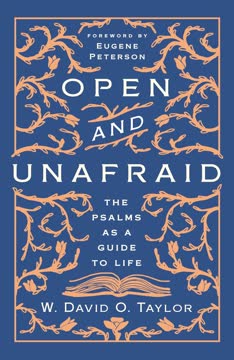
Reviews for Open and Unafraid are overwhelmingly positive, averaging 4.26/5. Readers praise Taylor's accessible yet profound writing style, his thematic exploration of the Psalms across topics like honesty, community, anger, and justice. Many highlight the reflection questions and exercises at each chapter's end as excellent for group study. Some critics note a lack of deep academic rigor or global perspective. The book is widely recommended for personal devotion and small group settings, with notable foreword by Eugene Peterson and afterword by Bono.
People Also Read
 Immersive