

Key Takeaways
Stop asking how smart AI is; ask how it rewires the system
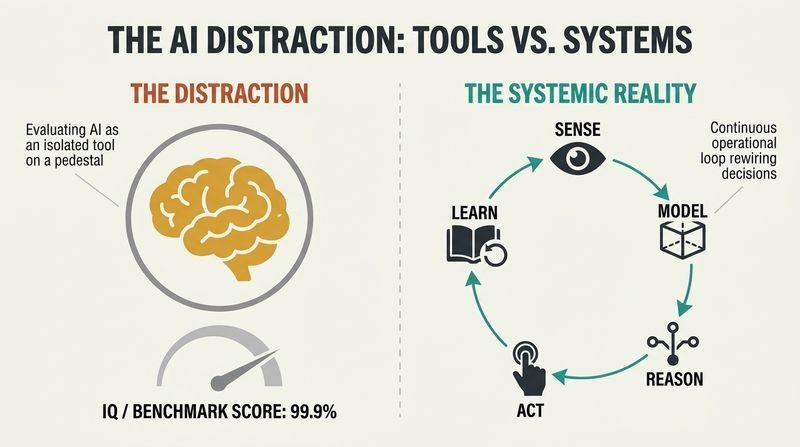
The intelligence question is a distraction. Choudary argues that debates about consciousness, creativity, and artificial general intelligence blind us to what matters economically. AI does not need to think like a human to reshape an economy. It processes patterns, predicts, and acts, following five steps: sense the environment, model it, reason, act, and learn. Google Maps and ChatGPT run the same loop despite looking nothing alike.
Systems, not tools, determine impact. The real lesson comes from Singapore's 2021 COVID collapse. Near-perfect contact tracing failed because the virus slipped through an unmonitored visa lane and discretion-loving KTV lounges that ignored compliance. The technology worked; the system it entered defied its assumptions. AI's power lies in restructuring how decisions get made, not in benchmark scores.
What's striking is how Choudary sidesteps the entire AGI shouting match that dominates AI discourse. His framing echoes economist W. Brian Arthur's work on technology as a system of interlocking components rather than isolated inventions. The Singapore parable also resonates with James Scott's Seeing Like a State, where high-modernist schemes fail because they ignore local, illegible reality. One caveat: dismissing intelligence entirely risks underrating genuine capability jumps. A model that reasons across domains could collapse the tool-versus-system distinction. Still, the reframe is bracing: most organizations obsess over model accuracy while their workflows, governance, and institutions remain the true bottleneck.
AI's real superpower is coordinating fragmented systems without requiring consensus
Coordination beats automation. The shipping container did not just speed up ports; it forced trucks, trains, ships, and customs into one reliable system through a single contract and standardized dimensions. Singapore bet on becoming a coordination hub, not just a faster port, and became an economic powerhouse. Coordination means aligning independent players toward outcomes none could reach alone.
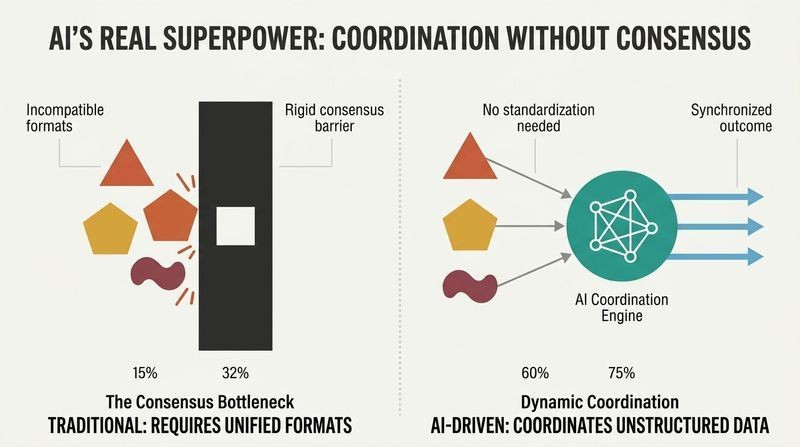
AI extends coordination where consensus was impossible. Older coordination required either a dominant enforcer (Walmart forcing barcodes) or upfront agreement (container standards). AI needs neither. By reading unstructured data (photos, emails, voice notes), it builds a shared understanding across parties who never agreed on formats. A travel assistant coordinates airlines, hotels, and guides that speak different digital languages. As value accrues, holdouts converge voluntarily. Value creates gravity, and gravity drives coordination.
This is Choudary's most original contribution, extending the platform economics of his earlier work into AI. It connects to Ronald Coase's theory of the firm: firms exist to reduce coordination costs, so when those costs collapse, organizational boundaries dissolve. The claim that AI coordinates without consensus is genuinely novel and challenges the standards-body model that governed prior tech waves. A skeptic might note that coordination without consensus can produce fragile, unaccountable systems where liability is murky when things break. Choudary acknowledges this tension. The deeper insight endures: the scarcest resource in a fragmented economy is not production but the ability to make disconnected parts cohere.
Your job is a temporary bundle of tasks that AI will reshuffle
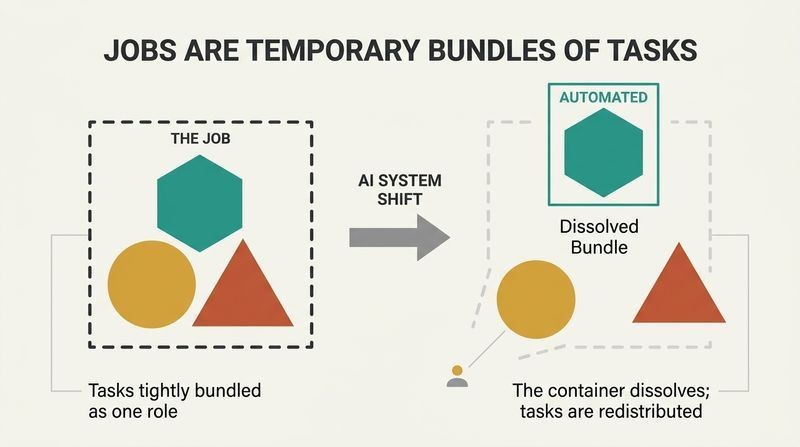
Jobs are artifacts, not fixed things. The popular mantra 'AI won't take your job, but someone using AI will' is like France's Maginot Line: a perfect answer to a war that no longer exists. It assumes the system of work stays put. Choudary counters that jobs are temporary groupings of tasks that make sense only within a given system. Change the system and the bundle dissolves.
The typist proves the point. Word processors did not eliminate typing; people type more than ever. They eliminated the typist, whose role existed only because fixing errors was once expensive. When basketball adopted analytics and prized three-point shooting, fixed positions like the pure center lost value even though dribbling and shooting never disappeared. Tasks persist; the logic that bundled them into a paid role evaporates.
The task-versus-system distinction is Choudary's sharpest tool for cutting through reskilling panic. It builds on the task-based labor economics of Autor, Levy, and Murnane, but pushes further: those economists asked which tasks automate, while Choudary asks whether the system still needs the bundle at all. The Maginot Line analogy is apt and memorable. The unsettling implication for workers is that competence at your tasks offers no protection if the architecture around them shifts. This mirrors how skilled telegraph operators vanished not because they lost skill but because telephony made the coordination they provided obsolete.
Chase the constraint, not the skill AI can't yet do
Constraints, not tasks, hold value. When AI commoditizes a skill, its economic value collapses because scarcity vanishes. Chasing the next task AI cannot do is a race with no finish line. Instead, find the new constraint the system now struggles with. Constraints come in three flavors: scarcity-based (limited access), risk-based (high consequences), and coordination-based (many parts must align).
The sommelier lives in the future. When wine knowledge became Googleable, the sommelier should have died. Instead the role grew more valuable by managing new constraints: choice overload and the emotional risk of picking wrong. Radiologists thrived despite AI beating them at reading scans, by rebundling toward judgment and tumor-board deliberation. Nurse navigators emerged to stitch together patient journeys that digitization fragmented. Identify what breaks, then rebundle capabilities around fixing it.
Reframing careers around constraints rather than skills is quietly radical and more durable than typical future-of-work advice. It parallels Eliyahu Goldratt's Theory of Constraints from operations management, now applied to human labor. The move from 'what can I do that machines can't' to 'what friction has the new system created' is a genuine cognitive upgrade. One tension worth flagging: identifying a constraint is necessary but not sufficient. Choudary himself notes the Tuareg guides who solved a critical navigation constraint yet captured little value because they were invisible and uncoordinated. Solving friction only pays when the system can see, price, and reward you for it.
Whether you work above or below the algorithm decides your fate
Two positions, opposite trajectories. In algorithmically managed systems, above-the-algorithm workers design and exploit the coordination logic to amplify their output: engineers, data scientists, anyone whose pay is tied to the system's growth. Below-the-algorithm workers are managed by it, assigned tasks, scored on narrow metrics, and rendered interchangeable. The Uber data scientist and the Uber driver both use AI, but only one captures the value.
Augmentation is a false comfort. Uber drivers got GPS, yet the premium for fast delivery flowed to the platform as brand value. Amazon warehouse workers were augmented by Kiva robots, yet their roles kept narrowing to serve the fulfillment system. Even knowledge workers (fashion designers at Shein, copywriters) get pushed below the algorithm as AI absorbs their judgment. The capital-labor divide is being redrawn along this axis.
This reframes the gig-economy critique with unusual precision. The above/below distinction sharpens Shoshana Zuboff's concerns about behavioral control and connects to labor scholar Alex Rosenblat's ethnography of Uber drivers managed by opaque metrics. The insight that augmentation can quietly strip value while preserving the job is the chapter's dark gem: it dissolves the reassuring automation-versus-augmentation binary. What deserves emphasis is that compensation structure (equity versus wages) tracks the divide, aligning above-workers with capital. A challenge: the boundary is porous, and Choudary notes knowledge workers can slide downward as their contributions become substitutable, which means today's above-workers should not assume permanent safety.
AI dissolves the trade-off between team autonomy and coordination
The coordination tax is the hidden drain. Choudary contrasts Real Madrid's Galacticos (superstars with no structure, chronic underperformance) against Guardiola's Barcelona, where positional discipline amplified individual freedom. Organizations pay a coordination tax: endless meetings, redundant emails, mental bandwidth spent staying in the loop. It grows exponentially with scale. NASA lost a 125 million dollar Mars orbiter because one team used pound-force and another assumed Newtons.
AI turns the seesaw into a flywheel. Generative AI converts unstructured knowledge (call recordings, contracts, Slack threads) into shared, searchable intelligence, then serves the right insight to the right team. Ramp studied its best salesperson, then rebuilt his relentless manual process as autonomous agentic workflows. Better coordination now enables more autonomy, which enables better coordination. Deploy AI narrowly for isolated automation, though, and you fragment the org, raising the tax instead.
The autonomy-coordination flywheel is a genuine contribution to organizational design, updating Coase and Oliver Williamson for the AI era. The coordination tax names something every knowledge worker feels but rarely quantifies. Choudary's warning about the coordination paradox (piecemeal AI adoption making things worse) is empirically grounded: uneven automation creates mismatched clockspeeds between teams. The Barcelona example elegantly shows structure as an enabler rather than a constraint, echoing research on how constraints boost creativity. A useful caution: the vision assumes AI can faithfully capture tacit organizational knowledge, which remains partly aspirational. Much institutional wisdom resists codification precisely because it lives in relationships and context.
Build businesses by renting modular blocks, then defend with constraints
Everything is now a rentable building block. MrBeast launched a burger chain overnight with no kitchens or staff, renting ghost kitchens and delivery services, powered by his audience. Cloud computing turned servers, payments, and delivery into on-demand components. AI now does the same to expertise, unbundling knowledge from labor so it becomes rentable, recombinable, and scalable at near-zero marginal cost.
But assembly is easy; constraints are the moat. MrBeast Burger collapsed into cold-fries complaints because he never managed quality control across ghost kitchens. The weakest link, not any single part, breaks a rebundled business. Muji thrives in a world of cheap manufacturing precisely by imposing positive constraints: no-brand minimalism forces a distinctive supply chain competitors cannot copy. When execution is trivial, the discipline of chosen limits, not the tools, creates defensibility.
The building-block economy vividly captures the composable-business trend, but Choudary's twist is the constraint-as-moat argument, which inverts conventional strategy. It resonates with the 'wrapper' problem now haunting AI startups that add a thin layer over foundation models and get absorbed when the model provider ships the feature natively. The Muji case is a superb illustration of how deliberate limitation creates identity and defensibility, echoing design principles from Dieter Rams. Andrej Karpathy's coinage of 'vibe coding' captures the risk perfectly: when creation feels effortless, output drifts toward meaningless. The enduring lesson is that in an age of frictionless execution, judgment about what NOT to build becomes the scarce differentiator.
Never let someone else's AI become the engine of your business
Tools bolt on; engines require integration. Choudary distinguishes AI as a tool (isolated, swappable, improves efficiency) from AI as an engine (determines system performance, changes how you compete). TikTok used AI as an engine, building a behavior graph from what you watch rather than a social graph of who you know, making the incumbents' network moat irrelevant. Facebook merely bolted AI onto its existing architecture.
Dependence is the trap. When the engine belongs to a third party, tighter integration means deeper lock-in. Uber built on Google Maps, then watched Google spin up Waymo to compete. Tool providers hold three structural advantages: they learn across the whole ecosystem, expand their scope, and innovate at a faster clockspeed than the businesses built on them. If losing access to a tool would cripple you, own it, as Amazon did by acquiring Kiva robotics.
The tool-versus-engine framing gives leaders a concrete build-versus-buy heuristic that is refreshingly clear: what happens if you lose access. The Uber and Google saga is a cautionary tale about training your future competitor, echoing Charlie Munger's observation that productivity gains from new technology often flow to tool providers or end customers, not the adopter in between. The clockspeed concept, borrowed from MIT's Charles Fine, is underappreciated: a fast-moving component forces the whole system to its pace. One nuance Choudary grants: not every tool must be owned. In competitive tool markets with low switching costs, renting is rational. The danger is specifically the tool that quietly becomes your performance layer.
Value flows to whoever absorbs risk, not whoever performs the task
Solutions absorb risk; tools amplify performance. Robots met benchmarks yet stalled on factory floors because buyers faced upfront cost, workflow disruption, and downtime risk. Formic cracked adoption not with better robots but by charging per hour, owning maintenance, and absorbing the risk: if robots don't work, Formic doesn't get paid. Residential solar spread through financing innovation (leases, power purchase agreements), not better panels.
Business models climb a risk ladder. Providers can charge for work (Rolls-Royce sells engine-hours), results (Orica guarantees blast-fragment size, not explosives), or outcomes (pharma pricing tied to patient response). Each rung means more risk, deeper integration, and higher reward. This threatens professional services: if AI does the skilled work and insurers price the liability, law and consulting firms get squeezed from both sides, since their real product was assuming accountability.
Reframing solutions as risk absorption rather than capability is one of the book's most practically useful moves for anyone selling technology. It draws on the servitization literature (Rolls-Royce Power-by-the-Hour is the canonical case) and Thomas Hughes's concept of the system builder from the history of electrification. The professional-services squeeze is a provocative, contestable prediction: it assumes liability can be cleanly unbundled from expertise and priced by insurers, but trust, relationships, and regulatory credentials remain sticky. The deeper principle is sound and echoes insurance economics: whoever can measure and bear uncertainty captures the premium. AI's ability to capture real-world performance data is what newly enables providers to shoulder that risk confidently.
Win by simplifying the customer's hardest decision, then rebundle around it
Decision support is the new moat. As choice explodes, confidence becomes scarce. Best Buy survived Amazon not by cutting prices but by turning stores into decision hubs with trained advisors, then guaranteeing price parity so browsing converted to buying. It earned a control point (a position others must route through), then rebundled the ecosystem: brands like Samsung paid for access to customers they could not reach otherwise.
Own direct demand to command derived demand. Nobody wants a mortgage; they want a home. Sephora captured the primary emotional need (beauty, confidence) via tools like Color IQ, turning powerful brands into dependent players on its shelves. Whoever meets the customer at the moment of uncertainty gains outsized power. AI supercharges this by simplifying complex choices, but deploy it through trusted intermediaries when errors carry high risk and liability.
The control-point-plus-rebundling playbook is the strategic heart of the book applied to customers, and the direct-versus-derived-demand distinction is a clarifying lens borrowed from economics. Best Buy's reversal of showrooming from threat to advantage is a genuinely instructive turnaround, and the price-parity insight (price wars signal you are locked out of the journey) is quotable and true. The Glossier arc, where a direct-to-consumer darling eventually needed Sephora's shelves, is a strong empirical check on the fantasy of bypassing ecosystems. A thoughtful reader might push on the risk calibration: deploying AI behind human experts reduces liability but also caps the scale advantage, a trade-off that varies sharply by industry stakes.
Control comes from dependence you create, not customers you own
Coordination earns control. Amazon's Alexa had scale, distribution, and 100,000 skills yet failed because it never solved the coordination problem: users had to memorize exact syntax and could not chain services. It asked partners to build but never equipped them to work together. Control points are created through dependence, and no one truly depended on Alexa.
Consensus-based versus learned coordination. CCC coordinates 30,000 auto-claims stakeholders by making everyone adopt shared damage codes (consensus). Tractable achieves the same alignment from raw smartphone photos, learning implicit standards without asking anyone to agree upfront (coordination without consensus). Both align insurers and repair shops, but Tractable's AI-driven rebundling can organize ecosystems where consensus was never practical, solving the cold-start problem by delivering value before anyone commits. Coordination breeds dependence; dependence becomes control.
Alexa as a cautionary tale is counterintuitive and valuable precisely because it looked like a winner on every conventional metric. The lesson that control flows from solving the coordination problem others cannot, rather than from owning the interface, reframes platform power away from gatekeeping toward indispensability. The CCC-versus-Tractable contrast crisply operationalizes the coordination-without-consensus thesis that anchors the whole book. This connects to network-effects theory and the cold-start problem articulated by Andrew Chen: AI's edge is that it can bootstrap value unilaterally rather than waiting for critical mass. The honest limitation Choudary raises is accountability: coordination without consensus leaves liability ambiguous, so mature ecosystems eventually need formal agreement to assign responsibility.
Don't build an AI strategy; reshape the playing field AI creates
Strategy still means where to play and how to win. Asking for an AI strategy is like requesting a prescription before a diagnosis. Companies fall into three traps: chasing transient wins, mistaking speed for direction (Yahoo mastered agile yet bet on human editors as the web exploded), or endless experimentation. Chegg surged during COVID then lost 99 percent of its value to ChatGPT, not because it stopped evolving but because the system evolved faster.
Four postures, four fates. Reactive optimizers speed up old tasks. Anticipators (Gretzky, skating to the puck) spot value migration but keep playing the old game. Logic shifters (Steph Curry's three-point revolution) change the rules. Field reshapers (Tiger Woods forcing courses to be redesigned) restructure the entire arena. Singapore won trade not through location alone but by solving coordination and risk constraints others ignored. Reshuffle the deck, or get reshuffled.
Closing on strategy rather than technology is the book's thesis made actionable: AI is a condition to design around, not a product to bolt on. The Gretzky-Curry-Woods progression is a memorable taxonomy that maps neatly onto disruption theory, distinguishing sustaining moves from those that alter the competitive terrain itself. Chegg is a sobering, recent case that grounds the abstraction. The framework's power is also its risk: field-reshaping is rare and often visible only in hindsight, so the advice can read as survivorship bias dressed as prescription. Still, the core discipline (start from the shifting system, work inward to tools, never the reverse) is a genuinely better default than the tool-first instinct most organizations bring to AI.
Analysis
Reshuffle is a thesis-driven business strategy book that stakes out a contrarian position in an overheated field. While most AI commentary oscillates between doom (mass unemployment) and utopia (abundance for all), Choudary argues both camps commit the same error: they treat AI as a tool that plays the existing game better or worse, when its real force is restructuring the game itself. The book's intellectual lineage runs through his platform economics work and connects to Coase and Williamson on transaction costs, Thomas Hughes on system builders, and the task-based labor economics of Autor and colleagues.
The organizing concept is coordination. Choudary's central and most defensible claim is that value in the modern economy flows to whoever can align fragmented actors, and that AI's genuinely novel capability is coordination without consensus: reading unstructured data to make disconnected parties cohere without prior agreement on standards. This reframes AI away from the intelligence question entirely, which is both the book's strength and a potential blind spot. If models achieve robust cross-domain reasoning, the tool-versus-system boundary he draws may blur.
The unbundling-rebundling framework threads through every level: jobs, organizations, value chains, ecosystems. It is elegant and portable, though occasionally so flexible it risks becoming unfalsifiable, explaining any outcome after the fact. The strongest chapters are the pragmatic ones: tool-versus-engine, risk absorption as the source of value capture, and above-versus-below the algorithm, which sharpens gig-economy critiques with real precision.
What distinguishes the book is its refusal of prediction. Choudary explicitly declines to forecast AI's trajectory, offering instead durable mental models. This is honest and wise given how fast the ground shifts, but it also means readers seeking concrete roadmaps will leave with frameworks rather than instructions. The recurring weakness is that coordination without consensus produces accountability gaps he acknowledges but does not fully resolve. For executives and strategists, it is among the most conceptually rigorous AI books available.
Review Summary
Reshuffle earns strong praise (4.48/5) for its framework-driven approach to understanding AI's systemic impact on work and organizations. Reviewers appreciate how it moves beyond task automation to explain how AI restructures value creation through coordination without consensus. The book's key insight—follow constraints, not skills—resonates with readers. Strengths include accessible language, practical examples, and strategic frameworks. Common criticisms mention repetitiveness and lack of editing polish. Recommended for knowledge workers, strategists, and business leaders seeking actionable understanding of AI's transformational effects on competitive advantage and career positioning.
People Also Read




Glossary
Coordination without consensus
AI aligning parties without prior agreementAI's ability to make fragmented actors work together without requiring them to agree on shared standards, formats, or rules upfront. By interpreting unstructured data from each participant, AI builds a common understanding and drives aligned action. As value accumulates, holdouts converge voluntarily. This contrasts with older coordination that needed either a dominant enforcer or negotiated standards.
Unbundling and rebundling
Systems break apart, then reassembleChoudary's core framework for how systems change. When a constraint (cost, time, coordination) collapses, the system built around it breaks into components (unbundling). A new coordination logic then reassembles those components into fresh configurations (rebundling). Applies across jobs, organizations, value chains, and ecosystems. Example: albums unbundled into songs, then rebundled into algorithmic playlists.
AI as tool versus AI as engine
Bolt-on efficiency versus core performance driverA tool performs an isolated, swappable function that improves efficiency without changing how a business competes. An engine determines overall system performance, so the business must be redesigned around it. TikTok used AI as an engine (behavior graph) while incumbents bolted it onto existing architectures. Building on someone else's engine creates dangerous dependence.
Above-the-algorithm versus below-the-algorithm
Who commands versus who obeys AIIn algorithmically managed systems, above-the-algorithm workers design or exploit the coordination logic to amplify their output and often share in the system's growth through equity. Below-the-algorithm workers are assigned, scored, and managed by the system, rendered interchangeable with limited autonomy. The Uber data scientist versus the Uber driver.
Coordination tax
Hidden cost of keeping teams alignedThe silent, escalating cost organizations pay to keep teams aligned: redundant meetings, clarifying emails, document hunting, and mental bandwidth spent staying informed. It grows exponentially with scale. Choudary argues AI can dismantle it by turning unstructured knowledge into shared, searchable intelligence served to the right team at the right moment.
Contextual value
A task's worth within its systemThe value a task or role holds because of its position within a specific system of work, based on the constraint it resolves rather than its skill or difficulty. A task can have high contextual value in one workflow and none in another. AI shifts contextual value by reorganizing workflows, making some roles pivotal and others irrelevant.
Control point
Position others must route throughA strategic position in a system or ecosystem that others must work through to create or deliver value. Control points create power not by owning customers directly but by becoming indispensable, either by simplifying a customer's key decision (demand side) or by solving the coordination problem partners cannot solve themselves (supply side).
Positive constraint
Deliberate limit that shapes performanceA chosen design boundary that guides and amplifies system performance and creates differentiation, as opposed to a negative constraint (an accidental bottleneck that limits performance). TikTok's original 60-second video cap and Muji's no-brand minimalism are positive constraints that shaped behavior and built defensibility.
Clockspeed
Relative rate of innovationThe pace at which different layers of a value chain evolve. AI tool providers often innovate far faster than the businesses adopting them, and when a fast-moving component enters a slow system, it forces the whole system to adapt to its pace. This speed gap tilts power toward tool providers.
Work, results, and outcomes as a service
Three risk-based business model rungsA ladder of solution-provider models with increasing risk and reward. Work-as-a-service charges for reliable operation (Rolls-Royce engine-hours). Results-as-a-service charges for measurable improvement (Orica's guaranteed blast-fragment size). Outcomes-as-a-service ties payment to a customer's strategic outcome (pharma pricing linked to patient response), requiring deep integration and heavy liability.
Agentic execution
Goal-driven autonomous AI actionAI agents that pursue a defined goal by monitoring context, making decisions, and acting across workflows without human input at each step. Unlike traditional automation that follows rigid rules, agentic systems adapt and recalibrate to stay aligned with the objective, as when a travel assistant rebooks a disrupted trip.
Field reshaper
Company that restructures entire arenaThe most transformative of Choudary's four AI strategic postures. Reactive optimizers speed up old tasks; anticipators spot value migration but keep the old game; logic shifters change the rules (Steph Curry's three-pointer); field reshapers restructure the whole competitive ecosystem (Tiger Woods forcing course redesigns, Climate Corp reorganizing agriculture).
Download PDF
Download EPUB
.epub digital book format is ideal for reading ebooks on phones, tablets, and e-readers.








































