Key Takeaways
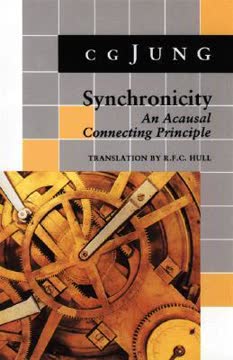
1. Synchronicity: An Acausal Connecting Principle
Synchronicity therefore means the simultaneous occurrence of a certain psychic state with one or more external events which appear as meaningful parallels to the momentary subjective state—and, in certain cases, vice versa.
Challenging causality. Modern physics has revealed that natural laws are statistical truths, not absolute, especially at the quantum level. This implies that the causal principle, while useful, is not universally valid and may require complementary explanatory factors. Synchronicity emerges as such a factor, describing connections between events that defy traditional cause-and-effect logic.
Meaningful coincidences. Unlike mere chance, synchronistic events are characterized by a profound, often numinous, meaningfulness that links them, despite the absence of any discernible causal chain. These are not random occurrences but rather "meaningful coincidences" that resonate deeply with an individual's inner state. Examples include:
- The "duplication of cases" where the same number appears repeatedly in unrelated contexts.
- Jung's personal "fish series" where the fish motif appeared six times in 24 hours.
Beyond rational explanation. Such events often leave observers with an undeniable impression that "this cannot be mere chance," even if a rational, causal explanation remains elusive. Synchronicity offers a framework to understand these phenomena, suggesting that meaning itself can be a connecting principle in the universe, independent of physical causation.
2. Beyond Causality: The Psychic Relativity of Space and Time
Causality is bound up with the existence of space and time and physical changes, and consists essentially in the succession of cause and effect. For this reason synchronistic phenomena cannot in principle be associated with any conceptions of causality.
ESP experiments defy physics. J.B. Rhine's experiments in Extra-Sensory Perception (ESP) and Psychokinesis (PK) provide compelling empirical evidence for acausal connections. These studies demonstrated that subjects could guess cards or influence dice throws with results significantly above chance probability. Crucially, these effects were not diminished by:
- Increased spatial distance (up to 4,000 miles).
- Temporal separation (guessing cards to be laid out in the future).
Space and time are elastic. The independence of ESP results from spatial and temporal factors suggests that space and time are not absolute constants but are "psychically variable" or "elastic." This implies that the psyche can, under certain conditions, reduce these dimensions almost to vanishing point, making causal explanations, which rely on fixed space-time, impossible.
A new understanding of reality. If space and time are psychically relative, then the traditional causal model of the universe is incomplete. Synchronicity proposes that events can be related not just by causal chains but also by a "meaningful cross-connection," where the simultaneity of events is the primary link, rather than a preceding cause.
3. The Unconscious and Archetypes as Ordering Factors
Here I will only point out that it is the decisive factors in the unconscious psyche, the archetypes, which constitute the structure of the collective unconscious.
Unconscious knowledge. Synchronistic events often involve an "a priori, causally inexplicable knowledge" of a situation that is otherwise unknowable. This knowledge emerges from the unconscious, either directly as an image or indirectly as a dream or premonition, coinciding with an objective external event.
Archetypes as patterns. The collective unconscious, a universal and identical psyche in all individuals, is structured by archetypes. These are:
- Formal factors that organize unconscious psychic processes.
- "Patterns of behavior" that carry a "specific charge" and numinous effects.
- Psychoid in nature, meaning they are not directly perceptible but influence both psychic and physical realms.
Constellating the archetype. Strong emotional states or "impossible" situations (where rational solutions fail) tend to constellate archetypes. This activation can lead to a "lowering of orientation" in consciousness, allowing unconscious contents to break through and manifest as synchronistic phenomena, providing a deeper, symbolic meaning to the coinciding events.
4. The Crucial Role of Affect and Expectation
Lack of interest and boredom are negative factors; enthusiasm, positive expectation, hope, and belief in the possibility of ESP make for good results and seem to be the real conditions which determine whether there are going to be any results at all.
Emotional catalysts. The success of ESP experiments, and the occurrence of spontaneous synchronistic phenomena, are profoundly influenced by the subject's emotional state. Enthusiasm, positive expectation, hope, and belief act as positive factors, while boredom, skepticism, and resistance yield negative results.
Abaissement du niveau mental. Emotional states produce an "abaissement du niveau mental," a narrowing of consciousness that simultaneously strengthens the unconscious. This shift creates a gradient for unconscious contents, often archetypal, to surface and influence conscious perception or external events.
Ancient wisdom. This connection between intense affect and "magical" or synchronistic happenings was recognized by ancient thinkers like Avicenna and Albertus Magnus. They believed that a human soul swept into "a great excess of love or hate or the like" could "alter things" or "bind things," suggesting an intuitive understanding of the psyche's role in shaping reality.
5. Mantic Arts: Ancient Methods for Grasping Wholeness
The I Ching, which we can well call the experimental foundation of classical Chinese philosophy, is one of the oldest known methods for grasping a situation as a whole and thus placing the details against a cosmic background—the interplay of Yin and Yang.
Intuitive techniques. Mantic procedures like the I Ching (Book of Changes) and geomancy are ancient methods designed to grasp a "total situation" by connecting an inner psychic state with an outer physical process through an acausal, synchronistic principle. Unlike Western science, which isolates variables, these methods embrace the fullness of nature's expression.
Meaning as the link. The Chinese philosophical concept of Tao, interpreted as "meaning," underlies these practices. It posits that the same living reality expresses itself simultaneously in the psychic state of the questioner and in the chance arrangement of physical elements (e.g., yarrow stalks or coins), creating an "equivalence of meaning."
Beyond rational inquiry. These methods do not impose conditions on nature but allow it to "answer out of its fullness." The resulting hexagrams or figures are rationally unintelligible answers to an unknown question, yet their interpretations formulate an "inner unconscious knowledge" that meaningfully coincides with the external chance results.
6. The Astrological Experiment: A Case of Meaningful Coincidence
It really does look as if the statistical material had been manipulated and arranged so as to give the appearance of a positive result.
Testing tradition. Jung conducted a statistical experiment using marriage horoscopes to investigate the empirical basis of astrological claims, specifically focusing on traditional marriage aspects like Sun-Moon, Moon-Moon, and Moon-Ascendant conjunctions. He aimed to see if these aspects occurred with a frequency exceeding chance probability in married couples.
Paradoxical findings. Initial batches of horoscopes showed statistically improbable maxima for precisely these three classical lunar aspects, suggesting a meaningful coincidence with astrological tradition. For example, the probability of the three classical moon conjunctions appearing as maxima in the way they did was calculated to be 1 in 62,500,000.
Synchronicity in action. Despite later corrections that reduced the statistical improbability, the consistent appearance of these specific traditional aspects as maxima was striking. Jung concluded that this was not a causal proof of astrology but rather a "synchronistic phenomenon" – a meaningful coincidence where the statistical material itself seemed "manipulated" by the researchers' unconscious interest and expectation, mirroring the very principle being investigated.
7. Numbers as Archetypes of Order
Number, therefore, is in one sense an unpredictable entity. Although I would not care to undertake to say anything illuminating about the inner relation between two such apparently incommensurable things as number and synchronicity, I cannot refrain from pointing out that not only were they always brought into connection with one another, but that both possess numinosity and mystery as their common characteristics.
Mysterious entities. Numbers are not merely human inventions or concepts of quantity; they are also "found" or "discovered," possessing a relative autonomy akin to archetypes. They carry a "numinous aura" and are considered irreducible, forming the most primitive element of order in the human mind.
Archetypes of order. Numbers, particularly 1 to 4, frequently appear in primitive patterns of order (triads or tetrads) and in spontaneous psychic images of wholeness, such as mandalas. This suggests that numbers function as "archetypes of order" that have become conscious, not only expressing order but also creating it within the unconscious.
Connecting inner and outer. The archetypal nature of numbers implies a deep connection between numerical patterns and psychic processes. This link is crucial for understanding synchronicity, as it suggests that the ordering principle observed in meaningful coincidences might be fundamentally numerical, reflecting an inherent "orderedness" in both the psyche and the external world.
8. Historical Echoes: Precursors to Synchronicity
The universal principle is found even in the smallest particle, which therefore corresponds to the whole.
Ancient wisdom. The idea of an acausal connecting principle, or "meaningful orderedness," has deep roots in ancient and medieval thought, long before modern science emphasized causality. Philosophers and mystics across cultures intuitively grasped a hidden interconnectedness of all things.
Key historical concepts:
- Tao (Chinese philosophy): "Meaning" or "purpose" that organizes reality, where opposites cancel out but are potentially present.
- Sympathy of all things (Hippocrates, Plotinus): A common flow and breathing, where all parts of the organism and the world work in conjunction.
- Microcosm/Macrocosm (Philo, Pico, Paracelsus): Man as a "miniature heaven" or "little God of the world," reflecting the universal order and containing the "images of all creation."
- Pre-established harmony (Leibniz): An absolute synchronism of psychic and physical events, like two synchronized clocks, where monads (souls) are "living mirrors of the universe."
A lost perspective. This rich tradition of "correspondence" and "prefiguration" was largely eclipsed by the rise of scientific causality in the 18th and 19th centuries. Synchronicity seeks to reclaim and re-evaluate this older perspective, grounding it in empirical observation rather than purely philosophical speculation.
9. Synchronicity as a Fourth Principle of Nature
Here synchronicity is to the three other principles as the one-dimensionality of time is to the three-dimensionality of space, or as the recalcitrant “Fourth” in the Timaeus, which, Plato says, can only be added “by force” to the other three.
Completing the worldview. Synchronicity is not merely a philosophical concept but an "empirically necessary principle" that complements the classical triad of space, time, and causality. It forms a "quaternio" (a four-fold structure) that allows for a more complete understanding of reality, especially phenomena that defy causal explanation.
The new tetrad:
- Indestructible Energy (replacing space)
- Space-Time Continuum (replacing time)
- Constant Connection through Effect (Causality)
- Inconstant Connection through Contingence, Equivalence, or "Meaning" (Synchronicity)
Acausal orderedness. Synchronicity, in its broader sense, encompasses all "acts of creation" and "acausal orderedness," including the properties of natural numbers and the discontinuities of modern physics (e.g., energy quanta, radioactive decay). It represents a "modality without a cause," an irreducible contingency that is "Just-So."
10. Rethinking the Body-Soul Connection
If that is so, then we must ask ourselves whether the relation of soul and body can be considered from this angle, that is to say whether the co-ordination of psychic and physical processes in a living organism can be understood as a synchronistic phenomenon rather than as a causal relation.
Beyond causal dilemmas. The body-soul problem has long been a philosophical impasse: how can physical processes cause psychic events, or an immaterial psyche move matter? Synchronicity offers a third way, proposing that the coordination of psychic and physical processes in a living organism might be a synchronistic phenomenon, an "acausal orderedness," rather than a causal one.
Consciousness in altered states. Remarkable observations during deep syncopes or comas, where normal conscious activity and sense perception are suspended, reveal that consciousness, perceptions, and judgments can still occur. Patients report "levitation" and observing events from outside their bodies, with verifiable details.
Transcerebral thought. These cases, along with studies on animal behavior (like bees communicating direction and distance), suggest the existence of "transcerebral thought and perception." This implies that psychic functions might not be exclusively tied to the cerebrum but could also be carried by other nervous substrates, like the sympathetic system, or manifest as synchronistic phenomena independent of organic processes.
Review Summary
Reviews of Synchronicity are mixed, averaging 4.01/5. Admirers praise Jung's bold, thought-provoking exploration of meaningful coincidences, quantum parallels, and philosophical connections to Taoism and archetypes. Many readers share personal synchronistic experiences that resonate with Jung's ideas. Critics, however, highlight serious flaws: reliance on Rhine's discredited parapsychology research, questionable statistical methodology, and unconvincing astrological experiments. Some find the writing dense and inaccessible to general audiences. Despite its shortcomings, most agree the concept itself is fascinating and intellectually stimulating, even if Jung fails to provide rigorous empirical proof.
People Also Read

 Immersive