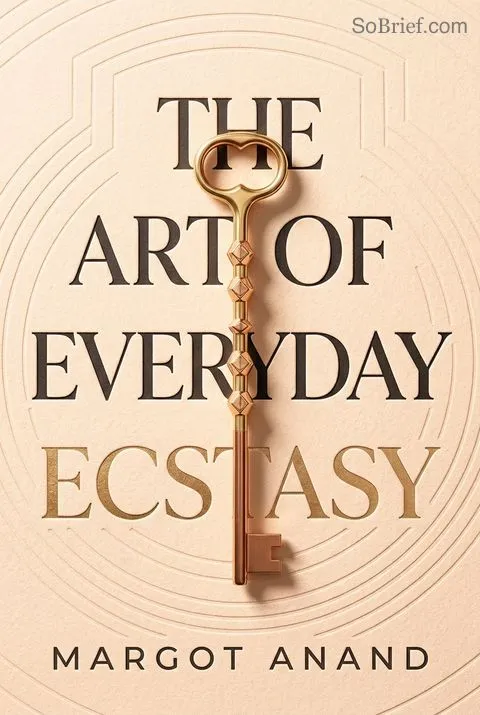
Key Takeaways
1. Ecstasy is an everyday, accessible state of joyful aliveness.
"ECSTASY IS ABOUT WAKING UP AND FINDING THAT YOU ARE IN LOVE WITH LIFE.”
Beyond sexual pleasure. Ecstasy is often narrowly defined as sexual, but it encompasses a broader, more profound state of intense contentment and inner joy. It's a "steady stream of joyful aliveness" that connects us to our Source, allowing us to live passionately and with spiritual focus. This expanded definition includes both "Ecstatic Awakenings"—moments of epiphany—and "EveryDay Ecstasy," a continuous connection to inner wisdom and power.
Inherent human potential. Psychologist Abraham Maslow's research on "peak experiences" found that "Almost all people have or can have peak experiences," indicating that ecstasy is a natural human capacity. It's not something we acquire but rather our true nature, programmed into us from conception. We are born to enjoy, love, and create beauty, and ecstasy is a skill we can learn to master and integrate into our daily lives.
Life's simple moments. Ecstasy isn't separate from ordinary life; it's present in every moment, waiting to be recognized. It's the wonder of childhood, the thrill of colors, the joy of a favorite story. By cultivating awareness and presence, we can access this natural ecstasy in simple moments, transforming mundane experiences into sacred ones and moving beyond pain and doubt to reach our highest potential.
2. Modern society's "anti-ecstatic conspiracy" dulls our spirit.
"Bringing healing, balance, and joy to our daily life in a world that is in the grip of what I term “the anti-ecstatic conspiracy” isn’t easy."
Cultural suppression. Our modern, work-obsessed, stress-filled culture actively works against our natural ecstatic state. This "anti-ecstatic conspiracy" dulls our spirits, throws us off balance, and alienates us from meaningful everyday experiences. It promotes a mindset where chronic misery and stress become normal, and money and possessions are mistakenly equated with bliss, leading to greed and consumerism.
Separation of flesh and spirit. This conspiracy is rooted in historical narratives, particularly the Judeo-Christian tradition, which separated flesh from spirit and condemned pleasure as sinful. This historical "murder of ecstasy" replaced earth-centered Goddess worship with a patriarchal model, fostering violence, demeaning feminine values, and instilling guilt and shame around sexuality. The consequences are seen in societal issues like:
- Sexual violence and abuse
- Gender confusion and conflict
- Environmental destruction
- Apathy and despair
Loss of authentic self. Through years of indoctrination, our souls are put to sleep, and we lose touch with our "original face"—our wild, innocent, ecstatic self. We become "educated" into a rigid, conventional mind-set, filtering out essential information and limiting our vision to survival. This reduced awareness, which society calls "reality," cuts us off from our potential and the infinite mysteries of the universe.
3. Tantra offers a holistic path to integrate sexuality and spirituality.
"The essence of the Tantric teachings can be summarized as this: Choose with awareness what gives you joy, and it will lead you to Spirit."
Embracing all of life. Tantra, an ancient Eastern science, is a spiritual path that uniquely includes sexuality as a doorway to ecstasy and enlightenment. Unlike ascetic traditions that suppress sexuality, Tantra teaches us to embrace and unify the ordinary, the erotic, and the sacred dimensions of life, recognizing their roots in Spirit. It challenges the notion that pleasure is a shortcut to hell, instead viewing it as a path to heaven.
Sexuality as a sacred art. Tantra has for millennia taught the cultivation of sexual love as an art and a skillful spiritual practice. At the peak of orgasm, we can "pierce through the illusion of fragmentation and separation, and glimpse the unity and interconnectedness of all beings." This potential for opening our being to ecstasy makes sexual union a form of worship and meditation, leading directly through the pleasure of the senses to spiritual liberation.
Expansion of consciousness. The Sanskrit root "tan" means "to expand." Tantra is defined as "the art of weaving the often contradictory aspects of our self or personality into a unified whole, for the purpose of expanding our consciousness." It teaches that we master desires not by avoiding them but by immersing ourselves in them with awareness. By embracing every moment in our totality—bodily, emotionally, perceptually—we can make everyday life a journey of awakening.
4. Balancing our inner masculine and feminine is crucial for wholeness.
"Ultimately, the key to ecstasy, inner peace, tribal peace, and world peace is our own individual wholeness."
The sacred marriage within. The world is full of dualities—female and male, receptive and aggressive, loving and hating—which create inner pressure. Wholeness and ecstasy arise when we find balance amid these tensions, integrating the seemingly contradictory aspects of our nature. This "sacred marriage" of our inner God and Goddess (Shiva and Shakti) is essential for creating ecstatic partnerships with others and achieving inner peace.
Healing ancestral wounds. We internalize our parents' relationship dynamics as our "inner man" and "inner woman," often carrying unhealed wounds. For men, societal pressures to reject feminine qualities can lead to emotional suppression and difficulty in relationships. For women, devaluing the feminine can cause low self-esteem and conflict with their masculine side. Healing these inner splits is paramount for authentic living and successful outer relationships.
Dynamic interplay. A balanced inner man acts with calm clarity, strength, and commitment, rooted in his connection to his inner feminine. A balanced inner woman is patient, intuitive, loving, and clear, empowered by her inner masculine. This dynamic interplay creates a unified whole, leading to endless creativity and joy. By recognizing and addressing imbalances, we can consciously cultivate these inner figures, transforming our relationships and our lives.
5. Integrating body, mind, heart, and spirit unlocks ecstatic potential.
"When your body is relaxed and grounded, when your heart is innocent and open to trust, when your mind is clear and your thoughts are nonintrusive, you can expand beyond the boundaries of self and meet others with compassion."
Four centers of being. Our body, heart, mind, and spirit are meant to function as a harmonious team, but are often in conflict. Each center is an "abode of ecstasy" or a place of suffering:
- Body: Vehicle for expression, capable of pleasure and healing.
- Heart: Emotional self, connecting us to others through love.
- Mind: Intellectual self, perceiving and interpreting.
- Spirit: Essential self, our positive, wise, and loving guide.
When these centers are aligned, energy flows freely, leading to holistic well-being.
Befriending the body. Tantra teaches us to "Be loving toward your body, befriend your body, revere your body, respect your body, take care of your body—it is God’s gift." Our body is a living miracle, constantly communicating its needs. Healing begins by accepting our body as it is, decoding "bad body thoughts" as deeper insecurities, and listening to its messages. This opens the door to pleasure and allows us to bring the "orgasm out of the bedroom into our daily life."
Opening the heart and clearing the mind. The heart, often wounded and defended, needs gentleness and forgiveness to open. This allows us to embrace our "shadow" parts and connect with others authentically. The mind, often chaotic and filled with negative programs, can be cleared by focusing on the body and heart through deep breathing and relaxation. This leads to "Sky Mind"—a clear, calm, silent awareness that underlies mental chatter and invites ecstasy.
6. Creating sacred space in our environment invites spiritual flow.
"Our environment, as our “greater body,” is an extension and a reflection of our Spirit."
Sanctuary for the soul. Creating sacred space is a conscious act to bring our spirit into harmony with our daily environment. It's a means of focusing our mind, becoming present to the sacred within, and anchoring the flow of Spirit in our physical surroundings. This concept extends beyond traditional temples to our homes, offices, and even our cars, transforming them into empowered sanctuaries.
Nature as primal sacred space. Nature is the original sacred space, nourishing and enlivening us. Spending time in nature helps us harmonize with its rhythms and cycles, reconnecting us to the "living chi" that animates all existence. The "Natural Bliss" ritual encourages mindful walking, opening all senses to the sights, sounds, and smells of nature, allowing us to be filled with its beauty and detach from purposeful activity.
Home as inner temple. Our home can become a sacred space by eliminating clutter, arranging things harmoniously, and surrounding ourselves with objects of power and beauty. This "personal feng shui" purifies and harmonizes our psyche. Rituals like "Clearing Your Space" involve physical cleaning, energetic purification with sound and scent, and filling the space with life and joy. Sacred mementos, chosen for their personal meaning, further infuse the space with spiritual energy.
7. Conscious rituals transform ordinary moments into sacred experiences.
"Through conscious use of rituals, we can recapture and reinvoke the power of the sacred in our everyday lives."
Meaning beyond routine. Our lives are filled with unconscious rituals, from greetings to celebrations. Conscious rituals, however, are deliberate actions performed with deep awareness and dedication to a higher purpose. They weave the simple strands of life into a tapestry of beauty and wholeness, opening doors to the sacred and giving significance to life's passages. Rituals can be elaborate or simple, spontaneous or planned, but their power lies in intention.
Healing and transformation. Rituals serve many purposes, including:
- Opening to Spirit and entering the ecstatic realm.
- Marking significant life transitions (birth, marriage, separation, death).
- Expressing love, gratitude, or mourning.
- Exorcising past traumas and generating renewal.
- Uniting with tradition and ancestors.
They provide a powerful forum for healing, allowing us to unite divided parts of ourselves and transform difficult emotions.
Keys to effective ritual. To create a great ritual, keep it simple, make it fun, and stay centered on your intention. Remember that you are bridging visible and invisible worlds, honoring all four centers (body, heart, mind, spirit). Rituals are dynamic and creative processes, allowing for improvisation while maintaining a clear structure with a beginning, a crescendo, and a serene end. Tools like candles, incense, music, and the four elements (fire, water, air, earth) can be used to evoke specific energies and meanings.
8. The seven chakras map our energy system for transformation.
"The chakra system is a symbolic map of our energy system, a blueprint of our pathway to ecstasy."
Energy centers. The seven chakras are spinning vortexes of energy in our bodies, drawing in life force (prana) and distributing it. They are like "antennae" that pick up cosmic vibrations and transform them. Each chakra is a rung on our evolutionary ladder, resonating with a unique frequency of life energy that we learn to master and integrate on our way to wholeness.
Orgasmic movement. Each chakra has both a female (receptive) and male (active) aspect, creating a spiraling, spinning, orgasmic movement. This "orgasm" is not just sexual but represents the building, churning, and rising of life force occurring constantly. An open chakra freely conducts this life force, irrigating and enlivening our whole being, allowing energy to flow and rise to the next level.
Interconnected system. The chakras function holographically, meaning each contains an aspect of the others and influences the entire system. When one chakra opens, all others are beneficially affected. The "Tantric Board of Directors" analogy illustrates how each chakra has a specific function—from the crown's spiritual guidance to the sexual center's foundational passion—and how their harmonious interaction is vital for the "Corporate Body" to function properly.
9. Healing past wounds and blocks is essential for energy flow.
"Our blocks, conflicts, confusions, delusions, and physical problems can make the initial opening painful."
Signs of obstruction. Chronic dilemmas, repeated thought patterns, and emotional issues are signs of blocked chakras. For example:
- First chakra (sexual center): Tenuous connection to pleasure, workaholism, or lack of motivation.
- Second chakra (belly center): Hazy personal boundaries, difficulty saying no, feeling helpless.
- Third chakra (solar center): Low self-esteem, victim mentality, inability to complete tasks.
- Fourth chakra (heart center): Inability to give or receive love, resentment, fear of intimacy.
- Fifth chakra (throat center): Difficulty expressing truth, self-criticism, nervous chatter.
- Sixth chakra (third eye center): Confusion, lack of vision, dependence on others for answers.
- Seventh chakra (crown center): Discontent, spiritual homelessness, fear of surrender.
Transformative release. When a chakra opens, often through intense experiences like deep breathing, dance, or emotional release, long-repressed emotions may burst forth. This "emotional outpouring is a response releasing an old pattern of protection that has kept the chakra closed and armored." While initially painful, this release is profoundly healing, creating new aliveness and inner space.
Embracing inner demons. Our inner demons—manifesting as powerful emotions like sadness, rage, or old memories—are not enemies but "angels in exile." By welcoming and embracing them, we can transform them into powerful allies, unlocking hidden or suppressed power and opening the door to wisdom. The "Chakra Talk" meditation provides a direct way to listen to these inner voices and receive guidance for healing.
10. Cultivating the "Witness" mind brings clarity and insight.
"The Witness experiences life directly, beyond thinking and imagining, unaffected by what happens, simply observing what is."
Sky Mind awareness. The sixth chakra, the third eye, is the seat of clarity and vision. Our thoughts and images occur within a boundless space called "Sky Mind," which is spacious and always available. The "Witness" is our awareness of this dimensionless space, observing life directly, unaffected by mental chatter. Cultivating the Witness allows us to transcend the "Monkey Mind" and achieve contentment through clear seeing.
Beyond intellectual intelligence. Intelligence is more than just thinking; it includes emotional and physical intelligence, all essential for wholeness. The intelligence of the sixth chakra is a "self-organizing intelligence of nature" that pervades all existence. When our third eye opens, we awaken to this detachment and direct observation, gaining clarity and perspective on our place and purpose within the "big picture."
Visualization and manifestation. The third eye enables us to think in pictures and project images of what we intend to create. Visualization, a powerful tool, allows us to hold a clear vision of our goals and feel them as alive and real, drawing us towards their manifestation. This power connects us by subtle energy strands to what we seek to create, turning our intentions into living realities.
11. Surrender to "what is" unlocks freedom and joy.
"When we accept this moment as it is and learn what it has to teach us, we are free."
Transcending struggle. Surrender is not a loss of free will but a melting into our highest potential, embracing "what is" rather than imposing conditions or agendas on life. This "great leap of the heart" allows us to love in all dimensions, beyond conditioning and fears. It transforms pain into wisdom and connects us to a Source vaster than any definition, leading to a state of profound freedom and joy.
The dark night of the soul. The path to awakening often involves a "dark night of the soul," where familiar attachments lose meaning, and we are left with longing and confusion. This suffering, however, has a purpose: our awakening. By recognizing its meaning, suffering becomes a wake-up call, a path to the divine. "Life as it is, is exactly the way it is supposed to be for you in this very moment." Embracing this truth frees us from the need to control or manipulate.
Meditation as being. True meditation is not forced concentration or a willful effort, but a state of conscious being, "enjoying our own nature." It arises when we surrender all effort, noticing our nature before fear or desire. This "nondoing of being" is our "Sky Mind," always present behind emotions and confusion. It's the "sparkling life force"—an intelligent, self-organizing universal intelligence that animates all existence, and we are a unique part of this living stream.
12. Commit to an ecstatic life through daily conscious choices.
"Make your commitment to ecstasy now."
Creating your day. An ecstatic life is a daily creation, beginning with conscious awareness and a clear vision. Just as one plans a dinner party, we can envision a joyous, harmonious day and prepare for it by opening all our centers. The "Ritual for Beginning the Day" guides us through each chakra, transforming potential difficulties into opportunities for abundance, flexibility, power, love, creative expression, clarity, and spiritual connection.
Simple truths for awakening. To live ecstatically, remember these truths daily:
- You have a unique purpose; find it and be energized.
- Life is a gift; reclaim it and make changes.
- Your clear intention creates magic; you are not a victim.
- Breathe deeply before any project; renew your commitment.
- Avoid sabotaging goals with your inner critic.
- Love yourself, have faith, and credit your accomplishments.
This perspective transforms every moment, even difficult ones, into an opportunity for awakening.
Ecstasy breaks and comrades. Misery thrives on routine; ecstasy loves surprise and adventure. Take "ecstasy breaks"—even five minutes to breathe and observe your surroundings, or plan longer trips to inspiring places. Find an "ecstatic comrade" to share adventures and enhance mutual joy, breaking free from predictable routines. This commitment to new experiences and supportive relationships fosters a culture of ecstasy.
Review Summary
Reviews for The Art of Everyday Ecstasy are generally positive, averaging 4.01 out of 5. Many readers appreciate its approach to integrating meditation and spirituality into daily life, with particular praise for its chakra guidance and moving meditations. Some found it transformative for their spiritual journeys, while others felt certain sections were redundant or not universally applicable. A few noted it skews toward a female audience. Common criticisms include overlapping chakra information and an overwhelming number of exercises in the latter half.
People Also Read






About the Author
Other books by Margot Anand
Download PDF
Download EPUB
.epub digital book format is ideal for reading ebooks on phones, tablets, and e-readers.








































