

Key Takeaways
Decide what deserves your emotional energy — most things don't
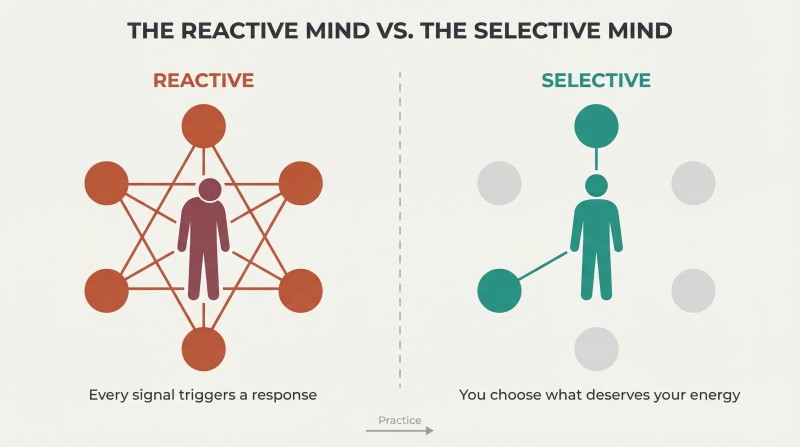
Emotional hyper-reactivity is a habit, not a trait. Research on Highly Sensitive People by Dr. Elaine Aron (1997) suggests about 20% of the population is born with more reactive nervous systems, processing emotional input more deeply than average. But wiring alone doesn't seal your fate. If childhood emotions weren't validated, you likely learned to overanalyze everything — absorbing others' moods, replaying conversations for hours, treating every emotional signal like a five-alarm fire.
The book's central thesis is surgical: this isn't about becoming emotionless. It's about recognizing that not every thought deserves belief, not every situation demands a reaction, and not every person deserves access to your peace. You've practiced reactivity for years. You can practice something different.
Your brain fills uncertainty with worst-case fiction, not facts
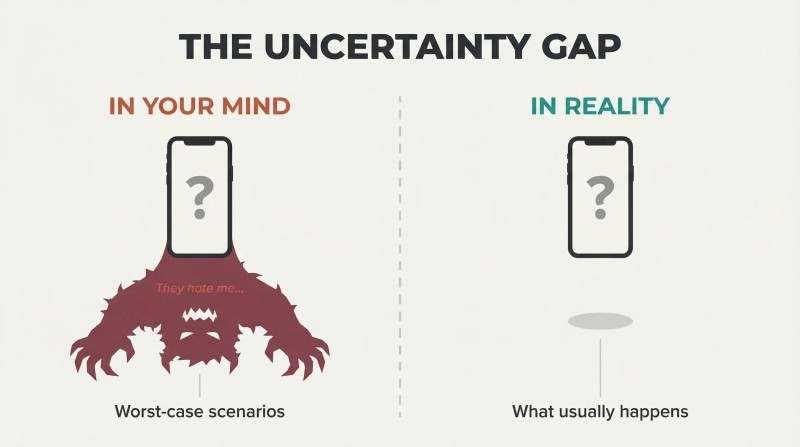
Your brain craves certainty. When someone doesn't text back, it doesn't default to "they're probably busy" — it leaps to "they're upset with me." Psychologists call this the negativity bias: negative events impact your psychological state more than equally intense positive ones (Baumeister, 2001). Combine this with Cognitive Load Theory — your brain's limited processing capacity — and you get the anxiety loop: a cycle where your brain fixates on a worry, feeds it with stress, then convinces you more thinking will "solve" it. Like quicksand, the harder you struggle, the deeper you sink.
Think of your mind like a cluttered bedroom. When it's packed with unprocessed stress, even dropping your phone feels catastrophic — not because it's serious, but because your brain is already at capacity. Most scenarios you lose sleep over never actually materialize.
When life finally calms down, your brain may sabotage the peace
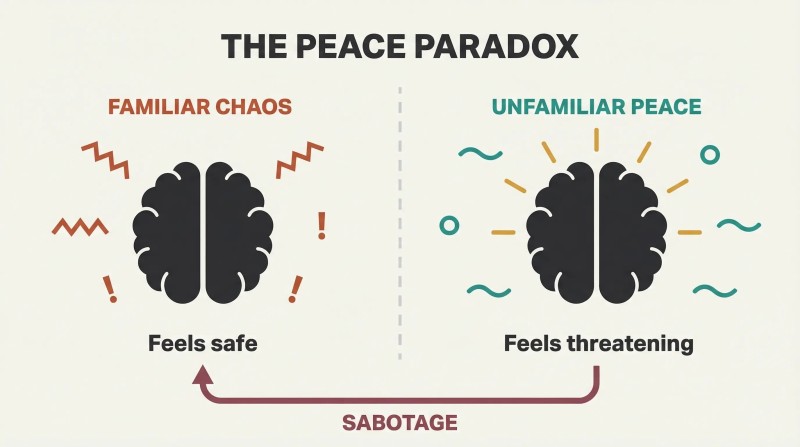
Rumination feeds the very suffering it pretends to solve. Psychologist Susan Nolen-Hoeksema (2000) found that continuously replaying distressing experiences deepens anxiety and depression rather than resolving them. Your brain becomes so efficient at producing painful thoughts that they become its default. The disturbing twist: when something finally goes right — a healthy relationship, a calm season — your brain panics and scans for nonexistent threats.
Familiar pain feels safer than unfamiliar peace. People unconsciously chase unavailable partners, stay in toxic cycles, or sabotage good situations — not because they enjoy suffering, but because chaos is what they know. The brain rewards overthinking through reinforced neural pathways and resists change through cognitive consistency — maintaining painful beliefs even when reality contradicts them.
Thank your anxiety instead of fighting it
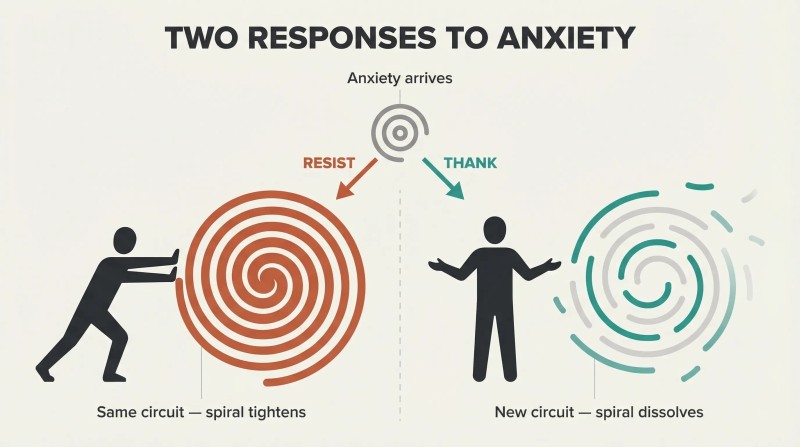
Resisting anxiety strengthens it. Neuroscience confirms that directly suppressing unwanted thoughts makes them more persistent (Wegner et al., 2012) — telling yourself "don't think about it" guarantees you will. Chidiac's counterintuitive technique: when anxiety strikes, smile and say, "Thank you for this feeling. I appreciate this shift in energy." Not sarcasm — genuine gratitude expression that short-circuits the spiral.
UC Berkeley research supports this approach. Gratitude practices activate different neural networks than stress, effectively interrupting anxious thought patterns. The technique works because it sidesteps analysis entirely, engaging a completely different emotional register. Start with small frustrations — a typo in an email, a wrong turn while driving. Notice how anxiety often dissolves not because you solved anything, but because your attention genuinely shifted.
Say 'I notice anger' instead of 'I am angry' to defuse it
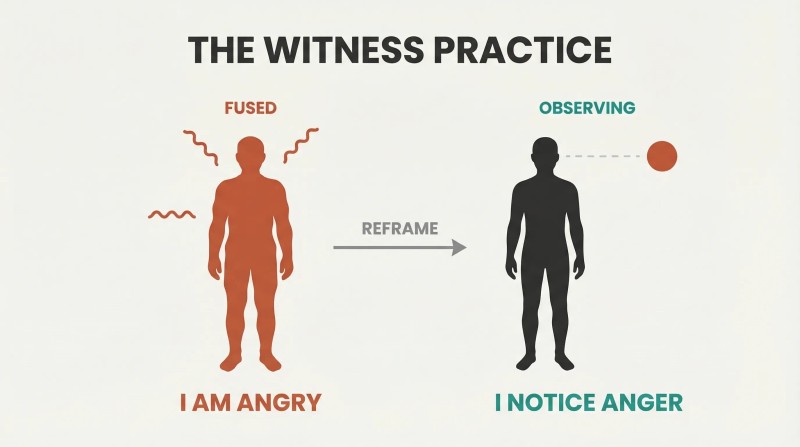
The Witness Practice is the book's core emotional regulation technique, built on three steps:
1. Name the specific emotion ("I'm feeling disappointed" not "I feel bad")
2. Create linguistic distance ("I notice anger arising" instead of "I am angry")
3. Locate the physical sensation — tightness in your chest, heat in your face
Brain imaging shows that labeling emotions precisely activates the prefrontal cortex and quiets the amygdala, your emotional alarm system. A related method, the Thought Diffusion Exercise, reduced the emotional impact of negative thoughts by over 40% in clinical studies (Masuda, 2010).
For stubborn thought loops, Dr. Jeffrey Schwartz's four-step Pattern Interrupt works directly with brain architecture: RELABEL the thought ("this is rumination"), REATTRIBUTE it ("my brain is stuck, not reality"), REFOCUS on an absorbing task, then REVALUE ("that wasn't helpful").
Carrying everyone's emotions is self-abandonment, not compassion
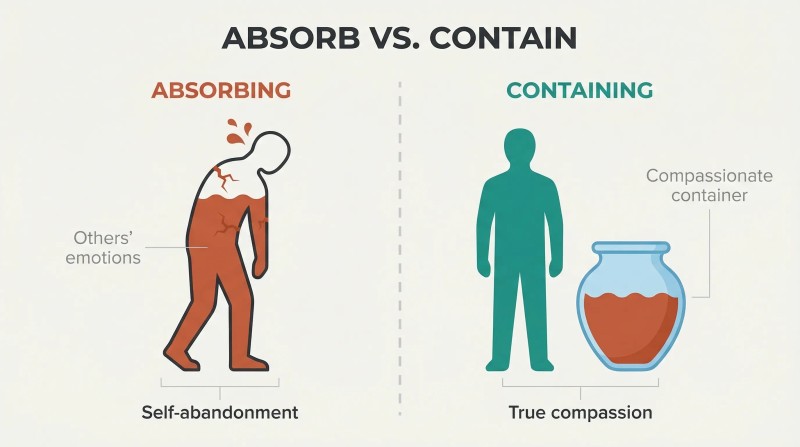
Compassion fatigue is clinically documented. Trauma researcher Charles Figley (2002) found that people who constantly absorb others' emotional burdens develop symptoms nearly identical to PTSD — exhaustion, detachment, and diminished sense of meaning. Your body doesn't distinguish between your own stress and absorbed stress; it releases the same cortisol cascade either way. The physical toll includes anxiety, sleep disturbances, headaches, and weakened immunity.
The book prescribes an Energy Exchange Audit: for one week, track how you feel before, during, and after every significant interaction. Then practice the Compassionate Container — visualize others' emotions as water held in a beautiful, separate vessel you can see and honor without absorbing. Neuroscience confirms this mindful compassion activates resilience-linked neural networks rather than the burnout pathways of emotional contagion.
People only respect the boundaries you actually enforce
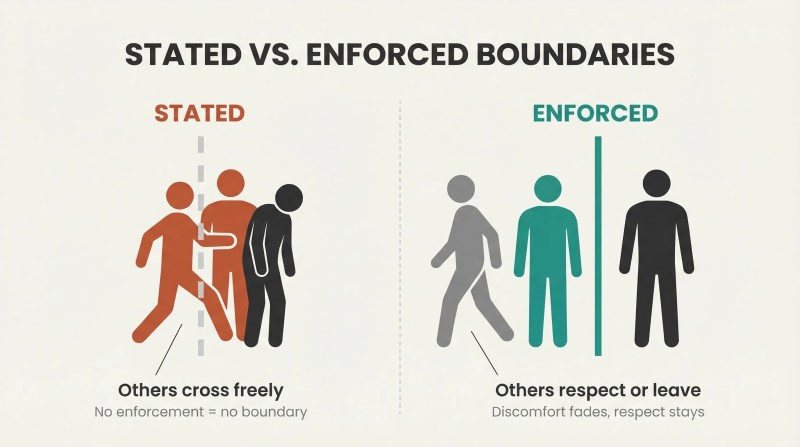
Guilt is the invisible enforcer keeping you boundary-less. The Sunk Cost Fallacy — the tendency to keep investing because you've already given so much — makes walking away feel wasteful. Attachment theory (Bowlby, 1988) explains why setting limits feels terrifying: if childhood taught you that expressing needs meant rejection, then saying "no" feels existentially threatening even decades later.
Stop over-explaining your limits. Chidiac advocates a Minimal Explanation Policy: "This doesn't work for me" is a complete sentence. Guilt after boundary-setting is your brain adjusting to a new neural pattern — temporary withdrawal, not evidence you did wrong. Each time you hold a boundary despite the discomfort, you literally rewire your brain to associate self-protection with self-respect rather than selfishness.
Rejection, control-seeking, and revenge share one dopamine circuit
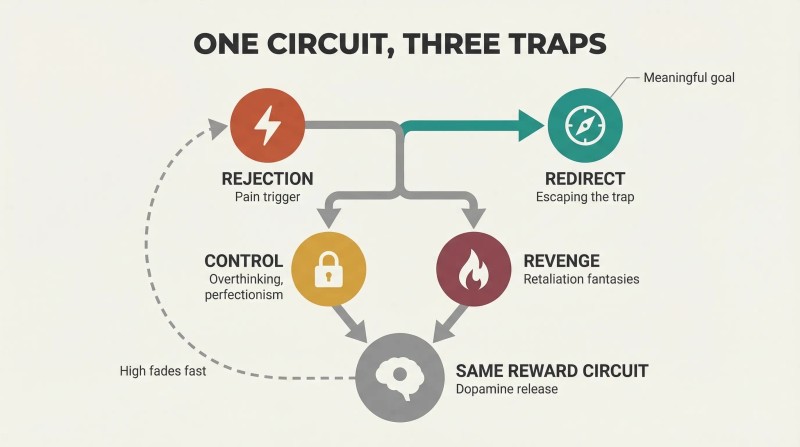
Rejection activates physical pain circuits. Eisenberger and colleagues (2003) found that social rejection lights up the same brain regions as bodily injury. Evolutionarily, tribal exclusion was a death sentence, so your brain treats a delayed text with the same alarm as a physical threat — triggering control-seeking through overthinking, perfectionism, or obsessive self-proving.
Revenge delivers a real but fleeting dopamine hit. Chester and DeWall (2016) found that merely imagining retaliation activates the nucleus accumbens, a key reward center — similar to winning a competition. But the high fades fast, keeps you emotionally tethered to whoever hurt you, and never heals the wound. The book's Redirection Protocol: acknowledge the urge for validation, identify a meaningful goal that provides genuine agency, and take one small action toward it immediately.
You're in love with who they could be, not who they are

Your hope is fundamentally misplaced. Researchers Prochaska and DiClemente (1983) studied thousands of people attempting personal change and discovered that transformation only happens when someone develops their own internal motivation — never because someone else wants them to change. Your belief that one more conversation, a little more patience, or deeper love will finally make them "get it" is fighting against how human change actually works.
The book prescribes a Reciprocity Reset. Stop initiating contact in one-sided relationships for 7-14 days — not as a test, but to observe the relationship without your over-functioning. Does it survive? Do they check on you? Based on what you observe, consciously choose: renegotiate for balance, accept with firm limits, or release entirely. Closure isn't an apology you receive — it's a decision you make.
When mentally stuck, change your physical location
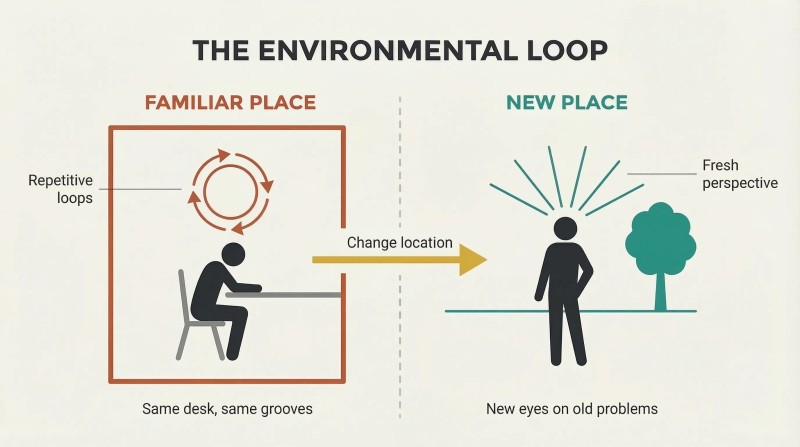
Chidiac's own breakthrough was embarrassingly simple. Trapped in weeks of anxiety and rumination, he tried meditation, journaling, and willpower — all helped momentarily but the loops continued. Then he went on a road trip. Two hours into the drive, his anxiety dissolved. He hadn't developed better coping skills; he'd changed his physical coordinates. The repetitive energy of his familiar environment had been feeding the repetitive thoughts.
Stagnant surroundings breed stagnant thinking. When you do the same things in the same places daily, your energy and thought patterns get trapped in familiar grooves. A weekend trip, a day in nature, or even working from a different location can break the cycle. Physical distance often translates directly to psychological distance — fresh eyes on problems that felt unsolvable from the same desk where they were created.
Forced forgiveness can deepen wounds instead of healing them
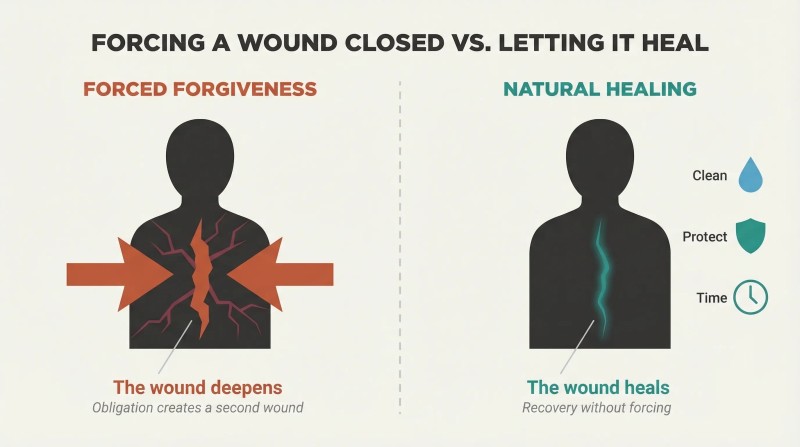
The body-healing analogy clarifies everything. When you suffer a deep cut, your body doesn't need to "forgive" what cut it in order to heal. It needs cleaning, protection from further harm, and time. Emotional healing follows the same logic — prioritizing your own recovery rather than your relationship with what harmed you. Chidiac argues that forgiveness pursued from obligation creates additional suffering: the gap between what you believe you should feel and what you actually feel becomes its own wound.
Moving forward without forgiving is valid. Many people build fulfilling lives without ever forgiving certain deep wounds — and their healing is no less complete. The crucial distinction: being stuck in bitterness tethers you to the past, but consciously choosing not to forgive while still reclaiming your life is an entirely different act. One is imprisonment; the other is sovereignty.
Analysis
Chidiac's work occupies a revealing position in contemporary self-help: it bridges clinical psychology and social media emotional literacy. The book essentially repackages established therapeutic frameworks — Acceptance and Commitment Therapy's defusion techniques become the 'Witness Practice,' Viktor Frankl's paradoxical intention becomes 'thank your anxiety,' Jeffrey Schwartz's OCD protocol becomes a general-purpose thought loop breaker — without explicitly naming these therapeutic lineages. This is both a strength (radical accessibility for readers who'd never open a clinical textbook) and a limitation (practitioners may find it derivative without attribution to these modalities).
The book's most original theoretical contribution is its triangulation of rejection, control-seeking, and revenge motivation as interconnected nodes in a single neurological reward system. By synthesizing Eisenberger's social pain research, Baumeister's decision fatigue work, and Chester and DeWall's revenge-dopamine findings into one coherent narrative, Chidiac gives readers a systems-level understanding of why emotional reactivity is so difficult to escape: multiple brain mechanisms conspire to keep you looping.
Structurally, the book reads like an expanded Instagram carousel — short paragraphs, embedded aphorisms designed for screenshotting, relentless second-person address. This mirrors how its target audience processes information and raises an interesting question about medium reshaping message: does the social-media-native format help readers who'd otherwise never engage with psychology, or does it risk substituting emotional validation for genuine behavioral change?
The forgiveness chapter represents the book's most mature thinking, pushing back against self-help orthodoxy that forgiveness is prerequisite to healing. By analogizing emotional recovery to physical wound care — where the body doesn't need to 'forgive' the knife — Chidiac creates space for readers trapped in guilt about their inability to forgive. This nuanced position, acknowledging that some wounds may never warrant forgiveness while still honoring its potential power when it arises authentically, elevates the book above its more formulaic sections and reflects genuine therapeutic wisdom rather than motivational performance.
People Also Read






Glossary
Witness Practice
Observe emotions without becoming themA three-step emotional regulation technique: (1) name the specific emotion you're feeling, (2) create linguistic distance by saying 'I notice [emotion]' rather than 'I am [emotion],' and (3) locate the emotion's physical sensation in your body. Based on neuroscience showing that labeling emotions activates the prefrontal cortex and reduces amygdala reactivity.
Anxiety Loop
Self-reinforcing worry cycleA mental pattern where the brain fixates on a worry, feeds it with more stress, then convinces you that continued thinking will 'solve' the problem. Each cycle strengthens the neural pathways involved, making the loop increasingly automatic. Compared in the book to quicksand—the harder you struggle against it, the deeper you sink.
Thought Containment Practice
Scheduled daily worry timeA rumination-breaking technique where you designate 15-20 minutes daily as 'worry time.' When intrusive thoughts arise outside this window, you write them down and commit to addressing them during the scheduled period. The practice gives your brain what it craves—a sense of control and completion—without allowing worries to infiltrate every moment of your day.
Compassionate Container
Separate others' emotions from yoursA visualization technique for empathetic people who absorb others' emotional states. You imagine the other person's emotions as water held in a beautiful, separate container—visible and honored, but not absorbed into your own being. Neuroscience research suggests this mindful compassion activates neural networks associated with resilience rather than the burnout pathways of emotional contagion.
Control Inventory
Map stressors to controllable actionsA practical tool where you draw a line down the center of a page: on the left, list everything causing stress; on the right, identify one aspect of each situation you can directly influence. Designed to redirect the brain's resources toward actionable areas, reducing the cognitive overload that makes minor stressors feel overwhelming.
Energy Exchange Audit
Track relational energy patternsA one-week diagnostic practice where you track every significant interaction, noting three things: (1) how you felt before, (2) what emotional weight you absorbed during, and (3) how you felt afterward. The audit reveals which relationships consistently deplete you and where emotional energy is being spent on burdens that aren't yours to carry.
Reciprocity Reset
Test relationships by pausing over-givingA 7-14 day practice of stopping all over-functioning in identified one-sided relationships: no initiating contact, no offering unsolicited help, no going above and beyond. The purpose is to observe the relationship's true nature when excessive effort is removed, then make a conscious choice to renegotiate, accept with firm limits, or release.
Compassion Fatigue
Burnout from absorbing others' painA condition identified by trauma researcher Charles Figley (2002) that mirrors clinical burnout in people who constantly take on others' emotional burdens. Symptoms closely resemble post-traumatic stress: emotional exhaustion, detachment, and diminished sense of meaning. The body responds to absorbed stress with the same hormonal cascade as directly experienced stress.
Thought Diffusion Exercise
Reduce thought impact through distancingA technique where you preface a recurring negative thought with 'I am noticing that I'm having the thought that...' then visualize it as text scrolling across a screen or written on leaves floating downstream. Research by Masuda and colleagues (2010) demonstrated this reduced both the emotional impact and believability of negative thoughts by over 40%.
Pattern Interrupt + Pivot
Four-step thought loop breakerDr. Jeffrey Schwartz's approach developed at UCLA School of Medicine, effective even for severe thought patterns: (1) RELABEL—identify the thought loop by name, (2) REATTRIBUTE—remind yourself it's your brain getting stuck, not reality, (3) REFOCUS—engage in an absorbing activity requiring full attention, (4) REVALUE—reflect that the pattern isn't helpful. Research showed this changes brain activity in the caudate nucleus.
FAQ
What’s "Stop Letting Everything Affect You" by Daniel Chidiac about?
- Core Focus: The book addresses why some people are deeply affected by everyday events, emotions, and the actions of others, and offers practical strategies to break free from overthinking, emotional chaos, and self-sabotage.
- Personal Growth Journey: It guides readers through understanding their emotional patterns, setting boundaries, and reclaiming control over their mental and emotional wellbeing.
- Holistic Approach: Chidiac combines psychological research, personal anecdotes, and actionable exercises to help readers move from emotional reactivity to inner peace and self-empowerment.
- Not About Numbness: The book emphasizes that the goal is not to become emotionless, but to learn how to manage what deserves your energy and attention.
Why should I read "Stop Letting Everything Affect You" by Daniel Chidiac?
- For Highly Sensitive People: If you find yourself easily overwhelmed, overthinking, or emotionally drained by others, this book offers validation and solutions.
- Practical Tools: The book provides step-by-step practices for breaking mental loops, setting boundaries, and managing emotional overload.
- Science-Backed Insights: Chidiac references psychological studies and neuroscience to explain why we react the way we do and how to change these patterns.
- Empowerment and Clarity: Readers gain a sense of agency over their emotions and learn to prioritize their own wellbeing without guilt.
What are the key takeaways from "Stop Letting Everything Affect You"?
- Emotional Reactivity Is Learned: Over-sensitivity and overthinking are habits that can be unlearned, not fixed traits.
- Boundaries Are Essential: Setting and maintaining boundaries is crucial for emotional health and is not selfish.
- Thoughts Aren’t Facts: Most anxiety and rumination stem from mental stories, not reality; learning to witness and distance from thoughts is transformative.
- Growth Involves Discomfort: True change requires letting go of old identities, tolerating temporary emptiness, and embracing new ways of being.
What are the main concepts and methods introduced in "Stop Letting Everything Affect You"?
- The Witness Practice: Learning to observe and label emotions rather than becoming them, creating space between feeling and reaction.
- Attention Restoration: Creating “attention sanctuaries” to reset your mental energy and prevent overwhelm.
- Thought Containment: Scheduling “worry time” and using structured journaling to prevent rumination from taking over your day.
- Boundary Reinforcement: Preparing, communicating, and maintaining boundaries without succumbing to guilt or over-explaining.
- Reality Anchoring: Documenting and validating your experiences to counteract manipulation and gaslighting.
How does Daniel Chidiac explain why some people are more affected by everything?
- Highly Sensitive Wiring: Some people are naturally more attuned to emotions and environmental cues, often due to genetics and upbringing.
- Absorbing Others’ Emotions: Empathetic individuals often take on the feelings and problems of those around them, leading to emotional exhaustion.
- Overthinking and Guilt: Deep feelers tend to overanalyze interactions and feel responsible for others’ happiness, which drains their energy.
- Unprocessed Emotions: When emotions aren’t processed as they arise, they accumulate and make even small stressors feel overwhelming.
What is the "Thought Prison" and how does it relate to overthinking in "Stop Letting Everything Affect You"?
- Mental Loops Defined: The “Thought Prison” refers to cycles of rumination where the mind tries to gain control by overanalyzing, but only ends up reinforcing anxiety.
- Negativity Bias: The brain is wired to focus on threats and negative experiences, making overthinking a default mode for many.
- Pain Becomes Familiar: People can become attached to emotional pain, replaying past hurts as a way to feel in control, even if it’s harmful.
- Breaking the Cycle: Recognizing that thoughts are not reality and practicing techniques like thought diffusion and containment are key to escaping these loops.
How does "Stop Letting Everything Affect You" address boundaries and emotional detachment?
- Compassionate Detachment: The book teaches how to care for others without absorbing their emotional burdens, using visualization and verbal boundaries.
- Energy Exchange Audit: Readers are encouraged to track which relationships drain or energize them, and adjust their involvement accordingly.
- Boundary Reinforcement System: Setting, communicating, and maintaining boundaries is presented as a skill that can be developed, even in the face of guilt.
- Letting Go of Over-Explaining: The book advocates for minimal explanations when asserting boundaries, emphasizing that not everyone deserves access to your inner world.
What does Daniel Chidiac say about manipulation, gaslighting, and reclaiming your reality?
- Recognizing Gaslighting: The book details how manipulators make you doubt your own perceptions and feelings, often by rewriting history or playing the victim.
- Reality Preservation Protocol: Chidiac recommends documenting interactions and seeking external validation to anchor your sense of reality.
- Cognitive Protection: When manipulation is detected, the book suggests pausing, creating distance, and affirming your own perceptions rather than engaging in debate.
- Definitive Departure: Strategies are provided for making a clean break from manipulative relationships, including planning, minimal communication, and resisting the urge to explain.
How does "Stop Letting Everything Affect You" help readers break free from the need for control, validation, and the fear of rejection?
- Control Inventory: The book teaches readers to distinguish between what they can and cannot control, focusing energy on actionable areas.
- Values Alignment Practice: Building self-worth based on personal values rather than external validation helps reduce sensitivity to rejection.
- Redirection Protocol: Instead of seeking to “win” or prove oneself after rejection, readers are guided to pursue meaningful, self-directed goals.
- Emotional Circuit Breaker: Techniques are provided to regulate the threat response before reacting to perceived rejection or loss of control.
What does Daniel Chidiac say about growth, grief, and the process of letting go in "Stop Letting Everything Affect You"?
- Grief of Growth: Outgrowing relationships and old identities can bring sadness, but it’s a necessary part of transformation.
- Creative Void: The “empty space” after letting go is described as a fertile ground for authentic self-discovery, not something to be feared.
- Honoring the Past: The book encourages gratitude for the old self and relationships, while also embracing the need to move forward.
- Emergence of Authentic Self: True freedom comes from living in alignment with your values and needs, not from maintaining outdated roles or connections.
What is Daniel Chidiac’s perspective on forgiveness and happiness in "Stop Letting Everything Affect You"?
- Forgiveness Is Personal: The book challenges the idea that forgiveness is always necessary for healing, emphasizing that authentic healing can occur on your own timeline.
- No Forced Forgiveness: Premature or pressured forgiveness can impede healing; it’s okay to prioritize your own recovery first.
- Beyond Happiness: Chidiac argues that the pursuit of constant happiness is unrealistic; instead, he advocates for understanding, acceptance, and embracing the full spectrum of human emotions.
- Inner Peace Over Perfection: True peace comes from accepting imperfection, learning from mistakes, and letting go of the need for perpetual positivity.
What are the best quotes from "Stop Letting Everything Affect You" by Daniel Chidiac and what do they mean?
- “The problem with being empathetic is that you even feel sorry for people who hurt you.” – Highlights the double-edged sword of empathy and the need for boundaries.
- “You can’t keep getting mad at people for sucking the life out of you if you keep giving them the straw. Protect your peace… leave.” – Emphasizes personal responsibility in maintaining boundaries and protecting your energy.
- “Growth feels like loss before it feels like freedom.” – Reminds readers that discomfort and grief are natural parts of personal transformation.
- “You are not lost. You are not broken. You are not someone who needs to be fixed. You are someone who is finally allowing your true nature to emerge.” – Encourages self-acceptance and the idea that authenticity is about uncovering, not fixing, yourself.
- “The peace you feel without their presence in your life, is worth being the villain in their story.” – Validates the difficult but necessary choice to prioritize your own wellbeing, even if others misunderstand or judge you.
Download PDF
Download EPUB
.epub digital book format is ideal for reading ebooks on phones, tablets, and e-readers.








































