Key Takeaways
1. American Democracy's Bitter End: A Crisis of Calcified Politics
The 2020 election and the attack on the Capitol were the culmination of a long year of casualties and crisis in the United States.
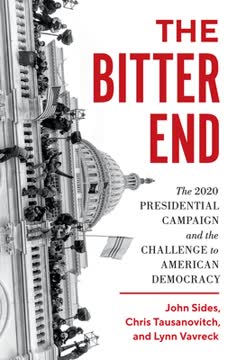
A jarring culmination. The January 6, 2021, insurrection at the U.S. Capitol, incited by President Trump and his allies, marked a violent and unprecedented challenge to American democracy. This event, which saw a mob breach the Capitol to disrupt the certification of the 2020 election, resulted in deaths, extensive damage, and severe harm to law enforcement. It underscored a fundamental breakdown in democratic norms, particularly the peaceful transfer of power and the consent of election losers.
Calcified politics defined. The book introduces "calcified politics" as a core concept, describing a political landscape characterized by hardening and rigidity. This means:
- Voters are more firmly entrenched in their partisan predispositions.
- There's less willingness to defect from one's party, even in the face of dramatic events.
- New events are absorbed into existing identity-based conflicts.
This rigidity leads to smaller fluctuations in election outcomes year to year, yet paradoxically, increasing partisan parity means even small shifts can be highly consequential.
Beyond simple division. While political division is obvious, the book clarifies its nature: it's not just about close elections, but about deep ideological, demographic, and affective polarization. This calcification, driven by long-term trends and sudden shocks, explains why the 2020 election ended so bitterly and signals a potential new democratic crisis.
2. Decades of Division: Tectonic Shifts in Partisan Attitudes
Over the long term, the Democratic and Republican parties have become more internally homogeneous and more different from each other in political ideology, certain demographic characteristics, and certain policy issues.
Slow-moving realignment. American politics has undergone "tectonic shifts" over decades, pushing the Democratic and Republican parties further apart while making them more uniform internally. This process, known as partisan sorting or polarization, has created a growing alignment between party identification and various attributes.
Key areas of divergence:
- Ideology: Democrats increasingly identify as liberal (25% in 1994 to 51% in 2020), and Republicans as conservative (58% to 75%).
- Demographics: Men are less likely, women more likely, to be Democrats. African Americans, Hispanic Americans, and Asian Americans lean Democratic. Religiously observant whites and evangelical Protestants lean Republican.
- Policy: Parties diverge on economic issues (government size, spending, regulation) and non-economic issues (e.g., abortion).
Visible and visceral. Americans increasingly perceive these differences, with 90% in 2020 (up from 50% in 1952) agreeing there are "important differences" between the parties. This perception is often exaggerated, with partisans overestimating the ideological and demographic distinctiveness of the opposing party. This leads to "affective polarization," where dislike of the opposing party has grown significantly, reaching record levels in 2020.
3. Trump's Catalyst: Identity Shocks and Accelerated Polarization
Over the short term—years, not decades—the Democratic and Republican parties have rapidly divided on issues related to identity, especially race, ethnicity, nationality, religion, and gender.
Earthquake-like shifts. While long-term trends slowly pushed parties apart, Donald Trump's campaigns and presidency delivered "identity shocks" that rapidly accelerated polarization on issues tied to identity. His rhetoric and actions placed these issues at the center of political conflict.
Immigration as a prime example:
- From 1965 to the early 2000s, partisan division on immigration levels was minimal or inconsistent.
- Between 2016 and 2020, the gap in Democratic and Republican support for increasing immigration surged by 20 points (from 17% to 37%).
- Democrats became significantly more open to immigration, largely in reaction against Trump's restrictive policies.
Broader identity divides. Similar rapid polarization occurred on other identity-inflected issues:
- Racial inequality: Democrats sharply increased their endorsement of structural explanations for racial inequality, while Republicans showed little change.
- Sexual harassment: Democrats became more sympathetic to claims, while Republicans became less so.
Trump's willingness to use inflammatory language and target minority groups, from calling for a Muslim ban to his "shithole countries" comment, directly fueled these rapid shifts, particularly among Democrats who reacted against his stance.
4. Unpopular Governance, Stable Support: The Paradox of Trump's Presidency
For the first three years of Trump’s presidency, the fight was often the point.
Governing for the base. Despite campaigning as an economic populist, Trump largely governed as a traditional conservative, prioritizing policies popular mainly with Republicans, often to the exclusion of broader public appeal. His executive actions and legislative agenda, such as the border wall and family separation, were distinctively unpopular compared to those of past presidents.
Examples of unpopular policies:
- Border Wall: Unpopular with the general public, yet a central focus.
- DACA: Trump rescinded the popular Deferred Action for Childhood Arrivals program under pressure from conservative hard-liners, despite its broad public support.
- Family Separation: Highly unpopular, with 67% disapproving in a June 2018 CNN poll.
- Obamacare Repeal: Failed, and the Affordable Care Act actually gained popularity during the repeal effort.
- Tax Cuts: Largely benefited the wealthy and corporations, with only 31% public support at the time of passage.
The paradox of stability. Despite pursuing unpopular policies, generating numerous scandals (346 Washington Post stories in his first term), and facing widespread protests, Trump's approval rating remained remarkably stable and low. This stability stemmed from unwavering Republican loyalty. Many Republicans, while perhaps having reservations about his character or specific actions, prioritized his conservative agenda and opposition to Democrats, overlooking his missteps.
5. The Pandemic: A Missed Opportunity for National Unity
The pandemic offered Trump an opportunity that might have been politically advantageous: to show Americans that he could lead through a crisis.
A brief moment of consensus. The COVID-19 pandemic presented a critical national crisis and a rare opportunity for a chronically unpopular President Trump to rally the country and gain political support. In March 2020, after declaring a national emergency, Trump's approval rating saw a brief bump, and there was a rare bipartisan consensus on the seriousness of the virus and the need for countermeasures.
Trump's pivot to division. This unity was short-lived. Within weeks, Trump reversed course, downplaying the virus, pushing for a rapid "reopening" of the country, and criticizing leaders who maintained restrictions. He politicized public health measures, notably masks, and even suggested slowing down testing. This approach transformed the pandemic response into another "us versus them" partisan battle.
Consequences of politicization:
- Partisan divide: Republican concern about the virus dropped, and support for countermeasures like mask mandates and business closures polarized along party lines.
- Leadership contrast: While many world leaders and U.S. governors saw their approval ratings increase and remain elevated during the crisis, Trump's approval declined after his pivot, returning to pre-pandemic levels.
- Ineffective response: The partisan patchwork of mitigation measures hampered the country's ability to control the virus, leading to successive surges in cases and deaths.
6. Racial Justice: From Consensus to Deeper Partisan Chasm
Gone are the days when a protest could remain independent from the partisan arena, and speak simply to injustice or wrongdoing.
Initial bipartisan condemnation. George Floyd's murder on May 25, 2020, sparked widespread outrage and the largest mass protest movement in U.S. history. Initially, it elicited a rare bipartisan consensus, with prominent Republicans joining Democrats in condemning Derek Chauvin's actions and expressing a desire to address racial inequalities. Public opinion shifted, with less favorable views of the police and increased concern about racial discrimination across partisan lines.
Trump's re-polarization. This moment of unity quickly dissolved as Donald Trump and his allies seized on instances of protest violence and calls to "defund the police." Trump labeled protestors "THUGS," threatened violence, and staged a controversial photo op after clearing peaceful protestors with force. This conservative counternarrative shifted attention from racial injustice to "law and order."
Deepening partisan divides:
- Police views: Republican attitudes towards the police quickly rebounded to pre-Floyd levels, while Democratic favorability remained lower, widening the partisan gap.
- BLM support: Republican opposition to the Black Lives Matter movement intensified, even as Democratic support grew.
- Racial inequality: While Democrats liberalized their views on systemic racism, Republican attitudes remained largely unchanged, creating a stark divergence in understanding the roots of racial inequality.
This "Trumpification" of racial attitudes accelerated a pre-existing trend, making racial justice a central and deeply polarizing issue in American politics.
7. Biden's Narrow Win: Calcified Electorate, Consequential Small Shifts
In many ways, Biden’s was an unusual victory.
Incumbent's rare defeat. Joe Biden's victory was notable as it's rare for an incumbent president to lose after only one term. However, the outcome was consistent with Trump's chronically low approval rating, which historically predicts electoral defeat. Even a small increase in Trump's popularity, such as the brief bump he received during the pandemic, could have swung the election in his favor.
A surprisingly close race. Despite a surge in voter turnout and Biden receiving over 15 million more votes than Hillary Clinton in 2016, his victory was excruciatingly narrow in key battleground states. The Democratic Party's disadvantage in the Electoral College was even larger than in 2016. This closeness highlights the impact of calcified politics and partisan parity, where small shifts have outsized consequences.
Polarization's enduring power:
- Voter stability: Shifts in voting patterns between 2016 and 2020 were the smallest in 70 years at the county level, and individual voter loyalty was extremely high (95% of 2016 Clinton/Trump voters stuck with their party).
- Ideological sorting: Trump gained votes among conservatives (including conservative Latinos), and Biden gained among liberals, intensifying ideological polarization across all racial groups.
- Limited event impact: Major events like the pandemic, racial justice protests, and extensive campaign advertising had surprisingly little discernible local impact on vote shifts, reinforcing the idea that most voters' minds were already made up.
8. Post-Election Subversion: The Enduring Threat to Democracy
A hallmark of democracies is the peaceful transfer of power after an election. That did not happen.
Trump's unprecedented challenge. Following his defeat, Donald Trump launched an unprecedented campaign to subvert the 2020 election results, refusing to concede and making unsubstantiated claims of widespread voter fraud. This included:
- Filing dozens of lawsuits, almost all dismissed by judges, including Republican appointees.
- Pressuring Department of Justice officials to investigate false claims and threatening to replace them.
- Calling state officials, like Georgia's Brad Raffensperger, to "find votes."
- Pressuring Vice President Mike Pence to overturn the results on January 6th.
Erosion of trust and norms. Trump's actions fostered deep and persistent distrust among his supporters, with 68% of Republicans believing the election was stolen even a year later. This level of distrust in election integrity and the legitimacy of the winning president was far greater than typical for a losing party. The January 6th insurrection was a violent manifestation of this subversion, directly challenging the peaceful transfer of power.
Appeasement and revisionism. Instead of accountability, the Republican Party largely engaged in appeasement and revisionism:
- Few Republican leaders supported Trump's second impeachment or the January 6th investigation.
- Critics of Trump within the GOP faced censure and removal from leadership.
- Some leaders downplayed the insurrection, calling it a "normal tourist visit" or a government conspiracy.
This response, coupled with a rise in Republicans justifying political violence, signals a continuing crisis for American democracy.
9. A Polarized Presidency: Division Metastasizes Beyond Trump
In an era of polarization, calcification, and close competition for control of the White House and Congress, there is a growing incentive for partisans to subvert elections if it helps them win.
Biden's polarized start. Despite campaigning on unity, Joe Biden's presidency began with unprecedented partisan polarization in his approval ratings, exceeding even Trump's. This "calcified politics" meant that even popular policies, like COVID relief, did not significantly boost his overall popularity, as partisan predispositions remained rigid.
Metastasizing division:
- Vaccine politicization: COVID-19 vaccines, a tool for unity, became deeply partisan. Trump's equivocation and conservative media skepticism led to a large partisan divide in vaccination rates, with Republicans disproportionately unvaccinated.
- Racial issues: Debates over race, from the Derek Chauvin verdict (53% Republican approval) to critical race theory in schools, remained intensely polarized. Republicans and Democrats hold fundamentally different perceptions of discrimination, making unity on these issues elusive.
- Election subversion efforts: The crisis of democracy continued post-Trump, with Republican-led state legislatures passing new laws to restrict voting and gain control over election administration, often targeting officials who resisted Trump's pressure in 2020.
The enduring test. The book concludes that the factors driving 2020's "bitter end"—tectonic polarization, identity shocks, and intense partisan priorities—make democratic subversion more tempting. The future of American democracy hinges on whether political leaders, especially those who lose, will uphold democratic norms and resist the incentive to overturn fair outcomes.
People Also Read