


Key Takeaways
Climb the ten rungs of muscle in strict order of importance
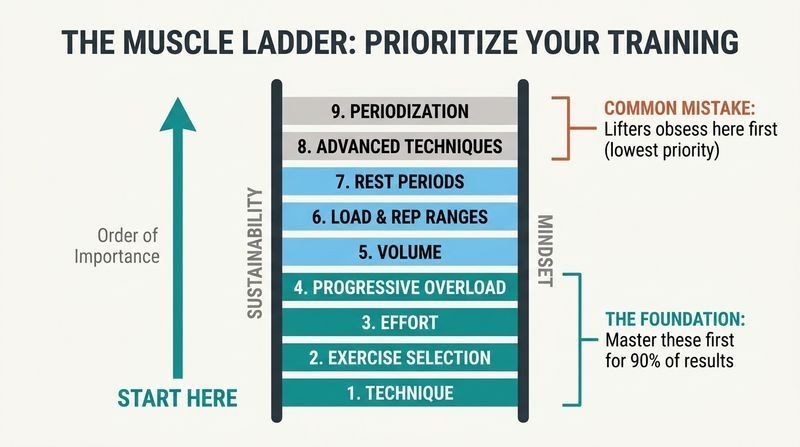
The Muscle Ladder ranks what matters. Jeff Nippard, a natural pro bodybuilder and science communicator, organizes everything about building muscle into a ladder held up by two side rails, sustainability and mindset, with ten rungs stacked by priority:
1. Technique
2. Exercise selection
3. Effort
4. Progressive overload
5. Volume
6. Load and rep ranges
7. Rest periods
8. Advanced techniques
9. Periodization
Most lifters obsess over the wrong rung. They fret about exotic techniques and periodization schemes (upper rungs) while neglecting effort and consistency (lower rungs). When a training question arises, ask which rung it belongs to. That tells you both where to find the answer and how much it actually matters for someone at your stage.
The ladder is essentially a triage system, and triage is where most fitness advice fails. Social media rewards novelty, so creators amplify obscure variables (grip width, tempo, muscle confusion) that occupy the top rungs, while the boring fundamentals that drive 90 percent of results get ignored. This mirrors the Pareto principle and echoes Eric Helms's Muscle and Strength Pyramid, which Nippard credits as inspiration. The framework's real value is diagnostic: it stops beginners from optimizing decimals before they have mastered the integers. One caution: the strict ordering implies linearity, but in practice the rungs interact constantly, something Nippard himself acknowledges with effort, volume, and frequency.
A program you quit beats no program, so make training enjoyable
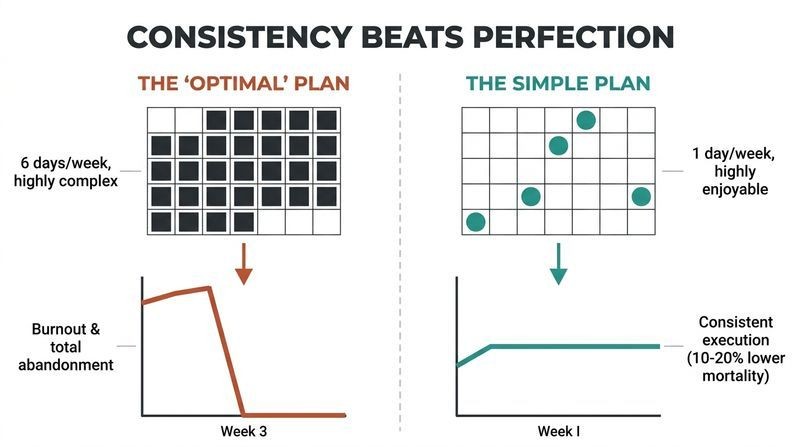
Sustainability is a load-bearing rail, not a soft add-on. Nippard argues that enjoyment, safety, and proper pacing determine whether you keep showing up after the newbie honeymoon fades (roughly six to twelve months in). His brother Bradley loathes lifting, so Nippard prescribed the most minimal program he ever wrote: three exercises (goblet squat, push-up, dumbbell row), once a week. It cured Bradley's hip pain and became his entry point into training.
Efficiency can trump effectiveness. For time-strapped people, the question shifts from what is the most effective way to train to what is the most efficient way to train effectively. A 2022 meta-analysis found just 30 to 60 minutes of resistance work weekly cut all-cause mortality risk by 10 to 20 percent.
This reframes adherence as the true limiting reactant, a point behavioral science strongly supports. The gym is a voluntary activity, and voluntary behaviors collapse without intrinsic reward. What is compelling here is the inversion of macho gym culture: Nippard treats fun as a performance-enhancing variable, noting people push harder when they enjoy the work. Research on exercise adherence backs this, showing autonomy and enjoyment predict long-term participation far better than knowledge or intention. The minimalist prescription also counters the sunk-cost fallacy of maximalism, where people attempt elaborate programs, fail, and quit entirely. A modest sustainable dose compounds; an optimal program abandoned in March compounds to zero.
Train with confidence, because a fragile mindset makes your body fragile
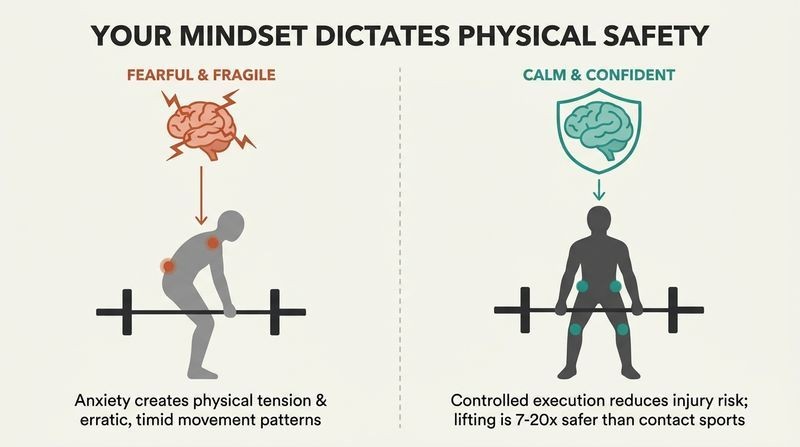
Weight training is far safer than you fear. A 2017 review found most strength sports produce 2 to 4 injuries per 1,000 hours, versus 15 to 81 for soccer, rugby, and cricket, making lifting 7 to 20 times safer. Early strength training even cut overuse injuries in children by 50 percent.
Fear itself raises injury risk. Research on injured athletes shows those in a state of fear are more likely to reinjure, because they train too timidly. Nippard prioritizes three injury-prevention levers: managing total workload, ensuring recovery, and proper technique, with the first two mattering most. Warning signs of overload include persistent joint aches, lost strength, exhaustion, extreme soreness, waning motivation, and poor sleep. When several cluster, deload for a week or two.
The claim that treating your body as fragile makes it fragile aligns with modern pain science, particularly the biopsychosocial model championed by researchers like Lorimer Moseley, which shows pain is modulated by expectation and threat perception, not just tissue damage. The nocebo effect (negative expectation producing real symptoms) is well documented. Nippard's ranking of workload and recovery above technique for injury prevention is quietly contrarian, since the fitness industry has long treated form as the primary safeguard. The evidence for a tight technique-injury link is genuinely weaker than most trainers assume. Still, readers should note that safety statistics from elite competitors may not transfer perfectly to untrained novices with poor movement literacy.
Track strength, photos, and weight together, and trust only the trend
No single metric tells the truth. Because muscle is invisible under skin and daily weight swings with water and food, Nippard triangulates three tools: strength performance (getting stronger in your rep range almost guarantees growth), progress photos every one to three months, and body weight averaged weekly. Combined, they diagnose five scenarios, from lean muscle gain to fat loss with excess muscle loss.
The trend line is everything. A disappointing weigh-in, an off workout, or a bloated photo are noise. Nippard also anchors expectations: men gain roughly 10 to 25 pounds of muscle in year one, women 6 to 15, then growth decelerates sharply, dropping toward half a pound to a pound annually by year five. Comparing yourself to others is compare and despair.
The multi-metric approach is essentially sensor fusion, the same principle self-driving cars use: no single noisy sensor is trustworthy, but combining independent signals cancels error. This is statistically sound and rare in a field obsessed with the scale alone. The year-by-year gain table is valuable precisely because unrealistic expectations drive dropout, a documented phenomenon in weight-loss research too. One nuance worth adding: strength as a proxy for hypertrophy weakens over time, since advanced lifters gain strength through neural efficiency without proportional size. Nippard handles this by specifying strength within a fixed rep range, a smart correction. The compare and despair warning also has grounding in social comparison theory and its links to reduced motivation.
Mechanical tension builds muscle, not soreness, pumps, or damage
The old theories are mostly wrong. For decades lifters believed muscle grew from damage (no pain, no gain) or from the blood-swollen pump. Research now shows excessive damage actually impedes growth, because the body diverts resources to repair instead of building. The pump's metabolic stress plays only a minor role.
Tension is the real driver. Muscles grow when fibers strain hard against resistance, activating molecular mechanosensors that trigger growth signals. This is why a light weight curled to true fatigue can build as much as a heavy one, and why a comfortable set of 10 that stops with reps to spare does almost nothing. The practical implication: you must push sets close to the point where you cannot complete another clean rep.
The shift from damage to tension reflects a genuine paradigm change in exercise physiology over the past fifteen years, driven by researchers like Brad Schoenfeld. It has practical teeth: it dismantles the cultural fetish for wrecking soreness as proof of a good workout. Delayed-onset muscle soreness correlates poorly with hypertrophy and often just signals unfamiliar movement. What deserves emphasis is how liberating this is: you do not need to suffer, only to work hard enough. A subtle open question the field still debates is whether tension per fiber or active tension across a full stretch matters most, which connects to the emerging enthusiasm for training at long muscle lengths.
Most lifters leave six reps in the tank, so learn what failure feels like
People drastically undertrain. In a 2017 Brazilian study, 160 experienced men were asked to pick their normal 10-rep weight and do as many reps as possible. The average was 16 reps. Not one person managed fewer than 10, and 26 percent hit 19 or more, meaning many left half their capacity unused. Nippard calls undertraining the single biggest reason lifters stall after a year or two.
Close to failure, not always to failure. Studies show training to failure and stopping one or two reps short produce similar growth, but failure causes far more fatigue. Nippard recommends most sets land at 0 to 3 reps in reserve (RIR), the anabolic sweet spot, using the RPE scale where 10 means no reps left, 9 means one left, and so on.
The 16-rep finding is the book's most quietly damning statistic, because it exposes a metacognitive failure: lifters genuinely believe they are working hard while systematically misjudging their limits. This is a calibration problem, identical to the overconfidence biases studied in judgment and decision-making research. The fix (occasionally training to true failure to anchor your internal gauge) is essentially deliberate practice applied to interoception. RPE and RIR borrow from endurance sport's Borg scale, adapted intelligently for resistance work. The main critique is that RPE remains subjective and takes years to calibrate accurately, which Nippard concedes. Video review and training partners, both of which he recommends, are underrated objective correctives to self-deception.
Ten to twenty hard sets per muscle weekly hits the sweet spot
Volume follows an inverted-U. More hard sets drive more growth, up to a point, after which extra sets add fatigue without benefit and eventually impair recovery. Nippard defines volume simply as the number of hard sets (working sets taken to a challenging effort), abandoning older rep-counting math. A 2017 meta-analysis showed a clear dose-response from under 5, to 5 to 9, to 10-plus sets weekly.
Match volume to experience and body part. Beginners thrive on about 10 sets per muscle per week; intermediates and advanced lifters need 10 to 20, rarely more than 20. Hamstrings often max out around 12 to 15 sets, while backs and glutes tolerate more. When progress stalls, try adding roughly 20 percent volume, then dial back if recovery suffers.
Counting hard sets rather than tonnage is a pragmatic simplification that trades precision for usability, and the trade is worth it for most people. The inverted-U framing is well supported, though the exact peak is fiercely contested, with some recent studies suggesting trained individuals tolerate far higher volumes than once thought. Nippard wisely treats the ceiling as individual rather than universal. The individualized 20 percent bump borrows the logic of progressive titration from pharmacology: find your minimum effective dose, then adjust based on response. The crucial insight buried here is that volume and effort are coupled: sloppy half-effort sets inflate your set count while doing nothing, so volume only means anything when each set is genuinely hard.
Any rep range from 5 to 30 builds muscle if you push hard enough
Load is surprisingly flexible. Randomized trials comparing 8-to-12-rep training against 20-to-25-rep training found no difference in muscle growth when both went close to failure. The catch: weights below about 30 percent of your one-rep max are too light, because tension never recruits all fibers, and you likely need to be near failure by rep 30.
But 6 to 15 reps is the practical zone. High reps (15 to 30) are exhausting and make judging effort harder; low reps (1 to 5) demand far more sets to match volume and tax the joints. Nippard suggests spending 60 to 80 percent of volume in the 6 to 15 range, reserving roughly 10 to 20 percent each for higher and lower reps. Strength, unlike size, is a specific skill requiring heavy, low-rep practice.
The equivalence of rep ranges for hypertrophy is one of the most counterintuitive findings in modern strength science and directly refutes the old dogma that specific rep windows target specific adaptations for size. It reflects the principle that the muscle responds to tension and proximity to failure, not to an arbitrary number. The important distinction Nippard draws, that strength is a skill while hypertrophy is nonspecific, connects to motor-learning research: maximal strength depends heavily on neural coordination and technique practice, which is why powerlifters rehearse heavy singles. The practical genius is choosing 6 to 15 not because it is uniquely anabolic but because it is the most sustainable, joint-friendly, and measurable range.
Rest two to five minutes on big lifts, ignoring the short-rest myth
Short rests sabotage tension. Old bodybuilding lore claimed brief rests boosted growth via metabolic stress. Research reversed this: a 2007 study found load and volume collapsed with rests under a minute, and a 2015 study showed three minutes beat one minute for hypertrophy. Longer rest lets you generate higher tension deeper into a workout.
Match rest to the demand. Nippard's guidelines: 1 to 2 minutes for isolation moves like curls, 2 to 3 for lighter compounds and machines, and 3 to 5 for heavy barbell squats, presses, and deadlifts. The heavier the load, the more muscle involved, and the more technical the lift, the more recovery you need. If short workouts are the goal, gradually shrink rest over weeks as conditioning improves rather than slashing it overnight.
This is a clean example of evidence overturning intuition. The metabolic-stress hypothesis was seductive because short rests feel brutal, and difficulty is easily mistaken for effectiveness. But the confusion was cardiovascular, not muscular: gasping for breath is not the same as maximizing fiber tension. The finding fits neatly with the tension-first model from earlier in the book, since incomplete recovery forces you to reduce load on subsequent sets, shrinking exactly the variable that drives growth. The nuance worth flagging is the volume workaround: research suggests you can compensate for short rests by doing roughly double the sets, which is fine for conditioning but defeats the purpose if efficiency is your aim.
Progress by adding reps or weight, and retire muscle confusion for good
Overload must be gradual and deliberate. Once you have adapted to a stimulus, your body has no reason to grow unless you raise the challenge. Nippard lists nine ways to overload, from adding load (linear progression) to adding reps, sets, slowing the negative, or extending sets past failure. His favorite for most people is double progression: work up the rep range at a fixed weight, then add weight and drop back down.
Muscle confusion is a myth. The popular idea that random, unpredictable workouts shock muscles into growth misunderstands biology. Muscles do not predict or get confused; they adapt to consistent, repeated stimuli. Constantly switching exercises prevents you from mastering technique or measuring progress. Controlled variety helps; haphazard variety just spins your wheels.
The debunking of muscle confusion is a public service, since the concept was marketed heavily by commercial programs and sounds scientific while being biologically incoherent. Adaptation is fundamentally a response to a repeated, progressively increasing stressor, the same principle behind Hans Selye's general adaptation syndrome and even antibiotic resistance. The distinction between progressive overload (the goal) and a progression scheme (the method) is a sharp one that many lifters blur, chasing heavier numbers without ensuring the effort is actually hard. A useful extension: this mirrors deliberate practice in skill acquisition, where measurable, incremental challenge at the edge of ability drives improvement, whereas random variation produces activity without development.
Fix nutrition with two numbers, calories and protein, and let the rest flex
Energy balance governs weight. Calories-in versus calories-out (CICO) determines whether you gain, lose, or maintain, though your metabolism adapts by burning less when you eat less. For muscle gain, eat a modest surplus; for fat loss, a 10 to 20 percent deficit. Protein targets run about 0.7 to 1 gram per pound when bulking and 0.8 to 1.2 when cutting.
Track only what matters, flexibly. Nippard tracks calories and protein but lets carbs and fats fall where they may, keeping fat between 20 and 35 percent of calories. A 1999 study found flexible dieting was linked to less disordered eating, lower body mass index, and better long-term weight maintenance than rigid rules. Supplements are supplemental: only protein powder, creatine, and caffeine have strong Tier 1 support.
Reducing nutrition to two tracked variables is a masterclass in cognitive load management, an application of the 80/20 principle to adherence. The flexible-dieting evidence connects to a broader psychology literature showing rigid dietary restraint predicts binge behavior and diet failure, while flexible restraint predicts success. This reframes discipline itself: sustainable moderation outperforms perfectionism. The creatine endorsement is among the best-supported in all of sports nutrition, with decades of safety data. What is refreshingly honest is the short supplement list, which cuts against an industry that profits from complexity. The metabolic adaptation point also usefully explains why plateaus are not failures of CICO but predictable shifts in the calories-out side of the equation.
Periodize training with deloads and specialization phases as you plateau
Organize time in three nested cycles. The macrocycle spans a year, mesocycles run one to three months, and microcycles cover a week. A basic bodybuilding mesocycle simply builds up (adding load, reps, or sets over four to eight weeks) then deloads for a week to shed fatigue and reset.
Deloads prevent burnout. Every four to twelve weeks, cut volume by 30 to 50 percent and effort by one to three RPE points. Advanced lifters who have plateaued can run specialization phases, boosting volume 20 to 40 percent for one or two lagging body parts while maintaining others, since maintaining muscle takes far less work than building it. Prioritize weak points by training them first in the week and first in the session, after a rest day.
Periodization is where the book most explicitly borrows from athletic sport science, and the nested-cycle structure originates in Soviet training theory. The deload concept is essentially planned recovery, and its logic mirrors interval training, stress-adaptation, or even sleep-wake balance: performance improves through cycles of stress and recovery, not relentless grinding. The specialization-phase insight rests on an asymmetry that is well established but underappreciated: maintenance volume is roughly a third to half of growth volume, which frees up recovery capacity to be redirected. John Kiely's work, which Nippard cites, raises a genuine caution that much periodization theory is tradition-driven rather than evidence-led, so readers should treat elaborate schemes as optional refinements, not prerequisites for the plateaued few who actually need them.
Analysis
The Muscle Ladder is a framework-driven, evidence-based training manual that succeeds by imposing hierarchy on a field drowning in undifferentiated information. Its central intellectual move is not discovering new science but ranking existing science by importance, a triage that most fitness content conspicuously lacks. This makes the book unusually resistant to the noise of social media, where engagement algorithms reward novelty and thereby inflate the significance of trivial variables. Nippard's ladder is, in effect, an antidote to attention-economy distortion of expertise.
The book's deepest through-line is that mechanical tension, achieved by training close to failure, is the master variable, and nearly every downstream recommendation flows from it. Rep ranges are interchangeable because they all reach high tension near failure. Long rest periods win because they preserve tension. The pump and soreness are demoted because they do not cause tension-driven growth. This conceptual coherence is the book's strongest feature; disparate recommendations are not arbitrary rules but consequences of one principle.
Where the book is most valuable is its honest calibration of expectations and its exposure of undertraining as the dominant failure mode. The 16-rep study reframes the core problem not as ignorance but as poor self-assessment, a metacognitive rather than informational deficit. This is a genuinely modern insight that connects to judgment-and-decision-making research on overconfidence.
The book's limitations are those of its genre. Much of the cited research uses short durations and untrained subjects, and evidence thins precisely where advanced lifters need it most, forcing Nippard into experience-based conjecture on the upper rungs. He is admirably transparent about this. The periodization chapters, while thorough, risk overwhelming the very audience the sustainability rail is meant to protect. The book is strongest when it simplifies (count hard sets, track two macros) and weakest when completeness tempts it toward complexity. Its lasting contribution is teaching readers to ask not just what works, but what matters most right now.
Review Summary
The Muscle Ladder is highly praised for its comprehensive, science-based approach to strength training and muscle building. Readers appreciate its clear explanations, practical advice, and suitability for both beginners and advanced lifters. The book covers exercise techniques, program design, and nutrition, offering valuable insights for those looking to improve their fitness. While some experienced lifters find the content familiar, many consider it an excellent resource for understanding the fundamentals of effective training and dispelling common gym myths.
People Also Read










Glossary
The Muscle Ladder
Priority-ranked training principle hierarchyNippard's central framework organizing all muscle-building knowledge into ten rungs ranked by importance (technique, exercise selection, effort, progressive overload, volume, load and rep ranges, rest periods, advanced techniques, and periodization) held together by two side rails, sustainability and mindset. It functions as a triage system for deciding which training questions matter most at a given stage.
Hard set (set volume)
A working set near failureNippard's preferred unit of training volume: a non-warm-up set taken to a challenging effort, generally RPE 6 or higher for primary lifts and RPE 7 or higher for others. Counting hard sets per muscle per week replaces older, more complicated calculations of rep volume or tonnage.
Reps in Reserve (RIR)
Reps left before failureA measure of effort describing how many additional repetitions you could have completed before reaching muscular failure. Zero RIR means failure, three RIR means three reps left. Nippard identifies 0 to 3 RIR as the anabolic sweet spot where most hypertrophy training should occur.
RPE (Rating of Perceived Exertion)
1-to-10 effort scaleA subjective 1-to-10 scale for gauging set intensity, adapted from endurance sport for lifting. RPE 10 means no reps left (failure), RPE 9 means one rep in reserve, and so on. Used to prescribe both effort and load without rigidly fixing the weight in advance.
Double progression
Add reps, then add weightA progressive-overload scheme using two variables. You work up through a target rep range at a fixed weight (for example 6 to 8 reps), and once you hit the top of the range across all sets, you increase the load and drop back to the bottom of the range, then repeat.
Lengthened partials
Partial reps in stretched positionAn advanced technique of performing partial-range repetitions in the portion where the target muscle is most stretched, such as the bottom half of a squat or leg curl. Emerging research suggests loading a muscle at long lengths is at least as effective, and possibly slightly better, than full range for growth.
Calories-in, calories-out (CICO)
Energy balance modelThe consensus energy-balance model: consuming more calories than you burn produces weight gain over time, fewer produces loss. Nippard stresses that the calories-out side is dynamic, adapting downward when you eat less (metabolic adaptation), which explains dieting plateaus without invalidating the underlying principle.
Deload
Planned light recovery weekA short period, usually one week, of reduced training load and volume (roughly 30 to 50 percent less volume and one to three RPE points lower effort) scheduled every four to twelve weeks to shed accumulated fatigue, promote recovery, and reset mentally before the next hard training block.
Specialization phase
Temporary high-volume focus on lagging muscleAn advanced periodization strategy in which volume for one or two weak body parts is raised 20 to 40 percent for a limited time while other muscles are held at maintenance. It exploits the asymmetry that maintaining existing muscle requires far less volume than building new muscle.
FAQ
What's The Muscle Ladder about?
- Progressive Training Framework: The Muscle Ladder by Jeff Nippard offers a structured approach to muscle building through a series of steps, or "rungs," focusing on technique, effort, and exercise selection.
- Scientific Principles: The book is rooted in scientific research, helping readers understand muscle growth fundamentals and apply them effectively in their training.
- Long-Term Sustainability: Nippard emphasizes a sustainable approach to training and nutrition, making it accessible for both beginners and advanced lifters.
Why should I read The Muscle Ladder?
- Comprehensive Guide: It serves as a detailed guide for improving physique, providing clear, actionable advice for both beginners and experienced lifters.
- Focus on Fundamentals: Nippard simplifies complex concepts into understandable principles, helping readers focus on what truly matters for muscle growth.
- Real-World Application: The author shares personal experiences and practical tips, making the information relatable and applicable to everyday training routines.
What are the key takeaways of The Muscle Ladder?
- Two Side Rails: Sustainability and mindset are crucial for long-term success in training, supporting the ladder's structure.
- Ten Rungs of Training: The book outlines ten rungs, including technique, exercise selection, effort, and progressive overload, each building on the previous one to enhance muscle growth.
- Importance of Mindset: A strong mindset is emphasized as critical for following through with training, especially during challenging times.
How does The Muscle Ladder define progressive overload?
- Gradual Increase in Stress: Progressive overload is a gradual increase in the amount of stress placed on the body from exercise, essential for muscle growth.
- Strategic and Incremental: Overload should be applied strategically and incrementally to avoid injury and ensure continued progress.
- Multiple Methods: Nippard outlines methods for achieving progressive overload, including increasing load, reps, and sets, and manipulating rest periods and exercise technique.
What is the significance of technique in The Muscle Ladder?
- Foundation of Training: Technique is the first rung of the Muscle Ladder, essential for ensuring safety and effectiveness in lifting weights.
- Control and Consistency: Proper technique involves controlling the negative phase of lifts and maintaining a consistent range of motion, maximizing muscle tension and growth.
- Long-Term Mastery: Mastering technique takes time and regular focus, crucial for progressing to more advanced training methods.
What are the best exercises recommended in The Muscle Ladder?
- Compound vs. Isolation: The book discusses the importance of both compound exercises (like squats and deadlifts) and isolation exercises (like bicep curls) for balanced muscle development.
- The Big Six: Nippard introduces the "Big Six" fundamental movements: squat-type, hip hinge, vertical push, horizontal push, vertical pull, and horizontal pull.
- Exercise Variation: Incorporating a variety of exercises targets different muscle groups effectively and prevents plateaus in muscle growth.
How does mindset play a role in training according to The Muscle Ladder?
- Mental Approach: Mindset is the second rail of the Muscle Ladder, influencing how lifters perceive their training and their ability to push through challenges.
- Self-Trust and Acceptance: Nippard emphasizes self-trust and acceptance, allowing lifters to navigate setbacks without harsh self-judgment.
- Goal Setting: The book encourages setting realistic goals and understanding the "why" behind training, which helps maintain motivation and commitment.
What is the recommended training frequency in The Muscle Ladder?
- Individualized Approach: Training frequency should be tailored to individual preferences and recovery needs, rather than a one-size-fits-all model.
- Full Body vs. Split Routines: Beginners may benefit from full-body workouts two to three times a week, while advanced lifters can explore split routines targeting specific muscle groups.
- Recovery Considerations: Adequate recovery time between workouts is crucial to optimize performance and prevent injury.
How does The Muscle Ladder address nutrition?
- Nutrition's Role in Training: Nutrition is a critical component of any training program, supporting recovery, muscle growth, and overall performance.
- Caloric Balance: Understanding caloric intake and expenditure is essential, with guidance on setting up a diet based on individual goals, whether bulking, cutting, or maintaining weight.
- Macronutrient Guidelines: Adequate protein intake is stressed for muscle repair and growth, alongside a balanced diet rich in whole foods.
What are advanced techniques discussed in The Muscle Ladder?
- Intensity Techniques: Advanced intensity techniques like drop sets, myo-reps, and forced reps push muscles beyond typical failure points to stimulate growth.
- Partial Reps: Lengthened partials target muscles in a stretched position for better hypertrophy, useful for stubborn muscle groups.
- Caution with Advanced Techniques: These techniques can lead to increased fatigue, so they should be used sparingly and primarily for the last set of an exercise.
How does The Muscle Ladder suggest dealing with plateaus?
- Recognizing Plateaus: Plateaus are a normal part of training, indicating that your body has adapted to your current routine.
- Implementing Specialization Phases: Focus on lagging muscle groups by increasing volume for those areas while reducing it for others to break through plateaus.
- Adjusting Training Variables: Change rep ranges, incorporate advanced techniques, or alter training splits to stimulate new growth.
What is periodization in The Muscle Ladder?
- Definition of Periodization: A systematic approach to organizing training over time to maximize gains while minimizing injury risk.
- Components of Periodization: Includes macrocycles (long-term planning), mesocycles (short-term phases), and microcycles (weekly training structure).
- Benefits of Periodization: Helps prevent plateaus and overtraining by varying training intensity and volume, allowing for sustained progress and adaptation.
Download PDF
Download EPUB
.epub digital book format is ideal for reading ebooks on phones, tablets, and e-readers.








































