

Key Takeaways
Attraction follows a predictable structure you can learn and rehearse
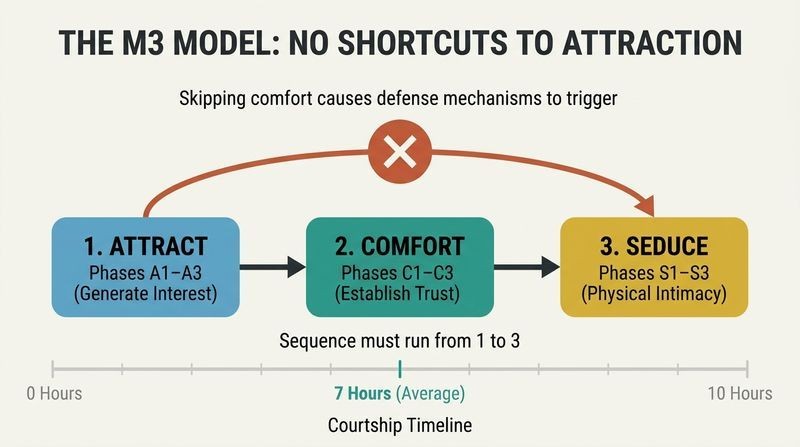
Courtship has a backward-engineered blueprint. Mystery (a self-described former shy magician) claims he reverse-engineered seduction by repeatedly succeeding, then asking himself how he did it. The result is the M3 Model, a three-stage sequence: Attract, Build Comfort, and Seduce. Each stage splits into three phases for nine total, running from the opening line to sex.
The pitch is bold and systematic. He frames himself as a modern Casanova (who bedded 122 carefully chosen women) and promises that any woman, however unattainable, can be seduced in four to ten hours, averaging seven. The philosophy treats meeting women like a skill akin to martial arts or playing guitar: study the patterns, internalize routines, and run the sequence. Attraction, he insists, comes before seduction, and skipping steps guarantees failure.
What's compelling is the systematization of a domain most people attribute to luck or charisma. This mirrors the deliberate-practice research of Anders Ericsson: expertise comes from structured repetition, not innate gift. But backward-engineering from one's own successes invites survivorship bias, the same flaw that plagues self-made-billionaire advice. Mystery never logs his failures with equal rigor. The book also launched the modern pickup-artist subculture, later popularized by Neil Strauss's The Game, and inspired both imitation and serious ethical pushback. Read as a framework for overcoming social anxiety through exposure, it has merit. Read as a guarantee, it overpromises wildly.
Women's attraction tracks social status, not your looks
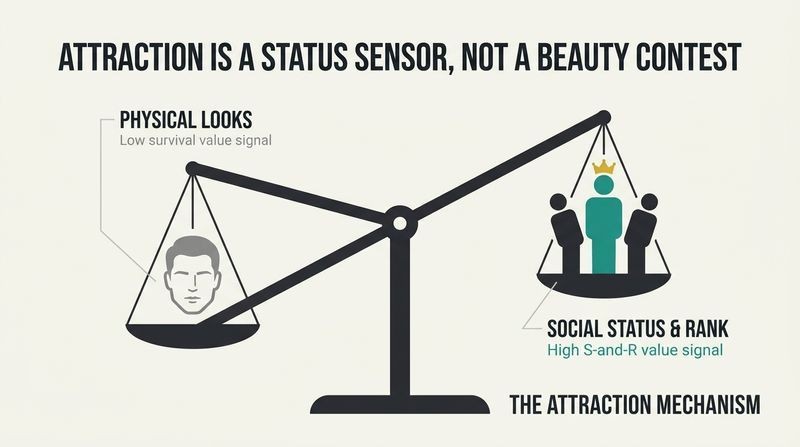
Attraction is a status sensor, not a beauty contest. Mystery grounds his method in evolutionary psychology: every person is wired to survive and replicate, and a woman's attraction circuits act as judges of a man's survival-and-replication value (his S-and-R value). Because women bear the larger biological risk in reproduction, they screen for a man's ability to protect and provide, signaled through social rank rather than physique.
The tribal-leader principle. He argues a man can be old, bald, and unattractive yet magnetic if he conveys dominance and resources, citing the cliche of a stunning woman beside a hunched nightclub owner. The practical implication: stop obsessing over your jawline and start projecting the traits of a tribal leader, leader of men, protector, and someone others defer to. Looks help, but perceived value decides.
The status-over-looks claim has partial empirical support: studies on mate preferences (Buss's cross-cultural work) do show women weighting status and resources more than men do. But the book overstates a contested theory as settled fact. Evolutionary psychology is notoriously hard to falsify, and effect sizes are modest, not deterministic. Physical attractiveness still predicts dating success robustly for both sexes. The deeper value here is reframing: anxious men fixate on immutable features while ignoring the malleable ones (confidence, social proof, leadership). That reframe is genuinely empowering. The reductive language of humans as biological machines, however, strips away culture, individual taste, and genuine compatibility.
Disqualify yourself as a suitor before she can dismiss you
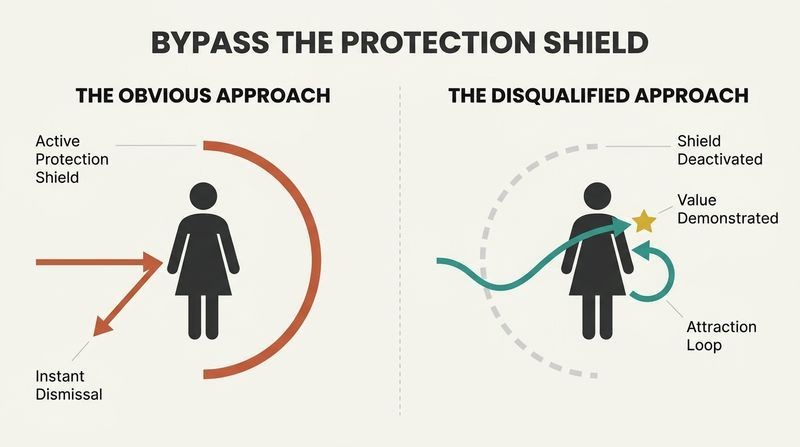
The counterintuitive core move. Mystery's central trick reverses normal courtship logic. The instant you approach a beautiful woman as an obvious suitor, you signal that you rank her value above your own, which makes you lower-value and gets you penalized, even for being nice. So you must first disqualify yourself from being seen as a potential suitor, then demonstrate value, then let her chase you.
Why it works. Beautiful women, he argues, field constant approaches and have built a protection shield to screen out the endless line of nice guys. By conveying that you are not hitting on her (through indirect openers, false time constraints, and apparent willingness to walk), you slip past the shield. He recounts opening a supermodel's group at a sushi bar, ignoring her romantically, building social proof, then isolating her, claiming victory in minutes.
Stripped of seduction context, this is sound social psychology: pursuing too eagerly signals low status, and scarcity raises perceived worth (Cialdini's scarcity principle). Playing hard to get has measurable effects in attraction research, though the findings are mixed and context-dependent. The reframe also reduces approach anxiety by removing the do-or-die stakes. The ethical tension is real, though: deliberately concealing romantic intent to bypass someone's conscious filters edges toward manipulation. A charitable reading is that authentic non-neediness is attractive precisely because it is honest. A cynical reading is that this teaches performed indifference as a tactic. The line between confidence and deception runs straight through this chapter.
Wrong order kills it: attract, build comfort, then seduce
Sequence is everything, and there are four classic failures. The linear order is attract, then build comfort, then seduce. Skip or reorder a stage and you sabotage yourself. Mystery names four sequencing mistakes:
1. The Seducer starts at the end, pushing for sex before attraction or trust exist.
2. The Nice Guy starts in the middle, building comfort with no attraction, boring her.
3. The Player attracts then jumps to seduction, skipping comfort, triggering buyer's remorse.
4. The Friend gets stuck in comfort, never signaling sexual intent, landing in the friendship zone.
The chess analogy. He compares premature seduction to fool's mate, a four-move chess win that only works against inexperienced opponents. You can occasionally win fast, but a socially experienced woman will not fall for it. Champions play a solid game through every stage.
The diagnostic structure is the book's most transferable idea: when something fails, identify which stage broke rather than blaming yourself globally. This maps neatly onto how relationships actually develop, from spark to rapport to intimacy, and onto sales funnels and persuasion theory generally. The friendship-zone warning resonates because it names a real failure mode: ambiguity about intent. Where the model strains is its rigidity. Real connection rarely advances on rails, and many lasting relationships begin with friendship-first comfort, the very sequence he condemns. Treating attraction and comfort as cleanly separable stages oversimplifies the messy, recursive way trust and desire actually build together.
Disarm a beautiful woman's guard with a playful neg
The neg is the book's signature technique. A neg is a brief, noninsulting remark that disqualifies you as an obvious suitor and gently dents the target's certainty about her own value, raising yours by comparison. It is not an insult. The classic example: glancing at a woman's nails and asking 'are they real?' then casually turning away. She feels she failed to win you over, which intrigues her.
Calibrated by attractiveness. Mystery advises that the more conventionally beautiful the woman (a 9 or 10 on his appearance scale), the more negs she can absorb, while average-looking women may react badly to the same line. The goal is to get close to her breaking point without crossing it, then pivot to appreciating things about her (never her looks). The neg works by sincerity: she must believe you genuinely are not trying to impress her.
The neg is the most infamous and most criticized idea in the entire pickup canon, widely condemned as a manufactured insecurity tactic. The steelman: highly attractive people are often surrounded by flatterers, so mild, playful teasing reads as refreshing authenticity and signals you are not intimidated. Teasing does build rapport in genuine friendships. The critique is sharper, though. Deliberately targeting someone's insecurity to lower their self-worth and create dependency is textbook negging in the abusive-relationship sense, a term that entered popular psychology partly through this subculture. The technique's effectiveness, where it exists, may say more about exploitable insecurity than about healthy attraction.
Stir her emotions instead of reasoning with her
Feelings drive decisions, logic rationalizes them. Mystery argues that people, women especially in his framing, act on emotion first and invent rational justifications afterward. So never try to argue, convince, or logically persuade a woman to like you. What she says she wants is not what she responds to. Instead, stimulate a wide range of emotions.
Even negative emotion beats apathy. Counterintuitively, he claims provoking frustration, jealousy, or embarrassment is better than provoking nothing, because an emotionally engaged woman is a reachable one. The full spectrum he lists includes curiosity, fascination, laughter, indignation, and fear of loss. The takeaway for conversation: stop reciting your resume and interview questions, and start telling vivid stories, teasing, and creating dramatic tension. Describe experiences through sensation and feeling, not dry facts, because emotional memory is what she carries home.
This aligns with a large body of decision science. Antonio Damasio's work on patients with damaged emotional centers showed they became unable to make even trivial choices, suggesting emotion is not the enemy of reason but its engine. Daniel Kahneman's fast-and-slow framing and Jonathan Haidt's elephant-and-rider metaphor both support the post-hoc-rationalization claim, for everyone, not just women. That universality is the catch: the book genders a general human trait, implying women are uniquely emotional and manipulable. The advice to favor evocative storytelling over interrogation is excellent and widely applicable. The framing that good emotions and bad emotions are interchangeable bait is where it turns troubling.
Approach the whole group, befriend the friends, then neg the target
Attractive women travel in packs for protection. Group theory is Mystery's claim that high-value women are rarely alone, so you must win over the entire set, not isolate the target. The friends are obstacles until disarmed. You open the group with an indirect story, become the most entertaining, highest-value person present, and crucially neg the target so her friends see no sexual threat and stop guarding her.
Preselection is the strongest switch. Being visibly valued by other women makes you instantly more attractive, a phenomenon he illustrates with grouse: a lone male bird struggles to attract a mate, but place a stuffed female beside him and real females flock over. Hence pawns (women you bring into a set) and pivots (female friends as social proof). Lead the men, he says, and the women follow.
The preselection insight is well-supported. Mate-choice copying is a documented phenomenon across species and in humans: studies show women rate men as more desirable when shown them with other women. Social proof (Cialdini again) is one of the most reliable levers in persuasion. Approaching the group rather than cornering an isolated woman is also, ironically, less predatory and more socially graceful than the alternative. The weakness is the instrumental view of other people, the friends as obstacles to disarm, the pawn women as props deployed and discarded. Treating an entire social circle as a system to be hacked optimizes for the pickup while corroding the genuine sociability it pretends to perform.
Chase reps and calibration, not any single night's outcome
Volume builds the skill that makes outcomes irrelevant. Mystery prescribes the Newbie Drill: go out four nights a week, four hours a night, three approaches an hour, roughly 2,000 women a year. The point is not to get one girl tonight but to internalize the method until it becomes automatic, the way a video-game player stops thinking about the controls.
Calibration is earned intuition. After enough approaches, patterns crystallize and social situations become predictable before they unfold. He calls this calibration. The flip side is process over outcome: the man who releases attachment to any single result is, paradoxically, the one most likely to succeed, because neediness leaks into everything and repels. Approaches blur together, fear shrinks, and competence (not confidence) becomes the real goal. He notes women are more socially skilled simply because they have fielded far more approaches.
This is the book's most defensible and genuinely useful psychology. It is exposure therapy by another name, the gold-standard treatment for social anxiety, repackaged as a training regimen. Desensitization through repetition demonstrably reduces fear. The process-over-outcome framing echoes Stoic philosophy (focus on what you control) and flow research (intrinsic engagement beats outcome fixation). The competence-not-confidence distinction is sharp and true: confidence follows capability, not the reverse. The honest caveat is the staggering time cost, sixteen hours weekly, and the question of what 2,000 approaches optimized purely for seduction does to one's capacity for unscripted, non-transactional human connection. The reps build a skill, but a narrow one.
Budget seven hours of comfort before making a move
The Seven-Hour Rule. Mystery claims it takes a cumulative four to ten hours, averaging seven, of comfort building before a woman is ready for sex. These hours need not be continuous; they accumulate across venue changes, phone calls, and dates. Comfort means trust, connection, and the sense that the interaction is real, the antidote to flaky phone numbers.
Skip it and you get buyer's remorse. He defines buyer's remorse as the regret a woman feels when escalation outpaced comfort, the morning-after coldness that kills the follow-up. His case study of Jim and Janine shows a man who made out fast, then never heard back, because he crossed the point of no return (where kissing becomes foreplay) without the trust to sustain it. The fix: be the one who pulls back, building comfort rather than arousal until privacy and trust align.
The specific seven-hour figure is almost certainly pseudo-precise, derived anecdotally from one man's field reports with no controlled data, and dressed up as a law. Treat the number as mnemonic, not science. But the underlying principle is sound and humane relative to the rest of the book: rushing physical escalation past someone's comfort level produces regret and rupture. The concept of buyer's remorse maps onto well-documented post-decision dissonance and the role of perceived agency in regret. Notably, this chapter quietly argues for restraint, patience, and reading comfort cues, the closest the method comes to advocating attentiveness to the other person's actual emotional state rather than her exploitable circuitry.
Make her invest through escalating compliance, not your chasing
Attraction is only bait; investment is the catch. Once a woman is attracted, Mystery insists you must get her to invest before she will value you, using the bait-hook-reel-release loop: bait her to demonstrate value, reward with a signal of interest, then withdraw slightly so she chases again. Rewards must be intermittent, the same schedule animal trainers use, because unpredictability is more compelling than consistency.
Compliance momentum. Small requests (hold this, guess my age, take my hand) condition her to comply with progressively larger ones. He layers this with kino escalation, gradual physical touch introduced so naturally it never feels like a single big move, comparing it to two jellyfish whose tentacles brush, withdraw, and intertwine. The rule: one step forward, two steps back. Create tension, then release it yourself, so she is conditioned to pursue rather than retreat.
The mechanics borrow directly from behaviorism. Intermittent reinforcement is the most powerful conditioning schedule known, the reason slot machines and notification feeds are addictive (B.F. Skinner's variable-ratio findings). The foot-in-the-door technique (small compliance breeds larger compliance) is a replicated persuasion effect. As applied psychology, the analysis is accurate and even impressive. As applied ethics, it is the book's most disquieting passage: explicitly framing a person as a subject to be conditioned like a trained animal, and physical escalation as compliance to be engineered, sits uneasily against modern, affirmative understandings of consent. The same knowledge that explains attraction can rationalize pressure. Readers should hold the mechanism and reject the manipulation.
Build real connection through vulnerability and your backstory
Comfort is where the game is actually won. Mystery argues the flashy attraction phase is merely the entry fee, and that lasting interest is built in quieter comfort-building locations through genuine rapport. Tactics include sharing vulnerability (an embarrassing story, a childhood memory, an insecurity overcome), which signals authenticity and invites her to reciprocate, and conspiracy, the in-jokes and shared frame that make two people feel like a team.
Grounding translates your identity. When she asks what you do, a bare label like 'magician' or 'student' creates distance or intimidation. Instead, ground yourself by narrating the journey from ordinary kid to who you are now, so she experiences the path with you and can imagine fitting into your life. Mystery describes filling twenty-three minutes with such stories before ever performing a trick. The aim shifts from getting sex to letting her fall for you.
This chapter is the book's redemption arc, and the parts that survive ethical scrutiny best. Vulnerability as a connection accelerant is strongly validated by research: Brene Brown's work and Arthur Aron's famous 36-questions study both show that mutual self-disclosure rapidly builds intimacy and even love between strangers. Grounding is essentially narrative identity theory, the idea that we understand ourselves and others through story, not labels. The advice to show the messy human journey rather than the polished resume is genuinely good for any relationship or even a job interview. The tension remains that even sincerity is taught here as technique, a performance of authenticity rather than the real thing, which raises the question of whether engineered vulnerability is vulnerability at all.
Analysis
The Mystery Method occupies a strange place in the self-help canon: a technically sophisticated, evolutionarily framed manual whose insights are frequently sound and whose ethics are frequently indefensible. Stripped of its seduction packaging, much of the book is applied social psychology that would not embarrass a peer-reviewed journal. Intermittent reinforcement, social proof, mate-choice copying, scarcity, foot-in-the-door compliance, and the primacy of emotion in decision-making are all real, well-replicated phenomena. Mystery's genuine contribution is assembling them into an operational sequence and prescribing exposure-based practice to overcome social fear. For anxious, isolated men, the underlying message (go out, talk to strangers repeatedly, stop fixating on outcomes) is therapeutically valid and probably helped many readers more than the specific scripts did.
The deeper problem is the worldview. The book reduces human beings to biological machines running exploitable subroutines, and it teaches the reader to engineer attraction by managing another person's insecurity, jealousy, and compliance. The neg, the manufactured jealousy plotline, and the framing of physical escalation as conditioning all treat a partner as a system to be hacked rather than a person to be met. This instrumental stance is precisely what later critics, and many former practitioners, came to reject. The very word negging entered mainstream vocabulary as a marker of emotional manipulation.
The book is also a historical artifact. Published in 2007 alongside Neil Strauss's The Game, it helped birth a subculture that has since fractured, with significant voices renouncing the manipulative core while retaining the confidence-building shell. Read today, it is most valuable as a case study in how accurate behavioral science can be weaponized, and as a reminder that the line between charisma and manipulation is not in the technique but in the intent and the respect (or lack of it) for the other person's autonomy.
Review Summary
The Mystery Method receives mixed reviews, with some praising its psychological insights and systematic approach to social interactions, while others criticize its manipulative tactics and objectification of women. Readers appreciate the book's breakdown of social dynamics and confidence-building techniques, but many find the methods unethical or outdated. Some view it as a valuable resource for improving social skills, while others see it as promoting shallow, insincere behavior. The book's controversial nature sparks debate about dating strategies, gender dynamics, and personal authenticity in romantic pursuits.
People Also Read










FAQ
What's "The Mystery Method: How to Get Beautiful Women Into Bed" about?
- Author and Focus: Written by Mystery, the book is a guide on how to attract and seduce beautiful women using a structured approach.
- Core Concept: It introduces the M3 Model, which breaks down the process of courtship into three stages: Attract, Build Comfort, and Seduce.
- Practical Application: The book emphasizes real-world practice in social settings, known as "the field," to develop skills and intuition.
- Target Audience: It is aimed at men who want to improve their dating lives by understanding social dynamics and attraction.
Why should I read "The Mystery Method"?
- Skill Development: It offers a systematic approach to improving social skills and confidence in interactions with women.
- Understanding Attraction: The book provides insights into the psychological triggers of attraction and how to leverage them.
- Real-World Application: It encourages practical application through exercises and missions in social environments.
- Comprehensive Guide: It covers a wide range of topics from opening conversations to building long-term relationships.
What are the key takeaways of "The Mystery Method"?
- M3 Model: The courtship process is divided into three stages: Attract, Build Comfort, and Seduce, each with specific objectives.
- Social Dynamics: Understanding group theory and social proof is crucial for successful interactions in social settings.
- Emotional Engagement: Engaging a woman's emotions is more effective than logical persuasion in building attraction.
- Practice and Calibration: Consistent practice in the field is necessary to develop intuition and refine techniques.
How does the M3 Model work in "The Mystery Method"?
- Attract Stage: Focuses on demonstrating higher value and creating initial interest without showing neediness.
- Build Comfort Stage: Involves developing rapport, trust, and a sense of connection over time and through multiple interactions.
- Seduce Stage: Occurs after sufficient comfort is built, leading to physical intimacy and the beginning of a sexual relationship.
- Sequential Process: Each stage must be completed before moving to the next to avoid common pitfalls like the "friendship zone."
What is the significance of "negging" in "The Mystery Method"?
- Definition: A "neg" is a subtle, negative comment that lowers a woman's self-esteem slightly, making her seek validation.
- Purpose: It helps to disarm a woman's defenses and create intrigue by showing that the man is not overly impressed by her looks.
- Application: Used primarily in the Attract stage to differentiate from other men who might be overly complimentary.
- Balance: Must be used carefully to avoid offending the woman or coming across as rude.
What role does "social proof" play in "The Mystery Method"?
- Definition: Social proof is the perception of value based on the approval and attention of others, especially women.
- Importance: It is a powerful tool for increasing attraction, as women are naturally drawn to men who are desired by others.
- Implementation: Can be demonstrated by being seen with other women, having a strong social circle, or being the center of attention.
- Effectiveness: Enhances the perceived value of the man, making him more attractive to potential targets.
How does "The Mystery Method" address approach anxiety?
- Understanding Anxiety: Approach anxiety is a natural fear of rejection or reprisal when approaching women.
- Three-Second Rule: Encourages approaching a woman within three seconds of seeing her to minimize anxiety and hesitation.
- Practice: Regular practice in the field helps to desensitize and reduce anxiety over time.
- Focus on Process: Emphasizes focusing on skill development rather than the outcome of any single interaction.
What are the best quotes from "The Mystery Method" and what do they mean?
- "If you can't attract a woman, you are, by dictionary definition, sterile." This highlights the importance of attraction in the replication process.
- "The one who releases himself from the emotional attachment to a desired outcome is, ironically, the one most likely to realize that outcome." It underscores the value of focusing on the process rather than the result.
- "Women will find a man more attractive if he has already been preselected by other women." This emphasizes the power of social proof and preselection in attraction.
- "The Game is played in the field." It stresses the importance of real-world practice and experience in mastering the art of pickup.
How does "The Mystery Method" suggest building comfort with a woman?
- Comfort-Building Locations: Use quieter, more intimate settings to develop rapport and trust.
- Time Investment: Spend an average of seven hours building comfort before attempting seduction.
- Multiple Interactions: Use a combination of phone calls, dates, and casual meetups to accumulate comfort time.
- Emotional Connection: Share vulnerabilities and create a sense of genuine connection to deepen the relationship.
What is the "Seven-Hour Rule" in "The Mystery Method"?
- Definition: It is the average amount of time needed to build enough comfort with a woman before seduction.
- Purpose: Ensures that sufficient rapport and trust are established to avoid buyer's remorse or last-minute resistance.
- Application: Time can be accumulated over multiple interactions, including phone calls and dates.
- Flexibility: While seven hours is an average, the actual time may vary depending on the individuals and circumstances.
How does "The Mystery Method" handle last-minute resistance?
- Understanding LMR: Last-minute resistance is a woman's natural hesitation before first-time sex.
- Techniques: Use token resistance, freeze-outs, and solid game to ease her through this phase.
- Building Trust: Ensure that sufficient comfort and trust have been established to minimize resistance.
- Persistence: Be patient and persistent, but respectful, to overcome any remaining barriers.
What is the role of a "wing" in "The Mystery Method"?
- Definition: A wing is a companion who assists the pickup artist in social settings.
- Primary Purpose: Helps to occupy obstacles, allowing the pickup artist more time with his target.
- Accomplishment Introduction: Can introduce the pickup artist to the set in a way that highlights his value.
- Support: Provides moral support and can help navigate complex social dynamics in the field.

Download PDF
Download EPUB
.epub digital book format is ideal for reading ebooks on phones, tablets, and e-readers.








































