


Key Takeaways
Master how attraction works and you erase your competition
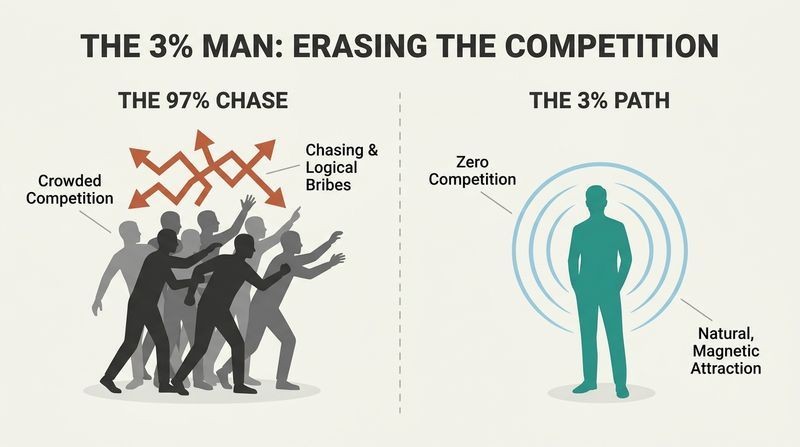
The core thesis. Corey Wayne claims only about 3 out of 100 men actually understand women, and those men enjoy their pick of partners. The name comes from the observation that the top 3% in any field capture most of the rewards. His argument: most men unknowingly talk women out of dating them because they misread what creates attraction versus what kills it.
Attraction is not a choice. Wayne borrows this line from David DeAngelo to make his central point: you cannot logic or bribe a woman into desire. Nature already decided within seconds. A woman knows in roughly three seconds whether you make the cut. The skill is not manufacturing attraction from nothing but reading it accurately and avoiding the needy behaviors that repel it.
The 3% framing is a motivational device more than a statistic, but it captures a real asymmetry: dating advice markets thrive because most men receive no coherent instruction. What's striking is how much overlaps with sales psychology, which Wayne openly credits. Reading interest signals, qualifying prospects, and not over-investing in cold leads are lifted directly from professional selling. Critics rightly note the book universalizes heterosexual, fairly traditional dynamics and treats women as a monolith. Yet the underlying claim, that confident non-neediness outperforms supplication, aligns with research on how anxiety and desperation cues undermine social attraction across contexts.
Stop chasing; create the space that makes her pursue you
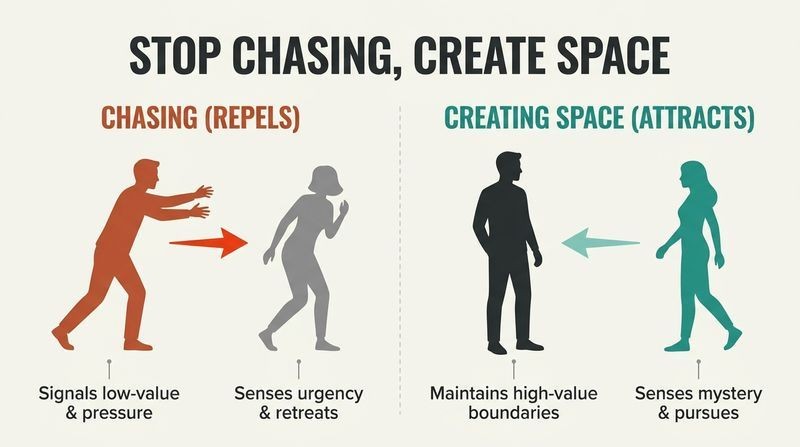
Inaction as strategy. Wayne's counterintuitive centerpiece is that chasing signals submission, a feminine quality, and repels women. Instead, give her room to miss you and she initiates contact to confirm you still want her. He cites the finding that women are more attracted to men whose feelings are unclear. He compares it to poker: hold your cards close so she reveals hers first.
The daughter-father dynamic. He argues women learn to seek masculine reassurance the way little girls run to a father's lap. When a woman texts or calls, she wants to feel your presence, so simply say yes and set the next date. His own turning point: at a nightclub he walked away feeling ignored, and the next morning she called asking where he went. Removing his attention captured hers.
The empirical anchor here is a real 2011 study by Whitchurch, Wilson, and Gilbert showing women rated men more attractive when uncertain whether the men liked them best. Wayne overextends a modest lab finding into a universal law, and the uncertainty effect likely fades once genuine interest is established. The deeper mechanism is intermittent reinforcement, the same variable-reward schedule that makes slot machines addictive. That should give pause: engineered unpredictability can tip from healthy self-respect into manipulation. The honest version of this advice is simply do not over-invest before reciprocity exists, which is sound. The scripted withholding is where it gets ethically murky.
Rate her interest on a 0-10 scale before investing anything
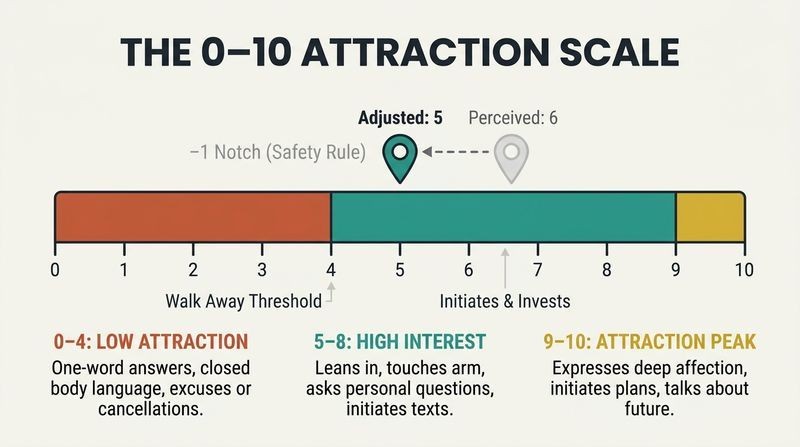
Below five, walk away. Wayne's attraction-level chart is his diagnostic tool. A woman must register at least a 5 out of 10 or you have no realistic chance, no matter what you say or do. He urges men to always underrate her level and act as if she is one notch lower than you think.
Reading the signals. Higher attraction shows in behavior, not words:
1. She asks your name and personal questions
2. She touches your arm, leans in, plays with her hair
3. She gives contact info freely, even asks for yours
4. She initiates calls and texts
5. Love begins at 9, when she says it first or asks where things are going
Low attraction looks like one-word answers, the escape-position body turn, and the call-back-to-confirm brush-off that usually means the date evaporates.
Quantifying a fuzzy human signal into a number is a clever cognitive hack. It forces detachment and interrupts the male tendency to project his own desire onto ambiguous cues, a documented bias sometimes called sexual overperception. By externalizing judgment into a rubric, a man stops rationalizing rejection. The weakness is false precision: real interest fluctuates with mood, context, and timing, and reducing a person to a scalar can breed a transactional, scorekeeping mindset. Still, the behavioral emphasis is sound. Actions predict follow-through far better than stated intentions, an insight echoed in behavioral economics, where revealed preference consistently beats declared preference.
Polarity drives desire: hold your masculine, let her feminine open
Opposites generate charge. Wayne, drawing on David Deida, frames masculine energy as purpose, direction, and breaking through barriers, and feminine energy as opening to receive love and connection. Desire lives in the gap between them. When a man stays centered and directional, a woman relaxes into playfulness and warmth.
When polarity collapses. He describes a stunning former Miss Figure competitor he could not enjoy dating because she lived in her masculine, controlling and directing everything, which killed his attraction despite her looks. He points to long-married couples in matching baggy shirts who have merged into sameness and stopped having sex. His prescription: a man should be her unshakable mountain, she his joy. Decide the plans, lead the interaction, and never surrender your center to earn her approval.
The masculine-feminine polarity model resonates with observed patterns but rests on contested essentialism. Deida's framework treats these as energies anyone can inhabit rather than fixed genders, a nuance Wayne partly preserves when he acknowledges couples with reversed polarity. The kernel worth keeping is about differentiation, a concept from family-systems therapist Murray Bowen: partners who fuse and lose distinct selves often lose erotic tension too. Esther Perel's work on desire says the same, that eroticism needs distance and mystery. The risk in Wayne's version is prescribing rigid dominance as the only masculine expression, ignoring that leadership can be collaborative rather than unilateral.
The phone sets dates, never fills silence; call weekly, in person
Appointments, not conversations. Wayne insists the phone works like a salesperson's tool: use it to lock a definite date, then hang up within a few minutes. Long calls give away all your mystery and make you predictable. A definite date has a specific time and place, with no call-back-to-confirm loophole, which he treats as a near-guarantee she will flake.
The once-a-week rhythm. For the first two months, initiate one call for one date per week until she starts reaching out first. Then simply set the next date whenever she contacts you. He maps the escalation: by week two or three she texts first, by week five or six you see each other several times weekly, by weeks seven and eight she brings up exclusivity herself. If met on a weekend, call Tuesday or Wednesday, not the next morning.
The mechanics reflect pre-smartphone dating and creak under modern app culture, where instant texting is the norm and a three-day wait can read as disinterest rather than intrigue. Yet the underlying principle survives translation: face-to-face interaction builds attraction more reliably than screen banter, a claim supported by research on media richness and rapport. The definite-date rule is genuinely useful. Vague plans correlate with low commitment, and requiring specificity is an efficient filter. Where the rigid weekly cadence falters is treating every woman as identical rather than calibrating to an actual person, which contradicts Wayne's own emphasis on reading individual signals.
Women fall in love slowly, so stay a mystery and build anticipation
Different clocks. Men, Wayne argues, are visual and ignite instantly, ready to declare love by the second date. Women warm through the whole experience of courtship, the anticipation of what happens next. Rushing relationship talk, gushing compliments, or dumping your baggage reads as needy and out of sequence, and it triggers retreat.
Guard your information. The person asking questions controls the conversation, so let her do 70 to 80% of the talking while you reveal little. He compares over-sharing to telling someone the ending of a movie they have not watched. When asked if he has a girlfriend, he deflects playfully rather than confessing a two-year drought. The goal is a slow reveal that keeps her fishing for more, because women want to feel they are inside an unfolding love story.
The asymmetry claim is partly supported: some studies find men report falling in love faster and saying it first. But the causal story is thinner than Wayne suggests, and plenty of women feel fast attraction too. The durable advice is about pacing and self-disclosure. Social-penetration theory holds that intimacy deepens through gradual, reciprocal revelation, so front-loading heavy confessions genuinely can overwhelm a new connection. The listening prescription is his strongest point, echoing Dale Carnegie, whom he cites: people warm to those who let them talk. The manipulative framing of mystery as strategy obscures that curiosity and reciprocity develop naturally when neither person is performing.
Treat dating as a numbers game and never fixate on one woman
Indifference is the difference. Wayne argues men sabotage themselves by getting hung up on a single woman before she has earned it, wasting months or years pining over someone unavailable or uninterested. Busy, successful men communicate abundance: if one connection fizzles, another bus comes in fifteen minutes. This detachment paradoxically raises attraction because it signals you are a prize, not a supplicant.
Rejection is not personal. He reframes a no as information, not a wound. Approach to find out if interest exists, and if it does not, move on without argument. He recalls fixating on unavailable women who felt emotionally familiar because they mirrored his cold childhood home. His counsel: be friendly to everyone everywhere, practice on women you are not interested in, and let the ones who help you into their lives self-select.
The abundance-versus-scarcity distinction maps neatly onto negotiation theory's BATNA, the best alternative to a negotiated agreement. A strong walkaway position genuinely shifts behavior, and desperation is legible to others. The self-awareness about repeating childhood attachment patterns is unexpectedly sophisticated, echoing attachment theory: anxiously attached people often chase avoidant partners because the familiar longing feels like love. That insight deserves more weight than the book gives it. The tension is that framing romance purely as a numbers game can flatten empathy and encourage treating people as interchangeable, the very interchangeability that later undermines the deep bonding Wayne says he wants.
She tests to feel your strength; hold your center and pass
Bluffing is testing. Wayne says all women test, especially beautiful ones, by pushing to see if you cave. A woman might insist she dislikes you, threaten not to visit, or try to change plans last minute, watching whether you fold. Caving fails the test; staying unmoved and playful passes it. He illustrates with the film Cinderella Man, where the boxer's wife protests his fight, then shows up to support him once he refuses to abandon his purpose.
Be the rock in the storm. He pictures a woman as an ocean and a man as a small boat that must not capsize no matter the waves. When she throws barbs, deflect with humor and indifference rather than argument. The strongest position is being able to walk away and mean it. Weather the storm and she opens back up.
Reframing conflict as testing is useful for men who spiral into defensiveness, but it is also unfalsifiable: any behavior can be relabeled a test, which lets the framework dodge disconfirmation. Sometimes a complaint is just a complaint. The healthier reading is emotional non-reactivity, again Bowen's differentiation, the capacity to stay calm when a partner is dysregulated. That skill genuinely stabilizes relationships. The danger is dismissing legitimate grievances as mere tests to be passed rather than needs to be met. Wayne partly guards against this elsewhere by emphasizing listening, but the testing lens can license men to ignore real signals of dissatisfaction.
When she shuts down, dig with questions until she says 'I feel better'
Bitchiness is a signal. Wayne argues a woman who withdraws sex, affection, or warmth is telling you she no longer feels safe in your leadership, not that she is simply difficult. The classic trap: she says nothing is wrong when something clearly is. That is a test of whether you care enough to break through her wall.
Listen to resolve, not to fix. His communication method: keep asking open questions like tell me more, what else, and how did that make you feel, then reflect her words back to show understanding. Do not rush to solve the problem, because for her, talking it through is the resolution. Keep going, using humor and physical warmth to interrupt her negative state, until you hear the release: I feel so much better, I'm glad we talked. Only then are the barriers down.
This is the book's most transferable and least gendered advice. Reflective listening and validating emotion before problem-solving are core techniques in couples therapy, notably John Gottman's research, which finds that men who accept influence and turn toward emotional bids have far more stable marriages. Wayne's insistence that men resist immediate fix-it mode addresses a well-documented pattern where solution-jumping makes a distressed partner feel unheard. The framing that a man must always draw it out positions him as perpetually responsible for her emotional state, which can breed over-functioning. Mutual accountability would be healthier, but the listening mechanics themselves are genuinely evidence-aligned and worth practicing.
The courtship never ends; complacency, not conflict, kills love
Keep doing what won her. Wayne's warning to married and committed men: the behaviors that attracted her are the behaviors that retain her, forever. Men who assume the relationship is handled and coast into TV-and-chips mode watch attraction quietly drain. He describes his own six-month lapse when a girlfriend, once a 9, drifted to a 7 while he made one small mistake after another until she blindsided him with her unhappiness.
Notice everything. When she shows you her new nails or hair, stopping to acknowledge it is giving her your presence, which is what she actually craves. Dismissing it says she is unimportant. He also prescribes spontaneity over routine, varying date nights so she never fully predicts you. Divorce statistics over 50%, he argues, largely reflect men who stopped paying attention.
The anti-complacency thesis is the book's most defensible claim and the one with the strongest research backing. Relationship science consistently shows satisfaction erodes not through dramatic rupture but through the slow decline of positive attention, what Gottman calls turning away from bids for connection. The habituation of reward is well documented in neuroscience: novel, varied experiences sustain dopamine response, which supports Wayne's spontaneity prescription. Where he oversimplifies is attributing divorce mainly to male inattention, ignoring finances, compatibility, and mutual growth. Still, the actionable core, that maintenance requires ongoing effort rather than a one-time conquest, is precisely what long-married couples and therapists alike report.
Enter every relationship to give, not to extract
Giving over getting. Wayne repeatedly frames the purpose of any relationship as contribution, not acquisition. Go in focused on what you can give, and expectations dissolve along with the disappointment they create. If your real goal on a date is simply to extract sex, he bluntly suggests a hooker would be cheaper and cleaner, because that is a transaction, not a relationship.
Love without attachment. He distills this into disciplines borrowed from a Tony Robbins seminar: selflessness, loving no matter what, being yourself, and gratitude. When you feel pain in a relationship, he argues, it means you have turned inward onto what you are getting; the cure is refocusing on the other person. He models it in how he ended things with his London girlfriend, staying loving friends rather than severing contact, because the only thing lost was physical intimacy.
The give-don't-get ethic sits in tension with the strategic gamesmanship elsewhere in the book, and that tension is worth naming. Scripted withholding and genuine generosity are not obviously compatible. Yet the giving orientation aligns with robust findings: research on communal versus exchange relationships shows that partners who track tit-for-tat report lower satisfaction, while those who give without scorekeeping report more. Detachment from outcome also echoes Stoic and Buddhist thought, where suffering stems from clinging to how things should be. The most charitable synthesis of the whole book is that its tactics are training wheels meant to dissolve into this final posture of secure, non-needy generosity.
Analysis
How to Be a 3% Man is a self-published, story-driven manual that fuses pickup tactics, relationship maintenance advice, and pop spirituality. Corey Wayne writes as a reformed nice guy turned coach, and the book's persuasive power comes less from data than from his confessional arc: the intimidated teenager writing letters through friends, the man who blew it with a perfect 10 by being too available, the eventual practitioner women pursue. It reads like a coaching transcript, repetitive by design, since Wayne insists readers absorb only a fraction per pass and should reread it fifteen times.
Intellectually, the book is a synthesis rather than an original theory. Its DNA includes Doc Love's attraction-level scorekeeping, David Deida's masculine-feminine polarity, David DeAngelo's cocky-funny attraction model, Dale Carnegie's listening principles, and Tony Robbins's pain-pleasure motivation and love disciplines. Wayne's contribution is packaging these into a single behavioral operating system for men, anchored by memorable heuristics: women are cats and men are dogs, the phone is for setting dates, hangout have fun and hook up, be her mountain.
The book's strengths and hazards are the same trait: reduction. By converting ambiguous social reality into rules and a numeric scale, it rescues anxious men from paralysis and over-analysis, and its anti-neediness core is genuinely supported by psychology on desperation cues and abundance mindsets. Its listening and anti-complacency chapters align closely with Gottman-style relationship science. But the same reduction flattens women into a predictable monolith, reframes all conflict as tests to pass, and leans on intermittent-reinforcement mechanics that shade into manipulation. Its evidentiary base is thin, resting on one uncertainty study stretched into law and heavy anecdote. The most useful reading treats the tactics as scaffolding toward the final posture the book itself endorses: secure, self-possessed, generous non-attachment. Taken as gospel it breeds gamesmanship; taken as a confidence primer, it can help.
Review Summary
"How to Be a 3% Man" receives mixed reviews, with many praising its practical advice on understanding women and building relationships. Readers appreciate the author's personal experiences and actionable tips. Some find the book transformative, recommending multiple re-reads. However, critics argue it promotes manipulative behavior and reinforces gender stereotypes. The book's repetitive nature and frequent references to external resources are noted drawbacks. Overall, it's seen as helpful for inexperienced men in dating, though some question its relevance for mature relationships.
People Also Read










Glossary
3% Man
Rare man who understands womenWayne's term for the roughly 3 out of 100 men who understand female attraction and therefore face little competition in dating and relationships. Named after the pattern that the top 3% in any field capture most of the rewards. Becoming one means mastering non-neediness, leadership, and reading a woman's interest accurately.
Attraction level
Her interest rated 0-10A diagnostic scale Wayne uses to gauge a woman's romantic interest in you. Below 5 means no realistic chance; love begins around 9. Read through behavior, not words: touching, initiating contact, asking personal questions, and giving contact info freely signal high levels. Wayne advises always underrating her level by a notch.
Definite date
Date with fixed time, placeA commitment with a specific time and location and no call-back-to-confirm caveat. Wayne treats requiring a definite date as a filter: a woman with genuine interest agrees to one, while insistence on confirming later usually predicts a cancellation and signals low attraction.
Hangout, have fun, hook up
Wayne's simple date formulaWayne's three-word blueprint for dating: set an evening date that could lead to sex, keep everything light and fun with no heavy topics, and make a physical move by going for the kiss and escalating. He frames seduction as steadily getting closer while building and releasing anticipation.
Masculine and feminine energy
Polarity that generates desireBorrowed from David Deida, this frames masculine energy as purpose, direction, and breaking through barriers, and feminine energy as opening to receive love and connection. Wayne argues sexual desire depends on maintaining polarity between the two, and that a man losing his center or a woman stuck in her masculine collapses attraction.
The take away
Withdrawing offer to test interestA sales-derived move, also called the negative sale, where a man withdraws the date offer when a woman is wishy-washy, saying they can do it another time instead. If her interest is high she reaffirms the plan; if low she lets it go, revealing her true attraction level without wasted effort.
Weathering the storm
Staying calm during her emotional testsWayne's metaphor picturing a woman as a turbulent ocean and a man as a small boat that must not capsize. When she throws emotional barbs, threats, or last-minute changes, the man stays centered, unreactive, and playful rather than arguing, thereby passing her test of his strength and reopening her emotionally.
FAQ
What's How to Be a 3% Man about?
- Focus on Relationships: Corey Wayne's book is a guide for men to understand women and build successful romantic relationships, emphasizing self-awareness and personal growth.
- 3% Man Concept: It introduces the idea of the "3% man," a small percentage of men who understand women and attract them effortlessly, serving as a benchmark for dating success.
- Practical Advice: The book offers actionable strategies on dating, communication, and maintaining attraction, making it a comprehensive manual for men seeking love.
Why should I read How to Be a 3% Man?
- Gain Understanding: The book helps demystify the dating process and provides clarity on what women truly want, offering insights from a woman's perspective.
- Improve Your Skills: It provides practical techniques for approaching women, building rapport, and maintaining attraction, enhancing dating success.
- Transform Your Mindset: Encourages a shift from insecurity to confidence, helping men become naturally attractive to women.
What are the key takeaways of How to Be a 3% Man?
- Self-Improvement is Essential: To attract the right partner, you must first become the person you want to attract, focusing on personal growth and self-awareness.
- Women Want a Challenge: Women are attracted to confident men with their own lives and interests, enjoying the chase and mystery.
- Courtship Never Ends: Maintaining attraction is an ongoing process, requiring continuous effort and attention to keep romance alive.
What are the best quotes from How to Be a 3% Man and what do they mean?
- "The courtship never ends.": Highlights the importance of nurturing the romantic aspect of a relationship continuously to maintain attraction.
- "Women are like cats, men are like dogs.": Illustrates the different approaches to relationships, with women requiring patience and independence.
- "You must love in such a way that the person you love feels free.": Emphasizes allowing your partner to feel secure and independent, involving mutual respect and freedom.
What is the "3% man" concept in How to Be a 3% Man?
- Definition of 3% Man: Refers to men who understand women and attract them effortlessly, characterized by confidence and self-awareness.
- Characteristics of a 3% Man: He is centered, has a clear purpose, and does not seek validation from women, making him more attractive.
- Becoming a 3% Man: The book provides strategies to develop these qualities, including improving communication skills and maintaining a sense of mystery.
How does How to Be a 3% Man suggest I approach women?
- Be Confident and Direct: Approach women with confidence and clarity, using a simple introduction and friendly demeanor.
- Read Body Language: Pay attention to body language and responses to gauge interest, looking for signs like eye contact and smiling.
- Create a Fun Atmosphere: Keep conversations light and fun, using humor and playfulness to build rapport.
What are the common mistakes men make in dating according to How to Be a 3% Man?
- Being Too Needy: Over-pursuing or seeking constant validation can be off-putting and diminish attraction.
- Talking Too Much: Oversharing personal information too soon can remove the mystery and excitement of getting to know someone.
- Ignoring Attraction Levels: Failing to recognize and respond to a woman's level of attraction can lead to missed opportunities.
How can I maintain attraction in a long-term relationship as suggested in How to Be a 3% Man?
- Continuous Courtship: Regularly plan dates, surprises, and romantic gestures to keep the spark alive.
- Stay Engaged: Keep communication open and engage in meaningful conversations, showing genuine interest in your partner.
- Be a Leader: Maintain your role as a leader by making decisions and guiding the relationship, creating security and attraction.
What does How to Be a 3% Man say about online dating?
- Create an Engaging Profile: Highlight personality and interests, using questions that resonate with potential matches.
- Be Direct in Communication: Keep conversations light and fun, aiming to set up a date rather than endless messaging.
- Watch for Red Flags: Be cautious of dishonesty or misrepresentation, moving on if someone seems untrustworthy.
How does How to Be a 3% Man define masculine and feminine energy?
- Masculine Energy: Characterized by purpose, direction, and assertiveness, men are encouraged to embrace this to attract women.
- Feminine Energy: Described as nurturing and receptive, women thrive in environments where they feel safe to express emotions.
- Balance is Key: Understanding and respecting these energies is crucial for a successful partnership.
How do I determine a woman's attraction level according to How to Be a 3% Man?
- Observe Her Behavior: Look for signs like frequent eye contact, physical touch, and enthusiastic responses.
- Use the Attraction Scale: Gauge attraction levels from 0-10, with 5 or higher indicating potential interest.
- Watch for Tests: Tests may indicate interest, as women assess strength and confidence.
What is the significance of timing in dating as explained in How to Be a 3% Man?
- Wait to Call: Waiting a few days to call builds anticipation and increases attraction, avoiding signals of neediness.
- Set Definite Dates: Be direct and ask when she is free, showing confidence and decisiveness.
- Maintain Mystery: Keep her intrigued by not revealing too much about yourself or your plans.
About the Author
Other books by Corey Wayne

Download PDF
Download EPUB
.epub digital book format is ideal for reading ebooks on phones, tablets, and e-readers.








































