

Key Takeaways
Treat daytime women like cats, not dogs, or they bolt
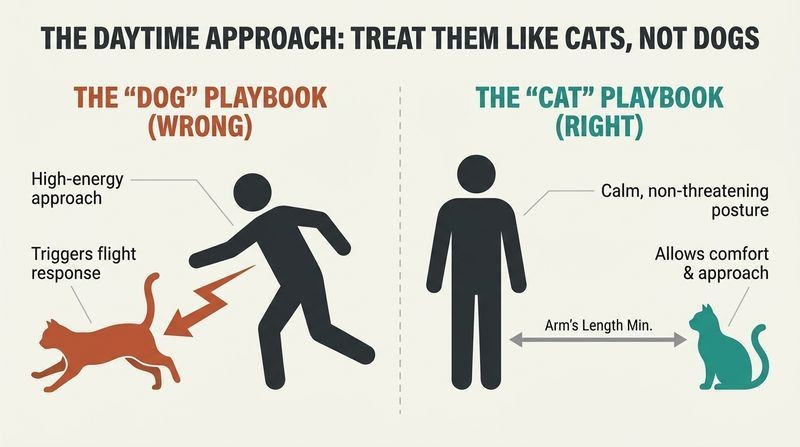
The core metaphor drives everything. Roosh argues that women in bars behave like dogs: they expect approaches, tolerate touching, and respond to cocky, high-energy game. Women approached during the day behave like cats: skittish, sensitive, and easily spooked. Rush a cat and it hides under the bed for hours. Sit calmly and let it drift toward you, and eventually it rubs your leg and asks to be petted.
Every daytime tactic follows from this. You stand farther away (arm's length minimum), speak in a flat monotone, avoid teasing, and never smile until she smiles first. The nighttime playbook (waist touching, cocky one-liners, sexual banter) triggers instant rejection before noon. The whole system is engineered to keep a nervous animal from fleeing.
The cat-versus-dog frame is a useful behavioral heuristic, and it echoes legitimate psychology: approach-avoidance conflict and the role of perceived threat in social openness. What's notable is the context collapse it captures. The same woman is genuinely more guarded sober at 2pm than tipsy at midnight, which aligns with research on alcohol's disinhibiting effect and social scripts. The blind spot is treating all women as a single skittish species rather than individuals with varied temperaments. The metaphor also frames connection as capture, which reveals the book's transactional worldview. Still, as pure tactical observation about lowering a stranger's defenses, the insight has real merit.
Open with the most boring question you can invent
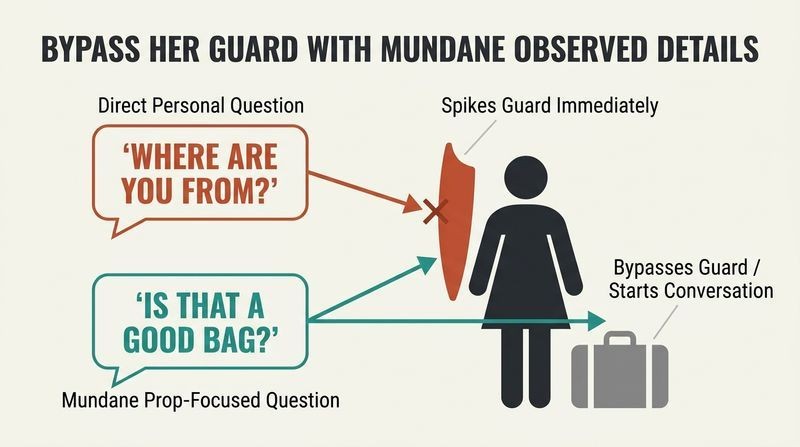
The elderly opener is deliberately dull. Roosh discovered it in a coffee shop near a retirement home, where old people constantly approached him asking, "Is that a good laptop?" The line works because it is non-personal, non-threatening, and asks for simple help. It signals: I am a normal human, not a creep, a beggar, or a threat.
The rule is to comment on a prop or environmental feature, never on her directly. If she has luggage, you ask "Is that a good bag?" not "Are you taking a trip?" If she has a pen, you become a curious pen shopper. Personal questions early ("Where are you from?") spike her guard and end the chat within a minute. Openers should be so mundane that witty guys, ironically, fail at day game.
There is a counterintuitive brilliance here that connects to sales and rapport research: low-stakes, help-seeking requests trigger reciprocity and the human instinct to assist. Asking for minor advice can increase liking, an effect sometimes called the Ben Franklin effect. The elderly-opener insight inverts pickup culture's obsession with clever lines. That said, the deliberate dullness is a filter, not attraction itself, and Roosh admits as much. The risk is that a man mistakes a compliant, polite response for interest. The genius is recognizing that in a low-approach environment, mere normalcy is differentiation, since almost no sober stranger initiates warmly.
Rejection is invisible: nobody remembers your awkward approach

Catastrophize on purpose, then act anyway. Roosh prescribes a "rejection mindset" for beginners: vividly imagine the worst case (the whole coffee shop erupting in mocking laughter, someone livestreaming your humiliation to a stadium) until you accept it, then approach regardless. The point is that the worst case never happens. Of roughly 700 approaches he witnessed by nervous newbies, only about ten went badly, and none came close to the imagined nightmare. That is a 1.4% sting rate.
The deeper reframe: the real danger is not rejection but obscurity. Most approaches end with a woman politely returning to what she was doing, and she forgets you within minutes. He tells a story of testing his blank-slate 14-year-old brother, who froze mid-approach, proving cold approaching is not natural but learnable.
This is exposure therapy dressed in locker-room language. Clinicians treat social anxiety with graded exposure and decatastrophizing, exactly what the rejection movie does: rehearse the feared outcome until the amygdala stops firing. The 1.4% figure is anecdotal, not controlled, but the underlying claim (that predicted social catastrophe wildly exceeds reality) is well supported by research on affective forecasting, where people overestimate the intensity and duration of negative emotions. The spotlight effect also applies: we overestimate how much others notice us. The brother anecdote is a sharp illustration that fear of judgment is near-universal rather than a personal defect, which is genuinely reassuring.
Ramble endlessly about nothing until her guard melts
Rambling is the hardest skill and the whole game. After the opener comes rambling: long-winded, low-stakes chatter designed to make a woman comfortable and to bait her into asking a question. Roosh distinguishes how men and women converse: men trade information efficiently, women often talk to talk. To connect with a cat, a man must bullshit at length about a trivial prop (he once talked about ugly socks for minutes and slept with the woman a week later).
The technique is bait. Small bait is casual opinions and observations that are easy to respond to. The rule of thumb: give rich, detail-loaded answers instead of one-word replies, spoon-feeding her hooks. Stay on the opening topic at least two minutes. Keep talking as long as she holds eye contact, even from near-zero feedback.
The gendered conversation claim is an overgeneralization, but linguist Deborah Tannen's work on rapport-talk versus report-talk lends it partial support: socialization does push conversational styles in different directions on average. The actionable core is strong and transferable far beyond dating: elaborated, hook-laden responses sustain conversation better than terse factual ones, a principle any networker or interviewer can use. Rambling also functions as sustained low-threat exposure, giving a nervous stranger time to habituate. The weakness is that the book frames a woman's comfort as something manufactured rather than earned, and prolonged one-sided talking can read as self-absorbed, a risk Roosh himself flags.
Drop juicy hints about your life and let her fish
Big bait reveals who you are, vaguely. Once rambling has warmed her up, you drop big bait: intriguing, personal fragments that hint at an interesting life without bragging. Classic openers are "When I lived in South America..." or "After I quit my corporate job..." You never elaborate unless she bites by asking a follow-up. The aim is a 70% interesting, 30% vague balance that hijacks her curiosity.
Roosh insists value must be real: game brings out existing value, it does not manufacture it. He recommends a personal "slogan" (his is traveler and writer who goes against the mainstream) and a pipeline of at least six bait pieces, ideally ten. Travel, hobbies, and unusual experiences beat job titles, which usually bore. A bartender outscores a heart surgeon because status must feel accessible and identifiable.
The withholding mechanic maps onto the psychology of curiosity as an information gap: we itch to close gaps in knowledge, so a half-revealed detail compels a question. This is also basic narrative craft, the tease before the payoff. The honest admission that "game doesn't create value where there is none" is the book's most defensible claim and its quiet self-rebuttal: technique amplifies substance, so the real long-term move is building an interesting life. The counterintuitive status point (bartender beats surgeon) reflects that women, being economically self-sufficient in Western contexts, weight relatability and lifestyle over raw earning signals, consistent with mate-preference research showing context-dependence.
One personal question from her is your green light
Wait for the question before you close. Roosh's non-negotiable rule: do not go for the number until she asks a personal question about you ("How old are you?", "What's your name?", "What do you do?"). At night these questions mean nothing. During the day, when a woman is guarded, a single personal question is a massive tell that almost guarantees a number, and, more importantly, a date.
He noticed the entire mood of a conversation shifts once she asks: it stops feeling stiff and becomes an equal exchange, pushing his odds of closing above 75%. Until that moment, he imagines his feet encased in cement, refusing to move or escalate. Numbers taken before she has invested this minimum interest lead to flakes and almost never convert to actual dates.
This is a disciplined application of investment and consistency psychology. When someone takes an active step toward you, they infer their own interest from their behavior, a self-perception loop, and become more committed. Waiting for her to ask reframes escalation as demand-following rather than demand-creating, which reduces reactance. It is also a clean, falsifiable signal in a domain full of wishful misreading, giving anxious men an objective checkpoint instead of guessing. The limitation: polite or lonely people ask questions without romantic intent, so the signal has false positives. But as a bar to clear before investing effort, it filters efficiently and prevents premature, flake-prone closes.
Close the number with the six-step Galnuc sequence
Galnuc turns interest into a date. Once she asks a personal question and the conversation peaks, Roosh runs a memorized mini-routine sequence spelled by the mnemonic Galnuc:
1. German: playfully guess her ancestry ("Are you half German?")
2. Age: ask how old she is
3. Location: ask where she lives (logistics for planning)
4. Name: ask her name, then pause for her to ask yours
5. Usually: ask where she usually hangs out
6. Cool: "Well you seem cool do you want to grab a drink sometime?"
The "you seem cool" line is a subtle neg said in one breath, implying he has been evaluating her. He then applies the yes-ladder (from Cialdini's persuasion research), getting her to agree she will reply enthusiastically to his text. He aims for a 10 to 15 minute conversation, walks away immediately after, and skips the day-game kiss (over 90% of women won't).
Galnuc is essentially a sales script, and it borrows openly from Robert Cialdini's Influence: the yes-ladder (commitment and consistency) and the because-reason effect (giving any justification boosts compliance, as in the copy-machine study). Scripting reduces cognitive load under anxiety, which is why checklists work in aviation and medicine too. The tactical wisdom of leaving right after the close is sound: lingering deflates the tension that motivates a follow-up. The weaker element is treating a woman's decision as an engineering output of correct button-presses. Real attraction is noisier. Still, as a repeatable close that converts interest into logistics, the structure is pragmatic and teachable.
Match your venue to your odds, and skip pairs
Coffee shops beat streets by a mile. Roosh ranks venues by conversion and logistics. Coffee shops, bookstores, and clothing stores yield the highest close rates (he claims consistent 50% streaks in a niche venue) because women are relaxed, isolated, and prop-rich. Street game is the hardest, with beginner close rates around 5%, since you are a literal stranger with no props. Each venue gets a tailored opener: pet shop directions on the street, "does this match my vibe?" in clothing shops, "is that any good?" in grocery aisles.
Two rules recur. First, approach only lone women; pairs freeze up or bail at the five-minute mark for fear of a friend's judgment. Second, engineer natural movement (toss a napkin, browse toward her) so the approach seems incidental, never a beeline that spooks the cat.
The venue-ranking logic is really about base rates and friction, a portfolio-optimization mindset applied to social life: concentrate effort where conversion is highest. The isolation point has grounding in conformity research, since a peer's presence heightens self-monitoring and social risk, making solo targets genuinely more receptive. The staged-incidental-movement tactic exploits how humans read intent from motion; a gradual, purpose-masked approach lowers threat perception, similar to how animal handlers avoid direct fast advances. The obvious critique is the surveillance-like quality of stakeouts and following women to crosswalks, which many would find unsettling. As logistics theory it is coherent; as social ethics it sits uncomfortably, a tension the book never fully resolves.
Sixty percent of women reject you before you speak
Accept the numbers or quit now. Roosh insists day game is a volume business. Even with flawless game, no man exceeds roughly a 40% overall close rate, because about 60% of women are simply not open at any given moment (relationships, bad moods, not attracted, not interested in strangers). Beginners with weak game get maybe 5%; his best students hit near 30%; he personally peaks at occasional 50% streaks.
He illustrates state-dependence with a story: a woman laughed off Fred Durst of Limp Bizkit at the height of his fame because she simply was not open. Fame and riches could not override her state. The takeaway is that abundant approaches, not perfect approaches, produce results, and he demands a minimum of ten approaches (two hours) per week to improve at all.
This is the book's most honest and psychologically healthiest thread: internalizing base rates protects against the personalization that fuels rejection pain. Reframing a no as a state mismatch rather than a verdict on one's worth is a legitimate cognitive-reframing technique used in sales training and CBT alike. The Fred Durst anecdote neatly separates value from timing, a distinction anxious people rarely make. The deliberate-practice framing (ten reps weekly) echoes skill-acquisition research, since spaced, high-volume repetition beats sporadic attempts. The caveat: framing women purely as a probability field to be sampled can entrench a mindset that struggles when the goal shifts from conquest to sustained relationship, which requires reading individuals, not averages.
The genuinely interesting man needs the least technique
Game amplifies substance; it cannot fake it. Roosh repeatedly concedes the ceiling on tactics: if a man has no travel, no hobbies, no stories, no hygiene, and no humor, no opener will save him. His benchmark question is blunt: are you more interesting than the woman you are approaching? Most people fill their free time with phones and reality TV, so a modestly curious man can clear that bar. But the hotter, cooler woman demands more, and a man who runs out of bait five minutes in loses her.
His prescription is a feedback loop: read, meet interesting people, take risks, break routine, then use those new experiences as conversational fuel. Getting laid makes you cooler and becoming cooler gets you laid. For many men, he says, game is really self-improvement wearing a disguise.
This is where the book quietly undercuts its own genre. If technique only amplifies existing value, then the highest-leverage move is not memorizing openers but building a life worth describing, a conclusion closer to classical virtue ethics than to pickup artistry. The interestingness-relative-to-target heuristic is a useful, humbling calibration tool. The feedback-loop claim also aligns with confidence research: mastery experiences (Bandura's self-efficacy) genuinely raise social ease, so competence and attraction can compound. The framing still instrumentalizes personal growth toward sexual conquest, which may cap how deep that growth goes. But stripped of context, the underlying advice, become someone with something to say, is sound and widely endorsed.
Analysis
Day Bang is a tactical manual, not a theory of romance. Written in 2011 at the height of the pickup-artist boom, it documents Roosh V's trial-and-error system for meeting women in non-nightlife settings: coffee shops, bookstores, grocery aisles, sidewalks, and subways. Its structure is procedural, opener to ramble to close, and its central innovation is recognizing that daytime approaching is a distinct discipline requiring the near-total abandonment of cocky nighttime tactics.
The book's real value is narrower and more defensible than its crude packaging suggests. Beneath the misogynistic register (women described as prizes, holes, cats to be captured) sits a legitimate curriculum in applied social psychology: graded exposure to defuse anxiety, base-rate acceptance to depersonalize rejection, help-seeking openers that trigger reciprocity, curiosity gaps that compel engagement, and commitment ladders drawn explicitly from Cialdini. Much of it is transferable to sales, networking, and general social confidence, which is why the material persists.
The book is hard to summarize honestly because its instrumental logic and its worldview are fused. The tactics assume women are an undifferentiated population to be sampled at volume, and the emotional coaching, while genuinely therapeutic in places, serves conquest rather than connection. Roosh's most interesting admissions cut against his own genre: game cannot create value that does not exist, and for many men the whole enterprise is self-improvement in disguise. That concession points toward a better book than the one written.
As a cultural artifact, Day Bang marks a specific moment before the manosphere hardened and before dating moved decisively online. Its ethics are dated and, in the stalking-adjacent street tactics, troubling. Its psychology, stripped of context and consent problems, occasionally lands on durable truths about anxiety, persistence, and the difference between a person's worth and a stranger's momentary receptiveness. Readers should extract the exposure-therapy and conversation-craft lessons and discard the transactional frame entirely.
Review Summary
Day Bang receives mixed reviews, with an average rating of 3.56/5. Some praise its practical advice for approaching women during daytime, highlighting the book's detailed conversation strategies and confidence-building techniques. Critics argue it's overly repetitive, potentially creepy, and promotes manipulative behavior. Supporters find value in its "indirect game" approach, while detractors view it as misogynistic and dishonest. Several reviewers note the author's later renunciation of his earlier work. Overall, opinions are divided on the book's effectiveness and ethics.
People Also Read









Glossary
Elderly opener
Dull, non-personal, prop-based questionAn opening line copied from how elderly people start conversations: an innocuous, help-seeking question about a nearby object or environmental feature, such as "Is that a good laptop?" It is deliberately boring and non-personal to signal safety and test whether the woman is open to chatting, without triggering the defensiveness a compliment or personal question would provoke.
Cat vs. dog
Daytime women skittish, nighttime boldRoosh's central metaphor. Women approached at night behave like dogs (expecting approaches, tolerating touch and cockiness), while women approached during the day behave like cats (guarded, easily spooked, needing slow warming). The comparison dictates all daytime tactics: stand back, speak calmly, avoid teasing, and let her drift toward you rather than rushing in.
Rambling
Long, low-stakes comfort-building chatterA long-winded, deliberately trivial style of conversation whose goal is to relax a guarded woman and bait her into asking a personal question. It relies on giving detail-rich, hook-laden responses (rather than terse answers) and staying on a neutral topic for at least two minutes before going personal.
Small bait and big bait
Conversational hooks to spark questionsBait is information dropped to provoke a response. Small bait is casual opinions, jokes, or observations easy to reply to. Big bait is an intriguing, vague personal fragment ("When I lived in South America...") that hints at an interesting life and tempts the woman to ask a personal question, which is the signal to begin closing.
Galnuc
Six-step number-closing routineRoosh's mnemonic closing framework run after a woman asks a personal question: German (guess ancestry), Age, Location, Name, Usually (where she hangs out), and Cool (the number-request line). It personalizes the interaction, builds playful rapport, and segues naturally into getting her phone number for a date.
Rejection mindset
Catastrophize, accept, then approach anywayA beginner desensitization technique. The man vividly imagines the most humiliating possible outcome of an approach, mentally accepts it, and then approaches regardless. Because the imagined catastrophe never materializes (a roughly 1.4% real sting rate), repeated rehearsal drains the anxiety from approaching, functioning as self-administered exposure therapy.
FAQ
1. What is Day Bang: How To Casually Pick Up Girls During The Day by Roosh V. about?
- Daytime pickup focus: The book is a comprehensive guide to meeting and attracting women during the day, outside of bars and clubs, using natural and indirect approaches.
- Personal journey and system: Roosh V. shares his transition from night game to developing a unique, tested day game system based on his experiences and workshops.
- Venue-specific strategies: It covers how to approach women in various daytime venues like coffee shops, bookstores, grocery stores, and public transportation.
- Emphasis on conversation: The book teaches how to initiate, maintain, and close conversations in a way that feels natural and non-threatening.
2. Why should I read Day Bang by Roosh V.?
- Proven, practical framework: The book offers a step-by-step, field-tested system for day game that has worked for Roosh V. and his students.
- Avoid common mistakes: It helps readers understand the differences between day and night game, preventing errors like being too direct or cocky during the day.
- Build confidence and mindset: The book addresses approach anxiety, rejection, and the mental preparation needed for successful cold approaches.
- Versatile and adaptable: Strategies are tailored for different venues and situations, making the advice widely applicable.
3. What are the key takeaways from Day Bang by Roosh V.?
- Day game is different: Approaching women during the day requires subtlety, patience, and indirect openers, unlike the more aggressive night game.
- Numbers game mentality: Success rates are inherently lower, so persistence and consistency are crucial.
- Conversation skills matter: Extended, non-personal rambling and the use of “bait” are essential for building rapport and attraction.
- Closing techniques: The Galnuc method and proper timing are vital for successfully getting a woman’s number.
4. What are the main differences between day game and night game in Day Bang by Roosh V.?
- Simplicity and subtlety: Day game openers are simple and indirect, while night game often uses more complex or bold openers.
- Natural behavior: Women are more natural and less guarded during the day, without alcohol or peer pressure influencing their actions.
- Physical escalation: Touching and flirting are more restrained and gradual in day game, with shorter conversations focused on getting contact info.
- Patience required: Day game requires more patience and a gentler approach to escalation and closing.
5. What is the “elderly opener” in Roosh V.’s day game method from Day Bang?
- Definition and purpose: The elderly opener is an innocuous, prop-based question designed to disarm and test if a woman is open to conversation.
- Cat-friendly approach: It mimics how elderly people start conversations, focusing on neutral topics like a bag, pen, or laptop.
- Examples: Questions like “Is that a good bag?” or “Is that a good pen?” keep the interaction non-personal and low-pressure.
- Goal: The opener signals you are a normal, non-threatening person, making it easier to transition into a natural conversation.
6. How does Roosh V. recommend handling approach anxiety and rejection in Day Bang?
- Visualize worst-case scenarios: Mentally accept the possibility of public rejection to desensitize yourself to fear.
- Rejection is normal: Understand that about 60% of approaches will fail due to factors beyond your control; embrace rejection as part of the process.
- Practice consistently: Commit to regular practice (at least two hours a week) to build confidence and reduce anxiety.
- Learning opportunity: Treat each rejection as a step closer to success and a chance to improve your skills.
7. What is “rambling” and how is it used in the day game model of Day Bang by Roosh V.?
- Definition: Rambling is a casual, extended monologue about non-personal topics related to the opener, designed to build comfort and rapport.
- Elderly chat style: The conversation mimics the meandering, non-threatening style of elderly people chatting about their surroundings.
- Use of “bait”: Sprinkle in small and big bait—interesting facts or stories—to keep her engaged and encourage her to ask personal questions.
- Avoids pressure: Rambling prevents the conversation from feeling like an interview and keeps the interaction light and natural.
8. What is the “Galnuc” method in Day Bang by Roosh V. and how does it work?
- Closing framework: Galnuc is a structured routine for smoothly transitioning from rapport to getting a woman’s phone number.
- Acronym breakdown: G - German ancestry guess, A - Age question, L - Location (where she lives), N - Name, U - Usual hangouts, C - Cool (asking her out for a drink).
- Timing: Run Galnuc after she asks a personal question and the conversation has peaked, usually after 5+ minutes.
- Execution: Use playful touches and humor, then exit smoothly after getting her number to maintain tension and avoid awkwardness.
9. How does Roosh V. suggest opening conversations in coffee shops according to Day Bang?
- Use environmental props: Start with questions about items like books, laptops, or bags to initiate a natural conversation.
- Approach from the front: Always approach where she can see you to avoid startling her, and say “Excuse me” loudly to get her attention.
- Observe openness: Look for signs like eye contact or scanning the room, but approach even if signals are weak, as some women warm up during the chat.
- Timing matters: Approach when she’s about to leave or packing up to avoid lingering after getting her number.
10. What is the “pet shop opener” in Day Bang by Roosh V. and why is it effective?
- Simple, non-threatening question: Ask, “Excuse me, do you know where the nearest pet shop is?” to engage her helpful side and lower her guard.
- Three-stage follow-up: Ramble about the difficulty of finding a pet shop, explain why you want a pet, and mention why you asked her specifically.
- Versatile use: Works well on the street and in groups, providing a natural topic for conversation and bait dropping.
- Builds rapport: The opener leads to a light, engaging conversation that feels organic and non-pushy.
11. How should personal questions and the timing of Galnuc be handled in Day Bang by Roosh V.?
- Avoid early personal questions: Don’t ask about her personal life before she shows interest, as it can break rapport and raise suspicion.
- Wait for her cue: Only reciprocate with personal questions after she asks about you, signaling genuine interest.
- Galnuc timing: Initiate the Galnuc routine after at least five minutes of conversation and after she asks a personal question.
- Maximize success: This approach increases the likelihood of a positive response and a successful close.
12. What are common mistakes men make in day game according to Day Bang by Roosh V.?
- Poor body language: Smiling too much, leaning in, or slouching can make you appear needy or creepy; maintain a neutral, confident posture.
- Running out of ramble: Ending the conversation too soon or resorting to rapid-fire personal questions kills the vibe; practice extended rambling.
- Dropping bait incorrectly: Offering big bait too early or too little reduces its effectiveness; space out interesting stories after rapport is built.
- Ignoring venue dynamics: Failing to tailor your approach to the specific environment (coffee shop, grocery store, etc.) can make interactions feel forced or awkward.

Download PDF
Download EPUB
.epub digital book format is ideal for reading ebooks on phones, tablets, and e-readers.








































