Key Takeaways
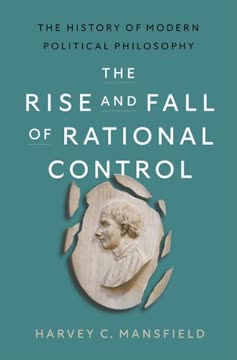
1. Machiavelli: The Birth of Rational Control through Necessity
Reason is to be used not merely to understand our problems but to control them.
A radical departure. Machiavelli initiated modern rational control by rejecting traditional morality and the pursuit of imaginary ideals. He emphasized "effectual truth," focusing on what is done rather than what should be done, arguing that reliance on goodness in a world full of those "who are not good" leads to ruin. This pragmatic shift prioritized human agency and control over divine or natural order.
The principle of necessity. For Machiavelli, success in politics demands a willingness to "learn to be able not to be good." His infamous play Mandragola illustrates this, showing how seemingly immoral acts, like adultery, can be justified by necessity to achieve a desired outcome, such as securing a family heir. This approach transformed vice into a tool for effective governance, making morality subservient to practical results.
Indirect government and acquisition. Machiavelli's "new modes and orders" laid the groundwork for modern political science, emphasizing the acquisition and maintenance of power. He viewed government as inherently manipulative and often conspiratorial, operating through hidden means and strategic uses of fear and manufactured gratitude. This indirect control, rather than open, principled rule, became central to his vision of a stable and expanding state.
2. Hobbes & Locke: Rationalizing Self-Preservation and Liberal Order
The end of man is nothing positive to aim at, but rather something to be escaped from.
Hobbes's scientific foundation. Thomas Hobbes applied a rigorous scientific method to politics, deriving the "state of nature" as a condition of perpetual war where life is "solitary, poor, nasty, brutish, and short." From this dire premise, he deduced the natural right to self-preservation and the necessity of an absolute sovereign. This artificial "Leviathan" was created by human reason to escape the fear of violent death, transforming Machiavelli's prudence into a universal, fear-driven science.
Locke's liberal refinement. John Locke, while sharing Hobbes's foundational concepts of the state of nature and self-preservation, presented a more peaceable natural condition. He argued that individuals possess inherent natural rights, including the right to property, which he broadly defined as "life, liberty, and estate." For Locke, the primary purpose of government is the "protection of property," establishing the framework for limited, constitutional governance.
Formal rights and "honest avarice." Locke's theory justified unlimited acquisition, transforming the pursuit of wealth from a vice into a driver of general prosperity. His concept of formal rights—where government protects the means (rights) but not dictates the ends (how individuals live)—created a sphere of civil liberty. This approach, while seemingly promoting individual freedom, implicitly relied on self-interest to generate collective well-being.
3. Rousseau: The Crisis of Progress and the Turn to History
The philosophers who have examined the foundations of society have all felt the necessity of going back to the state of nature, but none of them has reached it.
Critique of modern progress. Jean-Jacques Rousseau challenged the Enlightenment's core tenet that scientific and artistic advancement led to moral improvement. He argued that civilization, far from perfecting humanity, corrupted it, replacing natural goodness and genuine empathy with artificial politeness, self-serving vanity, and moral decay. This created a profound crisis for the idea of rational control.
History over fixed nature. Rousseau introduced "perfectibility," suggesting human nature is not static but evolves through historical "accidents." He contended that earlier philosophers mistakenly projected social traits onto a pristine state of nature, failing to account for man's historical development. His "hypothetical history" traced humanity's descent from a naturally good, asocial animal to a corrupted, political being, emphasizing that reason itself was an acquired, not innate, faculty.
The "general will" and legitimate chains. While exposing the social contract as a "fraud of the rich," Rousseau sought to make society's "chains legitimate" through the "general will." This concept demanded the total alienation of individual rights to the community, ensuring collective freedom and self-governance. However, it also implied a coercive aspect ("forced to be free") and rejected liberal representation, aiming for a unity that transcended individual interests.
4. Kant: Pure Morality and the Unattainable Ideal of Reason
The problem of establishing a state, no matter how hard as it may sound, is solvable even for a nation of devils (if only they have understanding).
Moral idealism and categorical imperative. Immanuel Kant sought to rescue morality from utilitarianism and Machiavellian expediency, asserting a "pure morality" based solely on reason, independent of consequences or happiness. His "categorical imperative" demanded actions be universalizable, treating humanity as an end in itself. This elevated every rational being to a legislator of universal moral law, making morality an absolute, internal command.
The separation of happiness and virtue. Following Rousseau's insights, Kant rigorously separated happiness from virtue, ensuring that moral actions were untainted by self-interest. This led to the concept of "perpetual peace" as an ideal—a moral duty to strive for, even if empirically unattainable. He believed that history, through its "unsocial sociability," would gradually, though not necessarily, align with this moral imperative.
A priori justice and its limits. Kant's strict, a priori morality, while demanding absolute adherence (e.g., forbidding lying or revolution), faced practical dilemmas. He posited that a just state could be built even by "devils" if they were rational, but this legalistic framework struggled to account for genuine moral motivation. His philosophy highlighted the tension between the ideal demands of reason and the imperfect realities of human nature, which he famously described as "crooked wood."
5. Hegel: History as the Actualization of Absolute Freedom
The mind is only that to which it makes itself; therefore, it is necessary that the mind presupposes itself.
Reason governs the world. G. W. F. Hegel sought to overcome Kant's "bad infinity" (unattainable ideals) by asserting that "reason governs the world" and is both substance and subject. He viewed history not as a series of accidents but as the necessary, dialectical development of "Spirit" (Geist) towards absolute freedom and self-consciousness. This made history itself the grand narrative of reason's unfolding.
The cunning of reason. For Hegel, freedom is actualized through history's stages, where seemingly irrational passions, conflicts, and the actions of "world-historical individuals" (like Caesar or Napoleon) serve as instruments for reason's progress. This "cunning of reason" meant that even destructive forces inadvertently contributed to the rational outcome. He reinterpreted Christianity and the Middle Ages as crucial transitions, demonstrating how the division between sacred and secular was overcome.
The end of history and the rational state. Hegel believed his philosophy marked the "end of history," where the rational state, embodying freedom and self-awareness, had been achieved. This state, articulated in Philosophy of Right, integrated abstract rights, morality, and ethical life, making politics the theater of morality and culture the driving force. This system aimed to complete modernity's quest for rational order, leaving no room for fundamental contradiction.
6. Marx: Overcoming Alienation through Historical Materialism
The philosophers have only interpreted the world in various ways; the point, however, is to change it.
Critique of liberal egoism. Karl Marx, a Left Hegelian, radicalized the critique of liberalism, arguing that its formal rights (property, equality, security) merely enshrined bourgeois egoism and perpetuated alienation. He viewed religion and politics as "superstructures" masking underlying economic realities, ultimately to be abolished as unnecessary products of alienated labor. For Marx, the liberal state, by protecting individual rights, perpetuated the very divisions it claimed to overcome.
Species being and productive essence. Marx defined man as a "species being," whose essence is conscious, social productivity. Under capitalism, labor becomes alienated—a means to subsistence rather than an end in itself—leading to the worker's dehumanization. Communism, for Marx, would overcome this by restoring man's wholeness, where production is for man, not for profit or private property, and work becomes a fulfilling expression of human essence.
Communism as historical necessity. Through historical materialism, Marx posited that capitalism, by solving scarcity and creating abundance, paradoxically intensified exploitation, making its overthrow by the proletariat inevitable. Communism, the final stage, would abolish class conflict, the state, and private property, leading to a society where "from each according to his ability, to each according to his needs," and the "free development of each is the condition for the free development of all."
7. Nietzsche: The Fall of Rational Control and the Will to Power
The great epochs of our life come when we gain the courage to rechristen our evil as what is best in us.
The "death of God" and nihilism. Friedrich Nietzsche declared "God is dead," signifying the collapse of all traditional, transcendent values and the onset of nihilism ("Nothing is true, everything is permitted"). He saw modern rational control, with its emphasis on universal enlightenment and happiness, as leading to the "last man"—a complacent, mediocre being devoid of passion, challenge, and true creativity, epitomizing the decline of humanity.
The will to power and revaluation of values. Nietzsche posited the "will to power" as the fundamental drive of all life, a constant striving for self-overcoming and enhancement. He critiqued previous philosophies, including modern rationalism, as expressions of underlying moral prejudices. His "genealogy of morals" exposed "slave morality" (pity, equality) as a reactive invention of the weak, contrasting it with "master morality" (pride, strength, nobility).
Creativity, nobility, and the philosopher of the future. Nietzsche advocated for a "revaluation of all values," urging individuals to embrace their inherent cruelty and self-overcoming to create new, life-affirming values. He envisioned "philosophers of the future" as "Caesarean cultivators" and "legislators" of new values, who, through radical honesty and self-cruelty (the will to truth turned against itself), would foster a new aristocracy of the spirit, transcending modern mediocrity and restoring genuine nobility.
8. The Enduring Paradox: Freedom's Bondage to Necessity
Freedom consists in an escape from God and nature, by which we are delivered into the bondage of human necessities.
Modernity's core dilemma. From Machiavelli's embrace of necessity to Nietzsche's will to power, the quest for rational control aimed to liberate humanity from external constraints (God, nature). Yet, this liberation often led to new forms of self-imposed bondage, as human necessities—whether acquisition, self-preservation, or historical determinism—became the new masters, creating a perpetual cycle of escape and re-enslavement.
The cost of certainty. The modern drive for certainty and universal solutions, from Hobbes's absolute sovereignty to Kant's categorical imperative, often simplified human nature and suppressed the complexities of moral and political choice. This pursuit of an "undoubted right" or a perfectly rational system inadvertently diminished the roles of prudence, courage, and moderation, essential for navigating an inherently uncertain world.
The unfulfilled promise. Despite grand ambitions to create a perfectly free and rational society, each philosopher's solution revealed new limitations or unintended consequences. The dream of overcoming all external and internal constraints remained elusive, suggesting that freedom might be inextricably linked to the very "necessities" it sought to escape, or that its true nature lies in a dynamic tension rather than a final resolution.
9. Philosophy's Role: From Interpreter to Commander
Genuine philosophers... are commanders and legislators.
The evolving role of the philosopher. Modern political philosophy transformed the philosopher's role from Socratic interpreter of nature to an active shaper of the world. Machiavelli explicitly positioned himself as a legislator of "new modes and orders," a commander of political thought. This shift reflected a growing confidence in human reason's capacity not just to understand, but to control and remake reality.
Reason as a tool for change. Hobbes, Locke, and Rousseau, each in their way, used philosophical reason to construct new foundations for society, moving from interpreting existing political forms to designing ideal ones. Kant, despite his emphasis on pure reason, saw philosophy as a "police" force protecting practical reason, while Hegel believed philosophy's ultimate task was to comprehend and affirm the rational unfolding of history itself.
The ultimate command. Marx famously declared that philosophy's point is "to change" the world, not merely interpret it, making the philosopher a vanguard of historical transformation. Nietzsche, in turn, saw philosophers as "Caesarean cultivators" and "legislators" of new values, asserting their will to power to command humanity's future. This trajectory highlights how modern philosophy, in its quest for rational control, increasingly sought to become the ultimate authority, dictating not just what is but what must be.
People Also Read
 Immersive
 Immersive
 Immersive