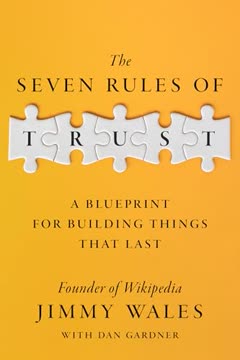
Key Takeaways
1. Trust is Personal, Always.
Trust is very often a lot more than a cold-blooded calculation.
Personal decisions. Trust is fundamentally a person-to-person decision, even when dealing with large organizations or abstract concepts. It's not a cold, logical calculation but an emotional response, deeply rooted in our evolutionary need for cooperation. The author's personal story of trusting Dr. Bernstein with his daughter Kira's life illustrates this, highlighting the profound emotional gravity of such decisions.
Triangle of Trust. This personal judgment relies on a "Triangle of Trust" comprising three key elements: authenticity, empathy, and logic (competence).
- Authenticity: Are you honest and true to your word?
- Empathy: Do you genuinely care about others' well-being?
- Logic: Are you capable of delivering on your promises?
These three elements collectively answer the core question: "Can I rely on you?"
Scaling up. Even global giants like Uber learned to apply this personal framework. When Uber faced a severe crisis of trust, Frances Frei helped them by addressing how their actions were perceived on a personal level by riders, drivers, and employees. Focusing on these individual perceptions of authenticity, empathy, and competence was crucial for their turnaround, demonstrating that personal trust scales up to organizational success.
2. Embrace Our Pro-Social Nature.
We’re a highly social animal and always have been.
Humanity's core. Despite the internet's darker manifestations, humanity's fundamental nature is pro-social, driven by a deep "need to belong." We are inherently wired to connect, collaborate, and share knowledge, as evidenced by our evolved capacity for language and teaching. This optimistic view of human nature formed the bedrock upon which Wikipedia was founded.
Cooperation's duality. However, cooperation is a powerful tool that can be wielded for both good and ill. The dark side of human nature, exemplified by historical atrocities like the Horace Maples lynching or online phenomena such as Gamergate, also involves self-organized, cooperative groups. These acts, while horrific, are expressions of our social wiring, channeled towards a shared, albeit destructive, purpose.
Purpose as differentiator. The critical distinction between constructive collaboration (like Wikipedia) and destructive mob behavior lies in purpose. While both tap into our innate social instincts, a positive, clear purpose channels our cooperative energies towards building something beneficial. Understanding this duality—that our social nature is a tool—is vital for fostering trust and positive collective action.
3. Define a Clear, Shared Purpose.
When we said “Wikipedia is an encyclopedia,” we were saying the equivalent of “Let’s write a Star Trek story.”
Power of mental models. A clear, shared purpose, such as "Wikipedia is an encyclopedia," instantly provides a powerful mental model for collaborators. This pre-existing understanding of an encyclopedia's content, style, and notability standards eliminated countless initial debates, making it easy for volunteers to grasp their role and contribute effectively from day one.
Recruitment and collaboration. This clarity of purpose was paramount for recruiting volunteers and fostering collaboration. It naturally attracted individuals who valued accuracy and the mission of knowledge sharing, creating a self-selecting community. Wikipedia's "Five Pillars," beginning with "Wikipedia is an encyclopedia," enshrined this purpose, guiding all editorial decisions and cultivating a culture obsessed with factual correctness.
Flexibility within purpose. While the core purpose was fixed, the methods were flexible, encapsulated by the directive "Wikipedia has no firm rules." This encouraged experimentation, learning, and evolution, allowing adaptation to the digital medium (e.g., abandoning alphabetical order, lowering notability thresholds). The purpose acted as a steadfast rudder, keeping the project on course while enabling bold innovation, ultimately leading to a dynamic and comprehensive knowledge base.
4. Give Trust to Get Trust (Reciprocity).
In business, nothing is more valuable than the trust of customers. And the best way to win the trust of customers, as the Quakers discovered, is to trust customers.
Quaker example. The historical success of Quaker businesspeople vividly illustrates the power of reciprocity. By consistently telling the truth and treating everyone fairly, even when it seemed to put them at a disadvantage, they earned an unparalleled reputation for honesty. This initial act of trusting customers, through transparent pricing and goods, led to customers trusting them in return, proving that "nice guys finish first."
Assume good faith. Wikipedia's foundational rule, "Assume good faith," embodies this principle. When an editor makes a questionable change, the default response is to assume positive intent, focusing on the substance of the disagreement rather than attacking motives. This approach fosters constructive dialogue, prevents unproductive "edit wars," and encourages respectful engagement, creating a positive feedback loop.
Long-term impact. This reciprocal trust extends beyond individual interactions. Sundar Lakshmanan's experience, where a patient editor (Arvind) assumed his good faith despite a policy violation, transformed him into a dedicated Wikipedian. This "pay it forward" mentality, where initial trust is reciprocated and then extended to others, is crucial for building and sustaining large-scale collaborative communities.
5. Civility is Foundational for Collaboration.
Civility simply demands that we put the focus on the substance of the disagreement, not on the people disagreeing.
Productive disagreement. Civility is not about avoiding disagreement but about enabling productive ones. Platforms like Reddit's r/ChangeMyView demonstrate that even on highly contentious topics, anonymous strangers can engage in serious, substantive, and civil discussions. This is achieved by rigorously focusing on arguments, not personal attacks, and fostering an environment where people are genuinely open to changing their views.
Beyond politeness. True civility means acknowledging others as fellow human beings, fostering mutual respect. While some argue that "radical candor" (like Linus Torvalds' abusive language) can be productive, it often alienates diverse talent and narrows perspectives. Python's success, built on Guido van Rossum's commitment to civility, shows that a welcoming culture attracts a broader range of contributors, enhancing diversity and collective wisdom.
Wikipedia's civility norms. Wikipedia enshrines civility as a core pillar, promoting "respect your fellow Wikipedians" and discouraging personal attacks. This is reinforced through public praise (barnstars) and, when necessary, enforcement (warnings, temporary blocks). Research on Wikipedia shows that politically diverse teams, operating under these civility norms, produce higher-quality articles, especially on controversial topics, by engaging in "longer, more constructive, competitive, and substantively focused but linguistically diverse debates."
6. Uphold Unwavering Independence.
If you are independent, what you are supposed to do is your singular purpose. It’s your one job.
Neutral point of view. Independence is crucial for trust, as it assures stakeholders that an organization's actions are driven solely by its stated purpose, not by external influences or hidden agendas. Wikipedia's "neutral point of view" (NPOV) pillar exemplifies this, presenting all significant, verifiable perspectives on a topic without endorsing any one as "right." This is akin to a newspaper not endorsing political candidates, focusing on reporting facts rather than swaying opinion.
Cost of taking sides. Research consistently shows that organizations—from scientific journals to corporations and universities—suffer a loss of trust when they take political stances. This damage often extends beyond those who disagree with the stance, impacting even those who align with it, as it signals a deviation from their core mission. The Washington Post's controversial decision to not endorse a presidential candidate, though poorly executed, reflected a recognition of this principle.
Purpose-driven independence. True independence means sticking to one's mission "without fear or favor." While it allows for taking a stand on issues directly impacting the organization's purpose (e.g., a university defending academic freedom), it otherwise demands neutrality. Anton Protsiuk, a Ukrainian Wikipedian, exemplifies this by focusing on "true, neutral facts" about the war, trusting that readers will draw their own conclusions, rather than using Wikipedia to promote a partisan view.
7. Transparency Builds Unshakeable Trust.
A man who speaks credibly is honest. And an honest man is trustworthy.
Power of disclosure. Transparency, especially when revealing potentially damaging information, paradoxically builds trust. Richard Nixon's "Checkers speech," where he disclosed every excruciating financial detail, worked because it was a "statement against interest," making his claims credible. Similarly, advertisers like Buckley's and Volkswagen gained trust by openly admitting product flaws ("tastes awful," "ugly").
Radical transparency. Wikipedia practices "radical transparency" by openly flagging articles with issues like "factual accuracy disputed" or "political neutrality disputed." This willingness to expose flaws, rather than hide them, assures readers that Wikipedia is committed to self-correction and accuracy. All editorial decisions, discussions, and changes are publicly logged, allowing anyone to "trust but verify."
Learning from mistakes. Airbnb's crisis in 2011, when a host's apartment was trashed, became a turning point due to CEO Brian Chesky's transparent admission of fault. This act of authenticity and empathy, combined with a commitment to developing robust trust and safety features (like identity verification and a $1 million host guarantee), transformed a potential disaster into a trust-building breakthrough. Transparency, coupled with decisive action, reinforces reliability.
8. Deliver on Your Promises, Consistently.
All the other rules of trust are important, but they will turn to dust if, in the end, you do not do what you say on the tin.
The ultimate test. The ultimate rule of trust is consistent delivery. All the preceding principles—personal connection, positive outlook, clear purpose, reciprocity, civility, independence, and transparency—are meaningless if an organization ultimately fails to do what it promises. Wikipedia's early studies, comparing its accuracy to Britannica, were crucial because they provided empirical evidence that Wikipedia "does exactly what it says on the tin"—delivering accurate, factual knowledge.
Social proof and reputation. Trust at scale is often built through "social proof" and reputation. People tend to trust what others trust. Airbnb's early growth, for instance, relied on founders building one-to-one relationships with hosts, who then became "evangelists." As more people use a service and have positive experiences, the collective judgment reinforces trust, making the service seem inherently reliable, much like automatic elevators became trusted through widespread use.
Fragility of trust. Trust, once earned, is not immutable. Boeing's recent struggles with the 737 MAX illustrate how quickly a sterling reputation can be tarnished by repeated failures to deliver on safety. Maintaining trust requires continuous effort and vigilance. Wikipedia, despite its global trust, must also remain committed to its core mission of accurate, neutral knowledge to prevent any erosion of its hard-won credibility.
9. Cultivate Trust for a Brighter Future.
Trust is the heart of the problem. Its loss is both symptom and cause.
Crisis of trust. The world faces a severe crisis of trust, particularly in government and media, leading to extreme polarization and a frightening acceptance of political violence. Social media algorithms, by prioritizing outrage and hate, exacerbate this by fostering "assume bad faith" as a norm, making constructive dialogue impossible and pushing societies towards dangerous divisions.
Countering polarization. To combat this, we must actively cultivate trust. This starts with organizations taking a "trust inventory" to identify key stakeholders and asking "How could this decision affect trust?" before acting. Tools like "glass mountain" (AI-summarized transparency) can make complex information accessible, fostering public understanding and accountability.
Empowering citizens. We can also foster trust by embracing our shared humanity and empowering citizens. Initiatives like "More in Common" reveal that people have more in common than they realize, while "social contact theory" suggests that shared goals and personal interaction can bridge divides. Experiments in democracy, like Citizens' Assemblies, and open-source digital platforms (Audrey Tang's work in Taiwan) demonstrate that giving trust to citizens can lead to innovative solutions and dramatically boost public confidence, paving the way for a more collaborative and hopeful future.
Review Summary
Reviews for The Seven Rules of Trust are mixed, averaging 3.87/5. Many readers appreciate the engaging history of Wikipedia and Wales' framework for building trust through authenticity, transparency, and good faith. However, common criticisms include repetitiveness, a self-congratulatory tone, and arguments that could have been condensed into a blog post. Some praise its optimistic philosophy and practical principles, while others find the ideas unsurprising or insufficiently scalable beyond Wikipedia's unique nonprofit model.
People Also Read



 Immersive
 Immersive