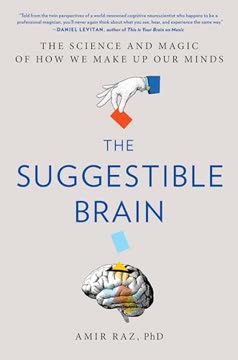
Key Takeaways
1. Suggestion is a Universal Force Shaping Our Reality
Given the right context and suggestion, people don’t always listen to and understand what you say. Instead, they hear and see what they think is happening.
Perception is reality. From a magician's stage to everyday interactions, suggestion subtly manipulates our perceptions, often making us believe things that aren't literally true. Disclaimers frequently fail because our minds are primed to interpret events through a lens of expectation, leading us to "hear and see what we think is happening." This phenomenon, termed "mental contamination," can be as simple as guiding a card choice or as profound as believing a theatrical performance implies real omniscient ability.
Beyond simple tricks. The author's journey from magician to scientist revealed that suggestion isn't just for entertainment; it's a learnable technique that influences even skeptics. Experiences like Richard Feynman's inability to open his eyes under hypnosis or a translator inadvertently hypnotizing an audience demonstrate that the power lies not in what is known or said, but in what others think is known and said. This highlights how dramatic experiences can increase suggestibility, communicating specific underlying messages without explicit guidance.
Defining suggestibility. Suggestion is an influential communication, while suggestibility is the degree to which one accepts and acts on it. Far from indicating feeble-mindedness, suggestibility is an ability to follow a suggestion, influenced by context and individual differences. It's a pervasive aspect of human behavior, impacting everything from our response to a simple card trick to our interpretation of complex social cues, and is measurable through psychological tools, though cultural context is crucial for accurate assessment.
2. Your Mindset Physically Alters Your Physiology
These outcomes transcend what people often collectively refer to as “placebo effects”—they form real instances when expectations shape physiology.
Mindset matters. Our expectations and beliefs can profoundly alter our physical body, extending beyond mere subjective feelings to measurable physiological changes. The "Indulgent" versus "Sensible" milkshake experiment, where identical shakes led to different ghrelin (hunger hormone) responses based solely on perceived calorie count, vividly illustrates this. Similarly, individuals with Type 2 diabetes showed glucose level changes based on perceived time elapsed or believed sugar content, not actual physiological factors.
Psychosomatic connections. The connection between mind and body is often undervalued, yet data consistently show mental influence over physical states. The author's experience with his son Glenn, whose throat pain from a "swallowed knife tip" vanished instantly upon seeing negative X-rays, exemplifies how psychological factors can manifest real physical symptoms. This top-down influence, where ideas and expectations within the brain govern physiology, is crucial for understanding conditions like nonepileptic seizures and even lactose intolerance.
Brain-immunity interface. Our understanding of how the brain and immune system interact has evolved, revealing that the brain is not immune-privileged. Mindset and mental states significantly impact how we get sick and recover, influencing immune responses. Stimulating brain regions involved in positive emotion (VTA) can reduce cardiac scar tissue or prime the immune system to fight cancer, while insula neurons can store and relaunch immune responses related to gut inflammation, explaining why suggestions can effectively treat conditions like Irritable Bowel Syndrome (IBS).
3. Human Memory is Reliably Unreliable and Highly Suggestible
Memory, like liberty, is a fragile thing.
Malleable recollections. Human memory is not a video recorder; it's a reconstructive process highly susceptible to suggestion and even complete fabrication. Elizabeth Loftus's research, including her personal experience of a false memory about finding her mother's body, demonstrates how external suggestions can implant vivid, emotional, and entirely unauthentic memories. This malleability means we often cannot reliably distinguish true memories from constructed ones, even with strong conviction or emotional attachment.
External influences. Leading questions, biased interrogations, and even casual misinformation can easily distort eyewitness accounts, changing details like car speed or the color of a jacket. This "misinformation effect" highlights how tenuous our grasp on event details can be. Even individuals with Highly Superior Autobiographical Memory (HSAMs), who remember nearly every day of their lives, are just as susceptible to false memories as the general population, indicating that these distortion mechanisms are fundamental to human cognition.
Narrative power. Magicians leverage memory's unreliability to turn tricks into miracles, knowing that spectators will reconstruct events to fit the illusion. Beyond entertainment, this principle has serious implications, as seen in "push polls" that plant false narratives in voters' minds, influencing opinions and voting behavior long after the initial suggestion. Our tendency to remember things that align with our existing beliefs further solidifies these suggested realities, making independent verification essential to protect against manipulation.
4. Clinical Interventions Often Harness the Power of Suggestion
Theatrical antics and contextual suggestions are part and parcel of many clinical interventions and medical healing. They unmistakably affect physiology and influence outcomes.
Beyond active ingredients. Many medical procedures and diagnoses inherently involve elements of suggestion and expectation, influencing patient outcomes. The "provocation tests" used in epilepsy clinics, where patients are given a sham substance with the explicit suggestion it will trigger a seizure, demonstrate how psychological factors can induce real, observable symptoms (psychogenic nonepileptic seizures) even without a biological trigger. This highlights the top-down influence of the mind on the body.
Theatrical medicine. The author's "Tic Detector" for Tourette's syndrome, a collection of broken electronics designed to "detect" and "deflect" tics, successfully reduced symptoms in children. This "theatrical medicine" works by leveraging belief and expectation, offering a narrative that empowers patients to control their symptoms. Similarly, the "artificial rose" test for asthma and experiments where lactose-intolerant individuals experienced symptoms only when they believed they had ingested lactose, underscore the profound impact of suggestion on biological conditions.
Ethical considerations. While effective, these methods raise ethical questions about deception in clinical practice. However, for conditions resistant to conventional treatments, judiciously applied suggestion, especially when patients are informed (open-label placebo), can offer significant benefits without the side effects of medication. The challenge lies in balancing scientific rigor and ethical principles to systematically study and harness suggestion for those who need it most, moving beyond anecdotal evidence to formal scientific understanding.
5. Antidepressants' Efficacy is Largely Driven by Suggestion
The difference between antidepressants and placebos is statistically significant but small—too small to make a clinically meaningful difference.
The antidepressant wars. Research, notably Irving Kirsch's meta-analyses of FDA data, reveals that the clinical efficacy of antidepressants for depression is barely distinguishable from that of placebos. While antidepressants show a statistically significant improvement over no treatment, the difference compared to inactive placebos is often less than two points on a 53-point depression scale, a margin deemed clinically insignificant. This suggests that much of their perceived benefit stems from the placebo effect and patient expectations.
Statistical vs. clinical significance. A key distinction often missed is that statistical significance (a finding is unlikely due to chance) does not equate to clinical significance (a finding is practically important in real life). For antidepressants, the small statistical advantage over placebos means that only about 15% of patients experience a clinically meaningful response not attributable to placebo, and even this may be inflated by "breaking blind" due to noticeable side effects.
Beyond the pill. The widespread use of antidepressants persists despite this evidence, partly due to slow medical adoption of new research, industry influence, and the powerful human need for hope. However, alternatives like Cognitive Behavioral Therapy (CBT), exercise, mindfulness, and social interaction show comparable or even superior long-term efficacy without the severe side effects (sexual dysfunction, emotional numbness, withdrawal, suicidality risk) associated with antidepressants. These alternatives often leverage suggestion and mindset to address the psychosocial roots of depression.
6. Suggestibility is an Evolutionary Advantage, Not a Weakness
We have been carefully crafted to be suggestible—some of us more, some less—likely because suggestibility serves an evolutionary purpose.
Adaptive trait. Suggestibility is an evolved human trait, akin to bipedalism or three-color vision, providing significant evolutionary advantages. It facilitates communication, learning, and cooperation within social groups, which are crucial for survival and thriving. The ability to accept and act on proposed information allows for rapid adaptation to changing cultural, societal, and technological demands, a process faster than genetic evolution.
Cultural transmission. Suggestion plays a key role in "cultural evolution" and "niche construction," where humans inherit and modify their environment based on shared knowledge and practices. Unlike instinctive behaviors in animals, human innovation—like building shelters—often arises from exposure to cultural suggestions. This dynamic allows for the efficient transmission of ideas, meanings, beliefs, and behaviors across generations, making us uniquely adaptable organisms.
Healing and social bonds. From a clinical perspective, suggestibility contributes to healing through placebo effects, where trust in a healer can improve survival. On a social level, it lubricates interpersonal relationships, fostering cooperation and group cohesion. Even today, no human is entirely immune to suggestibility, underscoring its fundamental role in our collective and individual functioning, from ancient rites and rituals to modern therapeutic practices.
7. Mass Suggestion and Misinformation Shape Society and Culture
Belief serves as fuel; technology as the vehicle of dissemination. Virtual spaces have become our houses of worship and pulpits.
Collective influence. Suggestion extends beyond individuals to influence entire groups, leading to phenomena like mass suggestion and social contagion. Historical examples, such as the Salem witch trials or European convent hysterias, show how psychological distress can convert into physical symptoms and spread through shared beliefs and social proximity. Today, digital social networks amplify this effect, instantly disseminating information and anxieties globally, turning virtual spaces into powerful platforms for collective behavior.
The rise of "truthiness." In the modern era, misinformation and "fake news" thrive, often leveraging our suggestibility and tendency to believe information that aligns with existing beliefs. "Push polls" manipulate voters by planting false narratives, and doctored images or biased news sources reinforce partisan views. This "truthiness"—what feels true rather than what is true—is exacerbated by social media algorithms that create echo chambers, making it increasingly difficult to agree on facts or reality.
Societal impact. The consequences of mass suggestion and misinformation are profound, contributing to social polarization, the spread of conspiracy theories, and even real-world events like the storming of the US Capitol. This erosion of shared reality poses significant challenges to societal consensus and trust. Recognizing these tactics and actively questioning our beliefs, especially when they align with our biases, is crucial for navigating a world where information is constantly manipulated.
8. Psychedelics Amplify Suggestibility, Offering Both Promise and Peril
Psychedelic substances, such as LSD, may rely on the human ability to increase suggestibility and attribute symbolic efficacy to introspective realizations and emotional insights.
Mind-manifesting effects. Psychedelic substances like LSD and psilocybin generate intense neural activity, creating new brain interconnectivity and accelerating neuroplasticity. This leads to profound perceptual and behavioral changes, including "ego dissolution" and a heightened "meaning effect," where individuals become unusually open to new patterns of thinking, observation, and interpretation. This increased suggestibility is a key mechanism behind their potential therapeutic benefits.
Therapeutic potential. When combined with supportive psychotherapy, psychedelics can unglue deeply entrenched depressive states, anxiety, and addiction by making individuals more receptive to hopeful ideas and narratives. Psilocybin, for example, has shown rapid and sustained antidepressant effects, even in treatment-resistant depression, by fostering greater openness and adaptability. The "set and setting"—mindset and environmental factors—are crucial, as they significantly influence the outcome of the psychedelic experience.
Double-edged sword. While offering immense promise for mental health, the amplified suggestibility induced by psychedelics also carries risks. Users may become more susceptible to believing misguided notions, from disturbing false memories to outlandish conspiracy theories, especially in the absence of trained support. The burgeoning "psychedelic revolution" demands careful scientific and ethical consideration to harness these substances for good while mitigating the potential for irrational thinking and further blurring the lines of truth.
9. Embrace Skepticism and Critical Thinking to Navigate a Suggestible World
The best thing we can do is to constantly question our beliefs, opinions, and mindsets.
Question your reality. Our minds are naturally susceptible to suggestion, and our confidence in beliefs often has a weak connection to truth. To navigate a world saturated with information and influence, it's crucial to cultivate a habit of constantly questioning our own beliefs, opinions, and mindsets, rather than blindly accepting what feels right or aligns with our existing views. This internal, deliberative dialogue is a form of self-administered cognitive behavioral therapy (CBT).
Informed vigilance. Protecting ourselves from unwanted suggestions and misinformation requires active engagement:
- Critically assess sources: Evaluate information for credibility, bias, and authority.
- Recognize social media's role: Be aware of how algorithms and online communities spread polarization and disinformation.
- Challenge assumptions: Understand that friction or disagreement on a topic can be an opportunity for deeper understanding, not just conflict.
Beyond subjective change. The pervasive influence of suggestion means that mindset can alter not just subjective perceptions (like pain or mood) but also objective physiological markers (like weight or blood pressure). Examples like the hotel maid study, where perceived exercise levels influenced health outcomes, underscore that our expectations can literally reshape our bodies. This challenges the old assumption that the placebo effect applies only to subjective experiences.
The magician-scientist approach. The journey through the suggestible brain reveals a synergy between the rigorous, systematic approach of science and the artful, deceptive techniques of magic. Both require organization, perseverance, and the ability to explore multiple solutions. By embracing this dual perspective, we can better understand the underlying mechanisms of suggestion, leverage its power for personal growth and social good, and protect ourselves from manipulation, ultimately enriching our lives in a world where truth itself is often a matter of perception.
People Also Read



 Immersive