

Key Takeaways
Don't manage stress, transform it through your heart's rhythm
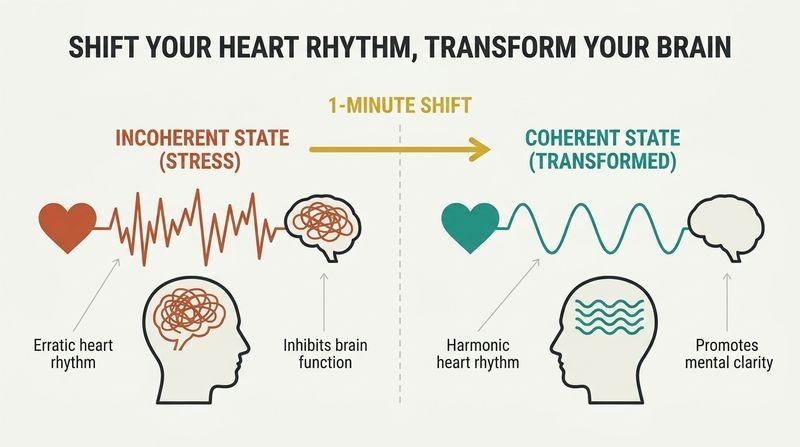
The HeartMath approach rejects the old model of coping with stress, which treats symptoms while ignoring the cause. Instead it claims you can convert stressful emotional energy into calm, clarity, and creative insight, the way a transformer converts electrical current. The core mechanism is the heart. Your physical heart is not just a pump but a rhythmic generator whose beat-to-beat pattern shifts with your emotions and feeds signals to your brain.
The stakes are high. The authors cite that 75 to 90 percent of doctor visits relate to stress, and that people unable to manage stress had a 40 percent higher death rate in one study. Their promise: with a one-minute technique, you can interrupt the automatic stress response etched into your neural circuitry.
The framing taps a real shift in physiology: the heart's signals do influence brain regions tied to emotion. What's compelling is the reframe from suppression (white-knuckling through) to conversion. The weakness is the word transform, which borders on marketing. Critics in stress science would note that much HeartMath research comes from its own institute, raising replication concerns. Still, the underlying claim aligns with mainstream vagal-tone research: heart rate variability genuinely predicts resilience and mortality. The book's contribution is packaging this into something a stressed person can actually do, rather than yet another lecture on diet and exercise they will ignore.
Smooth heart rhythms signal calm; jagged ones signal stress
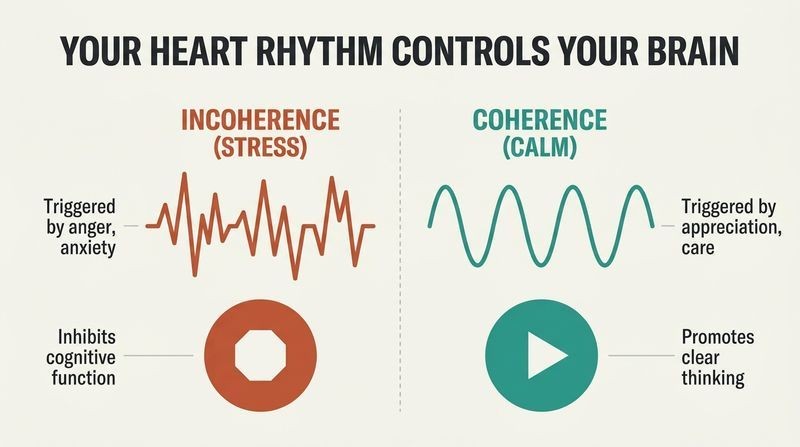
In their lab, the authors hooked people to ECG monitors and analyzed heart rate variability, the tiny fluctuations in time between beats. They found a clean correlation: positive emotions like appreciation, care, and compassion produced smooth, wavelike rhythm patterns they call coherence. Negative emotions like anger, anxiety, and frustration produced jagged, erratic patterns resembling an earthquake graph, which they call incoherence.
This matters because coherent rhythms boost immune function, balance hormones, and improve clear thinking, while incoherent rhythms inhibit the higher brain and make you say things you regret. The practical upshot: your heart sensations work like a traffic light. Solidity and security mean green, go. Jagged frustration means red, stop and recalibrate before acting.
Heart rate variability is one of the more robust biomarkers in psychophysiology, used today in elite sports, cardiology, and even military training. The coherent-versus-incoherent dichotomy is a useful simplification, though scientists would caution that coherence is not synonymous with health in every context; you want variability, not a flat metronome. The deeper insight, that emotion is legible in the body before the conscious mind names it, echoes Antonio Damasio's somatic marker hypothesis and Lisa Feldman Barrett's work on interoception. Training people to read internal bodily signals as data, rather than noise to be silenced, is a quietly radical reframe.
Your stress radiates outward and infects everyone within ten feet
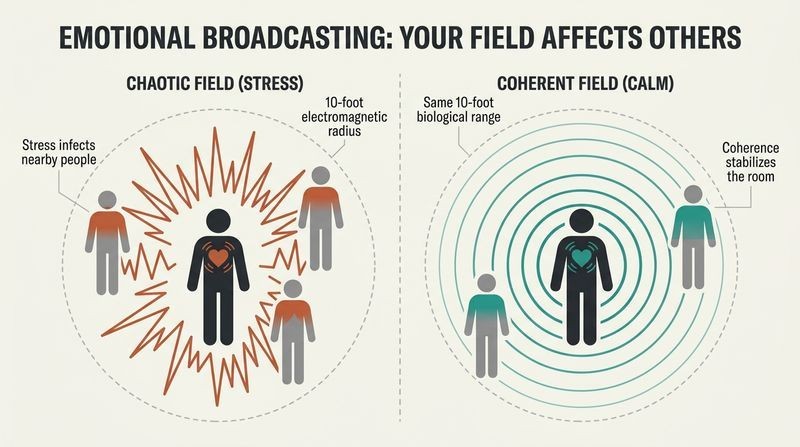
The heart generates an electromagnetic field roughly 5,000 times stronger than the brain's, measurable up to ten feet away. The authors argue your emotional state literally broadcasts, and researchers measured one person's heart rhythm showing up in a nearby person's brain waves. They call the result an emotional virus: judgment, blame, and negativity spread person to person through words and energy.
This explains why you can leave a tense meeting drained even when the topic did not concern you, or why a crowded elevator makes people instinctively shield themselves. You are most susceptible when already stressed or run-down, which is also when you are more likely to catch a cold. The flip side: a calm, coherent person can stabilize a whole room.
The electromagnetic-contagion claim is the book's most scientifically contested. While the heart's field is real and measurable, the leap to inter-personal emotional transmission via that field stretches the evidence. But the phenomenon itself is well documented through ordinary channels: emotional contagion is established in social psychology (Hatfield, Cacioppo), and mirror neurons plus facial mimicry explain much of it without invoking fields. The practical wisdom survives regardless of mechanism. Anyone who has managed a team or parented a toddler knows a calm nervous system is contagious. The metaphor of an emotional virus is sticky and genuinely useful for setting boundaries.
Reset your nervous system in sixty seconds with Quick Coherence
Quick Coherence is the book's flagship technique, designed to shift your physiology on the spot. Three steps:
1. Heart Focus: place attention on the center of your chest.
2. Heart Breathing: imagine breathing in and out through your heart, slowly, about five to six seconds per inhale and exhale.
3. Heart Feeling: recall and re-experience a genuine positive feeling, like appreciation for a person, pet, or place.
Slow breathing at five to six breaths per minute synchronizes the nervous system, and the positive feeling sustains coherence without effort. One man used it the instant he woke each morning to flip his whole-day outlook. The authors compare practice to abdominal crunches: five one-minute sessions a day, and within a couple of weeks you see real change.
This is essentially paced breathing plus positive affect induction, and both components have solid independent support. Roughly six breaths per minute hits the resonance frequency of the baroreflex, maximizing heart rate variability, a finding replicated across many labs and the basis for clinical HRV biofeedback. Adding a felt emotion is the clever twist: it gives the mind something to hold onto so the technique does not collapse into mechanical counting. The accessibility is the genuine innovation. Unlike meditation requiring twenty quiet minutes, this is deployable mid-argument or in traffic, which is precisely where regulation is needed most.
Your heart sends more signals to your brain than it receives
Stress hijacks you through the autonomic nervous system, which runs 90 percent of your body's functions automatically. It has two branches: the sympathetic (gas pedal, speeds the heart) and parasympathetic (brake, slows it). Anger and anxiety jam both at once, like driving with one foot on each pedal, wearing out the system. Crucially, the heart talks back. It sends more neural signals up to the brain than the brain sends down, routing through the thalamus and amygdala.
The amygdala stores emotional memories and its core cells synchronize to the heartbeat. A fast track lets threatening input reach it before the rational cortex weighs in, triggering reactions that seem irrational in hindsight. By changing your heart rhythm in the moment, you change the signal reaching the amygdala, breaking the stress habit at its source.
The bottom-up direction of heart-to-brain signaling is legitimate neuroscience and underappreciated in popular psychology, which fixates on top-down willpower. The fast-track amygdala pathway draws directly on Joseph LeDoux's foundational fear-circuitry research, which the book applies aptly. The contrast with cognitive behavioral therapy is sharp and fair: CBT works through the slow, rational route, which is why insight alone often fails to stop a panic reaction. Intervening at the physiological layer rather than the cognitive layer is the key insight. Where the book overreaches is implying the heart is the seat of intelligence; the heart modulates brain function, but the integration still happens upstairs.
Stress and youth fight over your DHEA-to-cortisol ratio
Stress floods you with a cascade of about 1,400 biochemicals. Two hormones dominate. Cortisol, the stress hormone, lingers for hours, depresses immunity, and in excess shrinks the hippocampus, your memory center, fragmenting your thinking. DHEA, the antiaging hormone, counters cortisol and makes you feel vital; both are built from the same precursor, so when one rises the other falls. The ratio between them is one of the most accurate physiological markers of stress and aging.
In one study, people practicing HeartMath techniques cut cortisol by an average of 23 percent and more than doubled DHEA in thirty days, without supplements or extra exercise. A six-month Unilever study showed DHEA up around 90 percent plus lower blood pressure and abdominal fat. The authors warn against DHEA supplements, which carry side effects and do not lower cortisol.
The cortisol-shrinks-the-hippocampus finding (Sapolsky, Lupien) is rock solid, and chronic cortisol elevation is genuinely implicated in metabolic and cognitive decline. The DHEA story is more nuanced than presented; DHEA's antiaging reputation is partly hype, and the precursor-competition model (the pregnenolone steal) is debated in endocrinology. The reported doubling of DHEA in thirty days is striking enough to invite scrutiny of methodology and sample size. That said, the core message, that emotional self-regulation measurably shifts stress biochemistry, fits a large literature linking meditation and slow breathing to cortisol reduction. The refusal to recommend supplements is responsible and worth noting.
A little stress sharpens you; too much triggers collapse
Drawing on World War II research with soldiers, the authors map a performance curve. A bit of stress, met with a positive attitude, actually improves performance and sharpens focus, which is why people believe stress motivates them. But push the challenge higher or longer and you cross a tipping point: performance degrades, you work longer and harder just to keep up, irritation rises, and eventually you hit exhaustion, breakdown, and illness.
Where your curve peaks depends on emotional resilience. Resilient people sustain high performance longer because they regularly appreciate the good, refuse to inflate small problems, and maintain a healthy hormone ratio. Workplace data from companies like Sony and Boeing showed HeartMath users cut anxiety 60 percent and exhaustion 45 percent; high schoolers raised math and reading scores 14 to 35 percent in three weeks.
This is the Yerkes-Dodson law, the inverted-U relationship between arousal and performance dating to 1908, here dressed in resilience language. It remains broadly valid and explains the seductive trap of stress addiction: the early uphill stretch feels productive. The advertising executive who once measured productivity by how stressed he felt captures a cultural pathology precisely. What the framework adds is the resilience lever, the idea that the curve's peak is trainable rather than fixed. The corporate effect sizes are impressive but come from the vendor's own assessments; independent replication would strengthen the case considerably. Still, the directional claim is sound and actionable.
Pair breath with the gut to lock in attitude shifts
Sometimes Quick Coherence is not enough to break a stubborn negative mood, so the authors add Attitude Breathing. You breathe in through the heart and out through the solar plexus, the gut-brain region four inches below the heart that produces those butterflies and knots. Then you deliberately breathe a chosen attitude, like calm, ease, courage, or forgiveness, even one you do not yet feel.
The logic: the heart, head, and gut each have nerve networks, and synchronizing all three gives shifts more staying power. A schoolteacher reassigned to a daunting junior-high class used it each morning while dressing, breathing appreciation despite a churning stomach, and arrived at class with the dread gone. The trick is earnest effort. Done from the mind without genuine heart engagement, it lacks the power to move emotions charged with feeling.
The gut-brain (enteric nervous system) is real and increasingly central to research on the microbiome-mood axis, so anchoring attention there is more than mystical flourish. Breathing an attitude you do not feel resembles opposite action in dialectical behavior therapy and the facial-feedback hypothesis: behaving your way into an emotion rather than waiting to feel it. The insistence that positive thinking alone is insufficient without bodily engagement is a genuinely useful correction to the affirmation industry. The construct can feel like technique proliferation, though; a skeptic might ask whether Attitude Breathing is meaningfully distinct from Quick Coherence or just a reframed variant for harder cases.
Unresolved feelings accumulate like debt in stress accounts
The authors describe stress accounts: stored-up feelings and beliefs about past events that make you overreact to the present. A relative who once disrespected you now irritates you every time they call, because the account is overloaded with accumulated irritation. These accounts become emotional habits, often inherited from family, religion, or culture, that fire automatic reactions before you can think.
Three paths refill your emotional reserves:
1. Build energy with internal boosters like appreciation and care, not external ones like coffee or shopping that crash you afterward.
2. Stop drains by tracking the irks and ughs that leak energy through blame and worry.
3. Clear old accounts so the same triggers stop firing the same habits.
Deferring this work compounds like credit-card interest until you can barely make the minimum payment.
The accounting metaphor is well chosen because it captures something cognitive science confirms: emotional memories are not neutral records but biased priors that shape perception, what Bayesian models call predictive processing. The distinction between internal and external energy boosters maps onto research on hedonic adaptation, the treadmill by which stimulants and purchases deliver shrinking returns. The cultural-inheritance angle gestures at intergenerational trauma, now a serious research area. The debt-compounding image is the strongest part, reframing avoidance as accruing liability rather than achieving peace. The challenge: clearing deep accounts often requires more than breathing techniques, which the book partly acknowledges by recommending professional help for serious issues.
Hit pause mid-reaction to edit the outcome with Freeze-Frame
Freeze-Frame is the book's deepest technique, named for pausing the movie of your life to edit a single frame. When a stressful situation hits, you take a time-out to admit exactly what you are thinking and feeling, including hidden judgments and projections. Then you shift focus to the heart, breathe through it, activate a genuine positive feeling, and ask: what would be a more efficient, effective attitude or action here? Finally, you quietly sense the new perception and act on it.
This requires heart vulnerability, the honest admission of your deeper feelings, which is different from emotional collapse. A seventeen-year-old used it when a friend seemed to give him the cold shoulder; instead of going ballistic, he realized the friend was simply preoccupied. The technique runs a reality check before reaction hardens into regret.
Freeze-Frame is functionally a structured pause plus cognitive reappraisal, with the physiological coherence step doing the heavy lifting that pure cognition often cannot. The reality-check element resonates with the gap between perception and fact that fuels most interpersonal conflict; the cold-shoulder example is a textbook case of the fundamental attribution error, where we read others' behavior as intentional slights rather than situational. The concept of heart vulnerability is underrated: distinguishing honest disclosure from being flooded by emotion is precisely the line that separates productive from destructive conflict, echoing Brene Brown's vulnerability research. The decision-making payoff, slowing emotion to speed up intelligence, is the book's most quietly profound formulation.
Children recover from upset in seconds; relearn that flexibility
The authors point to young children as proof of the body's natural resilience: one minute upset they do not get their way, the next minute laughing and playing, fully back in their hearts. Most adults lose this emotional flexibility, the capacity to release and let go, so stress accumulates instead of clearing. Mind and brain cling to past fears and project future ones, keeping the nervous system perpetually strained.
Progress comes not through perfection but through ratios. At first you might take three steps forward and two back, then three forward and one back. Emotional regeneration, the buildup of a reserve of high-quality feeling, reverses premature aging and restores that childlike buoyancy. The goal of practice is becoming a rhythm master: finding a smooth way through resistance rather than clunking against it.
The childhood-resilience observation is intuitively powerful and broadly consistent with developmental research showing that emotion regulation, and the habit of rumination, is largely learned. Adults do not just lose flexibility; they acquire the cognitive machinery to keep threats alive long after they pass, what Robert Sapolsky calls the human curse of stressing over psychological rather than physical dangers. The ratios framing is psychologically wise, sidestepping the all-or-nothing perfectionism that sabotages most behavior change; it mirrors the self-compassion research of Kristin Neff showing that harsh self-judgment after a lapse predicts more relapse, not less. The rhythm-master metaphor lands because it reframes resilience as a learnable skill, like riding a swing, rather than a fixed trait.
Analysis
Transforming Stress is a thesis-driven self-help book wrapped around a body of proprietary physiological research from the Institute of HeartMath, founded by Doc Childre in 1991. Its central claim is unusual in the stress-management genre: that the heart, not the brain, is the most efficient lever for emotional regulation, and that measurable heart rhythm coherence can be self-induced to reshape biochemistry, cognition, and even one's effect on others. The book sequences a ladder of techniques (Quick Coherence, Attitude Breathing, Heart Lock-In, Freeze-Frame) from one-minute resets to deeper emotional clearing, each anchored to physiological mechanisms and studded with client testimonials.
The book's intellectual strength lies in its bottom-up model of emotion. By emphasizing that the heart sends more signals to the brain than it receives and that the amygdala's fast track bypasses rational cognition, the authors make a defensible case that purely cognitive interventions often fail to stop reactive spirals. This anticipates the broader turn toward interoception and embodied cognition in contemporary affective science. The paced-breathing core of their methods rests on genuinely robust HRV biofeedback research; six breaths per minute reliably maximizes vagal tone.
The book's vulnerability is evidentiary. Much cited research originates from the institute itself, effect sizes (cortisol down 23 percent, DHEA up over 100 percent) invite independent replication, and the electromagnetic emotional-contagion claims outrun the data, even if ordinary contagion mechanisms preserve the practical wisdom. Some constructs feel proliferative, multiple branded techniques that overlap in mechanism.
Yet the practical core is sound and humane. Reading bodily signals as information, intervening physiologically rather than through willpower, building emotional reserves like savings, and forgiving lapses through ratios rather than perfectionism all align with mainstream resilience science. For a reader drowning in advice they never follow, the book's genuine gift is portability: regulation deployable mid-argument, in traffic, at a deathbed. That accessibility, more than the field theory, is its lasting contribution.
People Also Read



Glossary
Coherence
Smooth, ordered heart rhythm patternA physiological state in which the heart's beat-to-beat rhythm forms a smooth, wavelike (sine-wave) pattern, produced by positive emotions like appreciation and care. Coherence synchronizes the heart, brain, and nervous system, enhances immune and hormonal function, and facilitates clear thinking and intuition. Its opposite, incoherence, is a jagged, disordered rhythm produced by anger, anxiety, and frustration.
Quick Coherence
One-minute heart-rhythm reset techniqueHeartMath's flagship one-minute technique with three steps: Heart Focus (attention on the chest), Heart Breathing (slow breathing imagined through the heart at five to six seconds per cycle), and Heart Feeling (re-experiencing a genuine positive emotion). It shifts the body from incoherence to coherence on the spot, usable anytime to relieve tension and improve clarity.
Attitude Breathing
Breathing a chosen attitude inA technique for locking in attitude shifts that resist Quick Coherence. You breathe in through the heart and out through the solar plexus (gut-brain region), then deliberately breathe a chosen positive attitude such as calm, courage, or forgiveness, even one not yet felt. Synchronizing heart, head, and gut gives emotional shifts more staying power.
Heart Lock-In
Sustained coherence-building radiation techniqueA five-to-fifteen-minute emotional restructuring practice. You shift attention to the heart, breathe in through the heart and out through the solar plexus, activate genuine appreciation or care, and radiate that feeling to yourself and others. Practiced regularly, it builds the capacity to sustain coherence for longer periods and rewires stress-response circuitry.
Freeze-Frame
Pause-and-edit decision techniqueThe book's deepest technique, named for pausing life's movie to edit a frame. Steps: take a time-out to admit your thoughts and reactions, shift focus to the heart and breathe through it, activate a positive feeling, then ask what attitude or action would best balance the situation, and sense the new intuitive perception. Used for decisions and stressful triggers.
Stress accounts
Stored unresolved emotional baggageAccumulated stored-up feelings and beliefs about past events that cause you to overreact to present situations with more stress than warranted. Built from beliefs, attachments, and identities often inherited from family, religion, or culture, these accounts become automatic emotional habits that must be cleared to stop repetitive reactions.
Emotional virus
Contagious spread of negativityThe HeartMath term for how stressful emotions transmit from person to person and group to group through words, judgments, blame, and what the authors describe as the heart's electromagnetic field. You are most susceptible when already stressed, and one person's incoherent state can drain a whole room, just as a coherent person can stabilize it.
Emotional regeneration
Building reserves of positive feelingThe process of replenishing high-quality emotional energy by building reserves through internal boosters (appreciation, care), stopping drains, and clearing old accounts. It produces buoyancy and resilience, allows faster recovery from setbacks, and according to the authors reverses premature mental and physical aging, restoring the emotional flexibility of childhood.
Heart intelligence
Intuitive knowing from heart coherenceThe flow of intuitive awareness and direct knowing that emerges when the mind and emotions are brought into coherent alignment with the heart. Experienced as common-sense, clarifying thoughts and feelings that benefit oneself and others, it can be activated through self-initiated coherence practice and guides better decisions.
DHEA-to-cortisol ratio
Biomarker of stress and agingThe balance between two adrenal hormones built from the same precursor: cortisol (the stress hormone, which in excess harms immunity and memory) and DHEA (the antiaging hormone associated with vitality). Because they trade off, their ratio is described as one of the most accurate physiological indicators of stress and aging; coherence practice shifts the ratio favorably.
Download PDF
Download EPUB
.epub digital book format is ideal for reading ebooks on phones, tablets, and e-readers.








































