Key Takeaways
1. Management Needs a Reboot: Ditch Industrial-Era Thinking
“As a society, we’ve had hundreds of years to work on managing industrial firms,” says Reed Hastings, the serially disruptive founder of Netflix. “We’re just beginning to learn how to run creative firms, which is quite different.”
Outdated paradigms. The management principles established by Frederick Winslow Taylor in the late 1800s, focused on maximizing efficiency through systematic task study and rigid control, were revolutionary for the industrial age. Taylor's "scientific management" treated workers as cogs, prioritizing their bodies over their minds to mass-produce goods. This approach, while effective for its time, is fundamentally misaligned with the demands of today's knowledge economy.
The shift to knowledge work. The nature of work has dramatically changed, moving from manual labor and routine tasks to mental labor, problem-solving, and innovation. Organizations now require their workforce to engage in "knowledge work"—designing products, marketing, developing IT systems, and finding new capital sources. Yet, many companies still cling to industrial-era management tools, like a factory worker using the same shovel regardless of the material.
Reinventing the factory. This adherence to outdated practices stifles creativity, individual initiative, and overall organizational effectiveness. Modern leaders recognize that the "factory" itself—the management system—needs reinvention. By challenging assumptions and abandoning so-called best practices, they are building new tools that cater to the unique needs of creative firms, aiming to capture a far greater percentage of employees' mental energy and engagement.
2. Outlaw Email for Enhanced Focus and Productivity
“The volume of emails we send and receive is unsustainable for business,” he said. “Managers spend between 5 and 20 hours a week reading and writing emails.”
Email pollution. Thierry Breton, CEO of Atos SE, famously likened the daily deluge of emails to "email pollution," recognizing its detrimental impact on productivity and personal lives. His company, a leading IT services firm with over 70,000 employees, aimed for an "email-zero" internal environment, replacing it with a transparent social network. This shift dramatically cut internal email by 60%, leading to increased productivity and collaboration, and a rise in operating margin.
The hidden costs of constant checking. Research consistently shows that email, far from being a productivity tool, is a major source of distraction and stress. Employees check email an average of 36 times an hour, fragmenting attention and increasing multitasking. Studies reveal that cutting off email access leads to:
- More focused work
- Significantly less stress
- Increased face-to-face communication
- Higher perceived productivity
Limiting access, maximizing output. Companies like Volkswagen and Daimler have implemented policies to limit email usage outside of work hours or during vacations, recognizing its encroachment on work-life balance and its potential to cause anger and distress. Limiting email checks to specific times, rather than constant monitoring, has been shown to reduce stress as effectively as common relaxation techniques. The goal is to reduce task-switching and allow for deeper, more meaningful work.
3. Prioritize Employees to Elevate Customer Satisfaction
Simply put, profits are driven by customer loyalty, customer loyalty is driven by employee satisfaction, and employee satisfaction is driven by putting employees first.
The service-profit chain. Vineet Nayar, former CEO of HCL Technologies, shocked customers by announcing an "employees first, customers second" strategy. This seemingly counterintuitive approach is rooted in the "service-profit chain" model, which posits a direct link: employee satisfaction leads to higher internal service quality, which creates value for customers, driving customer satisfaction and loyalty, ultimately leading to profit and growth. HCLT's revenue nearly tripled and market capitalization doubled after this shift.
Investing in internal service quality. Companies like Wegmans Food Markets and Union Square Hospitality Group exemplify this philosophy. Wegmans, a highly respected grocery chain, invests heavily in employee training (e.g., sending cheese employees to Italy), offers extensive benefits, and empowers every employee to ensure customer happiness. This commitment results in annual turnover rates half the industry average and sales per square foot 50% higher than competitors.
Flipping the hierarchy. The core idea is to invert the traditional organizational hierarchy, making managers accountable to frontline employees, not the other way around. Starbucks, under Howard Schultz's leadership, learned this lesson after rapid growth diluted its customer experience. By refocusing on "partners" (employees) through retraining, leadership conferences, and maintaining comprehensive benefits, Starbucks revitalized its culture, leading to a significant financial turnaround. When employees feel valued and supported, they naturally extend that care to customers.
4. Foster Trust with Flexible Policies: Vacation & Quitting Bonuses
“If you act a certain way, over time, you’re going to overly justify your behavior,” explained Dan Ariely, a behavioral economist at Duke University and author of Predictably Irrational. “So the next morning after you rejected the $4,000, you’re going to wake up and say, ‘My goodness, I really must love this company if I rejected all that money.’”
Trust as a currency. Netflix famously abolished its vacation policy, allowing employees to take as much time off as they need, without tracking. This "non-policy" signals profound trust, fostering responsible behavior and higher performance. Richard Branson's Virgin Group and ConsumerAffairs adopted similar approaches, finding that when employees are trusted, they respond with quality work and engagement. The failure of Tribune Publishing to implement a similar policy highlights that trust, not just the policy, is paramount.
Paying people to quit. Zappos offers new hires $4,000 to quit during training, a practice Amazon and Riot Games have emulated with even higher bonuses. This seemingly insane idea works in two ways:
- Screens out bad fits: It helps individuals overcome the "sunk costs fallacy" (difficulty quitting after investing time/effort) and self-select out if the culture isn't right. Disengaged employees are costly.
- Boosts engagement: For those who reject the offer, "cognitive dissonance" kicks in. They justify their decision by believing they truly love the company, leading to increased loyalty and productivity.
The oxytocin effect. Research by Paul Zak suggests that being trusted triggers oxytocin release, fostering more trustworthy and generous responses. Policies like unlimited vacation or quitting bonuses are tangible acts of ceding power, which can elevate trust and productivity. These programs are not about giving days off or paying people to leave; they are strategic investments in employee autonomy and commitment, yielding significant returns in engagement and performance.
5. Embrace Transparency: Open Salaries & Ban Noncompetes
“We just want to be the counterpoint to the corporate culture that’s out there,” he said. “We want to help people understand that there are other ways to build successful organizations.”
The cost of secrecy. Dane Atkinson, CEO of SumAll, realized that pay secrecy created "information asymmetry," leading to employee distress, anger, and lower performance when pay disparities were discovered. SumAll, and later Buffer, adopted full salary transparency, even publishing the formula for pay. This fosters fairness, reduces strife, and attracts talent, as Buffer saw a doubling of job applications after going public with salaries. Whole Foods has practiced salary transparency for decades, believing it spurs deeper conversations about value.
Noncompetes: A double-edged sword. Noncompete clauses, once limited to high-level roles, are now ubiquitous, even for summer camp counselors or sandwich makers. While intended to protect intellectual property and investment in employees, research suggests they do more harm than good:
- Brain drain: States enforcing noncompetes (e.g., Route 128 vs. Silicon Valley, Michigan study) experience talent flight.
- Reduced innovation: They hinder knowledge transfer between firms and demotivate employees, leading to lower productivity and more mistakes.
- Limited growth: Companies lose out on the "cross-pollinating effect" of departing employees who could otherwise create valuable network linkages.
Freedom fuels innovation. Companies like Wieden+Kennedy (advertising), IBM Almaden Lab (research), and P&G (Connect + Develop) thrive by creating "non-noncompete environments." They foster open sharing of ideas, even with outsiders or former employees, recognizing that talent and information flow freely. This approach, supported by economic and psychological evidence, demonstrates that giving talent and information real freedom leads to greater innovation, adaptability, and overall competitive advantage.
6. Abolish Annual Performance Reviews for Continuous Growth
“If performance evaluations were a drug, they would not receive FDA approval,” he told the New York Times, because “they have so many side effects, and so often they fail.”
The failing grade of annual reviews. Traditional annual performance reviews, especially "stack ranking" systems popularized by Jack Welch, are widely disliked and ineffective. Adobe estimated 80,000 manager hours annually were spent on reviews, leading to a spike in voluntary attrition. A 2013 survey found 95% of managers dissatisfied with the process, and 90% of HR professionals doubted their accuracy or effectiveness. These systems often create competition, stifle innovation, and demotivate employees, even those with a "growth mind-set."
Shifting to continuous feedback. Adobe, Microsoft, Lear Corporation, Motorola, and Expedia have all ditched or significantly overhauled their annual review systems. They've moved towards more frequent, informal "check-ins" or "Connects" focused on:
- Expectations: Setting clear objectives and responsibilities.
- Feedback: Providing timely coaching and receiving input from employees.
- Growth & Development: Discussing career paths and skill improvement.
Benefits of the new approach. Adobe's shift to check-ins led to a 30% decrease in voluntary attrition and a 50% increase in involuntary departures (poor performers addressed faster). Microsoft eliminated its controversial stack ranking, fostering collaboration over internal competition. These new systems save significant manager time, improve morale, and genuinely enhance performance by focusing on ongoing development rather than backward-looking judgment. The goal is to make feedback a "gift" for continuous improvement.
7. Empower Teams: Hiring, Structure, and Self-Management
“You can always fool the team leader, but it’s very hard to fool the team,” Mackey explained. “The team can see through you.”
Hiring as a team sport. Whole Foods Market, built around autonomous teams, empowers those teams to vote on new hires after a trial period. This ensures cultural fit and team cohesion, as teams are best positioned to assess who will truly contribute. Research on Wall Street analysts shows that individual "star" performance often declines when they move solo, but remains strong if they bring their team ("lift-outs"). This highlights that performance is often a team, not just an individual, attribute.
Fluid organizational structures. Traditional, rigid organizational charts are ill-suited for dynamic knowledge work. Companies like Eden McCallum (consulting), SumAll (data analytics), and W. L. Gore (GoreTex) operate with "org charts in pencil," forming project-based teams that constantly reconfigure. This fluid network approach, akin to the "small world Q" network theory from Broadway studies, optimizes for creativity and adaptability by balancing familiar connections with new perspectives.
Firing the managers, empowering autonomy. Valve Software operates with no managers, allowing employees to self-organize into projects based on perceived value. Morning Star, the world's largest tomato processor, uses "Colleague Letters of Understanding" (CLOUs) where employees negotiate their missions and responsibilities with peers. This radical autonomy, supported by self-determination theory, fosters intrinsic motivation, loyalty, and significantly higher productivity (e.g., GE/Durham's aircraft engine plant, 50% cost reduction). Autonomy is not anarchy; it's about responsible freedom and shared accountability.
8. Optimize Workspaces for Choice, Not Just Openness
“Good workplaces ultimately give people a little bit of both. They push them to be together part of the time, and they give them the option or ability to be independent or isolated part of the time,” said David Craig.
The open office paradox. Jay Chiat's radical open office experiment at TBWA/Chiat/Day in the 1990s, which removed all desks and assigned spaces, famously failed, leading to turf wars, lack of privacy, and decreased productivity. Despite this, 70% of American workplaces are now open offices, often justified by cost savings and perceived collaboration benefits. However, extensive research consistently shows that open offices lead to:
- Decreased satisfaction with the environment
- Worsening team relations
- Lower perceived job performance
- Increased stress and noise levels
- Higher rates of sickness absence
The power of control and choice. The key to effective workspace design isn't simply open or closed, but providing employees with control over their environment. Studies show that employees who feel they can change their desk arrangement or move to different spaces are more satisfied, cohesive with their team, and productive. GLG (Gerson Lehrman Group) exemplifies this with its New York headquarters, offering a diverse range of workspaces—from living room-style atriums to private phone booths—and allowing employees to roam freely.
Designing for diverse needs. A successful workspace offers a mix of collaborative and private spaces, acknowledging that different tasks and individuals require different environments. GLG's approach, with its "neighborhoods" for business units and ample unassigned space, ensures that employees can choose the optimal setting for their work throughout the day. This flexibility, combined with employee involvement in the design process, mitigates the negative effects of open plans and maximizes both collaboration and focused work.
9. Mandate Sabbaticals for Rejuvenation and Development
“That is clearly enjoyable for myself,” he told the audience, “but probably more important . . . the work that comes out of this year flows back into the company and into society at large.”
The power of deliberate unproductivity. Acclaimed designer Stefan Sagmeister closes his studio for a full year every seven years for personal travel and experimentation, finding that all his best work in the subsequent seven years stemmed from that sabbatical. Sabbaticals, long a staple in academia, are gaining traction in the corporate world (e.g., McDonald's, Intel, Adobe, MeetUp, Morningstar, QuikTrip). They offer a structured period of rest and detachment, crucial for preventing burnout and fostering creativity.
Low cost, high return. Companies offering sabbaticals find the cost minimal, as work is often covered internally, and the benefits are substantial:
- Employee rejuvenation: Reduced stress, increased psychological resources, and improved overall well-being.
- Talent development: Opportunities for interim leaders to step up, gaining new skills and experience.
- Succession planning: "Bench testing" potential leaders for new roles.
- Innovation: Employees return with fresh perspectives and new ideas.
Beyond traditional sabbaticals. Innovative leaders are experimenting with variations to reap similar benefits:
- Paid-paid vacation: FullContact gives employees $7,500 annually to take a completely disconnected vacation, combating "misguided hero syndrome."
- Mini-sabbaticals: The Motley Fool offers monthly two-week paid breaks with $1,000. TED shuts down for two weeks every July.
- Pre-cations: 42Floors and Atlassian offer new hires paid vacations before they start, ensuring they begin refreshed and ready to perform.
These programs, regardless of duration or structure, represent strategic investments in employee well-being and long-term productivity. Time away from work, when structured deliberately, makes work better.
10. Celebrate Departures to Strengthen Your Organizational Network
“As profoundly stimulating as it is at McKinsey, people do leave. We’re OK with that. In fact, we’re proud of what they achieve as global leaders . . . . We think it’s great that there’s a lot of McKinsey in places other than McKinsey.”
The value of alumni networks. McKinsey & Company, a firm known for its "up or out" culture, actively celebrates departures and maintains a robust alumni network. This network, comprising former consultants who become global leaders, is a critical asset. It provides:
- Market intelligence: Alumni scattered across industries offer valuable "arm's-length ties" for market research and insights.
- Talent acquisition: Alumni refer new candidates, and some even return as "boomerang employees."
- Client impact: Alumni connections facilitate access to executives for current client projects.
- Brand building: Showcasing successful alumni enhances the firm's prestige and attracts top talent.
Embeddedness and competitive advantage. Sociologist Brian Uzzi's research on the New York City garment industry shows that firms with a balanced mix of "close-knit ties" (current employees, key clients) and "arm's-length ties" (alumni, broader industry contacts) have the highest survival rates and competitive advantage. This optimal "embeddedness" allows companies to leverage trust while also gaining diverse market information and adapting swiftly.
Growing trend and diverse models. Corporate alumni networks are on the rise, with 15% of companies now funding formal programs. LinkedIn, Microsoft, P&G, Accenture, and Chevron all invest in their alumni, offering benefits from premium memberships and educational events to philanthropic opportunities and referral bonuses. These networks are not just about nostalgia; they are strategic tools for fostering long-term relationships, enhancing market intelligence, and securing future talent. Celebrating departures transforms farewells into "see you laters," enriching the entire organizational ecosystem.
Review Summary
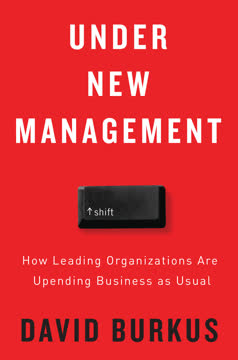
Under New Management receives strong praise from readers, earning a 3.91 average rating. Reviewers appreciate Burkus's blend of real-world case studies and research-backed evidence supporting 13 unconventional management ideas, including outlawing email, unlimited vacation, and salary transparency. Many find the concepts refreshing and thought-provoking, though some note limited applicability across all industries. The writing is consistently described as accessible and engaging. Critics note the book occasionally lacks examples of failed implementations and can feel formulaic, but most recommend it as an inspiring challenge to outdated workplace norms.
People Also Read