Key Takeaways
Crossed arms might just mean cold — never read a single cue
“Up to this point in your life, you've seen them all. You just didn't realize what they meant.”
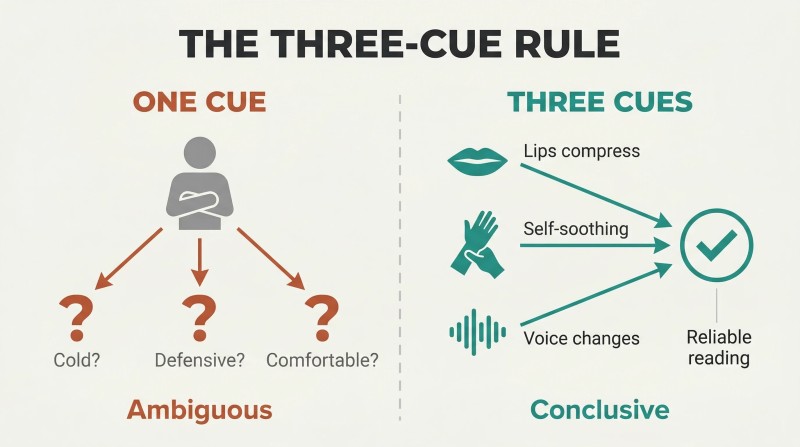
The cardinal rule of body language is that no single gesture proves anything. Crossed arms might signal defensiveness — or the person could simply be cold. A quick shoulder shrug might indicate deception — or a stiff neck. The author, a behavior analyst who trains law enforcement and military interrogators, insists you need at least three converging cues before drawing any conclusion.
Before interpreting, ask three questions:
1. Is this person's behavior normal for this situation?
2. Is something telling me there's an issue?
3. Is everything okay?
Only when multiple signals align — lips compressing, self-soothing behaviors increasing, voice changing — should you start making judgments about what someone is really thinking. Context always trumps any isolated gesture.
Liars maintain eye contact — they need to see if you buy it
“After a person gives information they know to be false but want to be believed, their blink rate actually slows down.”
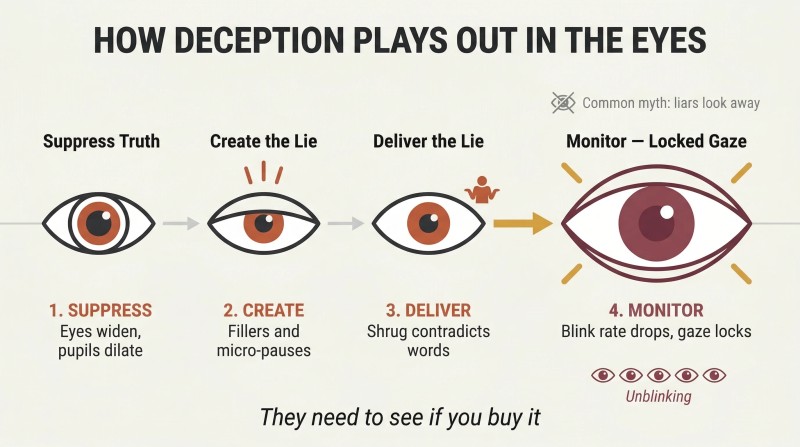
Most people assume liars look away. The opposite is true. The brain monitors whether its lie is landing, so it locks your gaze onto the target. The brain executes deception in three observable steps:
1. Suppress the truth (eyes widen slightly, pupils dilate, deeper breath)
2. Create the lie (fillers like "Well..." or a split-second too-long pause)
3. Deliver the lie (quick one-shoulder shrug, head nod contradicting words)
During President Clinton's denial of his relationship with Monica Lewinsky, he blinked 12 times in the 12 seconds it took to deliver his claim. After saying "These accusations are false," he went a full 7 seconds without blinking — scanning the room to gauge whether the press corps believed him.
Deploy the slow tiny smile to trigger bonding in any room
“A smile, no matter how large or small, is the most potent nonverbal cue in existence.”
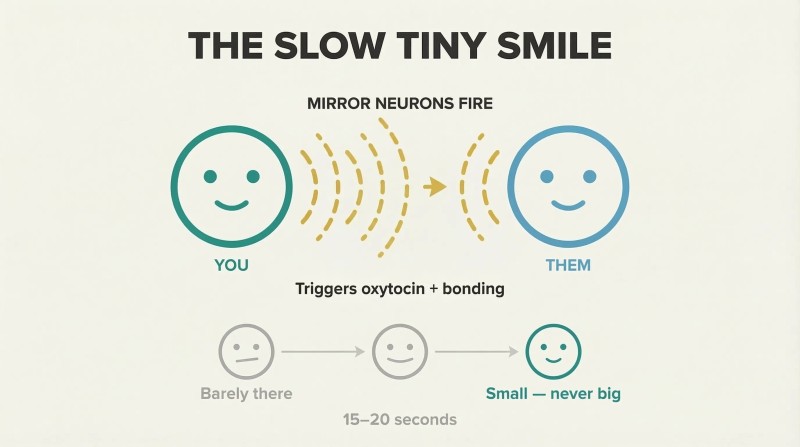
The slow and tiny smile is the author's most-used persuasion technique, borrowed from interrogation training. Start with a barely perceptible smile and let it grow gradually to small — never big. Mirror neurons in the other person's brain fire automatically and they smile back, triggering a cascade of positive emotion and oxytocin release.
This works everywhere: in job interviews (warms up the interviewer), on failing dates (resets the mood), and in presentations (every 5 – 7 minutes, deploy it for 15 – 20 seconds to stay human). If a presenter shows zero emotion for too long, audiences grow uneasy — a constant poker face can actually signal fear. The key is that the smile must start tiny and grow organically, never flash on all at once.
Watch for self-soothing gestures — adaptors reveal hidden stress
“The adaptors a person uses, whether large or small, tell you something isn't right for them psychologically.”
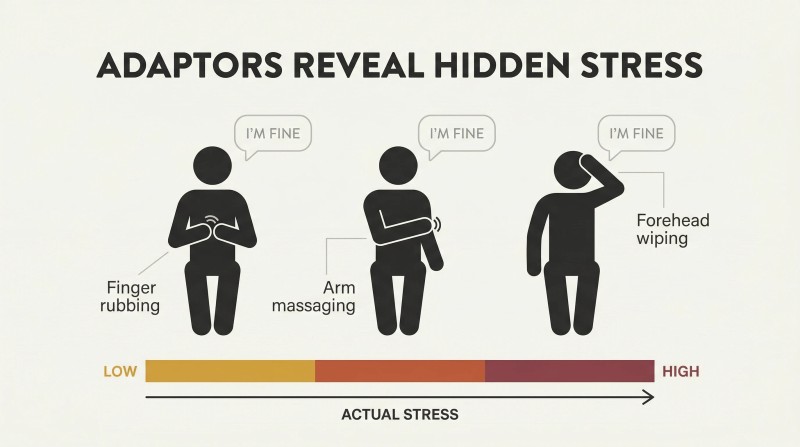
Adaptors are repetitive self-soothing behaviors — rubbing hands together, massaging an arm, fidgeting with a ring, biting nails — that people unconsciously deploy to manage rising stress. Before a TEDx talk in front of nearly 2,000 people, the author was massaging his own arm so aggressively that a friend asked if he was injured. He had no idea he was doing it.
The observation method is to start big, then work small. First assess posture and torso, then scan hands and arms for adaptors, then examine facial microexpressions. Watch for escalation: small adaptors (finger rubbing) growing into larger ones (shoulder stretching, forehead wiping, audible sighs). Escalating adaptors mean stress is building, even when the person's words say otherwise.
Feet point where the mind wants to go — check under the table
“One of the many things Navy SEALs are taught about human behavior is how to spot the leader of a group by looking at the feet of those in the group.”
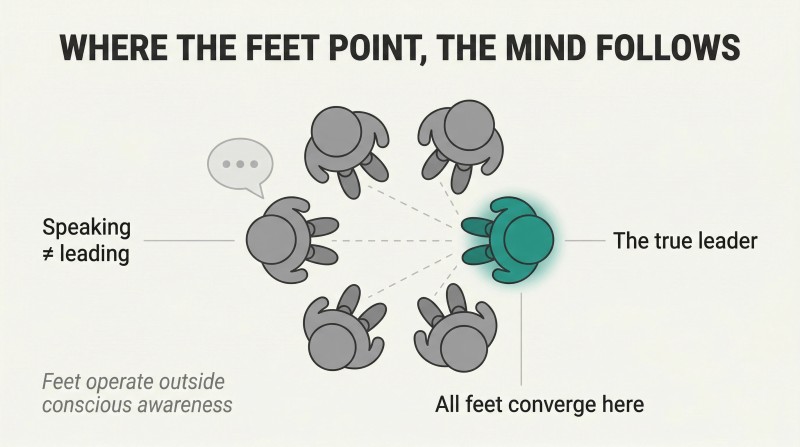
A person's feet betray their true interest in ways their face and words never would. Navy SEALs identify the leader of any group by noting whom most feet in the group point toward — that person commands attention. The principle extends everywhere.
On a date, if your partner's feet aim toward the exit rather than toward you, the evening is already over in their mind. In job interviews, if the interviewer's feet point at you, you have their full attention. At a party, if someone talks to both you and your friend but their feet angle toward you, they're more interested in you. Because feet operate far from conscious awareness — nobody rehearses where their toes point — they're among the most reliable indicators of genuine intent.
Body language isn't universal — a nod means 'no' in some cultures
“In Bulgaria, they shake their heads 'No' for 'Yes' and nod their heads 'Yes' for 'No.'
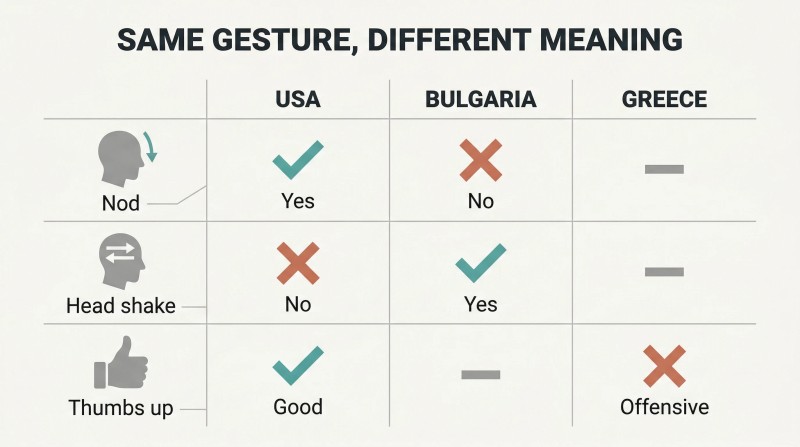
The author nearly torpedoed a major deal because he forgot this. Working with Maria, a Bulgarian CEO, and Yiannis, a Greek CFO, he grew suspicious when Maria kept nodding while saying "no" and shaking her head while saying "yes" — textbook deception signals in American body language. His alarm bells blared until a control question revealed she was simply Bulgarian.
Then things got worse. Rouse gave Yiannis a reassuring thumbs-up — which in Greece is the equivalent of flipping someone off. Yiannis stood up ready to throw a punch. In India, a side-to-side head bobble means "yes." In Greece, tilting the head up and back means "no." What looks like deception may simply be a cultural norm operating beyond the seven universal expressions.
Spot fake smiles: real ones crinkle the outer eye corners
“The Showtime Smile is practiced and rehearsed, and it looks exactly the same every time you see it.”
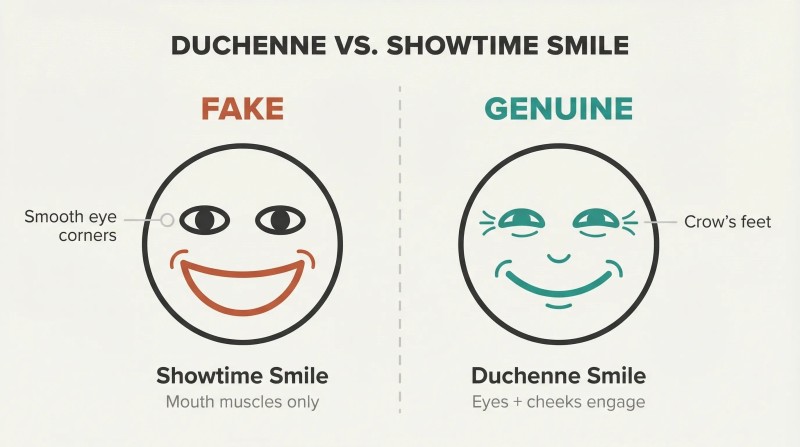
A genuine smile, called a Duchenne Smile after the French neurologist who identified it in the 1800s, recruits the muscles around the eyes to create small wrinkles at their outer corners. In a real smile, the cheeks are pulled upward by the brain's emotional response; in a fake smile, they're merely pushed up by the mouth widening. No wrinkles at the eyes means no real emotion behind it.
Celebrities deploy what the author calls the Showtime Smile — a rehearsed, identical expression seen on every red carpet. Compare photos from different events: same exact smile. The 43 facial muscles can produce over 10,000 expressions, yet only seven are universal across all cultures. Once you learn to spot those tiny eye-corner wrinkles, you'll never unsee the difference.
Gesture openly between belt and navel to radiate trust
“When you're in a meeting, giving a talk, or negotiating, people want to see your hands because you communicate much better when using your hands as you speak.”
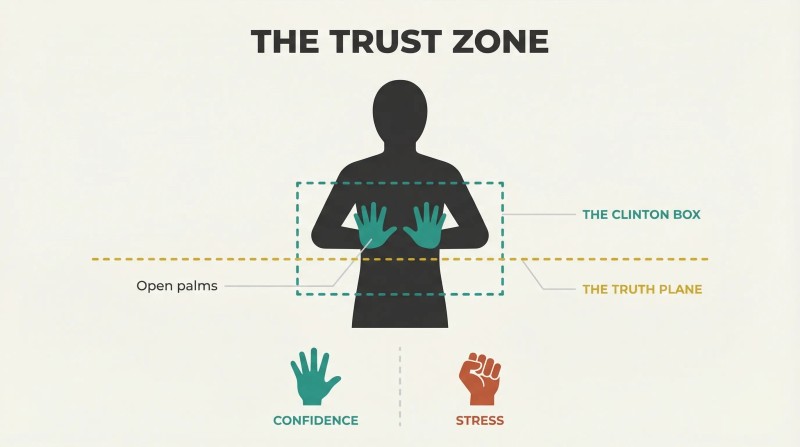
The world's most persuasive speakers gesture with open palms 80 – 90% of the time, almost exclusively between belt and stomach. This zone communicates openness and the absence of threat — your chest and stomach are exposed, signaling nothing to hide.
Bill Clinton mastered this with "The Clinton Box" — an invisible frame between his chest and navel where most gestures lived. Presenter Mark Bowden coined a similar concept called "The Truth Plane," the horizontal area at navel height. Rouse trained hundreds of entrepreneurs in these techniques at Nashville's Entrepreneur Center, and every single one was funded — totaling $480 million. Space between the fingers matters too: relaxed, spread fingers signal calm confidence, while clenched hands signal stress.
Quick or one-sided shrugs reveal doubt the mouth won't admit
“A real shoulder shrug lasts about a second, sometimes a second and a half.”
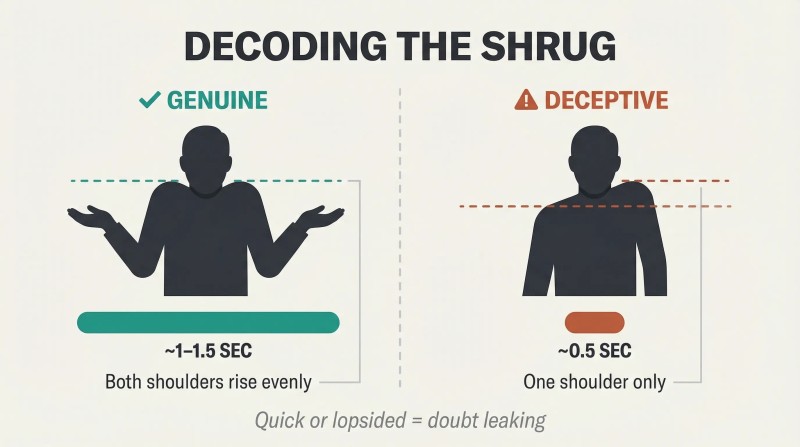
A genuine "I don't know" shrug involves both shoulders rising evenly for about one to one-and-a-half seconds. A deceptive or uncertain shrug looks starkly different: either a half-second pop or just one shoulder lifting. The person doesn't realize they're doing it — their brain is focused on you and your question, not monitoring their own body.
Try shrugging just your left shoulder right now. It feels unnatural — and it looks equally unnatural to observers. During Clinton's denial, his hand gestures pointed away from the person he was addressing and fell out of sync with the words they were supposed to emphasize. Mismatched illustrators, single-shoulder shrugs, and off-tempo gestures form a cluster that warrants serious scrutiny of whatever was just said.
Move less, stand wider, stay symmetrical — that's how leaders look
“The human brain demands to see symmetry in a leader.”
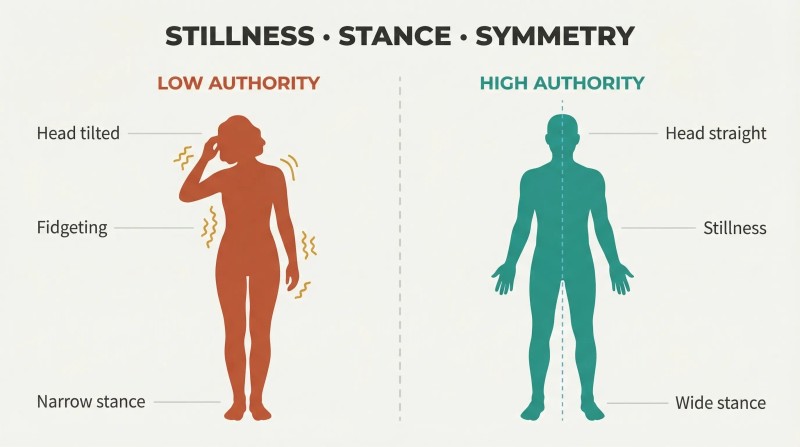
In any meeting, the CEO is almost always the person who moves least — gestures smooth, intentional, and purposeful rather than quick and jerky. Standing with feet shoulder-width apart in what Rouse calls the "Legs Akimbo" stance instantly communicates authority; it's the default posture of police officers, military personnel, and fighters.
To project leadership: stand symmetrical with head straight (not tilted back, which reads as arrogant), use evenly matched open-handed gestures, and anchor elbows when seated. Of the seven universal facial expressions, all but Contempt are symmetrical — a lopsided smirk reads as disdain. New hires fidget and preen throughout meetings; long-tenured employees claim more table space with relaxed arms. Stillness signals control, while fidgeting broadcasts that you'd rather be somewhere else.
Analysis
Rouse's book positions itself within the Ekman-Navarro lineage of body language literature but distinguishes itself through a practitioner's lens rather than an academic's. Where Navarro's 'What Every Body Is Saying' operates as an encyclopedia and Ekman's work stays close to laboratory findings, Rouse organizes knowledge by life situation — dating, interviews, workplace politics — making application immediate rather than requiring the reader to bridge theory and practice.
The book's most important intellectual contribution is its persistent 'no absolutes' framework, a corrective to pop psychology's tendency to assign fixed meanings to gestures ('crossed arms means closed off'). This epistemological humility is rare in the genre and paradoxically strengthens the practical advice by teaching probabilistic reasoning: look for clusters of three or more converging signals before making any judgment. Yet Rouse occasionally undermines his own caveat, offering interpretive claims that sound quite deterministic for individual cues.
His reliance on Ekman's seven-universal-expressions model places him on increasingly contested ground. Lisa Feldman Barrett's constructionist theory and recent meta-analyses challenge whether emotions map as neatly to facial configurations as the classical view suggests. Rouse's evidence is largely anecdotal — compelling stories about Clinton, Bulgarian entrepreneurs, and TEDx nerves — rather than systematic.
The entrepreneurship angle is the book's most distinctive differentiator: $480 million raised by startups he coached in nonverbal tactics is a measurable claim that grounds abstract theory in concrete outcomes. The cultural-variation chapter, often neglected in competing titles, deserves particular credit for preventing the exact interpretive errors Rouse himself nearly committed. For readers seeking laboratory rigor, Ekman or Barrett remain essential; for those wanting a working professional's field manual organized around the social situations they'll actually face tomorrow, Rouse delivers a uniquely accessible and actionable toolkit.
People Also Read

 Immersive
 Immersive

 Immersive
 Immersive
Glossary
Adaptors
Self-soothing stress-relief behaviorsSmall, repetitive behaviors people unconsciously use to calm themselves when stress or tension rises. Examples include rubbing hands together, massaging an arm, fidgeting with a ring, biting nails, or pulling on fingers. Adaptors escalate in size as stress increases—from subtle finger rubbing to visible shoulder stretching. They serve as reliable indicators that something is psychologically uncomfortable for the person exhibiting them.
Illustrators
Gestures emphasizing spoken wordsHand and arm movements used to emphasize specific words or phrases while speaking. For example, tapping a podium on key words or making sweeping gestures to underscore a point. When illustrators are in sync with spoken emphasis, communication appears natural and credible. When they fall out of sync—pointing the wrong direction or hitting off-beat—it can signal that the speaker's attention is divided or that something about their message is off.
Regulators
Gestures controlling conversation flowHand gestures used to direct, manage, or control the flow of conversation or interaction. Unlike illustrators, which emphasize content, regulators manage process: stopping someone from talking, signaling it's someone's turn, slowing the pace, or calling a pause. Examples include a raised index finger meaning 'hold on' or an open palm meaning 'stop.' They help orchestrate group interactions without verbal interruption.
Duchenne Smile
Genuine smile with eye wrinklesA real, genuine smile identified by French neurologist Duchenne de Boulogne in the 1800s. Distinguished from a fake smile by the activation of muscles around the eyes, creating small wrinkles at the outer corners. In a Duchenne Smile, the cheeks are pulled upward by the brain's emotional response rather than pushed up by the mouth widening. The presence or absence of these eye wrinkles is the most reliable way to distinguish authentic from performed smiles.
Showtime Smile
Rehearsed performer's identical smileA practiced, rehearsed smile used by celebrities, talk show hosts, and public figures that looks exactly the same every time it is deployed. Unlike a Duchenne Smile driven by genuine emotion, the Showtime Smile is consistent across appearances—compare red carpet photos from different events and the expression will be identical. It is a deliberately crafted expression designed to look pleasant on camera rather than to communicate authentic feeling.
Stress Mouth
Lips compressed and disappearing inwardA facial cue where the lips press together from top and bottom and curl inward until they appear to have disappeared. Also called 'Lip Compression' or 'Disappearing Lips.' Indicates the person is experiencing stress, holding back what they want to say, or feeling increasing psychological pressure. Commonly seen in courtrooms, difficult meetings, and tense social encounters. The degree of lip disappearance correlates with the intensity of stress being experienced.
Slow and Tiny Smile
Gradual small smile triggering mimicryA deliberate persuasion technique where a person begins with a barely perceptible smile and lets it grow gradually to a small but visible smile—never large. The slow onset triggers mirror neurons in observers, causing them to unconsciously smile back and experience positive emotion. Borrowed from interrogation training, it is recommended for job interviews, dates, presentations, and any situation where building rapport quickly is essential. Deployed every 5–7 minutes during presentations to maintain human connection.
Legs Akimbo
Feet shoulder-width apart, authority stanceA standing posture with legs straight and feet shoulder-width apart. Associated with dominance, leadership, and confidence. Used instinctively by police officers, military personnel, coaches, and fighters. It communicates that the person is balanced, grounded, and ready to take on challenges. The opposite—standing with legs close together—signals insecurity or social discomfort. Going too wide looks awkward; not wide enough fails to register as authoritative.
The Clinton Box
Gesture frame chest-to-navel areaAn invisible rectangular frame between the chest and navel within which Bill Clinton confined most of his open-handed gestures during public speaking. By keeping gestures within this box, speakers create visual symmetry and maintain a zone that audiences unconsciously associate with openness and honesty. The technique keeps hand movements controlled and visible without appearing frantic or aggressive. Used as a model in presentation training.
The Truth Plane
Horizontal gesture zone at navelA concept coined by body language expert Mark Bowden describing the horizontal plane at navel height where hand gestures are most persuasive and trusted. Gesturing at this level exposes the stomach and chest, signaling openness and lack of threat. Similar to The Clinton Box but defined as a horizontal plane rather than a rectangular frame. Recommended for pitches, presentations, and any high-stakes communication where building trust is essential.
Eye Blocking
Closing eyes to block unpleasantnessThe instinctive behavior of closing one's eyes longer than a normal blink, or covering them with hands, when presented with offensive, unpleasant, or distressing information. Remarkably, people who have been blind from birth also exhibit Eye Blocking when hearing bad news or graphic descriptions, suggesting it is an innate rather than learned behavior. In social contexts like dating, prolonged eye closure during conversation signals the person finds their companion or the topic deeply unappealing.
Extra Face
Forced smile when being observedA term for the odd, artificial-looking smile people display when they know they are being watched or recorded. First noticed by the author's brother, a TV director, who would ask extras to stop making 'that weird face' when cameras rolled. In social situations, Extra Face indicates the person may be hiding their true feelings—sadness, loneliness, or anxiety—behind a performed expression of well-being. The smile lacks the spontaneity and eye involvement of genuine emotion.
FAQ
1. What is "Understanding Body Language" by Scott Rouse about?
- Comprehensive Guide to Nonverbal Communication: The book provides a practical, scenario-based approach to decoding body language in everyday life, relationships, and professional settings.
- Science and Real-World Application: Scott Rouse combines scientific research with real-life examples, teaching readers how to observe, interpret, and respond to nonverbal cues.
- Step-by-Step Learning: The book is structured to take readers from foundational concepts to advanced applications, including social gatherings, dating, job interviews, and workplace dynamics.
- Focus on Observation and Context: Emphasizes the importance of context and observation, warning against assuming any single gesture has a universal meaning.
2. Why should I read "Understanding Body Language" by Scott Rouse?
- Practical Everyday Benefits: The book equips readers to make better decisions in social, romantic, and professional situations by accurately reading nonverbal cues.
- Avoiding Misinterpretation: Rouse dispels common myths and teaches how to avoid misreading body language, which can lead to misunderstandings.
- Confidence and Influence: Learning these skills can boost your confidence, improve your communication, and help you influence others more effectively.
- Trusted Expertise: Scott Rouse’s experience training law enforcement, military, and business leaders ensures the advice is credible and actionable.
3. What are the key takeaways from "Understanding Body Language" by Scott Rouse?
- No Absolutes in Body Language: There are no universal meanings for individual gestures; context and clusters of cues are crucial.
- The Limbic System Drives Reactions: Most nonverbal behavior is rooted in the brain’s limbic system, which governs instinctive responses like fight, flight, or freeze.
- Universal and Cultural Variations: While some expressions are universal (like the seven basic emotions), many gestures vary by culture and context.
- Observation is a Skill: Effective decoding starts with careful, non-intrusive observation, focusing on both large and small cues.
4. How does Scott Rouse define and explain the basics of body language in "Understanding Body Language"?
- Observation First: Rouse stresses that learning to observe without drawing attention is the foundational skill for reading body language.
- Micro and Macro Cues: The book explains both microexpressions (brief, involuntary facial expressions) and larger body movements, showing how both reveal emotions.
- Universal Emotions: Seven facial expressions—anger, joy, sadness, fear, surprise, contempt, and disgust—are recognized worldwide, as proven by Dr. Paul Ekman’s research.
- Adaptors and Illustrators: Rouse introduces terms like "adaptors" (self-soothing gestures) and "illustrators" (gestures that emphasize speech), explaining their roles in communication.
5. What is the role of the limbic system in body language, according to "Understanding Body Language"?
- Instinctive Reactions: The limbic system triggers automatic, unconscious physical responses to perceived threats or emotions, such as protecting vital organs or widening eyes.
- Fight, Flight, or Freeze: These primal responses manifest in body language, from large protective movements to subtle facial changes.
- Microexpressions and Leaks: Even when people try to hide emotions, the limbic system can cause brief, involuntary "leaks" of true feelings.
- Universal Patterns: Because the limbic system is hardwired, many nonverbal reactions are similar across humans, though context still matters.
6. How does "Understanding Body Language" address cultural variations in nonverbal communication?
- Gestures Vary by Culture: Rouse provides examples where gestures like head nods or thumbs-up have different meanings in different countries (e.g., Bulgaria, Greece, Iran).
- Avoiding Misinterpretation: The book warns against assuming your own cultural norms apply universally, emphasizing the need to learn local nonverbal customs.
- Real-World Scenarios: Anecdotes illustrate how cultural misunderstandings can occur even among experienced professionals.
- Importance in Business: Especially in international business or multicultural environments, understanding these differences is critical for building trust and avoiding offense.
7. What are the best practices and tips for success in decoding body language, according to Scott Rouse?
- Start Big, Then Small: Begin by observing large movements and postures, then focus on smaller cues like hand gestures or facial expressions.
- Look for Clusters: Don’t rely on a single gesture; look for groups of cues that reinforce each other.
- Context is Key: Always interpret body language within the specific situation and environment.
- Practice Observation: Use public places like restaurants to hone your skills, watching for patterns and changes in behavior.
8. How does "Understanding Body Language" by Scott Rouse help readers apply body language skills in social and dating situations?
- Social Gatherings: The book teaches how to spot shyness, nervousness, or fake confidence through posture, hand placement, and facial expressions.
- Dating Cues: Rouse details signs of attraction (e.g., head tilt, exposed neck, mirroring, steady eye contact) and disinterest (e.g., barriers, lack of eye contact, slouching).
- Turning Situations Around: Practical advice is given for improving rapport on a date or in a group by adjusting your own nonverbal signals.
- Real-Life Examples: The book uses relatable scenarios to illustrate how misreading or correctly reading cues can make or break social interactions.
9. What advice does Scott Rouse give for interpreting body language in job interviews and the workplace?
- Interview Success Cues: Positive signs include relaxed posture, small pleasant smiles, head nodding, direct but soft eye contact, and open-handed gestures.
- Warning Signs: Negative cues include slouching, pursed lips, fidgeting, lack of eye contact, and creating barriers with objects or arms.
- Turning Interviews Around: Rouse offers strategies to recover from negative cues, such as mirroring small smiles or breaking barriers by engaging the interviewer.
- Workplace Personalities: The book profiles common office types (e.g., agitator, content employee, power-hungry) and how to read and respond to their nonverbal behaviors.
10. What are some specific methods or definitions introduced in "Understanding Body Language" by Scott Rouse?
- Adaptors: Self-soothing, repetitive behaviors (e.g., rubbing hands, massaging arms) that indicate stress or anxiety.
- Illustrators: Gestures that accompany and emphasize speech, such as pointing or hand movements.
- Barriers: Objects or body parts placed between oneself and others to create distance or protection.
- Mirroring: Subconsciously or consciously matching another person’s posture or gestures, often indicating rapport or attraction.
- The "Slow and Tiny Smile": A subtle, gradually growing smile used to trigger positive emotions and mirror neurons in others.
11. What are the most common myths or misconceptions about body language that Scott Rouse debunks in "Understanding Body Language"?
- Crossed Arms Myth: Crossed arms do not always mean someone is closed off; they could be cold or comfortable.
- Eye Contact and Lying: Liars do not always break eye contact; in fact, they may maintain it to gauge your reaction.
- One-Size-Fits-All Gestures: No single gesture has a universal meaning—context and clusters are essential.
- Overreliance on Microexpressions: While useful, microexpressions are just one part of a larger picture and should not be the sole focus.
12. What are the best quotes from "Understanding Body Language" by Scott Rouse and what do they mean?
- “There are no ‘absolutes.’ That means there are no nonverbal cues that mean the same thing every time you see them.”
- Emphasizes the importance of context and avoiding snap judgments based on single gestures.
- “You will soon be able to decode everything in this situation within a few seconds.”
- Highlights the practical, learnable nature of body language skills with practice.
- “You’re looking for the adjustments in comfort and discomfort.” (quoting Joe Navarro)
- Focuses on the core principle of observing shifts in comfort as the key to reading nonverbal cues.
- “Take your newfound secret powers, go out into the world, and use them for good!”
- Encourages readers to apply their skills ethically and positively in daily life.








































