


Key Takeaways
Name three childhood memories and reveal what secretly drives you
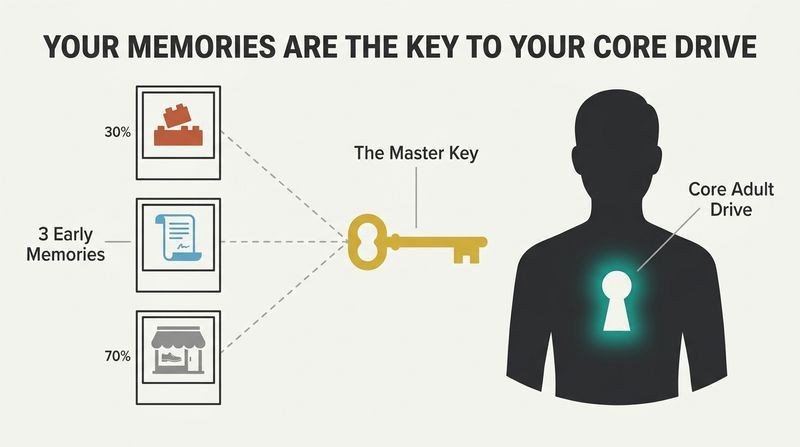
Kevin Leman's central claim is bold: give him three of your earliest childhood memories, and he can tell you what motivates you, what keeps you up at night, and what makes you who you are. Out of hundreds of thousands of childhood moments, your mind saved only a handful. That selection is not random.
He cites famous examples: Donald Trump recalling gluing his brother's building blocks together, Bill Gates negotiating a written contract with his sister for access to her baseball mitt, Martin Luther King Jr. remembering his father walking out of a segregated shoe store. Each memory foreshadows the adult. Leman argues these memories are a master key that slips past the facades and defenses people build over decades, offering a glimpse straight into the core self.
The premise echoes Alfred Adler, whose individual psychology treated early recollections as diagnostic of a person's core convictions. Modern memory science partly supports and partly complicates the claim. Autobiographical memory is reconstructive, not a recording, so what we recall is filtered through who we are now, meaning the memory reveals the present self as much as the child. That circularity is actually a feature here: Leman cares less about historical accuracy than about the interpretive lens. The celebrity examples are cherry-picked and unfalsifiable, but the underlying invitation, to treat your own recall as data about your values, is a genuinely useful self-inquiry tool.
Everyone runs on private logic, a personal lens built in childhood
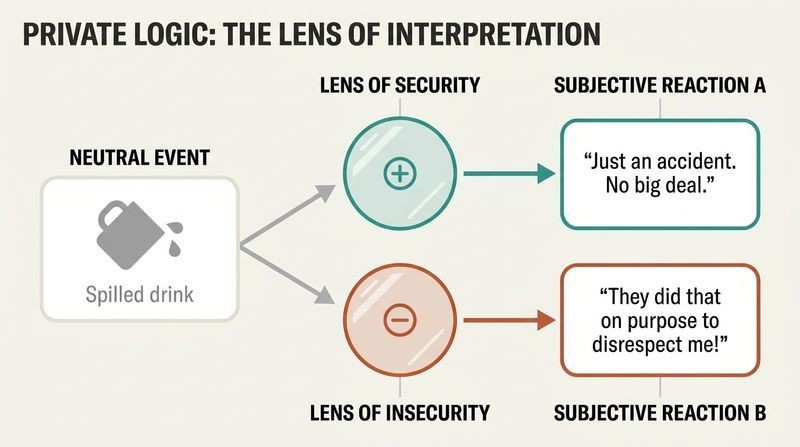
Leman borrows Adler's term private logic to describe your subjective interpretation of people, places, and events. It is how you complete the sentence "the moral of my life's story is." When a waiter spills a drink on you or an elderly driver crawls along the highway, private logic decides whether you shrug it off or feel personally attacked.
He illustrates with his own defining memory: at eight, he botched a five-second cheerleading routine in a packed gym. The crowd laughed. Instead of shame, he felt euphoria. In that instant he decided being the joker was his role. Two people can share nearly identical experiences and interpret them oppositely: one child sees a watchful father as smothering, another sees the same father as lovingly protective. The event is neutral; the interpretation is everything.
Private logic overlaps with what cognitive therapists call core beliefs or schemas, the automatic interpretive rules that shape emotional reactions. Aaron Beck built cognitive behavioral therapy on the insight that events do not cause feelings; interpretations do. Leman's contribution is anchoring those interpretations in childhood recall rather than in abstract belief inventories. One caveat worth flagging: temperament research suggests some of that interpretive style is heritable, present from infancy, not purely learned. So private logic is co-authored by biology and environment. Leman actually concedes this with his nature-plus-nurture framing, which keeps the concept from collapsing into pure determinism.
Memories stick only when an emotional spark burns them in
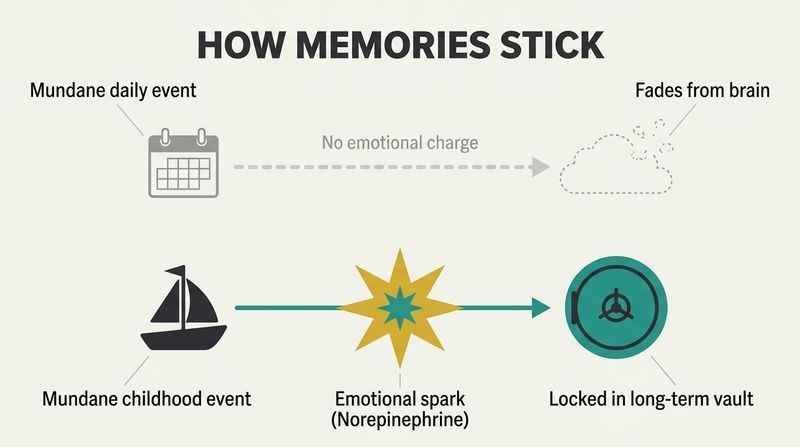
Why do we forget appointments yet vividly recall trivial childhood moments? Leman's answer, backed by memory researchers he cites, is that long-term memories require either repetition or strong emotion. The neurotransmitter norepinephrine acts as the key that unlocks the long-term memory vault. Without an emotional charge, an experience evaporates.
Crucially, "emotional" does not mean dramatic. Most childhood memories are mundane: finishing a puzzle, hearing a plane overhead, folding laundry. The emotion can be wonder, curiosity, security, or a craving for control. Actor Bill Murray recalled falling off a table doing an impression, cracking his head, and laughing through tears because he had finally made his hard-to-amuse father laugh. The physical pain mattered less than the emotional jackpot. That emotional resonance is what flagged the moment for permanent storage.
The neuroscience is directionally sound. The amygdala modulates memory consolidation, and stress hormones including norepinephrine and cortisol strengthen encoding of emotionally arousing events, work associated with James McGaugh at UC Irvine. Leman's expansion, that quiet emotions like curiosity or security also tag memories, aligns with findings that even low-arousal but self-relevant information is preferentially remembered. The book slightly oversimplifies by implying a single hormone is the master switch; consolidation is a distributed, multi-system process involving the hippocampus and sleep. Still, the practical upshot holds: pay attention to which memories carry feeling, because feeling is the fingerprint of significance.
Your birth-order rank stamps predictable themes onto your memories
Leman, famous for The Birth Order Book, maps how sibling position shapes recollection:
1. Firstborns and onlies: memories of breaking rules, making mistakes, getting hurt, packed with precise detail, often featuring heights or movement (achievement themes). Fred Rogers recalled playing organ on his porch while worrying about mistakes.
2. Onlies specifically: solitary, introspective memories, sometimes fearful of being left alone.
3. Middleborns: memories of comparison, negotiation, and situations that felt unfair.
4. Lastborns: memories set at parties and holidays, being the center of attention.
He notes exceptions. A five-year gap resets the pattern, so Jay Leno, ten years younger than his brother, blends baby and firstborn traits. Physical or mental challenges in an older sibling can shift traits downward. Birth order is a tendency, not a cage.
Birth-order psychology is Leman's signature and also his most contested ground. Large-scale studies, notably a 2015 analysis of over 20,000 people, found birth-order effects on personality that are statistically real but tiny, and a modest, replicable bump in measured IQ for firstborns. The vivid archetypes Leman describes likely overstate effect sizes that in rigorous data are subtle. That said, as a conversational heuristic for understanding family dynamics and one's own defaults, the framework has intuitive pull and clinical usefulness. The honest move is to hold it loosely: useful for generating hypotheses about someone, unreliable as a predictive law.
Your lifestyle is how you answer "I only matter when..."
Leman defines lifestyle not as your car or square footage but as the consistent pattern of how you respond to people and situations, revealed by finishing the sentence "I feel that I matter in life when." Children experiment until they find how to win attention, then keep running that program.
He sketches recurring types, each with a strength and a shadow:
1. Drivers and controllers: "I count when I win or dominate." Oprah writing her own letter to skip kindergarten.
2. Givers and takers: contributing versus extracting.
3. Pleasers and martyrs: "I count when others are happy," or when nobly self-sacrificing for attention.
4. Charmers: "I count when I'm the center of attention." Leman's own type.
5. Observers versus participants: watching life or diving in.
Most people blend several. The danger is sliding into a lifestyle's weakness until it runs you.
This is Adlerian "style of life" repackaged in plain English, and the reframing is genuinely clarifying. The pleaser-attracts-controller dynamic Leman describes maps onto attachment theory's anxious-avoidant pairing, where complementary insecurities lock partners into stable but corrosive patterns. The typology's weakness is the usual one for trait taxonomies: people are context-dependent, behaving as controllers at work and pleasers at home. The most actionable piece is the diagnostic sentence itself. Forcing yourself to complete "I matter when..." surfaces the conditional worth most people never articulate, and naming a conditional belief is the first step to loosening its grip, a move straight out of acceptance and commitment therapy.
The child you were still tugs your sleeve under pressure
Leman calls this the consistency factor: the way you saw the world as a child stays consistent with how you see it now, especially when stressed. His own earliest memory, at three, is being locked out on the front porch, pounding on the door, nobody hearing him. He has spent his life metaphorically banging on doors: rejected by 160 colleges, turned away from a talk show fourteen times, always feeling on the outside looking in.
Growth is possible but not linear. He introduces crucial reference points, life transitions like starting school, marriage, or a new career, that yank you back to childhood patterns. Even people who have changed feel the old private logic resurface. A reformed pleaser still feels the pull to say yes when a neighbor begs for a favor. Progress looks like three steps forward, two steps back.
The consistency factor resonates with research on continuity in attachment style and explanatory style across the lifespan, though longitudinal data show personality is more malleable in adulthood than folk wisdom assumes, particularly conscientiousness and emotional stability, which tend to improve with age. Leman's "propensity, not destiny" framing is the crucial nuance that saves the idea from fatalism. His Neverland cautionary tale, using Michael Jackson's lost childhood and reclusive adult retreat, dramatizes the shadow side: refusing to update childhood logic. The three-steps-forward realism is quietly the book's most therapeutic message, inoculating readers against the all-or-nothing thinking that derails most change attempts.
Confront the lies your private logic whispers about your worth
Leman argues everyone carries lies, internalized conclusions like "I only matter when I make people laugh" or "I'm a dummy." He calls the self-deception the Pinocchio Syndrome: the more you live the lie, the further you drift from your true self, like a puppet pulled by strings. His own turning point came from a geometry teacher, Ms. Wilson, who told him he had potential and skills nobody else had named. That single truthful voice redirected his life.
Memories are also distorted. The enormous hill he climbed to the grocery store turned out to be a two-hundred-yard rise. A childhood church he remembered as cathedral-sized had just ten pews per side. He cites the Wilkomirski case, a man who "remembered" a Holocaust childhood that never happened, to show that even fabricated memories still expose real private logic.
The distinction between factual accuracy and interpretive truth is philosophically sharp and clinically wise. Elizabeth Loftus's decades of research on memory malleability confirm that confidence and vividness do not guarantee accuracy; memories can be wholly implanted. Leman's judo move, that a distorted memory still reliably reveals your interpretive style, sidesteps the recovered-memory minefield that plagued 1990s therapy. The concept of self-talk he introduces is essentially cognitive restructuring: catching the automatic "you idiot" narration and testing it against evidence. His example of the woman blaming herself for a man who stood her up is a textbook cognitive distortion, personalization, and the corrective he offers is exactly what a CBT clinician would prescribe.
Rewrite painful memories with the ABCs of truth therapy
Leman offers a three-step method he calls truth therapy for defusing memories that poison the present:
1. Accept that your memories are inaccurate, shaped and possibly skewed by your private logic.
2. Believe the truth by seeking outside perspective, because you cannot see the back of your own head. Compare notes with family, since siblings remember the same Thanksgiving completely differently.
3. Change your behavior based on truth, in baby steps, expecting setbacks.
He illustrates the cost of skipping this with a couple married over forty years. The wife had silently resented one cutting sentence her husband said comparing her to his mother, who had been dead for twenty years. Two decades of intimacy were squandered over an unspoken grudge. Leman calls these the wasted years, and insists it is never too late to stop the bleeding.
The ABC structure deliberately echoes Albert Ellis's rational emotive behavior therapy, which also used an ABC model, lending it a proven scaffold. The insistence on external perspective is well-founded: the introspection illusion, documented by Emily Pronin, shows humans are systematically blind to their own biases while confident they see others clearly. Leman's warning against friends who merely validate your grievances, the bobble-head yes-man, anticipates the echo-chamber problem in modern support networks. Where the book could go deeper is on when outside perspective is unsafe, for example with gaslighting families. His caveat about trauma requiring professional help partly covers this, but the family-sharing exercise assumes a good-faith family that many readers do not have.
Forgive to free yourself, but forgiving is not forgetting
Leman reframes forgiveness as a self-liberating act, not an endorsement of the offense. Holding a grudge, he says, is like hurling a bucket of acid into a headwind: it blows back and burns you. He tells the wrenching story of Maria, sexually abused by her father for years, who over several years of counseling chose to forgive, not to excuse him but to strip him of ongoing control over her life. She still set hard boundaries, insisting he never be alone with her children.
Borrowing from theologian Lewis Smedes, Leman stresses that a healed memory is not a deleted memory; forgiveness creates a new way to remember. Actor Gene Hackman, abandoned by his father at thirteen, chose grace over bitterness and reconciled in his father's final five years. Forgiveness lets you stop blaming and start living.
The distinction between forgiveness and reconciliation is where this section earns its weight. Everett Worthington's research on forgiveness interventions shows measurable drops in anxiety, depression, and even blood pressure for the forgiver, supporting Leman's acid-in-the-wind metaphor with hard physiology. Crucially, Leman does not demand reunion or contact; Maria forgives while enforcing protective boundaries, which is psychologically healthier than the "forgive and forget" cliché that pressures victims back into harm. The book wisely routes serious trauma to qualified professionals rather than positioning itself as sufficient. One tension: forgiveness framed partly through Scripture may resonate less with secular readers, though the underlying mechanism, releasing rumination, is faith-neutral.
Read a loved one's memories to see life through their eyes
Leman turns the tool outward: ask your spouse, date, or friend for childhood memories to decode their private logic. He recounts blowing his wife Sande's birthday. He nailed a five-star dinner, then sprang a surprise party. Sande, a firstborn who craves order and dreads surprises, burst into tears and had to fake joy. Batting .500 got him the doghouse.
He suggests noticing whether someone's memories feature people, data, or things (a clue to how they relate), and whether family members appear warmly or coldly. For men reluctant to "dig into feelings," he advises the storytelling angle: ask about a first fishing trip or camping adventure, then say "tell me more" rather than "why did you feel that way," since why-questions read as judgmental. Judgments push apart; sharing feelings draws together.
The communication tactic is subtly expert. Asking "tell me more" instead of "why" aligns with the Gottman Institute's research on turning toward bids for connection and avoiding defensiveness-triggering language. Framing memory-sharing as curiosity rather than interrogation lowers threat, which neuroscience links to reduced amygdala reactivity and more open disclosure. The people-data-things distinction borrows loosely from vocational psychology (John Holland's RIASEC and the Department of Labor's worker-function taxonomy actually use those three categories). Leman's insight that you marry into someone's whole family of attitudes is well-supported by family-systems theory. The gendered word-count claim, seven thousand versus two thousand words daily, is a debunked myth, but the practical advice around it remains sound.
Stop chasing activities; give your family Vitamin N instead
For raising kids, Leman prescribes Vitamin N, the discipline of saying no to overscheduling. When one child plays soccer, he argues, the whole family is conscripted into soccer: siblings, dinner, weekends, all reorganized around a ninety-minute game reached by driving hundreds of miles. He recommends a maximum of one activity per child per term to preserve family cohesion, and reminds parents that saying yes to one thing always means saying no to something else, usually unstructured time at home.
The deeper point: positive memories are forged by presence, not spending. A child will barely register the expensive Disney trip but vividly remember the night she crashed the family computer and her parent responded with a hug instead of rage. He also urges spontaneous, level-playing-field activities like camping, where everyone contributes and nobody is the star.
The overscheduling critique has aged well. Research on the "hurried child," a term coined by David Elkind, links packed extracurricular calendars to elevated anxiety and diminished free play, and subsequent work by Peter Gray ties the decline of unstructured play to rising childhood mental-health problems. Leman's memory-versus-money insight is echoed by studies showing experiences and warm responsiveness predict wellbeing far more than material provision. The computer-crash anecdote captures a core attachment finding: children remember caregiver responses to their failures as templates for whether the world is safe. The one-activity rule is arguably too rigid for every family, but as a corrective to arms-race parenting, the provocation is healthy.
If work drains you, you may be a fish out of water
Leman's vocational test is simple: do your childhood memories center on people, data, or things? Match your work to that natural bent. He describes Salma, a deeply social woman stuck doing accounting spreadsheets in a back room, quietly withering, even though clients light up whenever she is at the front desk. She is a fish flopping on the bank; her gifts belong in sales or management.
Your greatest strength can become your greatest weakness in the wrong context. Bill, an engineer paid handsomely to spot flaws in blueprints, drags that flaw-finding home and criticizes his wife's cooking and his kids' B-plus grades, endangering his marriage. The skill that saves lives on a job site poisons his relationships. The remedy: notice which childhood memories carried joy and happy endings, because they point toward work and hobbies that genuinely fit you.
The people-data-things trichotomy again tracks real vocational science, and the "strength becomes weakness in the wrong setting" principle is one of the most transferable ideas in the book. It parallels the concept of overused strengths in modern strengths-based coaching, where, for instance, decisiveness curdles into rigidity when misapplied. Marcus Buckingham's work on playing to strengths and the broader person-environment fit literature both support Leman's core claim that misalignment, not laziness, explains much workplace misery. The engineer example doubles as a caution against importing professional norms into intimate life, where the currency is warmth, not accuracy. The advice to mine joyful memories for direction is a low-cost, high-yield exercise anyone can run tonight.
Analysis
Kevin Leman's book is applied Adlerian psychology dressed in stand-up comedy. Its architecture is a funnel: it opens by decoding the self through early recollections, then progressively widens the lens to relationships, parenting, and career. The spine is Alfred Adler's early-recollection technique and "style of life," which Leman renames private logic and lifestyle and translates into kitchen-table English studded with celebrity anecdotes and self-deprecating stories about his own trickster childhood.
The book's genuine strength is its interpretive humility disguised as confidence. Leman repeatedly insists memories are inaccurate, distorted, even fabricated, yet argues they remain diagnostically valuable because they expose how a person construes reality. This sidesteps the recovered-memory controversies of the era in which he wrote and aligns, perhaps unintentionally, with cognitive behavioral therapy's insight that interpretation, not event, drives emotion. His ABC truth therapy is essentially Ellis's REBT, and his self-talk coaching is Beck's cognitive restructuring, both delivered without jargon.
The weakest link is empirical. Birth-order archetypes, the author's brand, are real but far smaller in rigorous data than his vivid types imply, and the celebrity examples are unfalsifiable and cherry-picked. The seven-thousand-words-for-women claim is a known myth. Readers should treat the frameworks as hypothesis-generators, not laws.
What endures is the practical toolkit: complete the sentence "I matter when..." to surface conditional self-worth; ask loved ones for memories and say "tell me more" to build intimacy; forgive to release rumination while keeping protective boundaries; prescribe Vitamin N against overscheduling; and match work to whether you gravitate toward people, data, or things. The Christian and folksy framing may not travel to every audience, and the science is uneven, but the underlying invitation, to read your own recall as a map of your convictions and then consciously revise the ones that no longer serve you, is sound, humane, and actionable.
Review Summary
What Your Childhood Memories Say about You . . . and What You Can Do about It received mixed reviews. Some readers found it insightful and thought-provoking, appreciating Leman's humor and personal anecdotes. Others criticized it for being repetitive, lacking depth, and rehashing content from his previous works, particularly on birth order theory. Several reviewers noted that the book fell short of its promise to provide actionable advice. While some found value in exploring childhood memories and their impact on adult behavior, others felt the book was too focused on the author's experiences rather than offering concrete psychological analysis.
People Also Read





FAQ
What's "What Your Childhood Memories Say about You . . . and What You Can Do about It" about?
- Exploration of Memories: The book delves into how early childhood memories reveal insights into our personalities, behaviors, and life choices.
- Understanding Private Logic: It introduces the concept of "private logic," which is the unique way individuals interpret their experiences and the world around them.
- Impact on Present and Future: The book emphasizes that understanding these memories can help individuals make positive changes in their current lives and future.
- Practical Guidance: It offers practical advice on how to use these insights to improve relationships, parenting, and personal growth.
Why should I read "What Your Childhood Memories Say about You . . . and What You Can Do about It"?
- Self-Discovery: The book provides tools for self-discovery by analyzing childhood memories, which can lead to personal growth and self-awareness.
- Improved Relationships: By understanding your own and others' private logic, you can enhance your relationships with family, friends, and colleagues.
- Practical Applications: It offers actionable steps to apply these insights in everyday life, from parenting to career choices.
- Expert Insights: Written by psychologist Kevin Leman, the book combines professional expertise with relatable anecdotes and examples.
What are the key takeaways of "What Your Childhood Memories Say about You . . . and What You Can Do about It"?
- Memories Shape Identity: Childhood memories are crucial in shaping who we are and how we perceive the world.
- Private Logic: Each person has a unique private logic that influences their behavior and decisions.
- Change is Possible: Understanding and confronting the lies we tell ourselves can lead to positive changes in our lives.
- Relationships Matter: Exploring memories can improve how we relate to others, enhancing personal and professional relationships.
How does Kevin Leman define "private logic" in the book?
- Subjective Interpretation: Private logic is the subjective way individuals interpret their experiences and the world around them.
- Influences Behavior: It influences how people respond to situations, make decisions, and interact with others.
- Formed in Childhood: This logic is often formed during early childhood and can persist into adulthood unless consciously addressed.
- Key to Understanding: Understanding one's private logic is key to unlocking personal growth and improving relationships.
What is the "consistency factor" mentioned in the book?
- Behavioral Patterns: The consistency factor refers to the tendency for individuals to maintain consistent behavioral patterns throughout their lives.
- Rooted in Childhood: These patterns are often rooted in childhood experiences and memories.
- Influences Decisions: It influences how people make decisions and respond to new situations.
- Potential for Change: While consistent, these patterns can be changed with conscious effort and self-awareness.
How can understanding childhood memories improve relationships?
- Insight into Behavior: Understanding childhood memories provides insight into why people behave the way they do, improving empathy and communication.
- Conflict Resolution: It helps in resolving conflicts by understanding the underlying motivations and fears of others.
- Strengthening Bonds: Sharing and discussing memories can strengthen bonds between partners, family members, and friends.
- Tailored Interactions: It allows for more tailored interactions, as you can better anticipate and respond to others' needs and reactions.
What role do "lifestyle themes" play in the book?
- Expression of Private Logic: Lifestyle themes are the patterns through which individuals express their private logic in daily life.
- Influence on Choices: They influence choices, from career paths to relationship dynamics.
- Identifying Strengths and Weaknesses: Understanding these themes helps identify personal strengths and weaknesses.
- Path to Change: Recognizing and adjusting lifestyle themes can lead to personal growth and improved life satisfaction.
How does the book suggest confronting the lies we tell ourselves?
- Truth Therapy: The book introduces "truth therapy," a method for identifying and confronting the lies embedded in our private logic.
- Acceptance and Change: It involves accepting that memories may be inaccurate, believing the truth about them, and changing behavior accordingly.
- Objective Perspective: Seeking objective perspectives from trusted friends or family can aid in recognizing these lies.
- Gradual Process: The book emphasizes that change is a gradual process, requiring patience and perseverance.
What are some practical applications of the book's insights in parenting?
- Understanding Children's Logic: Parents can use the book's insights to understand their children's private logic and guide them more effectively.
- Creating Positive Memories: It emphasizes the importance of creating positive memories and a nurturing environment for children.
- Setting Boundaries: The book advises on setting healthy boundaries to foster a balanced family life.
- Encouraging Open Communication: Encouraging children to share their memories can strengthen family bonds and improve communication.
How can the book's concepts be applied in a work setting?
- Identifying Strengths: Understanding your private logic can help identify strengths and weaknesses in a professional context.
- Improving Team Dynamics: Applying these insights can improve team dynamics by fostering better understanding and communication among colleagues.
- Career Alignment: It can guide individuals in aligning their careers with their inherent strengths and interests.
- Conflict Management: The book's concepts can aid in managing workplace conflicts by understanding the underlying motivations of others.
What are the best quotes from "What Your Childhood Memories Say about You . . . and What You Can Do about It" and what do they mean?
- "Your childhood memories hold the key to understanding who you are right now." This quote emphasizes the importance of childhood memories in shaping current identity and behavior.
- "While you can’t change your past, you can change the way you understand it." It highlights the potential for personal growth through reinterpreting past experiences.
- "Tell me three of your early childhood memories, and I’ll tell you what makes you you." This underscores the book's premise that early memories reveal deep insights into personality and motivations.
- "The little boy or girl you once were, you still are." It suggests that childhood experiences continue to influence adult behavior and perceptions.
How does the book address the concept of forgiveness in relation to childhood memories?
- Forgiveness as Freedom: The book presents forgiveness as a way to free oneself from the control of painful memories.
- Not Forgetting: It clarifies that forgiving does not mean forgetting but rather changing the way one remembers the past.
- Healing Relationships: Forgiveness is portrayed as a crucial step in healing relationships and moving forward.
- Personal Growth: Embracing forgiveness is linked to personal growth and the ability to live a more fulfilling life.
About the Author
Other books by Kevin Leman






Download PDF
Download EPUB
.epub digital book format is ideal for reading ebooks on phones, tablets, and e-readers.








































